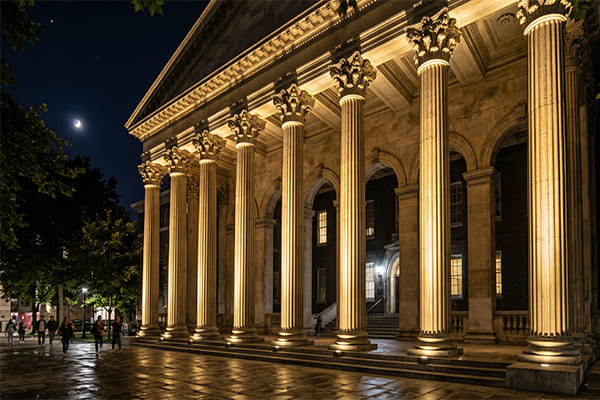
Choosing the wrong optics can ruin a building's look at night. It wastes money and fails to impress. Understanding four key techniques will help you pick the perfect optics.
The best optics for facade lighting depend on your goal. Use narrow beams (10°-20°) for texture with wall grazing, wide asymmetrical beams for smooth surfaces with wall washing, and ultra-narrow beams (1°-10°) for highlighting architectural lines and structures.
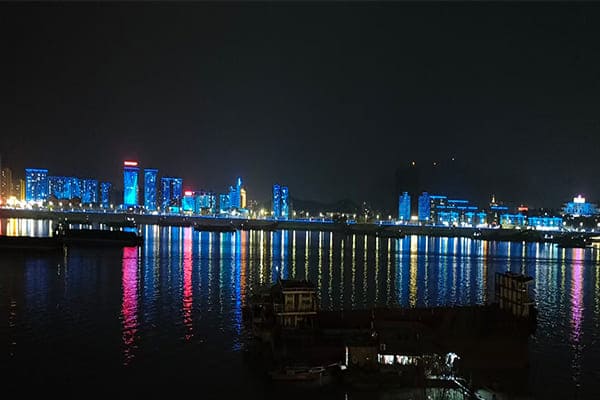
I’ve spent years in the lighting industry. I've seen amazing projects and some that didn't work out. The difference often comes down to the optics. It might seem complicated, but it's not. I've seen that success relies on just a few core principles. Let's break down the main techniques I use on my projects. It will help you see how simple it can be to choose the right solution for your own work.
How Do You Emphasize a Building's Texture?
Your building has beautiful stone or brickwork, but it looks flat at night. All that rich detail and character is lost. The secret is wall grazing, which uses light and shadow.
To emphasize texture, use wall grazing with a narrow beam optic, typically 10° to 20°1, or an elliptical lens. You must place the fixture very close to the wall's base. This creates strong shadows that dramatically highlight the surface's natural texture and depth2.
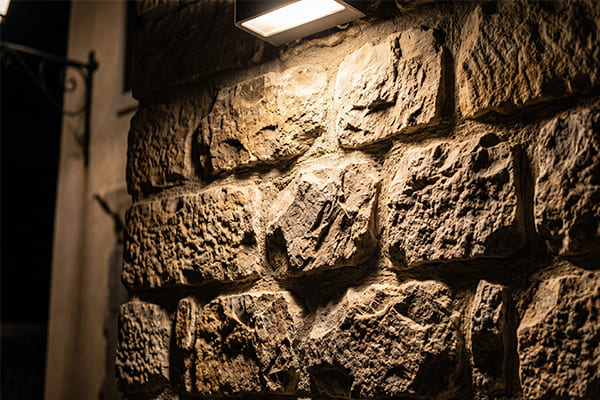
Wall grazing is all about creating high contrast. We use this technique to bring out the soul of materials like rough-cut stone, classic brickwork, or even corrugated metal panels. The magic happens because the light hits the surface at a very sharp angle. It catches all the high points and casts deep, dramatic shadows in the low points. This is what creates that three-dimensional, textured look. I remember a project with a historic stone facade. The client felt its character disappeared after sunset. We installed our JUXUANLED linear lights with 15° optics right at the base of the walls. The next night, the client called me, absolutely amazed. He said we had brought the "old soul" of the building back to life. That’s the power of proper grazing.
| Beam Angle | Effect | Best For |
|---|---|---|
| 10° | Very dramatic, long shadows | Deeply textured stone, rough concrete |
| 20° | Strong but softer contrast | Standard brickwork, smaller textures |
| Elliptical | Stretches light horizontally or vertically | Corrugated panels, ribbed surfaces |
How Can You Light a Smooth Facade Evenly?
You want to light a modern, flat facade, but you get ugly hot spots and dark patches. It looks unprofessional and undermines the building's sleek design. Use wall washing for a perfect glow.
For a smooth facade, wall washing with a wide beam is the answer3. On high-end projects, we use asymmetrical lenses4. This special optic pushes light up the wall efficiently. It creates a clean, seamless curtain of light from top to bottom.
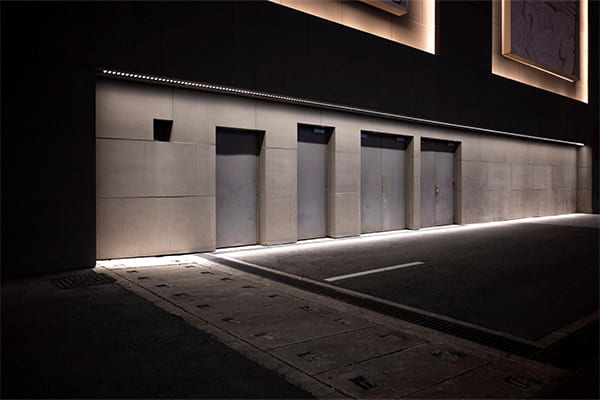
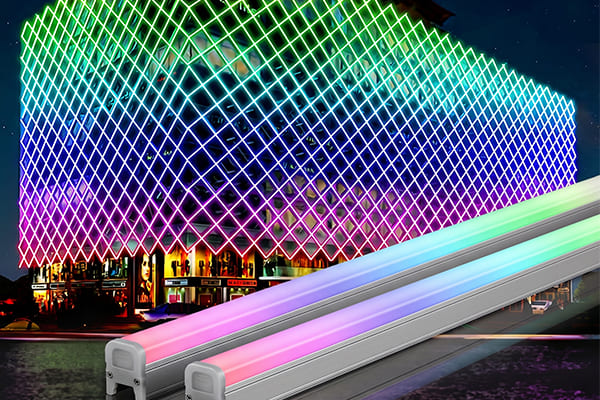
Wall washing is the opposite of grazing5. Here, the goal is to eliminate shadows and create a perfectly uniform surface of light6. It's ideal for modern architecture with smooth materials like glass, aluminum panels, or polished stone7. In the past, we used standard wide-beam floodlights. But this often created a bright hot spot at the bottom of the wall, with the light fading towards the top. Today, asymmetrical optics are the industry standard for premium projects. An asymmetrical lens is specially shaped to "scoop" the light and throw it upwards. This means we can place the fixture closer to the wall, save energy, and get a much more even result. For a new corporate headquarters with a glass curtain wall, we used our JUXUANLED asymmetrical wall washers. The result was a flawless, premium glow that made the building a landmark without any distracting hot spots.
| Optic Type | Light Distribution | Result |
|---|---|---|
| Symmetrical | Even cone of light | Hotspot at base, dimmer at top |
| Asymmetrical | Tilted, focused distribution | Even brightness from bottom to top |
How Do You Highlight Architectural Lines Without Glare?
You want to trace a building's columns and window frames, but the lights create blinding glare8. This is a source of light pollution9 and discomfort. Use ultra-narrow optics with anti-glare accessories.
Select ultra-narrow beams from 1° to 10° or elliptical optics. These create a strong, linear effect perfect for columns or window reveals. Always pair them with accessories like honeycomb louvers10 to control glare and ensure you only see the light, not the lamp.
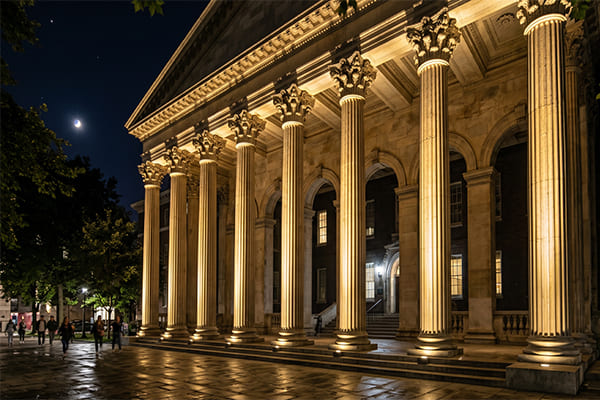
This technique is about precision. It is like drawing on the building with a very fine pen. The goal is to achieve an effect where you "see the light, but not the luminaire." This is a sign of high-quality architectural lighting. Ultra-narrow beams, like 1°, 3°, or 5°, create a tight "pencil beam" of light that can shoot up a tall column. An elliptical beam can create a sharp "blade" of light to trace the edge of a window. But the optics are only half the story. You must use anti-glare accessories. A honeycomb louver is a small grid that sits in front of the lens. It blocks light from spilling out to the sides, so you only see the beautiful effect on the wall, not a blinding light source. This method is also very important for controlling light pollution and creating responsible, sustainable designs.
| Structure Element | Recommended Optic | Why? |
|---|---|---|
| Tall Columns | 1°- 5° Narrow Beam | Creates a powerful vertical line to emphasize height. |
| Window Frames | Elliptical Beam | Paints a clean, sharp blade of light around the frame. |
| Cornices | Linear Fixture with Narrow Optic | Provides a continuous, unbroken line of light. |
How Do You Illuminate Large Landmarks from Afar?
Lighting a huge landmark from a distance seems impossible. The light just fades away. Your project can look underpowered, failing to create the grand statement you intended.
For large landmarks or when fixtures are far away, use powerful floodlights with rotationally symmetrical lenses. These optics provide the broad, even coverage and the sheer power needed to throw light effectively across long distances.
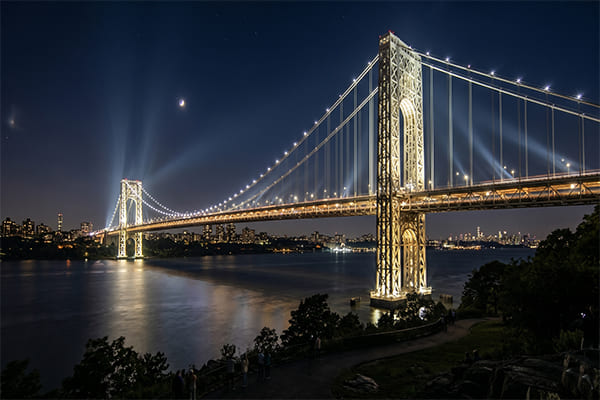
This method is for when you simply can't get close. Think of lighting a bridge, a stadium, or a historic monument where you cannot mount fixtures directly onto the structure. For these situations, you need pure power and throw. A rotationally symmetrical optic creates the classic floodlight pattern, a cone of light that spreads out evenly. While it's less precise than the other techniques we've discussed, its strength is in its reach. The key is to carefully choose the beam angle based on your distance and the size of your target. A narrower beam, like 15°, will travel further and stay more intense11. A wider beam, like 45°, will cover a bigger area from a closer distance. I remember we lit a large bridge for a city festival. We used our high-power JUXUANLED floodlights with 25° symmetrical optics. We mounted them on towers 50 meters away. It created a breathtaking spectacle and showed the power of well-planned floodlighting.
Conclusion
Matching optics to architecture is key. Use grazing for texture, washing for smoothness, and narrow beams for lines. This precision creates stunning, efficient, and glare-free nighttime masterpieces.
"Downsizing the Lumen - Illuminating Engineering Society", https://ies.org/lda/downsizing-the-lumen-2/. Architectural lighting references describe wall grazing as a technique that places luminaires close to a textured surface and uses narrow distributions to accentuate relief through shadow; the cited beam range should be treated as design guidance rather than a universal standard. Evidence role: expert_consensus; source type: education. Supports: Wall grazing commonly uses narrow beam optics around 10° to 20° to emphasize texture.. Scope note: Beam-angle recommendations vary by fixture photometry, mounting distance, and surface texture. ↩
"Scaling depth from shadow offset - PMC - NIH", https://pmc.ncbi.nlm.nih.gov/articles/PMC8631054/. Lighting education sources explain that grazing light emphasizes surface irregularities because the shallow incidence angle casts shadows from raised and recessed areas; this supports the optical mechanism but not the aesthetic judgment of how dramatic the result will be in every project. Evidence role: mechanism; source type: education. Supports: Grazing light creates shadows that reveal surface texture and depth.. Scope note: The visual strength of shadows depends on surface relief, fixture distance, beam distribution, and ambient light. ↩
"7 tips for your perfect wallwashing - Photometrics & practice | ERCO", https://www.erco.com/en_us/projects/focus/photometrics-practice/7-tips-for-your-perfect-wallwashing-7171/. Lighting design guidance identifies wall washing as the use of broad light distributions to illuminate vertical surfaces uniformly; this supports the use of wide beams for smooth facades, while final beam selection remains project-specific. Evidence role: expert_consensus; source type: education. Supports: Wide beam distributions are commonly used for wall washing smooth facades.. Scope note: Uniformity also depends on fixture spacing, setback, mounting height, surface reflectance, and photometric performance. ↩
"Wall Wash Lens Architectural LED Linear Lights", https://glledus.com/pages/linear-light-wall-wash-lens. Photometric and lighting-design literature describes asymmetric light distributions as directing more luminous intensity toward the target area, which can improve vertical surface uniformity in wall-washing applications; this supports the optical principle rather than proving superiority in all installations. Evidence role: mechanism; source type: research. Supports: Asymmetrical lenses are used in wall-washing applications to direct light upward and improve uniformity.. Scope note: Performance depends on the specific luminaire photometry, aiming, spacing, and installation geometry. ↩
"Outdoor Lighting 101: Wall Washing Vs. Wall Grazing - CAST Lighting", https://cast-lighting.com/blog/post/outdoor-lighting-101-wall-washing-vs-wall-grazing. Architectural lighting references distinguish wall washing, which aims for broad and uniform illumination, from wall grazing, which intentionally emphasizes texture through contrast; this supports the conceptual contrast, though the two techniques can overlap in practice. Evidence role: definition; source type: education. Supports: Wall washing and wall grazing are distinct facade-lighting techniques with different visual goals.. Scope note: Some projects may combine washing and grazing effects depending on luminaire placement and surface finish. ↩
"7 tips for your perfect wallwashing - Photometrics & practice | ERCO", https://www.erco.com/en_us/projects/focus/photometrics-practice/7-tips-for-your-perfect-wallwashing-7171/. Wall-washing definitions generally describe the technique as producing even illumination over a vertical plane; this supports the intended design goal, although measured uniformity is normally expressed by illuminance ratios rather than described as perfect. Evidence role: definition; source type: education. Supports: Wall washing aims to create uniform illumination on a vertical surface.. Scope note: “Perfectly uniform” is an idealized description; real installations have measurable variation. ↩
"Solar Wall Washers for Buildings | LED Architectural Lighting", https://beyondsolar.net/blogs/news/solar-wall-washers-architectural-lighting-for-buildings-and-landscapes?srsltid=AfmBOooVRtFfjUhaVwP_niTS1iJeFUU0ai1keXrht9MLyaH3NMgkSLkF. Architectural lighting guidance associates wall washing with smooth or flat vertical surfaces because uniform illumination minimizes surface shadows; this supports the material examples as contextual applications, not as an exhaustive material rule. Evidence role: general_support; source type: education. Supports: Wall washing is suitable for smooth facade materials such as glass, aluminum panels, and polished stone.. Scope note: Material reflectance, gloss, and viewing angles can affect whether wall washing is appropriate for a given glass, metal, or stone facade. ↩
"Influence of lighting on visual performance - PMC - NIH", https://pmc.ncbi.nlm.nih.gov/articles/PMC11627233/. Lighting science sources define glare as visual discomfort or reduced visibility caused by excessive luminance or contrast in the field of view; this supports the claim that exposed or poorly controlled facade luminaires can create uncomfortable glare. Evidence role: definition; source type: institution. Supports: Uncontrolled lighting can create glare that causes discomfort or impaired visibility.. Scope note: Whether a specific installation causes glare requires luminance, viewing-angle, and observer-position data. ↩
"NR Light Pollution Reduction | NJ Green Building Manual", https://greenmanual.rutgers.edu/nr-light-pollution-reduction/. Dark-sky and environmental lighting guidance identifies glare, light trespass, and excessive upward or sideways light as components of light pollution; this supports the relationship between uncontrolled facade lighting and light-pollution concerns, but not the performance of any specific product. Evidence role: expert_consensus; source type: institution. Supports: Controlling glare and spill light is relevant to reducing light pollution in exterior lighting design.. Scope note: A project-level assessment would require photometric data, aiming information, and local environmental context. ↩
"Honeycomb LED Lights: Glare-Free, Energy-Efficient Lighting ...", https://ironsmithlighting.com/blogs/news/honeycomb-led-lights?srsltid=AfmBOookSFihvKoMgVZgwdhYqvYv3i6ZLDmFYooScZ9QTPlIbIJHMHIS. Lighting design references describe louvers and shielding accessories as methods for limiting high-angle light and reducing direct glare from luminaires; this supports the stated control function of honeycomb louvers, though effectiveness varies with cell depth and fixture geometry. Evidence role: mechanism; source type: education. Supports: Honeycomb louvers can help control glare and side spill from narrow-beam luminaires.. Scope note: A honeycomb louver reduces spill and glare only within the limits of its physical geometry and the luminaire’s beam distribution. ↩
"[PDF] Light Radiometry and Photometry", http://graphics.stanford.edu/courses/cs348b-12/lectures/illumination/illumination.pdf. Photometry principles show that, for a given luminous flux, a smaller beam angle concentrates luminous intensity into a narrower solid angle, producing higher candela values and greater illuminance at distance; this supports the general relationship but not a fixed throw distance for a 15° beam. Evidence role: mechanism; source type: education. Supports: Narrower beam angles concentrate light and can maintain higher intensity over longer distances than wider beams.. Scope note: Actual intensity at distance also depends on lamp output, optical efficiency, atmospheric conditions, aiming accuracy, and target reflectance. ↩