How Can You Boost Energy Efficiency in Large-Scale LED Facade Linear Light Projects?
Running a massive LED lighting project can drain your budget with high energy bills. This waste hurts your bottom line. But you can cut costs without losing visual appeal.
To boost energy efficiency, focus on four key areas: optimizing the electrical architecture, using precise optical design, implementing smart controls, and refining software algorithms. This system-wide approach can cut energy use by over 50%1 while actually improving the final lighting effect.
I've been in the outdoor lighting business for over a decade, and I've seen countless projects struggle with high running costs. The common mistake is to think that saving energy just means buying lights with a lower wattage. The real secret is much bigger than that. It’s about designing a complete, intelligent system. It's a philosophy I call the "Four-Dimensional Optimization Method." This method looks at every part of the project, from the power supply to the pixels on the screen. Let’s break down how you can apply these four dimensions to your own projects.
How Can You Optimize the Electrical Architecture for Maximum Savings?
Are you worried about voltage drop and wasted heat in long runs of linear lights? This common problem secretly inflates your project's energy bill and causes lights to dim at the end.
You can fix this by using higher voltage systems like DC24V or DC48V, which cuts power loss from voltage drop by up to 75%2. Also, use dual-end power feeds and keep your power supplies running at a 70-80% load for the best efficiency3.
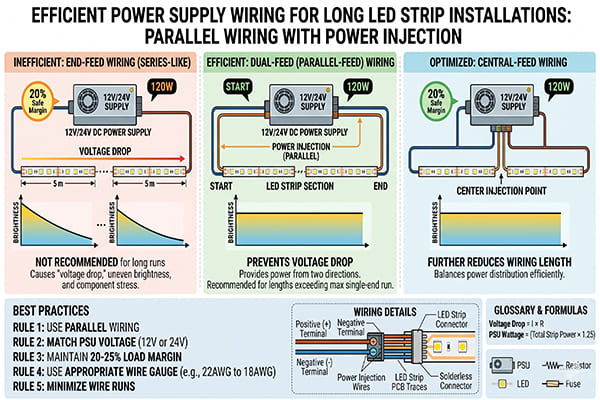
Optimizing the electrical setup is the foundation of an energy-efficient project. It's often overlooked, but it has a huge impact. I remember a project we consulted on where the contractor used a 12V system for a 20-meter run. The lights at the far end were noticeably dimmer and had a reddish tint. That dimness was energy literally turning into heat in the copper wires. We helped them switch to a 24V system with power fed from both ends. The result was perfect, even brightness and a 15% drop in their total power draw.
Voltage and Power Supply Strategy
The choice of voltage is critical. Lower voltage systems require more current to deliver the same amount of power. According to Ohm's law, power loss in a wire is proportional to the square of the current (P = I²R). By doubling the voltage from 12V to 24V, you halve the current, which cuts the power lost in the wiring by 75%.
| Feature | DC12V System | DC24V / DC48V System |
|---|---|---|
| Current | High | Low (50% of 12V) |
| Power Loss | High | Low (25% of 12V) |
| Max Run Length | Short (e.g., 5-10 meters) | Long (e.g., 15-30 meters) |
| Efficiency | Lower | Higher |
Another key is to never max out your power supplies. We follow a "golden rule" of loading them to only 70-80% of their rated capacity. This prevents them from overheating and keeps them running in their most efficient range.
Wiring and Power Factor
For long installations, simply running power from one end is not enough. We always design systems with either a dual-end power feed (powering the strip from both ends) or a middle parallel feed (powering from the center and splitting the run). This ensures every LED gets the voltage it needs and prevents dimming. Furthermore, we only use high-quality industrial power supplies with a Power Factor Correction (PFC) of over 0.94. Simply put, a high PFC means the power supply uses the electricity it draws from the grid very efficiently, reducing another source of hidden waste.
Why is Precise Optical Design More Efficient Than Just Using More Power?
Do your brilliant facade lights also light up the empty sky and neighboring buildings? That's not just light pollution; it's wasted electricity and money. There's a much smarter way to work.
Precise optics, like narrow-angle lenses, direct light only onto the building surface. This means a 12W/meter narrow-beam fixture can look brighter and more impactful than a 24W/meter floodlight, effectively cutting your power needs in half5 while creating a sharper look.
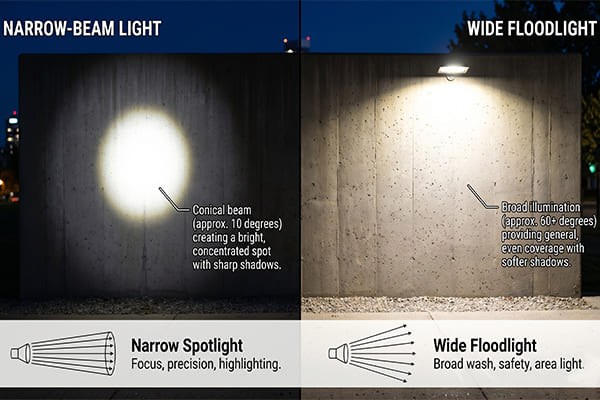
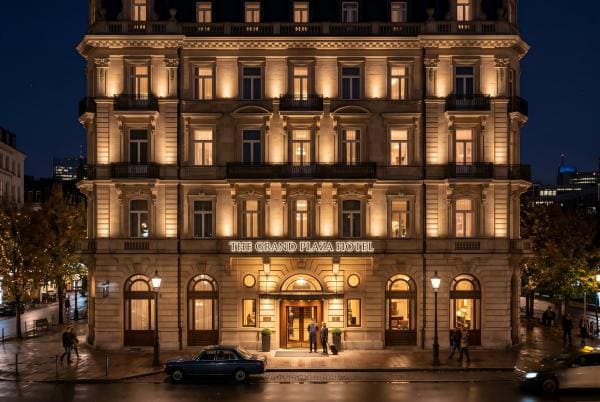
The old mindset in lighting was "brighter is better." This led to using high-power floodlights to blast a building with light. The modern, efficient approach is "more precise is more effective." The goal is to put every lumen of light exactly where it’s needed and nowhere else. I had a client who was about to sign off on a project using 24W/meter wash lights for their hotel facade. I showed them a demo using our 12W/meter linear lights with 10-degree lenses. The effect was more dramatic, with sharp, clean lines of light grazing up the columns. They were shocked that it looked better while using half the power. They got a better result and saved a fortune on their future electricity bills.
The Power of Narrow Beams
Instead of a wide, diffused flood of light, using fixtures with focused optics like 3°, 10°, or 15° lenses concentrates the light into a powerful beam. This concentration, or candela, is what the human eye perceives as brightness on a surface.6
| Feature | Wide Floodlight (e.g., 24W) | Narrow-Angle Light (e.g., 12W) |
|---|---|---|
| Light Spread | Wide, uncontrolled | Focused, controlled |
| Light on Target | Low percentage | High percentage |
| Wasted Light | High (spills into sky) | Minimal |
| Visual Impact | Soft, diffused | Sharp, dramatic, looks brighter |
| Power Usage | High | Low |
This strategy is about working smarter, not harder. You achieve a superior visual effect with less energy simply by controlling where the light goes.
Smart Design Integration
The best designs often create the illusion of "seeing the light, but not the fixture." We achieve this by carefully placing fixtures to graze surfaces or by using the building's own architectural elements. For example, we might integrate a linear light into a ledge so it bounces light off the surface above it. This reflected light is soft, elegant, and highly efficient. By making the building part of the lighting system, you can often use fewer fixtures and less power to create a stunning, high-end look.
How Do Smart Controls Dramatically Cut Your Lighting's Energy Use?
Is your building facade lit at 100% brightness all night long, even at 3 AM when no one is there to see it? This is a huge and completely unnecessary energy drain.
Smart control systems like DMX or DALI let you schedule and automate your lighting. You can automatically dim lights to 50-70% during late-night hours or adjust brightness based on ambient light. This "set and forget" approach can easily save 20-50% on energy costs7.
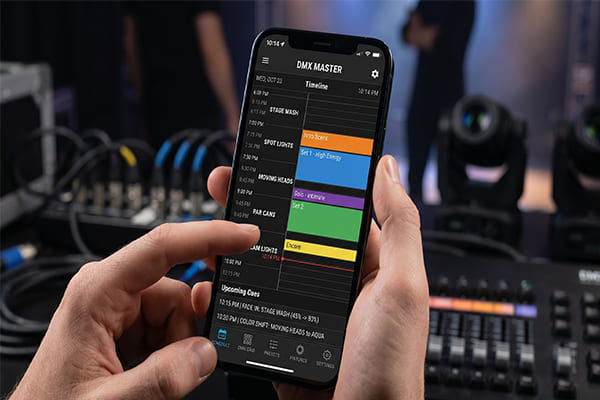
A static lighting installation that runs at full power from dusk until dawn is a relic of the past. Today, dynamic control is essential for any large-scale project. I once worked on a city landmark project where the managers were concerned about the high running costs. We installed a DMX control system with a simple astronomical time clock. We programmed a schedule: 100% brightness from sunset until 11 PM, then automatically dimming to 70% until 1 AM, and finally dropping to 50% until sunrise. Nobody noticed the change in brightness, but the city’s electricity bill for the landmark dropped by nearly 40%. It's one of the easiest wins in energy efficiency.
Time and Zone-Based Scheduling
The simplest form of smart control is scheduling. A building's lighting needs are not the same at 8 PM as they are at 4 AM. By creating a schedule, you match the light output to the actual need, saving immense amounts of energy during quiet hours. You can also divide a large building into zones and light them differently, rather than having the entire facade on one uniform setting.
| Time Period | Pedestrian Traffic | Recommended Brightness8 | Energy Savings |
|---|---|---|---|
| 7 PM - 11 PM | High | 100% | 0% |
| 11 PM - 1 AM | Medium | 70% | 30% |
| 1 AM - 5 AM | Very Low | 50% | 50% |
| 5 AM - Sunrise | Low | 70% | 30% |
Adaptive and Dynamic Control
For even greater savings, we can make the system adaptive. We use protocols like DMX (for dynamic color effects) or DALI (for architectural dimming) to give us full control over every fixture. By adding a simple photocell sensor, the system can measure the ambient light and adjust the facade's brightness automatically9. On a bright, moonlit night, it might dim the lights slightly. On a dark, overcast night, it might bring them up. This ensures the building always looks perfect while using the absolute minimum energy required. This moves the system from just being scheduled to being truly intelligent.
Can the Content on Your Media Facade Really Affect Your Power Bill?
Do you love running bright, flashy animations on your media facade? Be careful. Certain colors and patterns, especially solid white, are massive energy hogs that can double your electricity costs without you realizing it.
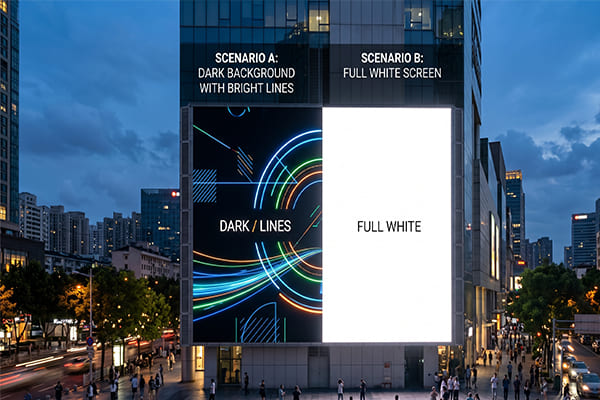
Yes, the content you display has a direct and significant impact on power consumption. Using dark backgrounds with high-contrast graphics uses far less energy than full-screen white, which requires all RGB LEDs to be at 100% power. This simple software choice can reduce power use by 20-40%10.
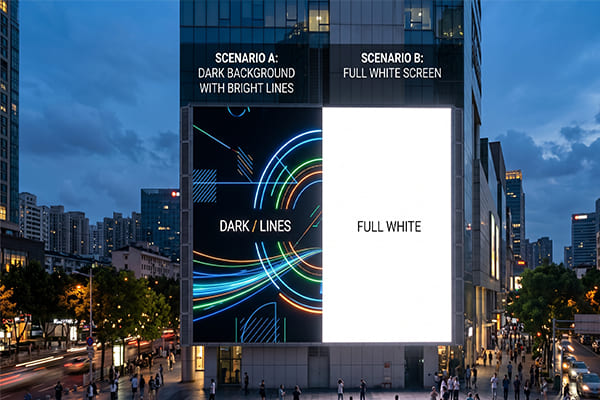
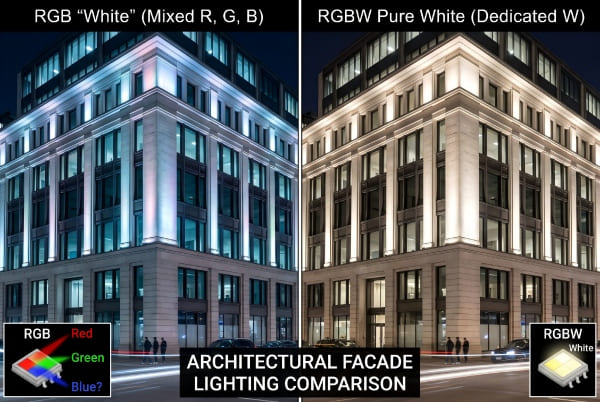
This is a factor many people in the advertising and design space never consider. For an RGB LED pixel, the color white is created by turning the Red, Green, and Blue diodes all on to their maximum brightness. It is the single most power-intensive state for a light. Black, on the other hand, is created by turning all the diodes off, using almost zero power. I had a client with a new media facade on their shopping mall. Their first electricity bill was double what they expected. We looked at their content schedule and found they were running ads with white backgrounds for hours at a time. We helped their design team create a new set of "power-conscious" templates using black backgrounds with colorful text and logos. The visual impact was still strong, but their next bill was 35% lower.
Power-Conscious Content Creation
The key is to think about power usage during the creative process. Instead of defaulting to bright, full-screen color washes, designers should embrace the power of contrast. Using a black or dark background makes colorful elements pop even more, creating a dynamic look that is also energy efficient.
| Color Displayed | RGB Diode State | Relative Power Consumption11 |
|---|---|---|
| Black | R: 0%, G: 0%, B: 0% | ~0% |
| Single Color (e.g., Blue) | R: 0%, G: 0%, B: 100% | ~33% |
| Mixed Color (e.g., Yellow) | R: 100%, G: 100%, B: 0% | ~66% |
| White | R: 100%, G: 100%, B: 100% | 100% |
Hardware and Driver IC Optimization
This optimization goes down to the component level. When we make our products, we focuseson pixel lights and use advanced driver ICs. Some modern ICs have a built-in "sleep mode." This means that when the software tells a pixel to be black, the chip doesn't just sit there waiting for the next command. It enters a low-power state. Across a facade with millions of pixels, these tiny savings add up to a significant reduction in standby power consumption, especially when displaying content with a lot of black. It’s a technical detail, but it’s part of a complete, system-wide approach to efficiency.
Conclusion
True energy efficiency is a total system approach. By optimizing electricals, optics, controls, and software together, you create smarter, more impactful lighting that costs much less to run.
"[PDF] Case Study: Energy Reduction through Lighting Improvement - EPA", https://www.epa.gov/sites/default/files/2015-05/documents/cs8-lovell-lighting.pdf. A source could provide data from case studies or modeling, showing that a holistic approach combining efficient hardware, optical design, and intelligent controls can lead to energy reductions of 50% or more compared to traditional or non-optimized systems. Evidence role: statistic; source type: research. Supports: That integrated design approaches for large-scale LED lighting projects can achieve energy savings exceeding 50% compared to non-optimized systems.. Scope note: The exact savings are highly dependent on the specifics of the project, including the baseline technology being replaced, operating hours, and the extent of optimization applied. ↩
"Ohm's law - Wikipedia", https://en.wikipedia.org/wiki/Ohm%27s_law. A source could explain the physics behind power loss in DC circuits, demonstrating that since power loss is proportional to the square of the current (I), doubling the voltage (V) for the same power (P) halves the current, resulting in a 75% reduction in power lost to heat in the wiring. Evidence role: mechanism; source type: education. Supports: That doubling the voltage (e.g., from 12V to 24V) reduces the current by half, which in turn reduces the resistive power loss in the wiring by a factor of four (a 75% reduction).. ↩
"80 Plus - Wikipedia", https://en.wikipedia.org/wiki/80_Plus. A source could provide typical efficiency curves for AC/DC power supplies, which often show peak efficiency in the range of 50-90% of the maximum load, supporting the practice of not running a power supply at its full rated capacity to optimize performance and reduce waste heat. Evidence role: general_support; source type: research. Supports: That LED power supplies and drivers exhibit a non-linear efficiency curve, typically peaking at a load below their maximum rated capacity.. Scope note: The exact peak efficiency point varies by manufacturer and model, but the 70-80% range is a common industry best practice. ↩
"[PDF] ENERGY STAR Program Requirements for External Power Supplies ...", https://www.energystar.gov/sites/default/files/FinalSpecV2.pdf. A source from an electrical engineering institution or a standards body like Energy Star could explain that Power Factor is the ratio of real power used by a load to the apparent power drawn from the grid. A low PF indicates wasted energy, and many regulations and efficiency programs require a PF of 0.9 or higher for commercial lighting to minimize grid-level losses. Evidence role: definition; source type: institution. Supports: The definition and importance of Power Factor (PF), and why a high PF (close to 1.0) is desirable for energy efficiency.. ↩
"Development of Lighting Application Efficiency Measurement ...", https://www.energy.gov/cmei/ssl/articles/development-lighting-application-efficiency-measurement-framework. A source could discuss the concept of application efficiency, showing that while a floodlight has high lumen output, much of it is wasted as light spill. A focused, lower-power beam can deliver a higher percentage of its lumens to the target, resulting in equal or greater perceived brightness (measured in lux or foot-candles on the surface) for significantly less energy. Evidence role: mechanism; source type: paper. Supports: That by using precision optics to direct light only where it is needed, a lower-wattage fixture can achieve the same or greater illuminance on a target surface as a higher-wattage floodlight.. Scope note: The 'half the power' figure is illustrative; the actual savings depend on the specific beam angles, distances, and fixtures being compared. ↩
"Luminous intensity - Wikipedia", https://en.wikipedia.org/wiki/Luminous_intensity. A source could clarify that while lumens measure the total light output of a source, candela measures the light's intensity in a specific direction. This directional intensity determines the illuminance (measured in lux or foot-candles) on a distant surface, which is what is commonly perceived as 'brightness.' Evidence role: definition; source type: encyclopedia. Supports: The definitions of and relationship between luminous flux (lumens), luminous intensity (candela), and illuminance (lux).. ↩
"Lighting Controls | Department of Energy", https://www.energy.gov/energysaver/lighting-controls. Reports from organizations like the U.S. Department of Energy or the DesignLights Consortium often quantify energy savings from lighting controls, with studies showing reductions typically ranging from 20% to 60% depending on the application, usage patterns, and control strategies employed. Evidence role: statistic; source type: government. Supports: That implementing lighting controls, such as scheduling and dimming, in commercial and architectural applications results in significant energy savings.. Scope note: The cited savings are an average range; actual results for a specific project will vary based on its operating schedule and the aggressiveness of the control strategy. ↩
"Exterior and Site Lighting | City of Scottsdale", https://www.scottsdaleaz.gov/design/design-guidelines/exterior-and-site-lighting. A source from a professional lighting organization, such as the Illuminating Engineering Society (IES) or the International Dark-Sky Association (IDA), could provide guidelines for outdoor lighting, which often include recommendations for curfews or adaptive lighting levels that are reduced during late-night, low-activity hours. Evidence role: general_support; source type: institution. Supports: That tiered lighting levels based on time and activity are a recognized strategy for energy conservation and light pollution reduction.. Scope note: The specific percentages in the table are illustrative; official guidelines may provide more nuanced recommendations based on lighting zones and specific applications rather than universal percentages. ↩
"Lighting Controls | Department of Energy", https://www.energy.gov/energysaver/lighting-controls. A source could describe how adaptive control systems use real-time sensor feedback to maintain a desired level of illuminance or visual effect. For facade lighting, this allows the system to compensate for factors like moonlight, snow cover, or adjacent light sources, dimming the electric lights when ambient light is high and using only the minimum energy necessary. Evidence role: mechanism; source type: research. Supports: That using photocells or ambient light sensors as part of a closed-loop control system for exterior lighting can optimize energy use.. ↩
"Signage Displays | ENERGY STAR", https://www.energystar.gov/products/signage_displays. Research on the power consumption of emissive displays like LED and OLED shows a strong correlation between pixel luminance and energy draw. Studies have demonstrated that shifting from predominantly white or bright content to designs that utilize black or dark backgrounds can reduce a display's energy consumption by a significant margin, with figures often cited in the 20-60% range depending on the specific content change. Evidence role: statistic; source type: paper. Supports: That the content displayed on an RGB LED screen has a direct and measurable impact on its power consumption, and that designing content with darker backgrounds can lead to significant energy savings.. Scope note: The 20-40% figure is an estimate; the actual savings depend on the original content, the redesigned content, and the specific display technology. ↩
"Additive & Subtractive Color Models > DINFOS Pavilion > Article", https://pavilion.dinfos.edu/Article/Article/2355687/additive-subtractive-color-models/. A source could explain that in an additive RGB color model, each pixel is composed of red, green, and blue sub-pixels. Displaying black requires all sub-pixels to be off (near-zero power). Displaying a primary color like red uses roughly one-third of the pixel's maximum power. Displaying white requires all three sub-pixels to be at maximum brightness, consuming the most power. Evidence role: mechanism; source type: education. Supports: The relationship between displayed color and power consumption in an RGB LED pixel.. Scope note: This is a simplified model; actual power draw can be affected by driver efficiency and gamma correction, but the relative relationship holds true. ↩