Struggling with high energy bills and a "dumb" building? Your static lighting wastes money and offers no intelligence. This is changing as smart lighting transforms buildings into responsive, intelligent environments.
The future of smart building lighting is its transformation into the building's digital nervous system1. It's moving beyond simple illumination, using AI, integrated sensors, and network connectivity to drastically save energy2, improve occupant well-being, and provide valuable data for building management.
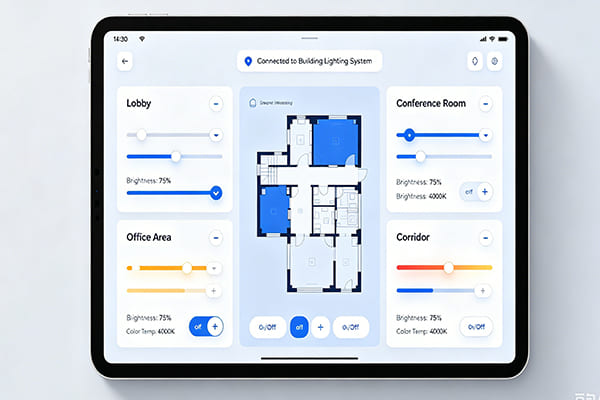
As a specialist in outdoor lighting for over a decade, I've seen technology evolve at a breathtaking pace. But what's happening inside buildings right now is a true revolution. We're moving past just flicking a switch. We are creating environments that think, sense, and adapt. This isn't just about swapping out old bulbs for new LEDs. It is a fundamental rethinking of what a building's infrastructure can do. The lighting system is becoming the most extensive and powerful network in the entire building. It’s an exciting time, and this shift is creating incredible opportunities for contractors, designers, and building owners. Let's explore what this new era of intelligent lighting really looks like.
How is technology convergence reshaping building lighting?
Juggling separate, complex control systems for lighting, HVAC, and security is a project manager's nightmare. This leads to tangled wires, soaring costs, and systems that refuse to communicate with each other.
Technology convergence simplifies this by using unified, IP-based protocols like Matter and KNX3. This allows lighting to integrate seamlessly with other building systems. Power over Ethernet (PoE) technology then uses a single network cable for both power and data4, dramatically cutting installation costs5.
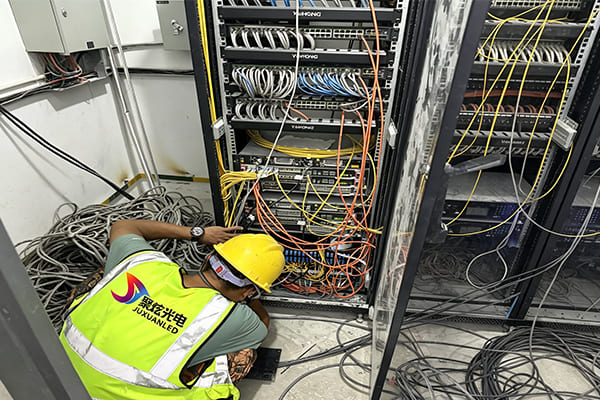
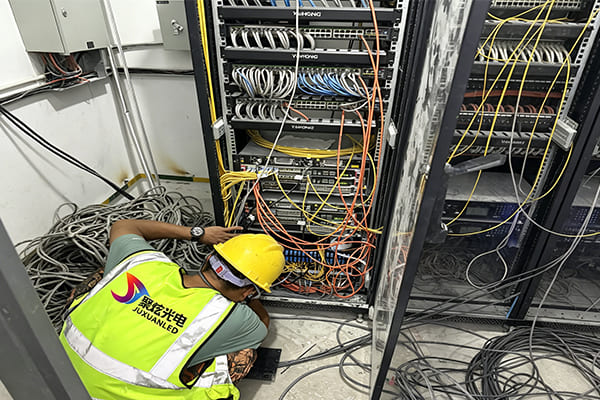
I remember a project a few years ago where we had to coordinate three different contractors just for the controls. The lighting guys had their system, the HVAC team had theirs, and the security company had a third. Nothing worked together smoothly. Today, that entire headache is being solved by technology convergence. It's about making everything speak the same digital language.
Unified Protocols: The Common Language
Think of protocols like KNX, Matter, and Thread as a universal translator for building systems. In the past, lighting controls used their own dedicated wiring, like DALI or 0-10V. Now, everything can run on the building's standard IT network6. This is a game-changer. When the security system registers the last person leaving a floor, it can now directly tell the lighting system to turn off and signal the HVAC to enter economy mode.7 This deep integration was once a complex, custom-coded luxury. Now, it's becoming the standard, making buildings truly automated and efficient.
The Power of PoE
Power over Ethernet (PoE) is one of the most practical innovations for our industry. It means a single, standard network cable can deliver both low-voltage power and data to a light fixture. This simplifies everything. You no longer need a certified electrician to run high-voltage conduit to every single light point.8 Your network installer can do most of the work. The cost savings on labor and materials are significant. I've put together a simple table to show the difference.
| Feature | Traditional Wiring | Power over Ethernet (PoE) |
|---|---|---|
| Power Source | High-voltage AC wiring | Low-voltage DC via network cable |
| Data Control | Separate control cables | Transmitted on the same network cable |
| Installation | Requires certified electrician, more materials | Simpler, faster, lower labor cost |
| Flexibility | Hardwired, difficult to change zones | Easily reconfigurable with software |
This shift makes installations faster, cheaper, and far more flexible for future changes.
Is your lighting system getting smarter with AI and sensors?
Your building's lights are on, but is anyone actually using the space? All that wasted electricity is a direct hit to your bottom line. Simple motion sensors help, but they are only reactive.
Yes, AI and sensors are making lighting proactive, not just reactive. AI algorithms can analyze historical data, weather, and even electricity prices to predict usage and optimize energy.9 Each light fixture, embedded with sensors, becomes a node in a building-wide data collection grid.
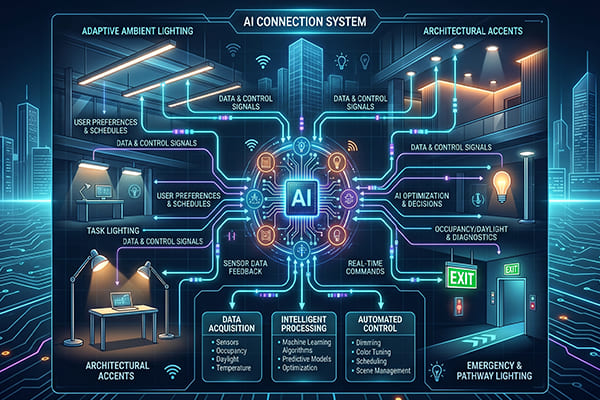
The leap from basic motion detection to AI-driven control is huge. A simple sensor reacts; it turns a light on when you walk in and off when you leave. But an intelligent system predicts. It learns the rhythms of the building and makes decisions that save energy and improve the environment before anyone even notices. This is the difference between a simple tool and an intelligent partner.
From Dumb Sensors to AI Brains
An old system's logic is basic: "Motion detected, turn on light." An AI-powered system thinks on a whole new level. It might reason, "The marketing team always leaves by 6:00 PM on Fridays. The weather forecast shows a sunny afternoon. Let's begin to slowly dim the lights on that floor starting at 5:45 PM to save energy and ease the transition." This predictive power is enabled by edge computing10. Instead of relying on a slow, central server, the processing power is built directly into the fixture or a local controller. This ensures instantaneous response and means the system keeps working even if the internet connection goes down.
A High-Density Sensor Grid
This is the most exciting part for me. When you embed sensors into every light fixture, you're not just installing a lighting system anymore. You are creating a high-density "sensor grid." Each light becomes a data point, collecting information on ambient light, temperature, humidity, CO2 levels, and even air pollutants (VOCs). Suddenly, your lighting infrastructure can do so much more.
Can smart lighting make buildings healthier and more sustainable?
Harsh, static office lighting can lead to eye strain, fatigue, and lower productivity. This isn't just an inconvenience; it directly hurts employee well-being and your company's overall performance.
Absolutely. Human-Centric Lighting (HCL) adjusts light color and intensity to support our natural body clock, improving health and focus.11 Combined with energy savings of up to 80%12, smart lighting is now a cornerstone for sustainable building certifications like LEED and WELL.

For years, our main focus was on making things bright and saving energy. Now, a third, equally important factor has emerged: people. We're finally recognizing that the quality of light has a direct biological effect on us. At the same time, the push for sustainability has never been stronger. Smart lighting is uniquely positioned to deliver on both of these critical goals, making it an essential part of modern building design.
Lighting for People (Human-Centric Lighting)
Human-Centric Lighting, or HCL, is designed to mimic the natural patterns of daylight. Our bodies are tuned to this daily cycle. Modern lighting fixtures with RGBW (Red, Green, Blue, White) channels can now precisely replicate it. The system provides cool, bright, blue-tinted light in the morning to increase alertness and suppress melatonin production. As the day progresses, the light slowly transitions to a warmer, dimmer, amber hue in the late afternoon, signaling our brains that it's time to wind down. We've seen this implemented in schools to improve student concentration and in hospitals to promote patient healing. It's about creating environments that work with our biology, not against it.
The Green Imperative
The ability to cut a building's lighting energy consumption by up to 80% is a powerful promise. For our clients pursuing green building certifications like LEED (Leadership in Energy and Environmental Design) or WELL, a smart lighting system isn't a luxury; it's a necessity. It provides a huge number of points toward certification. The future is even more integrated. We are already designing systems that link directly with on-site solar panels and battery storage. The lighting system can automatically dim itself during periods of peak grid demand, relying instead on stored solar power. This transforms the building from a simple energy consumer into an active, intelligent participant in a cleaner energy ecosystem. This is the clear path toward Net Zero buildings.
Conclusion
Smart lighting is no longer just about light. It has become the intelligent, sensing nervous system that makes modern buildings efficient, healthy, and truly prepared for the future.
"LoRaCELL-Driven IoT Smart Lighting Systems - PMC - NIH", https://pmc.ncbi.nlm.nih.gov/articles/PMC10818303/. A source on intelligent buildings or IoT-enabled lighting can support the characterization of networked lighting as a distributed sensing and communications infrastructure within buildings; this is a conceptual framing rather than proof that lighting is universally the dominant building network. Evidence role: general_support; source type: research. Supports: Smart lighting is evolving from illumination into a distributed sensing and communication layer for building management.. Scope note: Supports the analogy contextually, not as a standardized technical term. ↩
"[PDF] A Meta-Analysis of Energy Savings from Lighting Controls in ...", https://eta-publications.lbl.gov/sites/default/files/a_meta-analysis_of_energy_savings_from_lighting_controls_in_commercial_buildings_lbnl-5095e.pdf. Research on smart lighting controls can document that occupancy sensing, daylight harvesting, networking, and advanced control algorithms reduce lighting energy use in buildings; reported savings vary by building type, baseline, and control strategy. Evidence role: statistic; source type: paper. Supports: AI, sensors, and networked controls can reduce building lighting energy consumption.. Scope note: The source may support energy savings generally, but the magnitude depends on local conditions and system design. ↩
"Matter (standard) - Wikipedia", https://en.wikipedia.org/wiki/Matter_(standard). Protocol documentation and neutral technical references can establish that KNX and Matter are interoperability-oriented building or smart-home communication standards, although KNX is not exclusively IP-based and Matter can operate over IP networks such as Ethernet, Wi-Fi, and Thread. Evidence role: definition; source type: institution. Supports: Unified protocols such as Matter and KNX are intended to improve interoperability among connected building devices.. Scope note: The wording should be checked because KNX includes multiple media and Matter is more common in residential and light-commercial contexts than all building automation markets. ↩
"[PDF] The Demonstration of Power over Ethernet (PoE) Technologies in ...", https://www.osti.gov/servlets/purl/1970746. IEEE or educational technical references can verify that Power over Ethernet transmits electrical power and data over twisted-pair Ethernet cabling under standardized limits. Evidence role: definition; source type: institution. Supports: PoE can deliver both power and data over a single Ethernet cable.. ↩
"[PDF] PoE Lighting System – Energy Reporting Study, Part 1", https://www.energy.gov/sites/prod/files/2017/04/f34/2017-02%20ssl-poe_part1_0r.pdf. A building technology study or government laboratory report can support that PoE lighting may reduce some installation complexity by combining low-voltage power and communications, but cost reductions are project-specific and can be offset by network equipment and fixture costs. Evidence role: general_support; source type: research. Supports: PoE lighting can reduce installation complexity and may lower installation costs in some building projects.. Scope note: Cost savings are not guaranteed and depend on labor rates, code requirements, fixture density, and network architecture. ↩
"Exploring new innovations in wireless lighting control - Consulting", https://www.csemag.com/exploring-new-innovations-in-wireless-lighting-control/. Technical references on IP-based building automation can show that many lighting and building-control functions can be integrated over Ethernet/IP networks, though legacy systems and fieldbus protocols often remain in use. Evidence role: mechanism; source type: research. Supports: Modern lighting controls can be integrated with building IT networks through IP-based communication.. Scope note: The support is partial because not all lighting systems or building controls run solely on standard IT networks. ↩
"A review of occupancy-based building energy and IEQ controls and ...", https://pmc.ncbi.nlm.nih.gov/articles/PMC8428992/. Building automation literature can support that occupancy or access-control data may be shared with lighting and HVAC controls to reduce energy use; the example is an illustrative use case rather than evidence of universal direct integration. Evidence role: mechanism; source type: paper. Supports: Integrated building automation can use occupancy-related signals to coordinate lighting and HVAC energy-saving actions.. Scope note: Specific interoperability depends on installed systems, data permissions, and control logic. ↩
"725.144 Transmission of Power and Data.", https://www.electricallicenserenewal.com/Electrical-Continuing-Education-Courses/NEC-Content.php?sectionID=399. Electrical-code or PoE lighting guidance can support that PoE luminaires use limited-power low-voltage circuits rather than conventional branch-circuit wiring to each fixture; however, licensing and permitting requirements vary by jurisdiction. Evidence role: mechanism; source type: government. Supports: PoE lighting can reduce the amount of high-voltage branch wiring required at individual light points.. Scope note: The statement should not imply electricians are never required, because local codes and project scope may still require licensed electrical work. ↩
"Energy consumption prediction in an office building by examining ...", https://pmc.ncbi.nlm.nih.gov/articles/PMC10884458/. Peer-reviewed work on model predictive control and machine-learning energy management can support that building control algorithms use occupancy history, weather forecasts, and energy-price signals to optimize energy consumption. Evidence role: mechanism; source type: paper. Supports: AI or predictive control systems can use historical, weather, and price data to optimize building energy use.. Scope note: Most evidence concerns building energy management broadly; direct lighting-only implementations may be less common than HVAC or whole-building control examples. ↩
"Edge Computing for IoT - arXiv", https://arxiv.org/html/2402.13056v1. Edge-computing references can support that computation performed near sensors or devices can reduce latency and maintain local functionality compared with cloud-only architectures; this does not prove every smart lighting fixture contains sufficient local processing. Evidence role: definition; source type: paper. Supports: Edge computing enables local processing close to lighting devices, supporting faster responses and resilience to connectivity loss.. Scope note: Supports the general technical rationale, not the specific capabilities of all lighting products. ↩
"Human-Centric Lighting: Foundational Considerations and a Five ...", https://pmc.ncbi.nlm.nih.gov/articles/PMC7873560/. Circadian-lighting research can support that light intensity, spectrum, timing, and duration influence circadian physiology and alertness; evidence for broad health and productivity improvements in real buildings remains context-dependent. Evidence role: expert_consensus; source type: paper. Supports: Human-centric lighting uses changes in light spectrum and intensity to influence circadian rhythms and alertness.. Scope note: Supports biological plausibility and some outcomes, but not all claimed health or focus benefits across all occupants and settings. ↩
"[PDF] A Meta-Analysis of Energy Savings from Lighting Controls in ...", https://eta-publications.lbl.gov/sites/default/files/a_meta-analysis_of_energy_savings_from_lighting_controls_in_commercial_buildings_lbnl-5095e.pdf. Government or laboratory guidance on LED lighting and controls can support that combining efficient LED luminaires with occupancy sensors, daylight dimming, and advanced controls can achieve large lighting-energy reductions in some applications; the upper bound is not a universal expectation. Evidence role: statistic; source type: government. Supports: Smart lighting systems can reduce lighting energy use substantially, with some sources reporting savings approaching 80% under favorable conditions.. Scope note: The figure is best treated as a possible upper-range result relative to inefficient baselines, not a guaranteed savings level. ↩