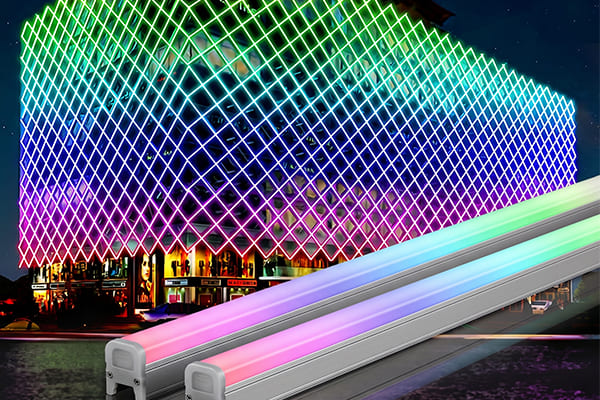
Struggling with complex lighting projects? Unreliable controls and poor effects can ruin your design. We have the solution to make your vision a reality and ensure your project shines.
Choose the right solution by focusing on four key pillars: protocol stability (DMX512/SPI), optical precision, power reliability (DC24V), and intelligent control software. This ensures your project looks amazing and lasts for years.
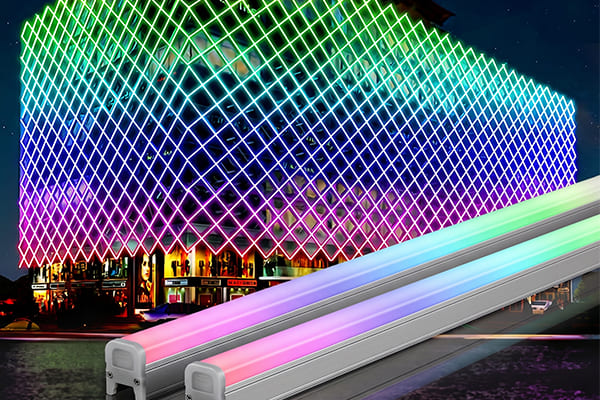
Getting these elements right is crucial for a successful project. In my years of experience, I've seen that a project's success is determined long before the first fixture is installed. It's decided in the planning phase. Let's break down each part to help you make the best choices for your specific needs. It all starts with the control protocol, the language your lights use to communicate.
Which Control Protocol is Best for Your Project, DMX512 or SPI?
Choosing the wrong protocol causes signal drops and flickering lights. This frustration can derail your project timeline and budget. Let's simplify the decision for you and get it right.
For large-scale outdoor projects, use DMX512 for its stability and long transmission distance. For high-density, dynamic indoor effects, SPI is better, but choose ICs with breakpoint resume to avoid maintenance headaches.
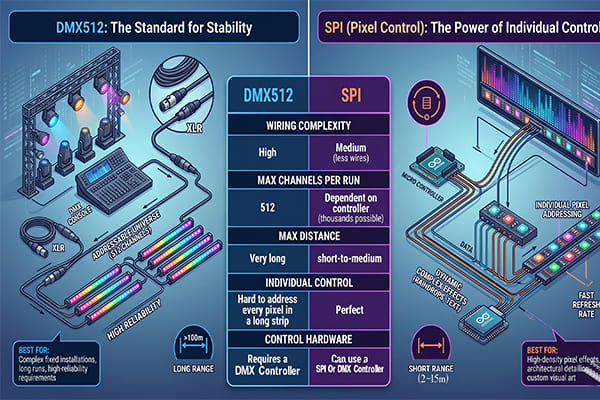
The protocol is the backbone of your control system. Selecting the wrong one is like building a skyscraper on a weak foundation. Let's dive deeper into the two main choices for professional LED linear light projects.
DMX512: The Outdoor Champion
DMX512 is the industry standard for most outdoor architectural lighting. It uses an RS-485 differential signal, which is extremely resistant to electrical interference.1 This makes it perfect for complex outdoor environments. You can run cables up to 300 meters2, and with signal amplifiers, the distance is virtually limitless. When we work on large building facades, DMX512 is almost always our first choice for its sheer reliability.
| Recommended DMX512 ICs | Key Feature | Best For |
|---|---|---|
| UCS512 | Online auto-addressing, signal continues even if one light fails (parallel). | The most common and reliable choice for outdoor linear lights. |
| SM17500 / SM17512 | High 16-bit grayscale for ultra-smooth dimming without flicker at low levels. | Projects demanding perfect dimming, like theaters or museums. |
SPI: The Master of Dynamic Effects
SPI protocol is designed for speed.3 It's great for creating fast-moving, high-resolution effects like dynamic water flows or complex video displays. However, traditional SPI has a major flaw: if one chip fails, the rest of the lights in the chain go dark4. For professional projects, this is a huge risk. That’s why we now exclusively use ICs with a breakpoint resume feature. These have a backup data line, so if one light fails, the signal just skips it and continues to the rest. But remember, SPI signals are sensitive and can only travel 2-5 meters between lights without an amplifier.5
A final, critical note on customization: Linear lights come in standard lengths, but projects often require custom sizes. You must confirm with the factory before cutting any lights yourself. This is especially true for DMX512 fixtures that use a master/slave IC design. Cutting them improperly will damage the internal circuitry. We always handle this during production to ensure it's done right.
How Can You Achieve the 'Light Without Seeing the Fixture' Effect?
Visible, bulky fixtures can spoil a building's clean lines. Glare and light spill create a cheap look. We know how to integrate light seamlessly into architecture for a premium finish.
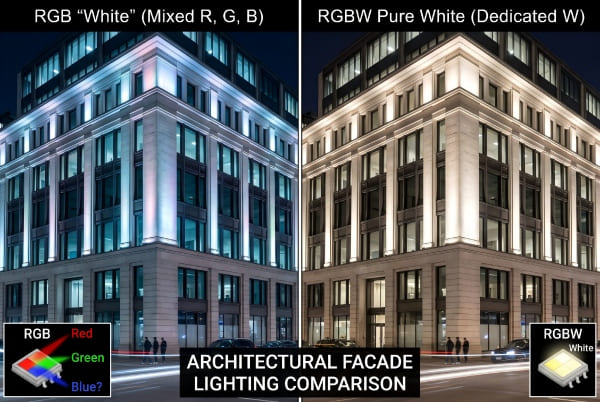
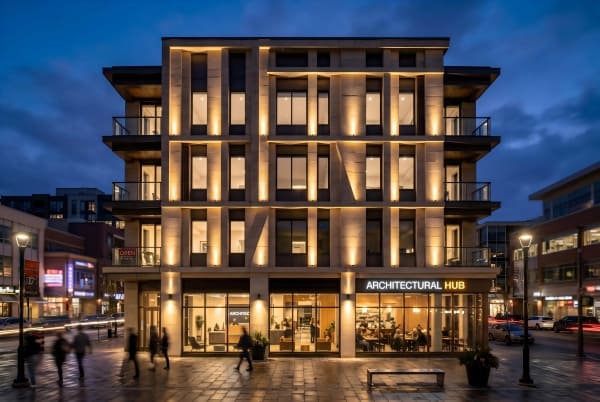
Use custom optics like narrow-angle lenses to control light precisely. Match the fixture housing color to the building facade. This 'invisible' approach creates a high-end, clean aesthetic without glare or light pollution.
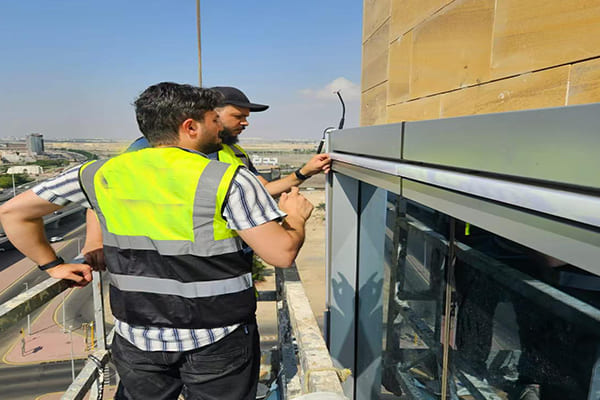
The most elegant lighting designs are often the ones you can't see. The goal is to see the beautiful effect of the light, not the hardware that creates it. This philosophy, "see the light, not the fixture," is what separates average projects from exceptional ones. We achieve this through three main techniques.
Precision Optical Customization
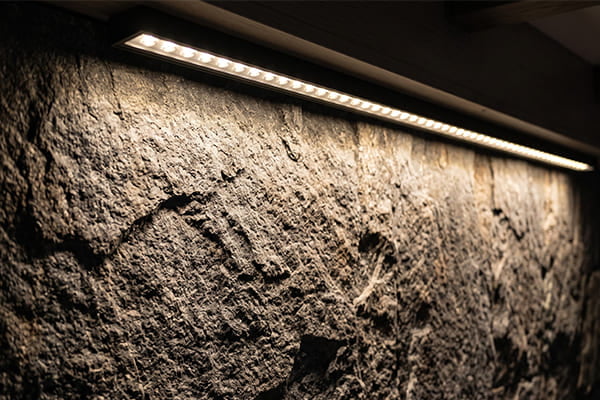
Optics shape the light. To hide the source, we need to control the beam with extreme precision. We often use custom 3° to 5° super-narrow angle PMMA lenses. These create a sharp, focused beam of light that travels far up a building facade without spilling onto neighboring windows. For other applications, an asymmetric 20°x45° lens can wash a surface evenly from an offset position. For softer effects, a PC acrylic cover diffuses the light, creating a gentle glow. The key is choosing the right optic to put light exactly where you want it and nowhere else.
Stealthy Fixture Integration
The fixture itself should blend in completely. We achieve this by producing custom aluminum housings for our linear lights. We design the profiles to fit perfectly within architectural seams, window reveals, or other structural gaps. Then, we take a sample of the building material and color-match the surface treatment of the aluminum. Whether it's a stone facade or a metal curtain wall, the fixture becomes virtually invisible during the day.
Asymmetrical Optics for Wall Washing
A common challenge is washing a tall wall evenly without creating a bright "hotspot" at the bottom and a dim area at the top. The solution is asymmetrical optics. We use special lenses that push more light toward the top of the wall. By combining these lenses with a concealed mounting position near the base of the wall, the entire surface is bathed in uniform light. Viewers experience a beautiful, glare-free effect without ever seeing the source.
What's the Secret to a Reliable Power and Wiring System?
Voltage drop dims your lights and inconsistent power causes failures. Poor wiring is a safety hazard and a maintenance nightmare. A solid power plan is not optional, it's fundamental.
Prioritize a DC24V or DC48V system to minimize voltage drop. Use a centralized power supply with a distributed control layout. Always use high-quality, UV-resistant outdoor cables and waterproof connectors for safety.
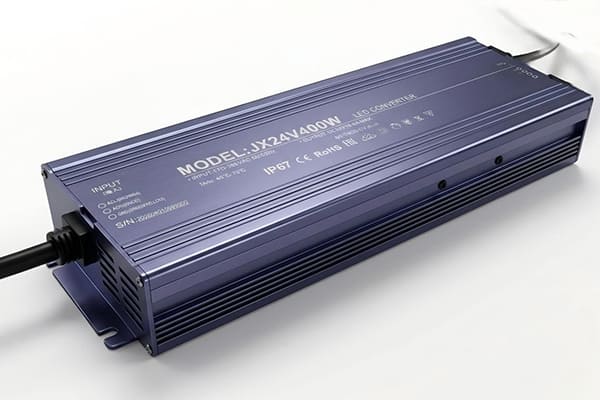
Power is the lifeblood of any lighting system. I've seen perfectly good projects fail because of a poorly planned power infrastructure. You can have the best fixtures in the world, but they are useless without clean, stable power. Let's review the best practices we follow on every project.
Choosing the Right Voltage
For any project with long cable runs, DC24V or DC48V is the standard. A higher voltage system allows power to travel further with less energy loss, a problem known as voltage drop.6 With a lower voltage like DC12V, lights at the end of a long chain can appear noticeably dimmer than those at the start7. Using a higher voltage system ensures uniform brightness across the entire installation. We also design our fixtures with back-entry cables, which helps further minimize line loss and creates a cleaner installation.
System Architecture
The most efficient and maintainable layout is a centralized power and distributed control model. This means we locate the main power supplies in an accessible, protected area, like an electrical room. From there, we run main power lines out to the lighting zones. The smaller DMX decoders or SPI controllers are then placed closer to the lights themselves. This topology simplifies maintenance, reduces the amount of high-voltage wiring needed outdoors, and makes troubleshooting much easier.
Cable and Connection Standards
This part is non-negotiable, especially for outdoor projects. First, you must calculate the correct wire gauge (cross-sectional area) for your main power lines to ensure voltage drop stays below 3%8. Under-speccing the cable is a common and costly mistake. Second, all outdoor cabling must be UV-resistant rubber cable. Standard PVC cables will degrade and crack under sun exposure9, leading to water ingress and failure. Finally, every single connection must be made with high-quality, IP67 or IP68 rated waterproof connectors10. This ensures the system remains sealed and safe for years to come.
How Do You Select the Right Software for Intelligent Lighting Control?
Your amazing hardware is useless with clumsy software. Programming complex effects is difficult, and daily operation shouldn't require an expert. Let's explore smart, user-friendly control platforms.
For dynamic media facades, use MADRIX for its powerful pixel mapping. For stable, everyday architectural lighting, use a system like RGBPLAYER that supports automated schedules. This ensures both spectacular effects and reliable operation.
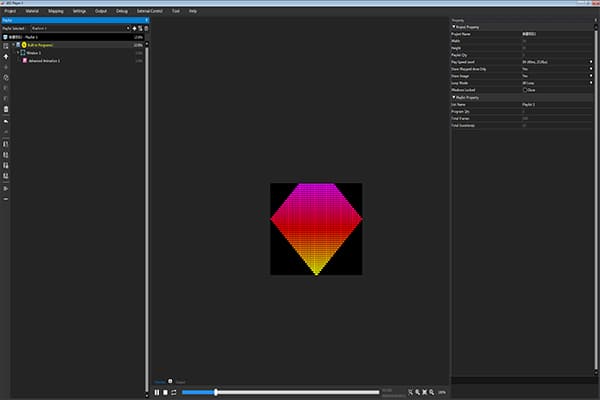
The control system is where your creative vision comes to life. A powerful yet intuitive system allows you to create stunning shows and also ensures the building looks great every single day with minimal effort. The choice of software depends entirely on the project's goal.
Software Platforms for Different Needs
There are two main categories of control software we use. For highly creative, media-driven projects, MADRIX is the gold standard. It’s a powerful tool that allows lighting designers to perform pixel mapping, which turns the entire building facade into a virtual video screen11. It’s perfect for creating complex animations and syncing lights to music.
For most architectural projects, however, the primary need is stability and automation. For this, we use robust architectural controllers like RGBPLAYER. These systems are designed for long-term, offline operation. We can program them with an astronomical clock to automatically turn on at sunset and off at sunrise. We can also create different scenes for weekdays, weekends, holidays, and seasons, and the system will switch between them automatically.
Building an Intelligent Control System
The best systems are built on a layered control architecture. This makes them both powerful and easy to manage. We typically design four main layers:
- Basic Layer: Simple, static white or single-color lighting for normal nights.
- Accent Layer: Highlights key architectural features.
- Media Layer: For dynamic shows and full-color effects.
- Festive Layer: Pre-programmed scenes for special holidays or events.
This structure allows the building owner to easily switch between modes. We can also integrate the system with sensors for interactive effects or with music for spectacular synchronized shows. This level of intelligent control is what transforms a static building into a dynamic landmark.
Conclusion
A successful project rests on four pillars: stable protocols, precise optics, reliable power, and intelligent software. Mastering these ensures a stunning and lasting lighting installation for your clients.
"RS-485 - Wikipedia", https://en.wikipedia.org/wiki/RS-485. Technical references on RS-485 describe it as a balanced differential signaling standard, a design that improves common-mode noise rejection in electrically noisy environments. Evidence role: mechanism; source type: encyclopedia. Supports: DMX512 uses an RS-485 differential signal that is resistant to electrical interference.. Scope note: This supports the signal-noise mechanism generally; actual immunity depends on cabling, grounding, termination, and installation quality. ↩
"DMX512 - Wikipedia", https://en.wikipedia.org/wiki/DMX512. DMX512 reference materials commonly describe cable runs on the order of hundreds of metres, with about 300 m often cited as a practical maximum for a single properly terminated DMX line. Evidence role: general_support; source type: encyclopedia. Supports: DMX512 cable runs can reach up to about 300 meters under appropriate installation conditions.. Scope note: The supported distance is contextual rather than universal; cable type, topology, termination, device loading, and electrical environment can reduce the practical limit. ↩
"Serial Peripheral Interface - Wikipedia", https://en.wikipedia.org/wiki/Serial_Peripheral_Interface. Descriptions of the Serial Peripheral Interface characterize SPI as a synchronous serial bus that supports relatively high data rates over short distances, which explains its use in rapid device-to-device data transfer. Evidence role: definition; source type: encyclopedia. Supports: SPI is a protocol suited to fast data transfer.. Scope note: This supports SPI’s general speed-oriented design; LED implementation performance varies by chipset, clock rate, wiring, and controller. ↩
"LED Strip", https://wp.nyu.edu/computer_music/led-strip/. Addressable LED strip and serial-bus explanations note that daisy-chained pixel systems pass data from one device to the next, so a failed device or broken data path can interrupt downstream pixels. Evidence role: mechanism; source type: education. Supports: In traditional daisy-chained SPI-style LED systems, a failed chip can interrupt downstream lights.. Scope note: This is a general daisy-chain failure mechanism; some LED ICs include bypass or breakpoint-continuation designs that reduce this failure mode. ↩
"SPI over 1.5m distance - EEVblog", https://www.eevblog.com/forum/projects/spi-over-1-5m-distance/. Technical discussions of SPI emphasize that it is intended for short-distance communication and that signal integrity degrades with wiring length, capacitance, and clock speed. Evidence role: general_support; source type: education. Supports: SPI-controlled LED signals are short-distance signals and may require amplification or buffering for longer runs.. Scope note: The 2–5 m figure is installation-specific and may not be stated as a universal standard; a source may support the short-distance limitation more generally rather than this exact range. ↩
"[PDF] Eliminate Excessive In-Plant Distribution System Voltage Drops", https://docs.nrel.gov/docs/fy13osti/56004.pdf. Electrical engineering references explain that, for a given power, increasing voltage reduces current, and lower current reduces resistive voltage drop and I²R losses in conductors. Evidence role: mechanism; source type: education. Supports: Higher-voltage low-voltage lighting systems can reduce voltage drop and conductor losses for the same power load.. Scope note: This supports the electrical principle; real LED system performance also depends on driver design, conductor size, run length, and load distribution. ↩
"Landscape Lighting Voltage Drop: Your Essential Fix for Dim ...", https://tru-scapes.com/landscape-lighting-voltage-drop-your-essential-fix/. Guidance on low-voltage lighting voltage drop explains that resistance in long conductors lowers voltage at the load, which can reduce light output or cause uneven brightness at the far end of a run. Evidence role: mechanism; source type: government. Supports: Voltage drop in long low-voltage lighting runs can make distant lights dimmer than lights near the power source.. Scope note: The visible effect depends on the LED driver topology and fixture tolerance; regulated fixtures may mask voltage variation until input limits are reached. ↩
"Maximum Allowable Voltage Drop", https://www.txdot.gov/manuals/trf/hwi/electrical_systems/calculating_voltage_drop-chdhdebc/maximum_allowable_voltage_drop-i1006115.html. Electrical installation guidance often cites a 3% branch-circuit voltage-drop recommendation as a design target to maintain efficient operation and acceptable equipment performance. Evidence role: expert_consensus; source type: government. Supports: Designers often target voltage drop below about 3% when sizing conductors for lighting circuits.. Scope note: The 3% threshold is commonly a recommendation rather than a universal legal requirement, and applicable limits vary by code jurisdiction and project specification. ↩
"Long-Term Effect of Ultraviolet Irradiation on Poly(vinyl chloride ...", https://pmc.ncbi.nlm.nih.gov/articles/PMC6650850/. Materials references on polyvinyl chloride note that ultraviolet exposure and weathering can degrade PVC unless it is properly stabilized or rated for outdoor use. Evidence role: mechanism; source type: research. Supports: Non-UV-rated PVC cable insulation can degrade under sunlight exposure.. Scope note: This supports the risk for non-UV-rated PVC generally; UV-resistant PVC formulations may perform differently outdoors. ↩
"IP code - Wikipedia", https://en.wikipedia.org/wiki/IP_code. Ingress Protection rating references define IP67 and IP68 as classifications for dust-tight enclosures with protection against temporary or continuous immersion in water under specified conditions. Evidence role: definition; source type: institution. Supports: IP67 and IP68 ratings indicate high levels of dust and water ingress protection for connectors.. Scope note: The rating indicates tested ingress resistance under defined conditions; it does not guarantee long-term waterproofing if connectors are poorly installed, damaged, or used outside their rated environment. ↩
"Media Façade Lighting: Pixel Mapping & Control Protocols", https://ditra-solutions.com/wiki/what-is-media-facade-lighting. Lighting-control references describe pixel mapping as assigning video or image data to arrays of individually addressable light pixels, allowing architectural surfaces to display video-like patterns. Evidence role: definition; source type: education. Supports: Pixel mapping can make an array of facade lights behave like a low-resolution video display.. Scope note: This supports the concept of pixel mapping in general; the visual result depends on pixel density, viewing distance, fixture placement, and media content. ↩