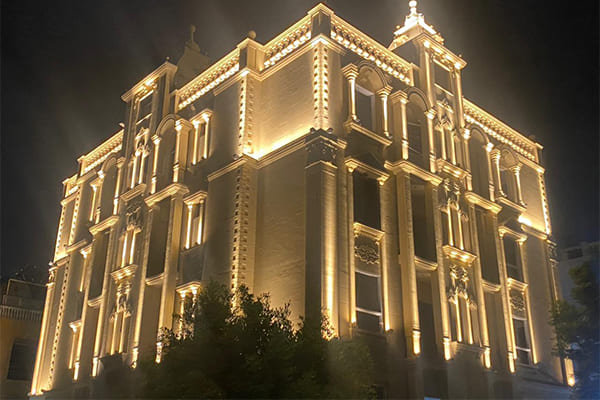
Choosing the right outdoor light feels complicated. Make the wrong choice, and your beautiful architectural project can look flat or poorly lit. This guide will make the decision simple.
A wall washer light creates a uniform, even "wash" of light on a flat surface1, like a curtain of light. A flood light projects a strong, concentrated beam to highlight a specific object or area2, creating a dramatic focal point. One provides a base, the other adds drama.
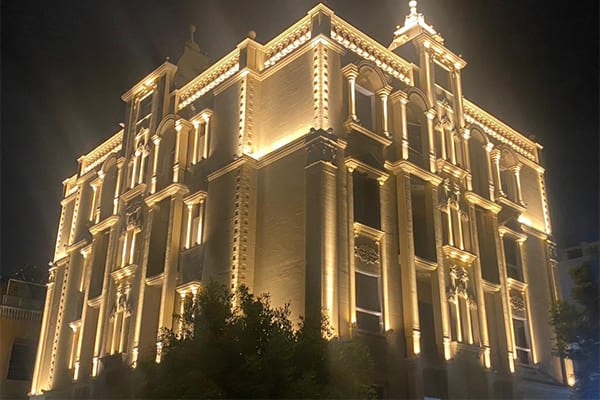
Deciding between them is a common challenge for our clients. As a lighting expert, I've guided countless projects, from huge skyscrapers to historic landmarks. The choice isn't just about the fixture; it's about the effect you want to create. One light paints with a broad brush, the other with a fine-point pen. Understanding the core purpose of each light is the first step. Let's dive deeper into how each one works and where it shines best, so you can make the right choice for your project every time.
What's the Core Mission of a Wall Washer Light?
You want a building's facade to glow, but all you see are ugly hot spots and distracting shadows. Using the wrong fixture ruins a clean look. A wall washer is your solution.
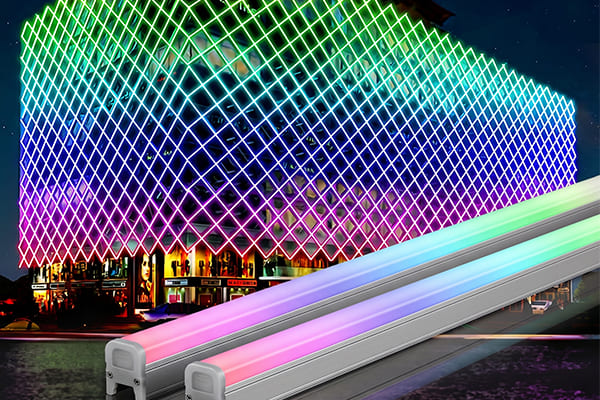
A wall washer's main job is to create a "seamless light curtain." It uses special optics to spread light evenly down a vertical surface3, turning the entire wall into a smooth, glowing canvas.
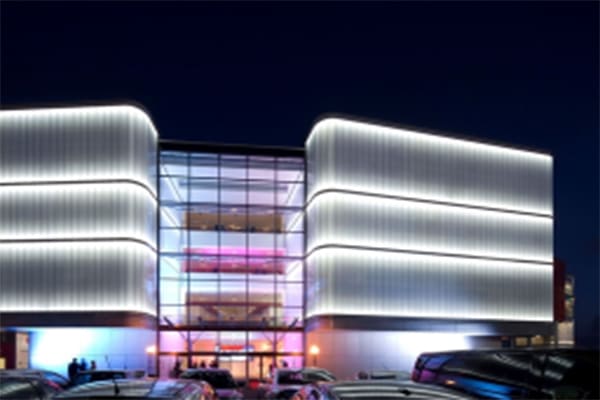
A wall washer is designed for one primary goal: to make a surface look perfectly and evenly lit. Think of it as painting a wall with light. We don't want to see brush strokes, just a flawless finish. The key to this is the specialized optics. Unlike a simple spotlight, a wall washer uses an asymmetric optical design4, something like a 10°×60° beam angle5. This shape pushes light downwards and sideways, not just straight out. This allows the fixture to be placed close to the wall and still "wash" the entire surface from top to bottom6. It's perfect for modern buildings with glass curtain walls or smooth plaster finishes where you want a clean, sophisticated glow. We often recommend this for high-end commercial buildings that need to look polished and premium at night. I remember a client with a new corporate headquarters. They wanted it to be a beacon of modernity. We used our JUXUANLED linear wall washers with RGBW color-changing capabilities. The result was stunning; the entire facade became a single, dynamic screen, free of any shadows or blotches.
| Feature | Description | Benefit |
|---|---|---|
| Optics | Asymmetric (e.g., 10°×60°) | Spreads light evenly down a vertical surface |
| Effect | Uniform "light curtain" | Eliminates shadows, creates a clean look |
| Installation | Precise spacing near the wall | Ensures seamless blending between fixtures |
| Best For | Flat facades, modern architecture | Creates a sophisticated, uniform glow |
When Should You Choose a Powerful Flood Light?
You need to highlight a specific statue or architectural column from far away. A weak or wide beam just won't reach it, or the light will look washed out and ineffective.
Choose a flood light when you need dramatic, high-contrast effects. It's a "regional lighting tool" that uses a strong, directional beam to highlight specific structures, textures, and shapes from a distance.
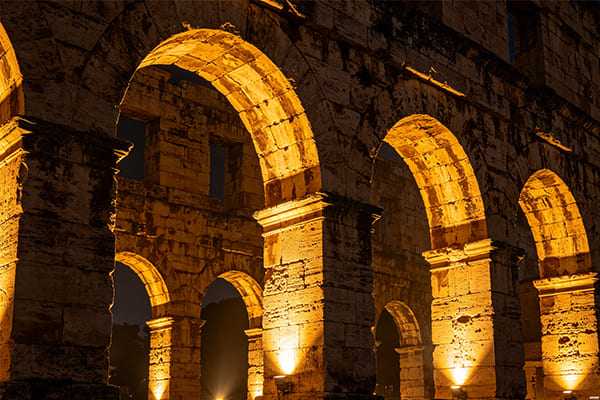
Where a wall washer provides a smooth surface of light, a flood light is all about creating a "visual focus." It's the tool you use when you want to say, "Look at this!" Flood lights use symmetric optics7, meaning the beam is conical, like from a flashlight. We offer these lights in a huge range of beam angles, from a very narrow 5° to a wide 120°8. A narrow beam is like a laser pointer; it can project a powerful punch of light over a very long distance to hit a small target9, like the top of a steeple or a flagpole. A wider beam can illuminate a whole statue or a group of trees. This flexibility makes it the perfect choice for buildings with complex shapes, deep textures, or historical details. Think of old stone buildings, ornate carvings, or the powerful structure of a bridge. A wall wash would flatten these features, but a flood light makes them pop with dramatic shadows and highlights10. I once worked on a project for a historic city bridge. We used our narrow-beam flood lights placed on the riverbank to precisely light up the underside of each stone arch. It created a breathtaking reflection on the water and instantly turned the bridge into a nighttime landmark.
| Feature | Description | Benefit |
|---|---|---|
| Optics | Symmetric (e.g., 5°-120°) | Directs a concentrated beam of light |
| Effect | High-contrast, dramatic | Emphasizes texture, shape, and 3D form |
| Installation | Flexible, long-distance | Can illuminate targets from far away or up close |
| Best For | Sculptures, columns, bridges | Creates a powerful focal point |
How Can You Combine Both for the Perfect Result?
Using only one type of light can make a project look boringly flat or visually chaotic. A one-dimensional lighting scheme simply fails to impress your clients or the public.
The best professional practice is to combine both11. Use wall washers to create a soft, uniform background. Then, use flood lights to punch out key architectural details and create focal points.
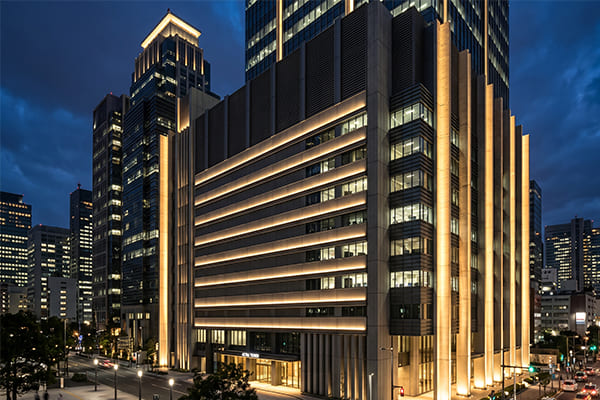
The truly great architectural lighting designs I've worked on almost always use a combination of lights. This is what we call a layered, "surface light + point light" system. The wall washer provides the canvas (the surface light), and the flood light provides the dynamic details (the point light). Imagine a large hotel facade. You could use our linear wall washers installed discreetly on each floor level to create glowing horizontal bands of light across the building. This provides a beautiful, uniform base. Then, you could use our compact flood lights mounted at the base of the building, aimed up the vertical columns. This highlights the structure's height and rhythm. The final effect is a building that has depth, texture, and visual interest. It looks sophisticated and thoughtfully designed. The key here is balance. The motto we use in our design team is: Wall washers do the 'face project' by covering the broad surfaces, while flood lights create the 'visual focus' by drawing the eye to what's important. This is where our expertise at JUXUANLED really helps our clients. With our free lighting effect design and programming services, we can create a simulation showing you exactly how this combination will look on your specific project, ensuring a perfect result.
| Strategy | Application | Outcome |
|---|---|---|
| "Surface + Point" | Use wall washers for the base facade and flood lights for columns, cornices, or logos. | A rich, layered lighting design with depth and focus. |
| Create Rhythm | Alternate washed surfaces with highlighted structural elements. | Guides the eye across the building in a dynamic way. |
| Enhance 3D Form | Light large surfaces gently while using strong light to carve out key shapes. | The building's form is more visible and dramatic at night12. |
Conclusion
Wall washers create even surfaces, and flood lights make dramatic points. Understanding this difference and using them together is the key to creating stunning architectural lighting for any project.
"Wallwasher - Wikipedia", https://en.wikipedia.org/wiki/Wallwasher. Lighting design references define wall washing as illumination intended to produce an even distribution of light over a vertical surface. Evidence role: definition; source type: institution. Supports: A wall washer light creates a uniform, even wash of light on a flat surface.. ↩
"Floodlight - Wikipedia", https://en.wikipedia.org/wiki/Floodlight. Lighting engineering sources describe floodlights as luminaires that project controlled beams over an area or toward a target, supporting their use for object and area illumination. Evidence role: definition; source type: institution. Supports: A flood light projects a strong beam to highlight a specific object or area.. Scope note: Some floodlights are designed for broad-area illumination rather than narrowly concentrated beams, so the source should be used to support the general function rather than every beam type. ↩
"Vertical lighting: wallwashing for more orientation and ...", https://www.erco.com/en_us/designing-with-light/lighting-knowledge/lighting-design/wallwashing-7483/. Lighting design literature explains that wall-washing luminaires use optical control and placement geometry to distribute light across vertical planes with improved uniformity. Evidence role: mechanism; source type: institution. Supports: Wall washers use specialized optics to spread light evenly down a vertical surface.. Scope note: The source may describe the principle generally and may not validate the performance of any particular fixture model. ↩
"Wall washer - Asymmetric | BEGA", https://www.bega-us.com/categories/exterior/ceiling/120007. Technical lighting references describe asymmetric light distributions as directing light preferentially in one direction, which is commonly used where luminaires must illuminate vertical or offset surfaces from nearby mounting positions. Evidence role: mechanism; source type: education. Supports: An asymmetric optical design helps wall washers direct light down and across a wall rather than straight outward.. Scope note: This supports the optical principle; actual uniformity depends on fixture photometry, mounting distance, aiming, and spacing. ↩
"[PDF] MiT8 - LINEAR T8 FLUORESCENT - Penn State Engineering", https://www.engr.psu.edu/ae/thesis/portfolios/2014/jer5224/LuminaireSchedule.pdf. Luminaire photometric documentation commonly reports beam spread in two orthogonal planes, allowing asymmetric distributions such as narrow-by-wide beam angles to be specified. Evidence role: definition; source type: institution. Supports: A beam angle such as 10°×60° is an example of an asymmetric luminaire beam specification.. Scope note: The citation would support how beam angles are specified, not that 10°×60° is the optimal distribution for all wall-washing applications. ↩
"The Geometry of Uniformity: Master the Wall Wash It's ... - Instagram", https://www.instagram.com/p/DWmF2CLmSvp/. Wall-washing design guidance notes that luminaire distribution, setback distance, spacing, and aiming determine vertical illuminance uniformity on a wall. Evidence role: mechanism; source type: institution. Supports: Optical distribution and placement allow wall-washing fixtures to illuminate a vertical surface with relative uniformity.. Scope note: The source should be read as design guidance; it does not guarantee full top-to-bottom coverage without project-specific photometric calculations. ↩
"Symmetrical vs Asymmetrical Light: Key Distribution Types", https://tridentprolighting.com/asymmetric-vs-symmetrical-lighting/. Photometric references distinguish symmetric light distributions, which spread light similarly around an axis, from asymmetric distributions that direct light preferentially. Evidence role: definition; source type: education. Supports: Flood lights often use symmetric optics that produce a generally conical beam pattern.. Scope note: The source should support the optical classification, not the suitability of every floodlight for every application. ↩
"LED Flood Lights for Commercial & Industrial Application", https://www.ledlightingsupply.com/led-outdoor-lights/led-flood-lights. Lighting photometry resources classify luminaires by beam spread and show that beam angles can range from narrow spot distributions to wide flood distributions. Evidence role: definition; source type: institution. Supports: Flood-type luminaires are available in narrow to wide beam spreads for different aiming and coverage needs.. Scope note: The exact 5° to 120° range is product-dependent; neutral sources can support the broader concept of narrow-to-wide beam spread rather than this full commercial range. ↩
"Inverse-square law - Wikipedia", https://en.wikipedia.org/wiki/Inverse-square_law. Illumination engineering sources describe how beam angle and luminous intensity affect illuminance at distance, supporting the use of narrow beams for distant or small targets. Evidence role: mechanism; source type: education. Supports: A narrow-beam floodlight can deliver higher intensity to a smaller distant target than a wide beam of comparable output.. Scope note: The achievable distance depends on fixture output, atmospheric conditions, aiming accuracy, and target reflectance. ↩
"How Direction of Illumination Affects Visually Perceived Surface ...", https://pmc.ncbi.nlm.nih.gov/articles/PMC2761220/. Architectural lighting guidance notes that directional light creates shadow and contrast that can reveal surface texture and three-dimensional form, while diffuse or uniform illumination reduces visible modeling. Evidence role: mechanism; source type: institution. Supports: Directional floodlighting can emphasize architectural texture and form more strongly than uniform wall washing.. Scope note: The visual outcome also depends on material reflectance, viewing angle, light position, and ambient light levels. ↩
"Lighting Design: Techniques to Transform Interior Spaces", https://marymount.edu/blog/lighting-design-techniques-to-transform-interior-spaces/. Architectural lighting design references describe layered lighting as the coordinated use of ambient, accent, and focal lighting to support visibility, hierarchy, and visual interest. Evidence role: expert_consensus; source type: institution. Supports: Combining broad surface lighting with accent or focal lighting is a recognized professional lighting design strategy.. Scope note: This supports layered lighting as a recognized design approach, not an absolute rule that every exterior project must combine wall washers and floodlights. ↩
"[PDF] Patterns of Connection in Architecture: The Paradox of Light and ...", https://scholarspace.manoa.hawaii.edu/server/api/core/bitstreams/45b6861e-71a3-48dd-a894-e3e2de540758/content. Research and design guidance on façade and exterior lighting indicate that luminance contrast, directionality, and accent lighting influence nighttime perception of architectural form. Evidence role: general_support; source type: research. Supports: Combining gentle surface illumination with stronger accent lighting can make architectural form more legible and visually dramatic at night.. Scope note: The source can support the general visual principle; perceived drama is partly subjective and project-specific. ↩