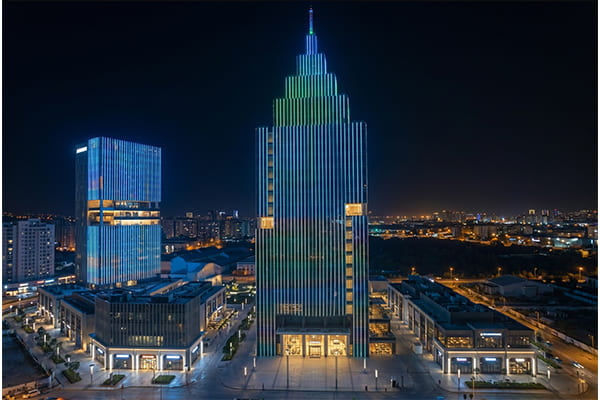
Choosing the right facade lighting is a major decision. The wrong choice wastes your budget and can undermine your entire architectural vision1. It's a confusing landscape of technical terms.
For facade lighting, Single Color is best for static elegance and budget projects2. RGB is for creating dynamic color shows without needing white light. RGBW is the professional choice, offering both pure white light for daily use and full color-changing capabilities for special occasions.
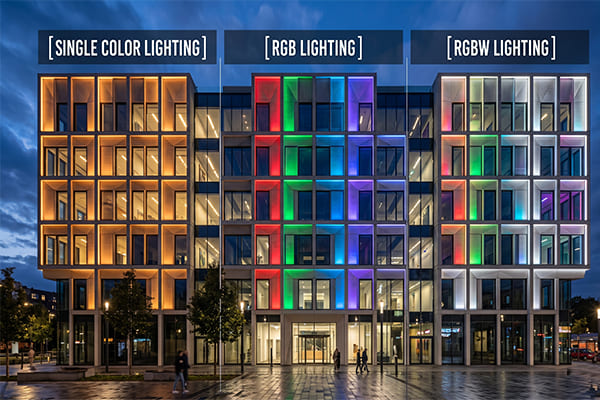
Now that you have the quick answer, it's clear that each lighting type serves a very different purpose. Making the right choice means investing your money wisely and achieving the perfect look for your building, both day and night. To do that, you need to understand the specific strengths and weaknesses of each option. Let's break them down one by one so you can choose with confidence.
What's the best use for Single Color facade lighting?
You need high-quality, reliable lighting for your building, but you're working with a tight budget. You worry that a lower-cost option will look cheap or require constant maintenance.
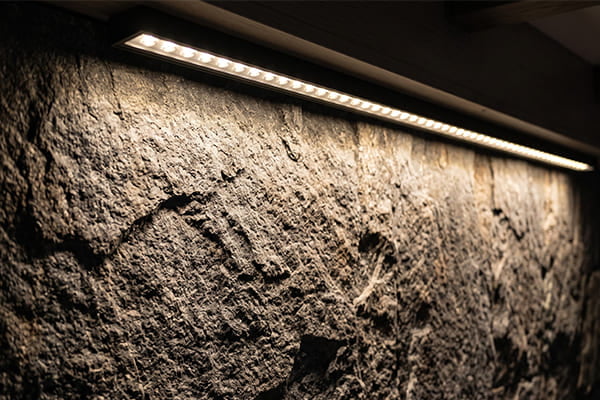
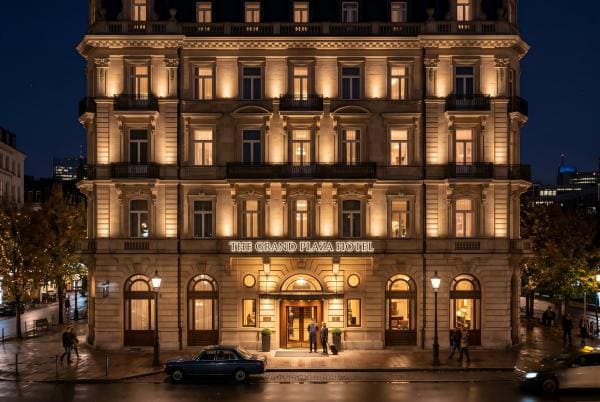
Single Color lighting is perfect for projects that need to highlight architectural beauty with elegance and simplicity. It's the top choice for historic buildings, government offices, and high-end residences where a timeless, sophisticated look is key. It delivers the most light for the least energy3.
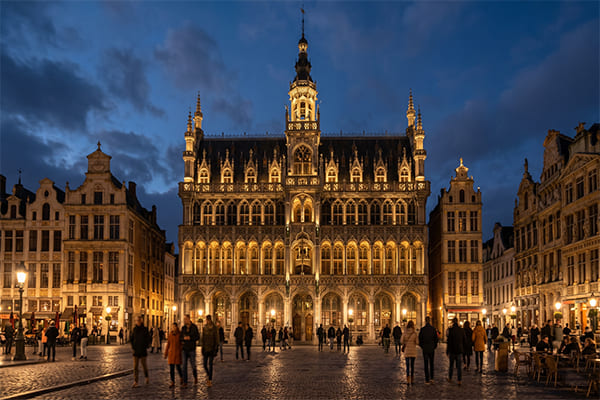
As a lighting expert, I often recommend Single Color fixtures when the goal is to celebrate the building itself. This option is not about creating a light show; it's about using light to reveal texture, form, and material quality.
Why Simplicity Is Its Greatest Strength
The main advantage of Single Color lighting is its efficiency and reliability. Because the fixture only has one job—to produce light of a single, optimized color—it does it exceptionally well. These fixtures produce the most lumens (light output) per watt4, leading to lower energy bills. They also have the best Color Rendering Index (CRI)5, meaning they show the true colors of the building's materials, whether it's warm brick, cool stone, or sleek metal paneling. I remember a project for a heritage hotel where the client wanted to highlight the intricate stonework. We used 3000K single-color wall washers, and the result was pure, timeless elegance. The client was also thrilled with the significantly lower running costs compared to more complex systems. Maintenance is also simpler, as there are fewer electronic components that can fail6.
| Feature | Single Color Lighting |
|---|---|
| Best For | Emphasizing architecture, texture, and form |
| Ideal Projects | Historic buildings, government offices, residences |
| Key Advantage | Highest efficiency (lumens/watt), lowest cost |
| Key Disadvantage | No color changing, limited creative expression |
| My Pro Tip | Use 3000K for a warm, premium feel. Use 4000K for a modern, neutral white. |
When should you choose RGB for your building?
You want to turn your building into a landmark that can't be missed. A simple, static lighting scheme just won't cut it in a busy commercial district or entertainment zone.
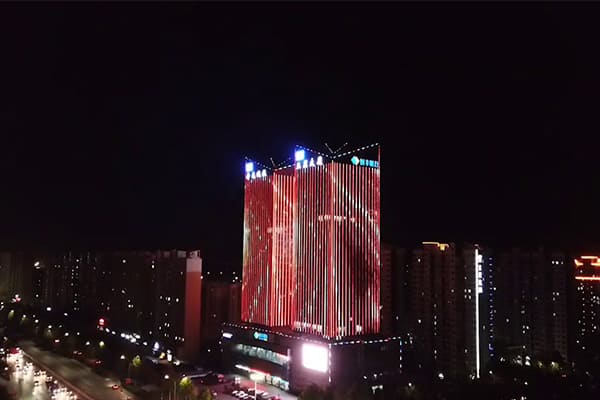
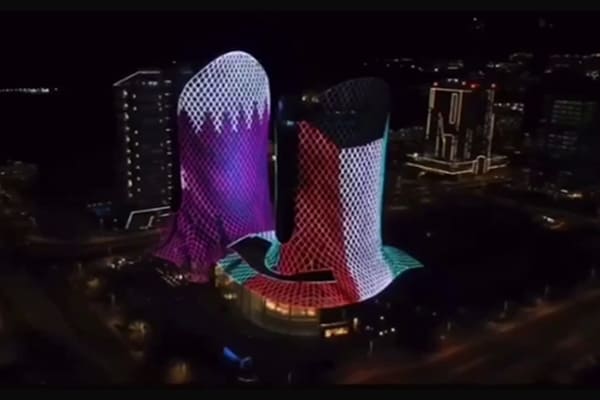
Choose RGB lighting when your primary goal is to create a vibrant, dynamic, and eye-catching spectacle. It's made for commercial plazas, entertainment venues, bridges, and temporary light shows where grabbing attention with millions of colors and animated effects is everything.
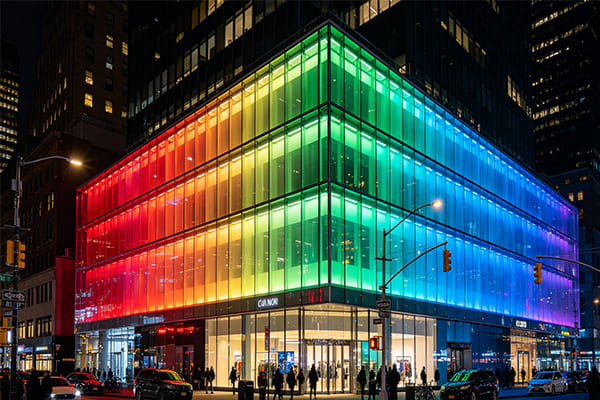
RGB is the tool for pure visual impact. It uses three primary colored LEDs—Red, Green, and Blue—to mix and create a spectrum of over 16 million colors7. Paired with a DMX512 control system8, you can program anything from slow, gentle color fades to fast-paced, strobing light shows that sync with music.
The Challenge of "White" Light
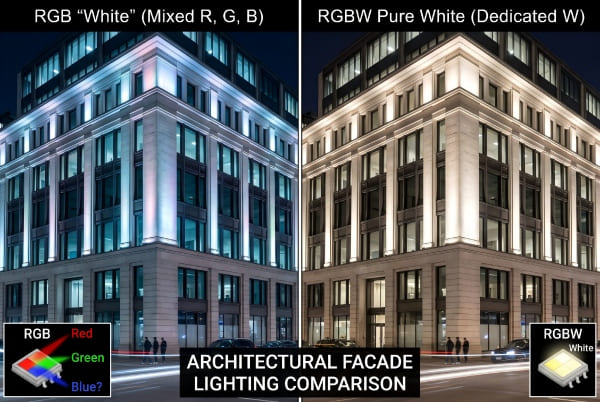
However, RGB has a critical weakness: it cannot produce pure white light9. When you mix red, green, and blue light to create "white," the result is often a tinted, unconvincing shade that can look bluish, purplish, or grayish. This mixed white has a very low CRI10, which can make a building's facade look unnatural and dull. I always explain it to clients this way: it's like mixing primary paint colors. You can get a muddy grey, but you can't create a pure, crisp white. For this reason, RGB is not suitable for projects that require high-quality functional white lighting for everyday use. We once used RGB for a new shopping mall's grand opening. They needed a massive, week-long light show to generate buzz. It was all about spectacle, and RGB was the perfect, cost-effective choice for that specific, temporary goal.
| Feature | RGB Lighting |
|---|---|
| Best For | Creating visual excitement and dynamic color shows |
| Ideal Projects | Malls, entertainment venues, ad campaigns |
| Key Advantage | Huge color palette, supports DMX512 animation |
| Key Disadvantage | Cannot produce pure, high-quality white light |
| My Pro Tip | Use RGB when you only need color effects and never need functional white lighting. |
Why is RGBW the professional choice for landmark projects?
Your flagship project needs to look stunning every single night with high-quality white light. But you also want the flexibility to celebrate holidays and special events with vibrant color.
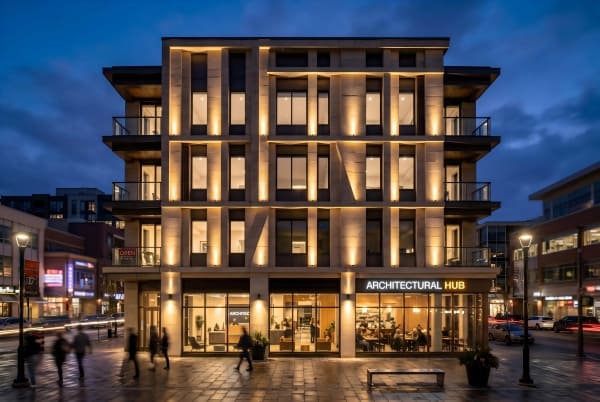
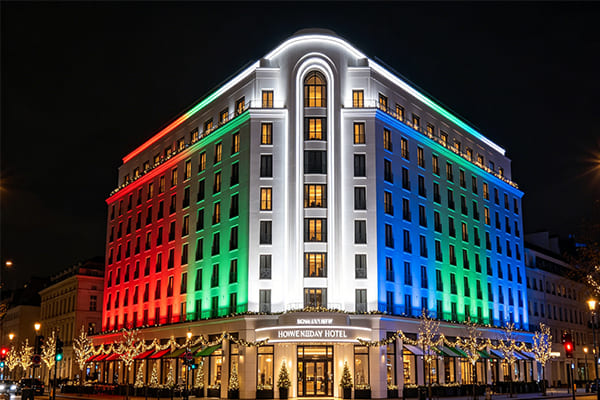
RGBW lighting is the professional, all-in-one solution. It eliminates the compromise between functional white light and dynamic color by adding a dedicated White LED chip to the standard RGB setup11. It is the undisputed king for landmark buildings, five-star hotels, and premium commercial facades.
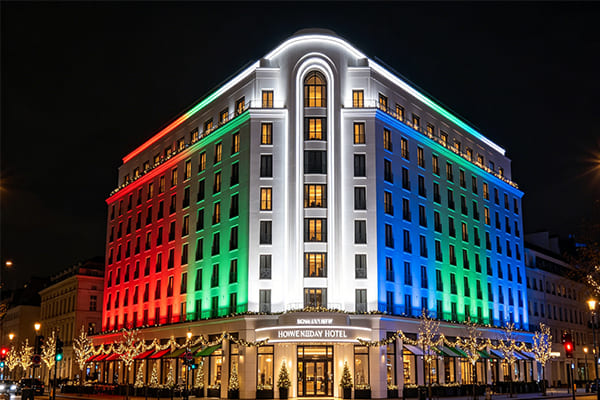
The "W" in RGBW changes everything. This dedicated white chip provides pure, high-quality, and efficient white light that you can use for sophisticated everyday illumination. Then, for holidays, festivals, or special events, you have the full RGB color-mixing capability at your fingertips. You get two lighting systems in one fixture. This is why the market trend for high-end projects is shifting decisively toward RGBW12. While the initial investment is higher, the long-term value and capability are unmatched.
The Best of Both Worlds
I always tell my clients that choosing RGBW is an investment in ultimate flexibility. A common project we handle is for a new city landmark tower. The owners want a crisp, 4000K neutral white to highlight the modern architecture on most nights. But on New Year's Eve, they want a spectacular, colorful countdown. RGBW is the only technology that can deliver both functions perfectly. Before ordering, we confirm the exact color temperature of the "W" chip—3000K for warm, 4000K for neutral, or 6000K for cool white—to match the project's daily needs. For tall buildings over 30 meters, we pair these fixtures with narrow 5°-15° beam angle lenses to ensure the light is powerful enough to reach the top. The control system is more complex, but that’s where a partner like us comes in to handle the programming and commissioning to bring your vision to life.
| Aspect | RGB (Red, Green, Blue) | RGBW (Red, Green, Blue, White) |
|---|---|---|
| White Light | Mixed, often bluish/purplish, low quality | Pure, high-quality from a dedicated white LED |
| Functionality | Decorative color effects only | Dual-purpose: functional white + decorative color |
| Best For | Short-term shows, entertainment venues | Landmark projects, hotels, high-end commercial |
| Cost | Moderate | Highest |
| Verdict | A compromise | The complete, professional solution |
Conclusion
Choosing between Single Color, RGB, and RGBW lighting depends entirely on your project's function, budget, and long-term goals. Evaluate your need for daily lighting versus dynamic effects to make the smartest choice.
"(PDF) TEXTUAL PERCEPTION OF THE ARCHITECTURAL FAÇADE", https://www.academia.edu/3398771/TEXTUAL_PERCEPTION_OF_THE_ARCHITECTURAL_FA%C3%87ADE. Architectural-lighting guidance from a professional or educational source supports the view that exterior lighting affects perception of form, material, and nighttime architectural identity; this is contextual support rather than proof of outcomes for every project. Evidence role: general_support; source type: education. Supports: The wrong facade lighting choice can undermine the architectural vision of a building.. Scope note: The source will likely support the design principle broadly, not quantify how often poor lighting undermines architectural intent. ↩
"The Illuminated Skyscraper - Brown University", https://webhelper.brown.edu/joukowsky/courses/13things/7514.html. A neutral lighting-design reference can support that monochromatic or fixed-white facade lighting is commonly used for static architectural emphasis and is simpler than color-changing systems; the source may not rank it as universally “best.” Evidence role: expert_consensus; source type: institution. Supports: Single Color facade lighting is suited to static, elegant, budget-conscious projects.. Scope note: The word “best” is comparative and project-dependent, so evidence should be framed as common suitability rather than an absolute rule. ↩
"LED Basics", https://www.energy.gov/cmei/ssl/led-basics. Technical LED references indicate that white or single-channel LED luminaires are generally optimized for luminous efficacy compared with multi-channel color-mixing systems; the comparison depends on fixture design, drive current, optics, and LED generation. Evidence role: mechanism; source type: research. Supports: Single Color facade lighting can deliver higher light output per watt than more complex color-changing systems.. Scope note: This supports the typical technical rationale, not a universal guarantee that every single-color fixture has the highest efficacy. ↩
"LED Lighting | Department of Energy", https://www.energy.gov/energysaver/led-lighting. Government or laboratory LED documentation can support that luminaire efficacy is measured in lumens per watt and that optimized white LED systems can achieve high efficacy; it does not by itself prove superiority for every facade product. Evidence role: definition; source type: government. Supports: Lumens per watt is the relevant measure for comparing lighting energy efficiency.. Scope note: The source can define and contextualize efficacy, while product-specific comparisons require manufacturer photometric data. ↩
"Color rendering index", https://en.wikipedia.org/wiki/Color_rendering_index. Lighting standards and educational references define CRI as a measure of how accurately a light source renders object colors compared with a reference illuminant; whether single-color fixtures have the “best” CRI depends on the spectral design of the specific LED source. Evidence role: definition; source type: institution. Supports: CRI is relevant to how accurately facade materials appear under lighting.. Scope note: The source can define CRI and its relevance, but it may not prove all single-color facade fixtures outperform all RGBW fixtures. ↩
"Effects of System Complexity on Reliability", https://psych.hanover.edu/classes/hfnotes/tsld032.html. Reliability engineering literature supports that systems with fewer components and interconnections can have fewer potential failure points, assuming comparable component quality and operating conditions. Evidence role: mechanism; source type: paper. Supports: Simpler single-color lighting systems may be easier to maintain because they contain fewer failure-prone components.. Scope note: This supports the reliability principle generally, not a measured maintenance advantage for the specific facade fixtures discussed. ↩
"RGB color model - Wikipedia", https://en.wikipedia.org/wiki/RGB_color_model. Digital color references explain that 24-bit RGB color represents 256 intensity levels for each red, green, and blue channel, yielding 16,777,216 possible combinations; actual perceived colors from LED fixtures may be limited by calibration, optics, and control resolution. Evidence role: mechanism; source type: encyclopedia. Supports: RGB systems are commonly described as capable of producing over 16 million color combinations under 24-bit control.. Scope note: The mathematical RGB value count does not guarantee that a physical luminaire will render all colors distinctly or accurately. ↩
"DMX512 - Wikipedia", https://en.wikipedia.org/wiki/DMX512. Standards documentation identifies DMX512 as a digital communication protocol widely used to control stage and entertainment lighting equipment; application to facade lighting is an extension of the same control principle. Evidence role: definition; source type: institution. Supports: DMX512 is a lighting-control protocol used to program dynamic lighting effects.. Scope note: The source supports what DMX512 is and its lighting-control role, not the quality of any specific installation or animation. ↩
"Understanding LED Color-Tunable Products | Department of Energy", https://www.energy.gov/cmei/ssl/understanding-led-color-tunable-products. Color-science and LED-lighting sources explain that RGB systems create white by additive mixing of red, green, and blue primaries, while the resulting spectrum differs from broad-spectrum or phosphor-converted white light; the acceptability of the white depends on calibration and application requirements. Evidence role: mechanism; source type: research. Supports: RGB fixtures do not produce white light in the same way as a dedicated white LED source.. Scope note: RGB can produce a chromaticity perceived as white, so the evidence should distinguish perceived mixed white from high-quality broad-spectrum white light. ↩
"Color rendering index - Wikipedia", https://en.wikipedia.org/wiki/Color_rendering_index. Lighting research on RGB white light reports that three-primary LED mixtures can have limited spectral coverage and lower color-rendering performance than white-light sources optimized for color rendition; results vary with LED wavelengths and control algorithms. Evidence role: mechanism; source type: paper. Supports: RGB-mixed white light can have poor color-rendering performance compared with dedicated white light sources.. Scope note: The degree of CRI reduction is fixture-specific and cannot be assumed for every RGB system without photometric data. ↩
"RGB vs RGBIC vs RGBW vs RGBWW vs RGBCW vs RGBCCT", https://www.superlightingled.com/blog/rgb-vs-rgbic-vs-rgbw-vs-rgbww-vs-rgbcw-vs-rgbcct/. Technical descriptions of RGBW LED systems define RGBW as red, green, blue, and white emitters in one luminaire or package, with the white channel used to provide white light separately from RGB color mixing. Evidence role: definition; source type: education. Supports: RGBW lighting adds a separate white LED channel to standard RGB color channels.. Scope note: This defines the RGBW architecture; performance still depends on the white LED type, driver design, optics, and calibration. ↩
"Architectural Lighting Market Report, Industry Size & Revenue ...", https://www.strategicmarketresearch.com/market-report/architectural-lighting-market. A market-analysis or industry standards source may document increased adoption of multi-channel LED systems such as RGBW for architectural lighting; unless it specifically studies high-end facade projects, it should be treated as contextual market evidence rather than direct proof of a decisive shift. Evidence role: statistic; source type: research. Supports: High-end architectural lighting projects are increasingly adopting RGBW or multi-channel LED systems.. Scope note: Neutral data on this exact niche may be limited, and many market reports may be commercial rather than scholarly. ↩