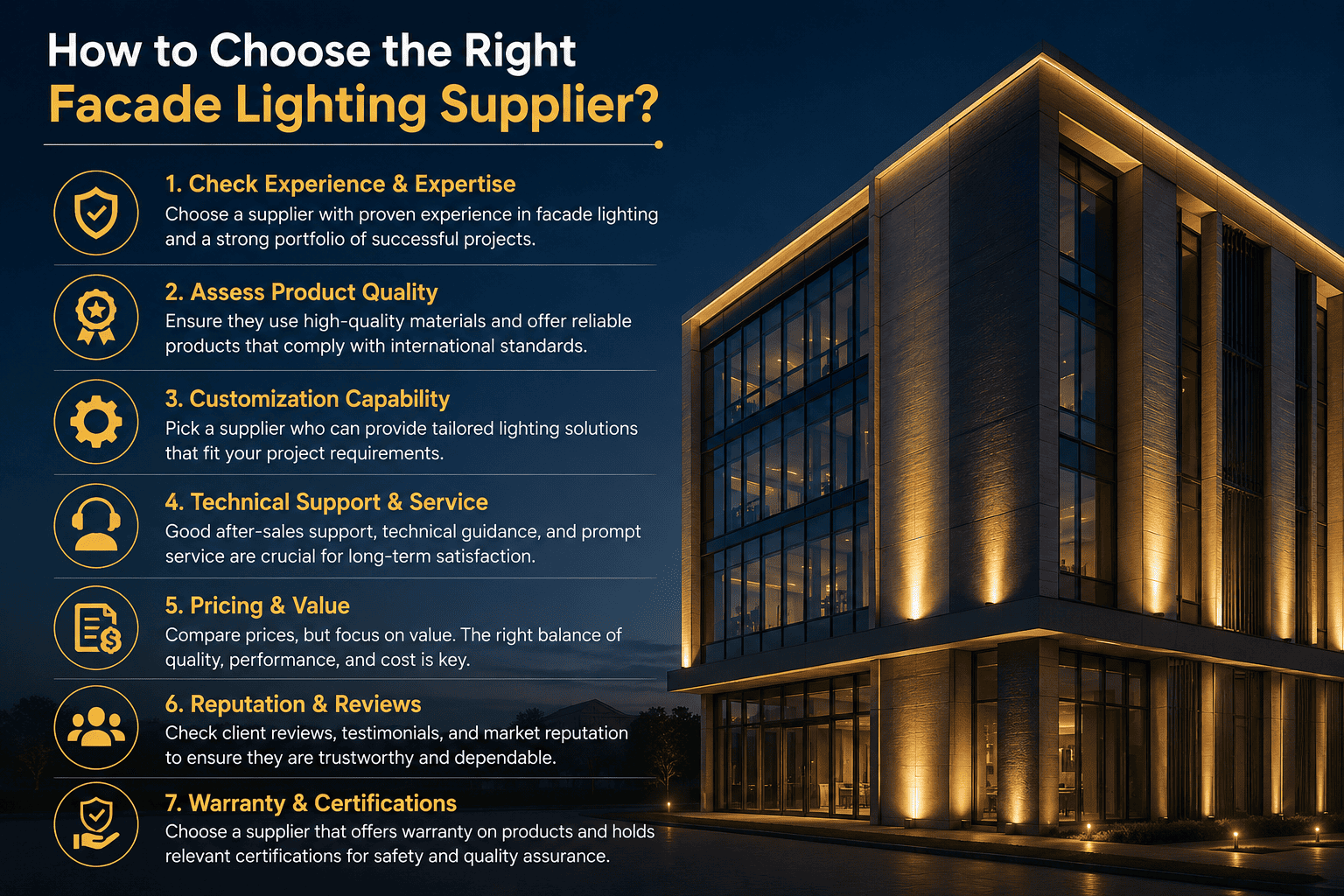
Choosing a facade lighting supplier feels overwhelming and risky. A bad choice can lead to project failure, damaging your reputation and budget1. Don't let your architectural vision be ruined by poor quality.
To choose the right facade lighting supplier, you must select an expert partner, not just a product seller. Look for proven engineering experience, a complete product line with system integration, strong technical support, and verifiable case studies relevant to your project's specific needs.
This decision is one of the most critical you'll make for your project2. It's not just about buying lights; it's about forming a partnership that ensures success from the design phase to long after the installation is complete. Let me tell you a story about a client from Uzbekistan that taught me exactly what a true partnership looks like. It showed me what experienced contractors are really looking for, and it has nothing to do with the lowest price.
What Really Matters More Than the Price Tag?
Worried about your budget? It is easy to focus on the lowest price. But cheap lights often lead to expensive problems3, damaging your reputation and timeline. What if you could secure a successful project instead?
A supplier's expertise and partnership value far outweigh the initial cost4. Look for deep product knowledge, engineering support, and a history of successful, long-lasting projects. This ensures your project's quality and your peace of mind.

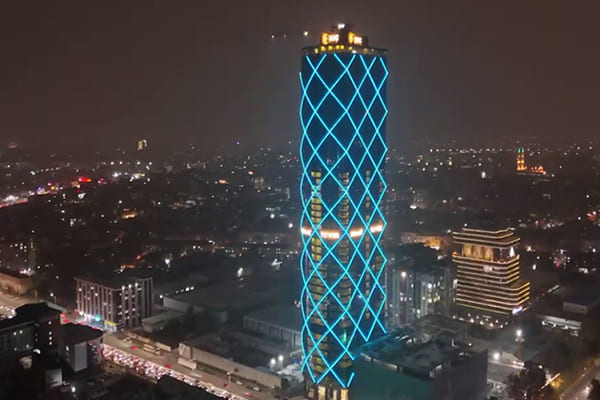
I remember a client from Uzbekistan who contacted us on Alibaba. We spent weeks working on the design, making several revisions until he was completely satisfied. When he flew to China, he came to our office on the first day. He asked so many questions and tested our samples thoroughly. I showed him a major airport project we completed in his country. I explained why we chose a specific linear light for that climate and showed him videos of our team providing remote commissioning support. He was impressed with our professionalism. But he kept saying, "I need to see the factory." I knew then that this was about more than just lights. It was about trust. For him, the key was not the price on the quotation but the value and reliability behind it. He later told me, "I chose you because you have rich experience. You understand the products and the technology."
| Focus Area | Price-Focused Choice | Partner-Focused Choice |
|---|---|---|
| Priority | Lowest initial cost | Long-term project success and reliability |
| Product | Standard, off-the-shelf items | Customized solutions, high-quality components |
| Support | Limited to sales and shipping | Full-cycle support (design, programming, commissioning) |
| Outcome | High risk of failure, costly repairs | A stunning, durable installation and a strong reputation |
How Can You Verify a Supplier is a Real Manufacturer?
You found a supplier online with a great website, but are they genuine? Many are just trading companies with no control over quality. Don't get stuck with subpar products and zero support.
Insist on a factory visit, either in person or via a live, unedited video call. Ask to see the production lines, quality control stations, and aging test rooms5. A real manufacturer will welcome this transparency; a trader will make excuses.
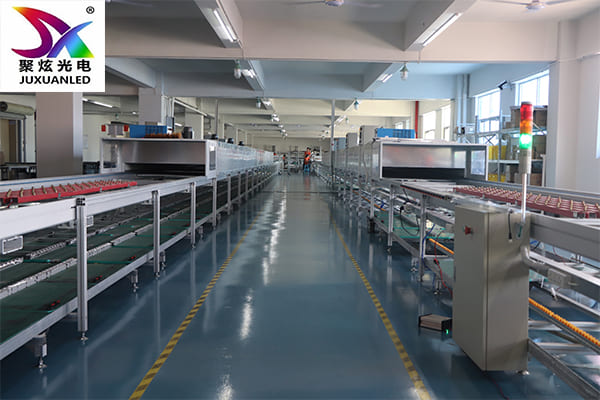
The story with my Uzbek client took a strange turn. After our first meeting, he was supposed to visit our factory the next day, but he disappeared. We couldn't reach him for four days. I was worried. On the sixth day, he called. He told me he had been visiting other factories in Shenzhen and Zhongshan. He came back to our office, and we finalized the product choice. But even after that, he looked at me and said, "I still need to see your factory. Right now." I drove him straight to our factory in Zhongshan. He didn't want any tea or small talk. He walked directly onto the production floor. He inspected everything himself, from the assembly line to our testing rooms. Afterwards, in the reception area, he studied our "culture wall," which was covered in photos of our team at projects and exhibitions over the years. He saw my face in many of them. He finally sat down, smiled, and said, "Okay. I can confirm the order now. I trust you."
What to Check During a Factory Tour
- Production Lines: Look for organized assembly stations, SMT machines for PCBs, and potting/gluing processes for waterproofing.
- Quality Control: Ask to see their QC stations for incoming materials, in-process checks, and final product inspection.
- Testing Facilities: A serious factory must have an aging test room, waterproof test tanks6, and an integrating sphere to verify light parameters7.
What Kind of Technical Support Should You Expect for a Complex Project?
Your design is complex, with custom effects and long cable runs. Are you worried your supplier will just ship boxes and leave you to figure it out? This can lead to installation chaos and failure.
A professional supplier provides end-to-end technical support. This includes effect design, customized programming, detailed wiring diagrams, and remote or on-site commissioning. They are your partner from concept to completion.
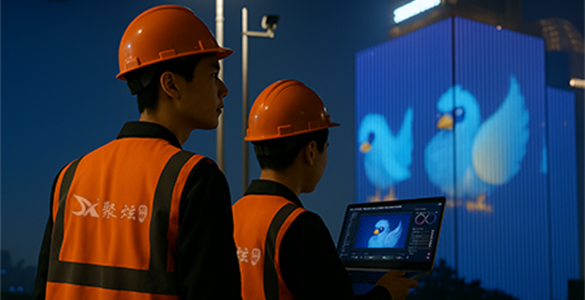
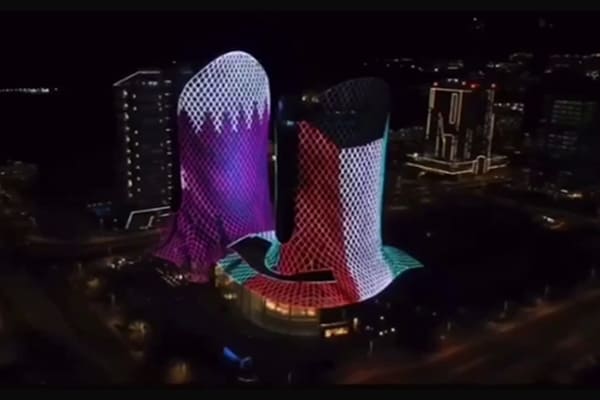
With my Uzbek client, we were deciding between two types of pixel lights for his 20-story building. Each floor was over 80 meters long. He was also unsure about the control system. This is where a true partner adds value. I didn't just sell him a product; I gave him a professional solution. I recommended a 5cm DMX RGBW pixel light. He asked why. I explained it to him simply.
Why DMX for Long Distances?
For a single run of 80 meters, a standard SPI signal8 would be too weak and unstable, leading to flickering or data loss at the end of the line. DMX is a more robust and reliable protocol designed for exactly these kinds of professional, long-distance installations9. It ensures every single light works perfectly.
Why RGBW for Better Color?
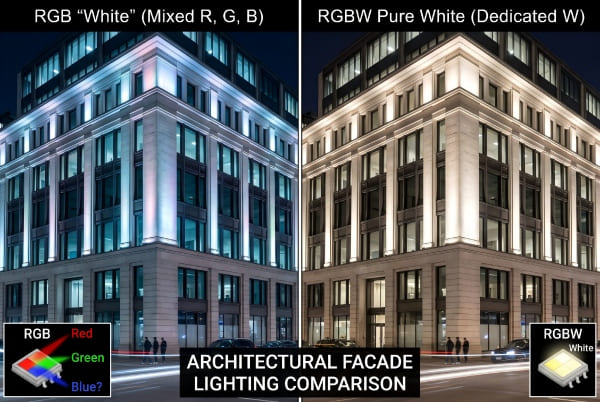
His project included displaying the national flag, which has a large section of pure white. A standard RGB light creates white by mixing red, green, and blue at full intensity10. This often results in a slightly bluish or pinkish, inconsistent white. An RGBW fixture has a dedicated white LED chip11. This produces a pure, bright, and beautiful white that makes the design look crisp and professional.
He listened, nodded, and said, "I accept your suggestion." He needed a partner who understood the technology deeply enough to protect his project from potential problems.
| Support Level | "Box Mover" Supplier | "Project Partner" Supplier |
|---|---|---|
| Design Phase | Sells what's in stock | Helps design lighting effects, suggests best product |
| Installation | Provides basic manual | Provides detailed wiring diagrams, custom programming |
| Commissioning | "Figure it out yourself" | Offers remote or on-site support to ensure it works |
| After-sales | Hard to reach | Provides long-term warranty and technical assistance |
How Do You Spot the Red Flags of a Bad Supplier?
An unusually low price seems like a great deal, right? But what if it's a trap? Choosing the wrong supplier can lead to project failure and massive hidden costs down the line.
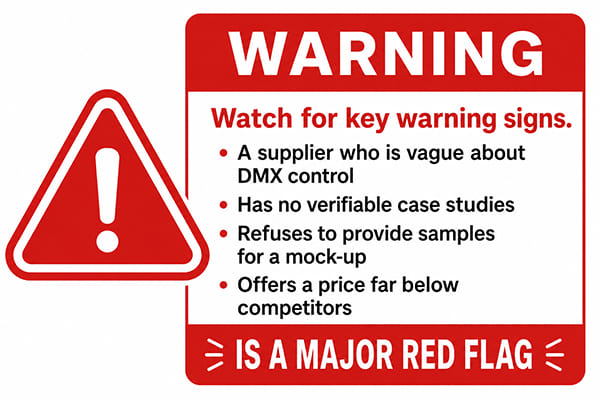
Watch for key warning signs. A supplier who is vague about DMX control, has no verifiable case studies, refuses to provide samples for a mock-up, or offers a price far below competitors is a major red flag.
After we secured the order, I asked my Uzbek client why he chose us after visiting five other companies. His answer was a perfect summary of what every buyer should look for and what red flags to avoid. He chose us for our experience, our real factory, our clear communication, and the trust we built. The other suppliers likely fell short in one of these areas. Price is the easiest thing to compare, but it is the least important factor in the end. A low price often means the supplier is cutting corners.
Warning Signs to Watch For
- No Technical Depth: They can't explain why DMX is better than SPI for your project. They just say "both are okay." This shows they don't understand the core technology.
- No Verifiable Projects: They only show you beautiful computer renderings. Ask for addresses of real projects that have been running for at least 3 years. A proud manufacturer will be happy to share this.
- Refusal to Mock-up: They are unwilling to provide samples for you to test on-site. This likely means they are not confident their product will perform as promised. It could have color inconsistencies or poor waterproofing.
- Suspiciously Low Price: If a price seems too good to be true, it is. To achieve it, the supplier is using cheaper LED chips, inferior power supplies, inadequate waterproofing seals, and poor heat sink designs. Your lights will fail, and the supplier will be gone.
Conclusion
Choosing a facade lighting supplier means finding a partner. Prioritize their engineering expertise, verifiable experience, and comprehensive technical support over the initial price for a successful and lasting project.
"[PDF] Coordinated Supplier Selection and Project Scheduling in Resource", https://rucore.libraries.rutgers.edu/rutgers-lib/51582/PDF/1/play/. Construction procurement and quality-management literature links supplier selection and material quality to project cost, schedule, and performance outcomes; this supports the risk framing but does not quantify facade-lighting-specific failure rates. Evidence role: general_support; source type: paper. Supports: Selecting a poor facade lighting supplier can create project, budget, and reputational risks.. Scope note: Contextual support from construction/project-management research rather than direct evidence for facade lighting suppliers only. ↩
"[PDF] Outdoor Lighting Design Guide - California State University", https://www.calstate.edu/csu-system/doing-business-with-the-csu/capital-planning-design-construction/operations-center/Documents/guidelines/Outdoor-Lighting-Design-Guide-R3-2018-12-10.pdf. Architectural lighting guidance describes facade and exterior lighting as an integrated design, safety, maintenance, and controls decision; this supports the importance of supplier selection only indirectly through the technical complexity of the lighting system. Evidence role: expert_consensus; source type: institution. Supports: Facade lighting supplier selection is a highly important project decision because facade lighting involves design, technical, installation, and maintenance considerations.. Scope note: The source may support the importance of facade lighting design and systems, not rank supplier selection among all project decisions. ↩
"Life-Cycle Cost Analysis for Buildings Is Easier Than You Thought", https://www.fs.usda.gov/t-d/pubs/htmlpubs/htm08732839/page01.htm. Life-cycle cost analyses for lighting systems show that purchase price is only one component of total cost, while energy use, maintenance, replacement, and failure costs can dominate over time; this supports the economic logic but not every individual product comparison. Evidence role: mechanism; source type: government. Supports: Low initial lighting cost can be outweighed by later maintenance, replacement, and operational costs.. Scope note: Life-cycle cost evidence is general to lighting systems and may not prove that all lower-priced facade lights fail or cost more. ↩
"[PDF] a guide to best practices for past performance - GovInfo", https://www.govinfo.gov/content/pkg/GOVPUB-PRVP-PURL-LPS6227/pdf/GOVPUB-PRVP-PURL-LPS6227.pdf. Procurement research on best-value selection emphasizes technical capability, past performance, quality assurance, and life-cycle outcomes alongside price; this supports the principle that non-price factors can be decisive, though it does not assign a universal weight to expertise over cost. Evidence role: expert_consensus; source type: government. Supports: Supplier expertise, support capability, and past performance can be more important than lowest initial price in complex project procurement.. Scope note: Best-value procurement frameworks vary by project type and do not prove that expertise always outweighs price in every facade lighting project. ↩
"[PDF] Lifetime and Reliability", https://www1.eere.energy.gov/buildings/publications/pdfs/ssl/life-reliability_fact-sheet.pdf. LED luminaire quality-assurance and reliability literature describes production inspection and burn-in or aging tests as methods for detecting early failures and verifying product stability; this supports the relevance of these facilities but not the quality of any particular factory. Evidence role: mechanism; source type: paper. Supports: Quality-control stations and aging test rooms are meaningful indicators of LED luminaire production and reliability processes.. Scope note: Presence of testing facilities does not by itself prove that tests are properly designed, documented, or passed. ↩
"Ingress Protection (IP) ratings - IEC", https://www.iec.ch/ip-ratings. IEC 60529 ingress-protection testing defines standardized tests for protection against water ingress, supporting the relevance of waterproof testing for outdoor luminaires; it does not verify whether a supplier’s internal tank test is equivalent to certified IP testing. Evidence role: definition; source type: institution. Supports: Outdoor facade luminaires require water-ingress testing, and waterproof testing relates to recognized IP protection standards.. Scope note: A factory water test may not be identical to accredited IEC IP certification unless test conditions and documentation are verified. ↩
"Integrating sphere - Wikipedia", https://en.wikipedia.org/wiki/Integrating_sphere. Photometry references describe integrating spheres as instruments for measuring total luminous flux and related optical parameters of lamps and luminaires; this supports their relevance to verifying light output but not all aspects of fixture performance. Evidence role: definition; source type: education. Supports: An integrating sphere is used to measure and verify lighting parameters of luminaires.. Scope note: Integrating-sphere measurements address optical parameters such as luminous flux and spectrum, not mechanical durability, waterproofing, or control-system reliability. ↩
"Serial Peripheral Interface - Wikipedia", https://en.wikipedia.org/wiki/Serial_Peripheral_Interface. Technical references on the Serial Peripheral Interface describe SPI as a synchronous board-level serial bus commonly used for short-distance communication between integrated circuits; this supports the concern about long cable runs but does not establish a specific 80-meter failure threshold for every SPI-based lighting system. Evidence role: definition; source type: encyclopedia. Supports: Standard SPI is generally intended for short-distance device communication, making it less suitable for long facade-lighting runs without additional engineering.. Scope note: SPI distance limits vary with clock speed, driver hardware, cable, shielding, and repeaters, so the source should be used as contextual support rather than a universal distance rule. ↩
"DMX512 - Wikipedia", https://en.wikipedia.org/wiki/DMX512. DMX512 technical references describe it as a digital communication standard for stage and architectural lighting control using differential signaling over cable runs specified for professional installations; this supports the claim of professional long-distance suitability, though actual reliability depends on cabling, termination, topology, and installation quality. Evidence role: definition; source type: encyclopedia. Supports: DMX512 is a professional lighting-control protocol suitable for longer cable runs than many chip-level data protocols when installed correctly.. Scope note: DMX performance is conditional on correct implementation and does not guarantee fault-free operation in every installation. ↩
"Additive & Subtractive Color Models > DINFOS Pavilion > Article", https://pavilion.dinfos.edu/Article/Article/2355687/additive-subtractive-color-models/. Color science and LED lighting references explain that RGB systems create additive white by combining red, green, and blue primaries, supporting the mechanism described; perceived white quality can vary by calibration, LED binning, optics, and control settings. Evidence role: mechanism; source type: education. Supports: RGB luminaires produce white light through additive mixing of red, green, and blue channels.. Scope note: The source supports the additive-color mechanism, while the degree of bluish or pinkish appearance depends on fixture design and calibration. ↩
"RGB Lights Vs. RGBW Lights – What's The Difference", https://www.ledlightexpert.com/rgb-lights-vs-rgbw-lights?srsltid=AfmBOor_It6cGb1LOOQD8yASB31LHZ3Ep5UO2AZy8-OJlfT3-hbEEzCt. LED lighting literature describes RGBW luminaires as adding a separate white emitter to red, green, and blue channels, which can improve white-light output and color control; this supports the design rationale but not the performance of every RGBW product. Evidence role: mechanism; source type: paper. Supports: RGBW fixtures use a dedicated white LED channel that can improve white-light rendering compared with RGB-only mixing.. Scope note: Actual white quality still depends on the white LED’s color temperature, color rendering, binning, optics, and control calibration. ↩