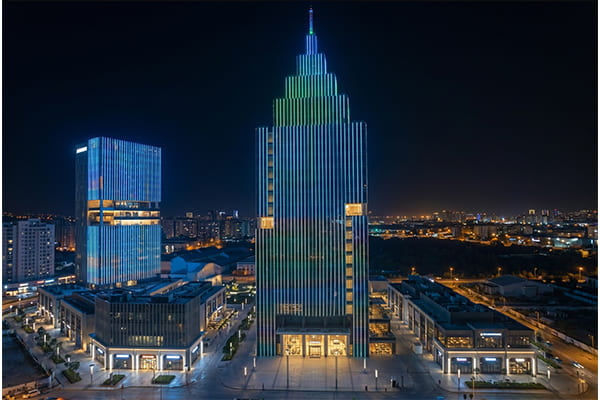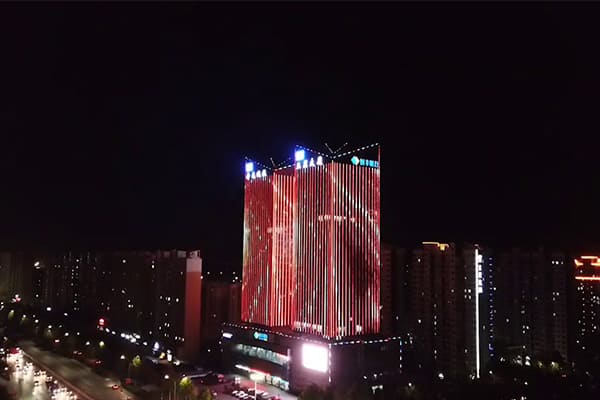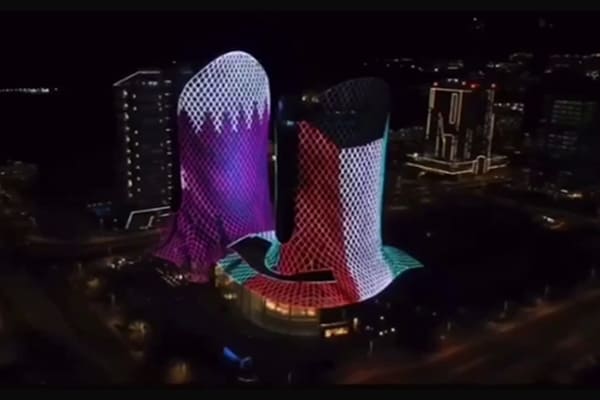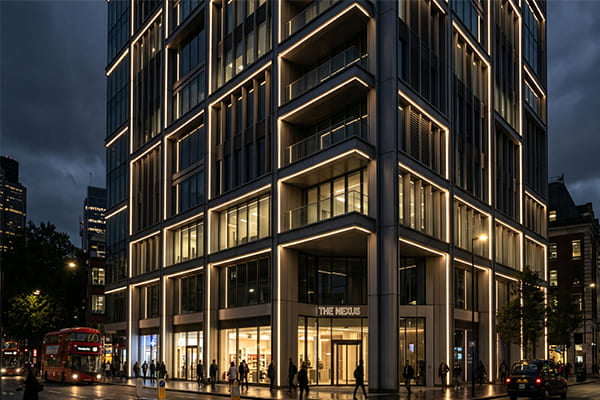
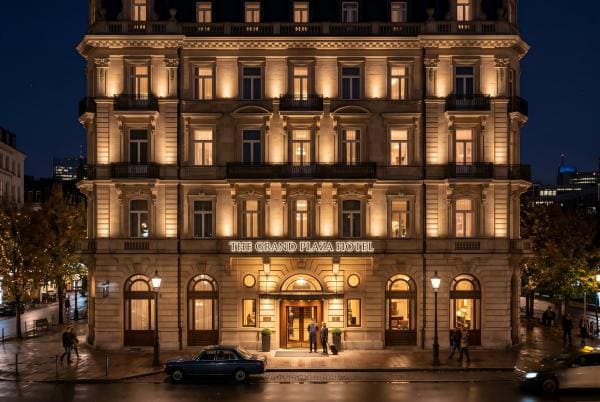
Your hotel facade is a huge branding opportunity, but bright lights can cause glare and annoy neighbors. You want a stunning look, not a reputation for light pollution1.
The best way to light a hotel facade is to focus on precision and control. Use smart lighting techniques to illuminate the building itself, not the sky. This involves using the right fixtures, managing brightness levels, and implementing smart scheduling to be both beautiful and responsible.
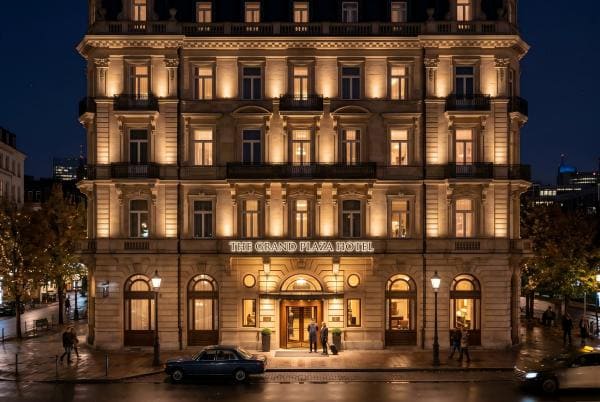
We have all seen hotels that are lit up like a stadium. It looks impressive for a moment, but it is often harsh and wasteful. As a lighting expert, I've learned that true luxury in lighting is not about being the brightest. It is about being the smartest. The goal is to make the architecture shine, not the light fixtures themselves. This creates a memorable experience for guests and shows a commitment to the environment.
But how do we actually achieve this balance? It comes down to a few core strategies that we use in our projects every day. Let's break them down into practical steps you can use.
How Can You Master Precise Light Control to Avoid Glare?
Spilling light everywhere looks unprofessional and creates unwanted glare. This can annoy guests, neighbors, and passersby. We have a much better way to focus light only where needed.
You can achieve precise control by using fixtures with asymmetric light distribution and narrow beam angles, from 5 to 15 degrees2. Adding accessories like honeycomb louvers or shrouds ensures light hits only the facade, preventing light spill and glare.
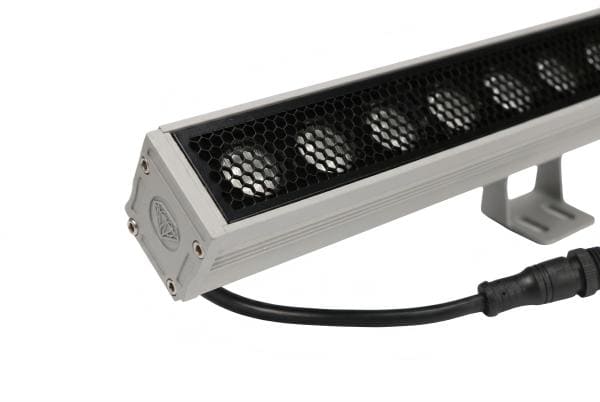
In my experience, the biggest mistake in facade lighting is using a "flood" approach. This is where wide-beam floodlights are pointed at a building from a distance. It’s an old technique that creates massive light pollution and hot spots3. Modern, high-end lighting is about surgical precision. We want to "paint" light exactly onto the architectural surfaces we want to highlight. This is where specialized optics and accessories become your most important tools. They allow us to control every single beam of light.
The Tools for Precision
The secret is in the details of the fixtures you choose. It's not just about the lamp; it's about how the lamp's light is shaped and directed.
-
Asymmetric Optics: Unlike standard lights that spread light symmetrically in a cone, asymmetric fixtures push light forward in one direction4. This is perfect for wall washing from the base of a building, as it directs light up the facade without spilling it backward or into the sky.
-
Narrow Beam Angles: A narrow beam, like 5°, 10°, or 15°, acts like a spotlight. It’s ideal for accentuating columns, window frames, or other vertical elements. A wider beam would wash out these details.
-
Anti-Glare Accessories: These are what separate professional installations from amateur ones.
| Accessory | Purpose | Best Use Case |
|---|---|---|
| Honeycomb Louver | A grid that sits over the lens. It cuts off light at sharp angles, eliminating peripheral glare for viewers5. | Fixtures at eye level or visible to passersby. |
| Shroud or Shield | A hood that extends over the light source. It physically blocks light from going upward or sideways. | Ground-mounted uplights to prevent skyglow. |
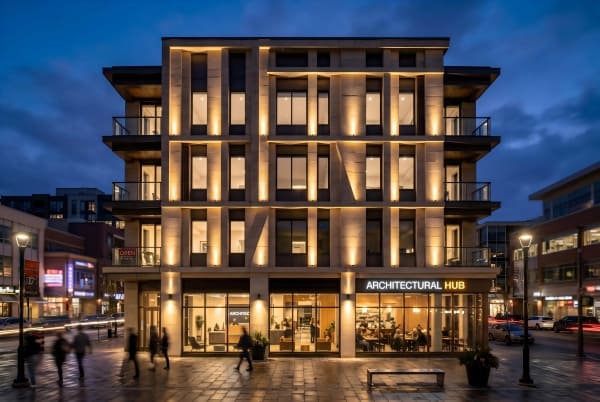
By combining these elements, you can create a design where the building seems to glow from within. You see the beautiful effect, but you can't see the source. That is the essence of quiet luxury.
How Do You Determine the Right Brightness for Different Environments?
Is brighter always better for a hotel facade? Absolutely not. Overly bright lighting just wastes energy and can look harsh, especially in a quiet, residential area. It can even violate local lighting ordinances6.
The solution is to manage brightness based on the hotel's location. We follow specific standards: lower brightness for suburbs (≤5 cd/m²) and residential zones (≤10 cd/m²), and a bit higher for busy commercial districts (≤25 cd/m²).
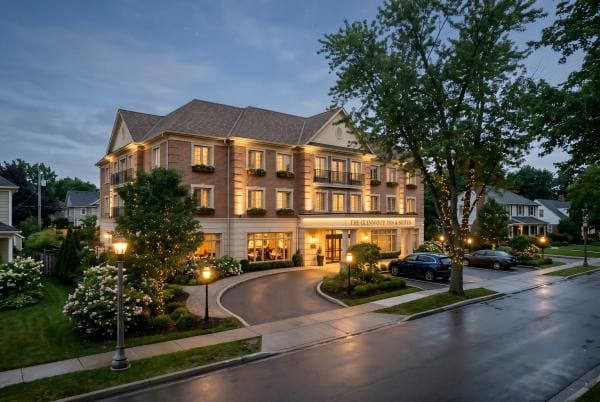
I always tell my clients that we should aim for "just right," not "as bright as possible." The human eye is very good at adapting to light. A building doesn't need to be overwhelmingly bright to be noticeable. In fact, a thoughtfully lit facade in a dark environment will have more impact than a blinding one in an already bright city center. The goal is to complement the surroundings, not dominate them. This shows respect for the community and the environment. It also saves a significant amount of money on energy costs over the long term.
Brightness by the Numbers
To take the guesswork out of it, lighting professionals use standards for luminance, which is the measured brightness of a surface. We measure it in candelas per square meter (cd/m²). Here’s a simple guide we use when planning projects.
| Environment Zone | Recommended Max Luminance | Reason |
|---|---|---|
| Suburbs / Rural Areas | ≤ 5 cd/m²7 | The surrounding area is dark, so a little light goes a long way. This preserves the natural dark sky. |
| Urban Residential Areas | ≤ 10 cd/m² | Balances the need for visibility with respecting residents. This level avoids shining into bedroom windows. |
| Central Business District (CBD) | ≤ 25 cd/m²8 | The ambient light level is already high. You need this level to stand out, but it’s still controlled. |
Sticking to these guidelines ensures your project is responsible. It moves the conversation from "how bright can we be?" to "how beautifully can we light this?" This shift in thinking is what creates truly timeless and sophisticated designs. The most memorable projects are often the ones that show restraint and precision.
How Can Smart Scheduling Make Your Hotel Lighting More Efficient?
Leaving your beautiful facade lighting on at 100% brightness all night is a huge waste of energy and money. It is also completely unnecessary after midnight when foot traffic and arrivals have dropped off.
The most effective solution is a smart, time-based control system. This allows you to program different lighting scenes for different times of the night, such as a full welcome mode in the evening and a gentle energy-saving mode overnight.
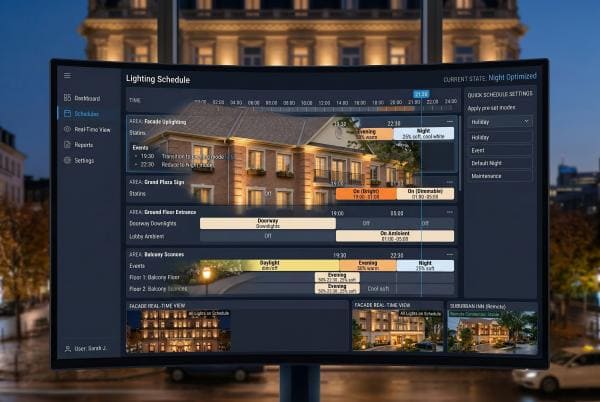
Static lighting is a thing of the past. Today, dynamic control is not just a fancy feature; it is a core part of responsible and effective lighting design. Think about it: a hotel’s energy needs are not the same at 8 PM as they are at 3 AM. Your lighting shouldn't be either. I once worked on a project where implementing a simple dimming schedule cut the facade's energy consumption by over 40% annually9. The hotel owner was thrilled, as it provided a clear return on investment and a great sustainability story to share with guests. Smart controls allow the lighting to adapt to the life of the building.
A Typical Hotel Lighting Schedule
A dynamic schedule brings a building to life. It responds to the flow of the evening and demonstrates a high level of sophistication. We often program a schedule using a DMX or DALI control system10. Here’s a simple yet highly effective schedule we recommend.
| Time Period | Brightness Level | Mode Name | Purpose |
|---|---|---|---|
| Dusk – 10:00 PM | 100% | Welcome Mode | Create maximum impact during peak arrival times. Greets guests with a vibrant, welcoming atmosphere. |
| 10:00 PM – 12:00 AM | 70% | Transition Mode | Subtly reduce energy as the evening winds down. The visual change is minimal, but the energy savings are real. |
| 12:00 AM – Dawn | 20-30% | Energy-Saving Mode | Maintain a secure and visible presence with minimal power. It keeps the hotel's silhouette visible without unnecessary brightness. |
This tiered approach is the perfect compromise. It delivers a powerful visual statement when it matters most and acts responsibly when it doesn't. At JUXUANLED, we not only supply the fixtures but also provide the expertise to program these custom scenes, ensuring the system works flawlessly from day one.
What Technical Choices Define High-End, Eco-Friendly Facade Lighting?
You want an elegant facade, but visible, bulky fixtures can ruin the building's aesthetic during the day. Furthermore, using the wrong color of light can make a luxury property look cheap and uninviting.
The key is to select a warm white color temperature between 2200K and 3000K. This creates a high-end feel and reduces blue light pollution11. Then, use techniques like wall washing and grazing to highlight the building's texture and integrate the fixtures so they are hidden from view.
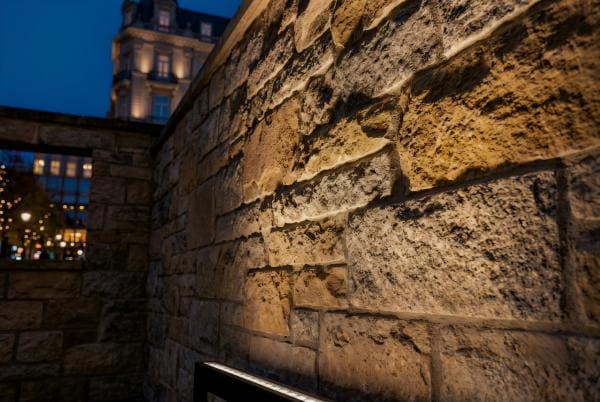
The most sophisticated hotel lighting projects I've been a part of share a common philosophy: "Let the building glow, not the fixtures." This means every technical choice is made to serve the architecture, not draw attention to itself. It’s a holistic approach where the lighting is woven into the fabric of the building. This requires careful planning from the beginning, often in collaboration with the architects. When done right, the lighting feels like a natural extension of the design, appearing as if by magic when the sun goes down.
The Three Pillars of Technical Excellence
To achieve this seamless effect, we focus on three critical technical areas.
1. Color Temperature is Key
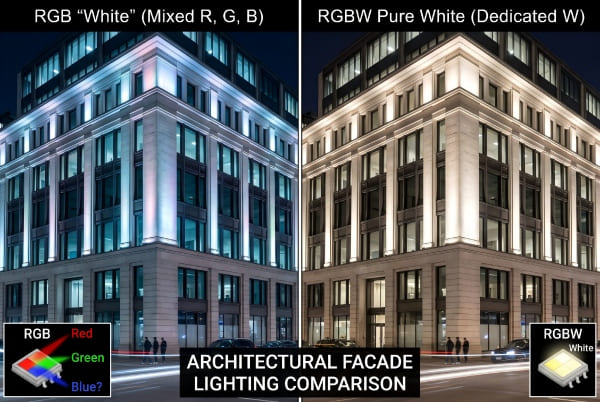
The color of light dramatically affects mood. For a high-end, welcoming atmosphere, we strictly use warm white light in the 2200K to 3000K range. 2200K is like candlelight, very warm and intimate. 3000K is a pure warm white, clean and sophisticated. This range avoids the harsh, cold feel of blue-toned light (4000K and above), which is also known to cause more skyglow and disrupt wildlife12.
2. Masterful Lighting Techniques
Instead of just pointing lights at a wall, we use specific methods to reveal the architecture.
- Wall Washing: This technique uses fixtures like our linear lights to create a smooth, even layer of light across a large, flat surface.
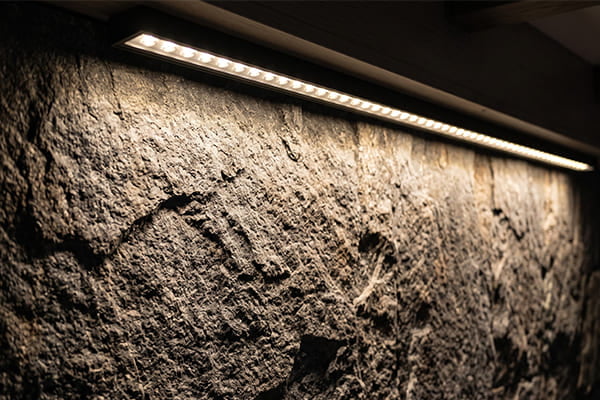
- Grazing: By placing lights very close to a textured surface like stone or brick, grazing casts dramatic shadows that reveal the material's depth and character.
- Contouring: We use slim linear fixtures to trace and outline the building's shape, defining its silhouette against the night sky.
3. Integrated Design
The ultimate goal is to make the lighting fixtures disappear. This is achieved by designing them into the architecture itself. We work with builders to include recessed channels, coves, and other mounting positions that hide the hardware from sight. This means planning for power and control wiring early in the construction process. The result is a clean, uncluttered look during the day and a stunning, integrated lighting effect at night.
Conclusion
Truly advanced hotel lighting is not about being flashy. It is about being "quietly premium." By using precise, smart, and restrained design, you can create a memorable brand image and meet your environmental responsibilities.
"[PDF] Ž perceptions of sustainable hotel practices in a Mexican destination", https://oasis.library.unlv.edu/cgi/viewcontent.cgi?article=1026&context=hhrc. Sources like the International Dark-Sky Association and hospitality industry reports suggest that demonstrating environmental stewardship, including responsible lighting, can enhance a property's reputation and appeal to eco-conscious travelers. Evidence role: general_support; source type: institution. Supports: The source should support the idea that environmental responsibility, including mitigating light pollution, is increasingly important for a hotel's brand image and guest perception.. ↩
"[PDF] Exterior Lighting for Energy Savings, Security, and Safety", https://betterbuildingssolutioncenter.energy.gov/sites/default/files/attachments/exterior_lighting_savings.pdf. Lighting design handbooks confirm that narrow beam angles, typically below 20 degrees and often as focused as 5-15 degrees, are used for accent lighting to precisely highlight architectural details like columns and window frames while minimizing light spill. Evidence role: general_support; source type: education. Supports: The source should confirm that narrow beam angles, often in the range of 5 to 15 degrees, are used in architectural lighting to create accent effects and highlight specific features with high precision.. Scope note: Specific recommended ranges can vary slightly based on the fixture, application, and desired effect. ↩
"Text-Alternative Version: What Is Sky Glow? - Department of Energy", https://www.energy.gov/cmei/ssl/text-alternative-version-what-sky-glow. The International Dark-Sky Association identifies unshielded, upward-aimed floodlighting as a primary contributor to light pollution, as it directs a large amount of light into the atmosphere, creating skyglow, and often results in uneven illumination and glare. Evidence role: expert_consensus; source type: institution. Supports: The source should confirm that poorly aimed, broad-beam floodlighting is a significant cause of skyglow, glare, and light trespass, which are key components of light pollution.. ↩
"Asymmetric Vs Symmetric Floodlights - Ansell Lighting", https://ansell-lighting.com/en/articles/technical/asymmetric-vs-symmetric-floodlights. Lighting engineering resources define asymmetric distribution as an optical design that shapes and directs light non-uniformly, often pushing it forward and upward, which is ideal for illuminating vertical surfaces evenly from a close setback. Evidence role: definition; source type: education. Supports: The source should define asymmetric light distribution and explain how it is engineered to direct the majority of light in a specific direction away from the fixture's mounting position.. ↩
"Honeycomb Louvers - Beachside Lighting Honolulu", https://www.beachsidelighting.com/lighting/honeycomb-louvers/. Technical guides on lighting accessories explain that honeycomb louvers consist of a grid of cells that restrict the viewing angle of the light source, effectively cutting off light output at higher angles to reduce peripheral glare for observers. Evidence role: mechanism; source type: other. Supports: The source should explain the mechanism by which a honeycomb louver, or cellular louver, controls light distribution to reduce high-angle glare.. ↩
"[PDF] ENVIRONMENTAL LAW IN NEW YORK Light Pollution", https://climate.law.columbia.edu/sites/climate.law.columbia.edu/files/content/docs/Michael%20Gerrard/Environmental%20Law%20in%20NY/1998/April%201998.pdf. Many municipalities have adopted lighting ordinances, often based on models like the one developed by the Illuminating Engineering Society (IES) and the International Dark-Sky Association, which set legal limits on luminance levels and light trespass to protect residents and dark skies. Evidence role: case_reference; source type: government. Supports: The source should provide evidence that municipalities enact lighting ordinances that regulate aspects like brightness (luminance), light trespass, and curfew times to control light pollution.. ↩
"[PDF] Exterior Lighting for Energy Savings, Security, and Safety", https://betterbuildingssolutioncenter.energy.gov/sites/default/files/attachments/exterior_lighting_savings.pdf. Professional lighting guides, such as those from the Illuminating Engineering Society (IES), recommend maximum luminance values for building surfaces based on lighting zones; for rural or dark suburban areas (LZ1/LZ2), these values are typically low, often in the range of 1-5 cd/m², to preserve ambiance and dark skies. Evidence role: statistic; source type: institution. Supports: The source should be a professional lighting standard that specifies recommended maximum surface luminance values for building facades based on environmental zones.. Scope note: The exact values can differ slightly between standards (e.g., IES vs. CIE) and depend on the specific lighting zone definition. ↩
"[PDF] Outdoor Lighting - California Energy Commission", https://www.energy.ca.gov/sites/default/files/2025-07/06_OutdoorLighting_ada.pdf. Illuminating Engineering Society (IES) guidelines for high-ambient-light areas like central business districts (Lighting Zone 4) permit higher facade luminance levels to ensure visibility, with recommended maximums often around 25 cd/m² to stand out while still controlling for excessive brightness. Evidence role: statistic; source type: institution. Supports: The source should be a professional lighting standard that specifies a higher, but still controlled, maximum luminance value for building facades in bright, commercial urban centers.. ↩
"Low Energy Facades & Daylighting", https://windows.lbl.gov/low-energy-facades-daylighting. Studies from organizations like the DesignLights Consortium and research in energy efficiency have shown that implementing networked lighting controls with strategies like scheduling and dimming can reduce energy consumption for exterior lighting by 30-60%, depending on the baseline and specific schedule. Evidence role: statistic; source type: research. Supports: The source should provide data or analysis showing significant energy savings (ideally in the 30-50% range) achieved by implementing scheduled dimming for exterior architectural lighting.. Scope note: The anecdotal 40% figure is plausible, but actual savings vary based on the specific dimming schedule, fixture efficiency, and hours of operation. ↩
"Digital Addressable Lighting Interface - Wikipedia", https://en.wikipedia.org/wiki/Digital_Addressable_Lighting_Interface. DMX is a standard for digital communication networks commonly used to control stage lighting and effects, while DALI is a protocol for networked lighting control systems in building automation; both are widely used in architectural lighting to manage dynamic scenes, color, and brightness. Evidence role: definition; source type: encyclopedia. Supports: The source should define DMX (Digital Multiplex) and DALI (Digital Addressable Lighting Interface) and establish them as common communication protocols used in the lighting industry for dynamic control.. ↩
"[PDF] An Investigation of LED Street Lighting's Impact on Sky Glow", https://www.energy.gov/sites/prod/files/2017/05/f34/2017_led-impact-sky-glow.pdf. Research confirms that light sources with a lower color temperature (under 3000K) emit significantly less blue-violet light, which scatters more readily in the atmosphere and is therefore a primary driver of skyglow, a key component of light pollution. Evidence role: mechanism; source type: research. Supports: The source should explain that light with a lower Correlated Color Temperature (CCT), such as 3000K or below, contains a smaller proportion of short-wavelength blue light, which is a primary contributor to skyglow.. ↩
"Artificial light at night alters behavior in laboratory and wild animals", https://pmc.ncbi.nlm.nih.gov/articles/PMC6205897/. A large body of ecological research demonstrates that artificial light at night, especially light rich in blue wavelengths (typically >3000K), can disrupt the circadian rhythms, navigational abilities, and predator-prey relationships of a wide range of nocturnal and crepuscular species. Evidence role: expert_consensus; source type: paper. Supports: The source should be a scientific paper or report detailing how artificial light at night (ALAN), particularly blue-rich light, negatively affects wildlife behavior, such as migration, reproduction, and foraging.. ↩