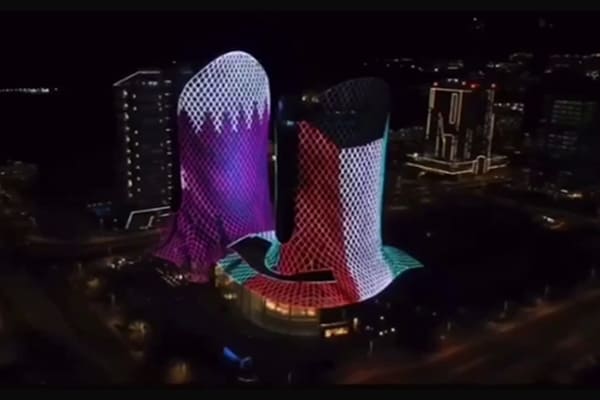
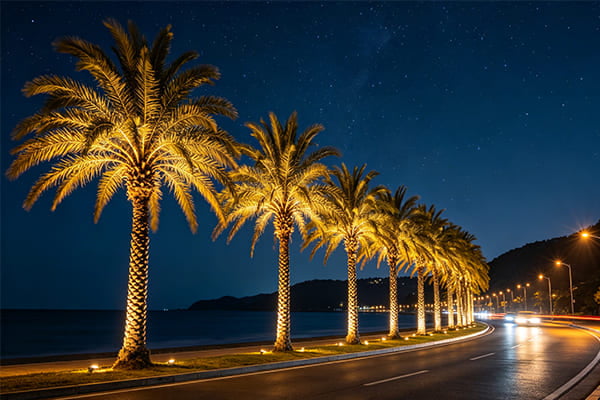
Lighting tall, slender palm trees can be a real challenge. Get it wrong, and you're left with ugly glare or a flat, boring look that completely kills the tropical vibe.
The best way to light a palm tree is by using a very narrow-beam (5-15 degree) uplight placed at its base1. This technique traces the light up the tall trunk to illuminate the fronds, highlighting the tree's unique shape without causing light pollution or glare2.
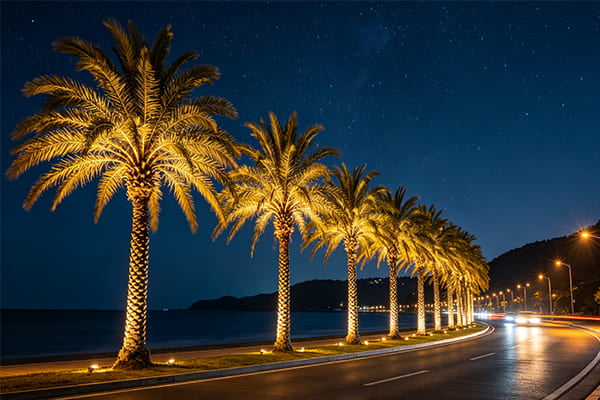
I've worked on many projects featuring palm trees, from grand city boulevards to quiet resort pathways. Each setting demands a different touch. It's not just about making the tree visible; it's about enhancing the entire environment, whether that means ensuring driver safety or creating an unforgettable vacation atmosphere. So, let's break down the specific strategies and technical details that will make your palm tree lighting project a success.
What Are the Best Lighting Techniques for a Palm Tree's Unique Shape?
Palm trees are tall and thin with a burst of leaves at the top. Using a standard wide floodlight just washes out the trunk and spills light uselessly into the sky3.
To properly showcase their elegant form, you need specialized techniques. The most effective methods are uplighting with a focused beam to trace its height and moonlighting to create a more natural, atmospheric effect on the ground below4.
These two core methods form the foundation of almost all successful palm tree lighting designs I've implemented. They address the tree's unique verticality and can be adapted for any environment, from a busy highway to a peaceful park. Understanding how and when to use each one is the first step toward creating a stunning visual impact.
Uplighting: The Go-To Method
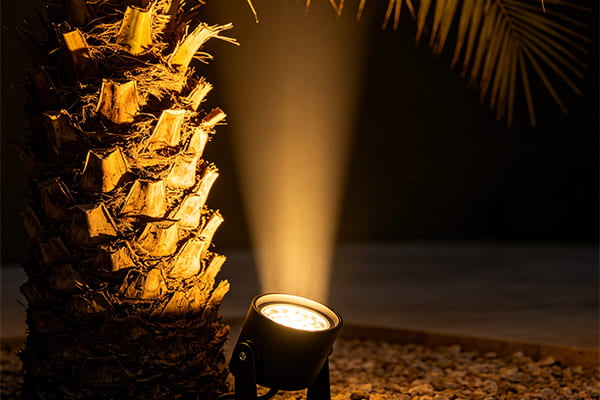
This is the most common and effective technique. By placing a fixture at the base of the trunk and aiming it straight up, you create a dramatic effect. The key here is the beam angle. You must use a very narrow beam, typically between 5 and 15 degrees. This tight focus ensures the light "climbs" the entire length of the trunk and bursts into the fronds at the top. A wider beam would spill light everywhere, creating glare and wasting energy. For important trees in scenic spots, I often recommend placing two fixtures on opposite sides of the trunk. This eliminates harsh shadows and ensures the tree looks three-dimensional from any viewing angle5.
| Common Fixture Types | Key Parameters |
|---|---|
| In-ground Uplight | 18–36W LED, Adjustable Beam, IP67/IP68, 24V or 220V |
| Tree Ring Light | 36–72W LED, IP65 Waterproof, Monochrome or DMX512 RGB |
Moonlighting: Creating Atmosphere
For a more subtle and natural feel, especially in parks or resort areas, I love using the moonlighting technique. This involves mounting a fixture high up in the palm tree itself or on an adjacent structure and directing it downwards. The light filters through the palm fronds, casting soft, dappled shadows on the ground below. It perfectly mimics the effect of natural moonlight, creating a tranquil and enchanting atmosphere for pathways and seating areas. This approach is less about highlighting the tree and more about using the tree to shape the light and mood of the space around it.
How Should You Light Palm Trees Differently for Roads vs. Parks?
The lighting needs for a public road are completely different from those of a tourist park. One requires safety and clarity, while the other needs drama and ambiance.
Applying the same lighting strategy to both will fail. Roadside lighting that's too "dramatic" can be distracting and dangerous, while park lighting that's too "functional" will feel sterile and uninviting. The environment dictates the design.
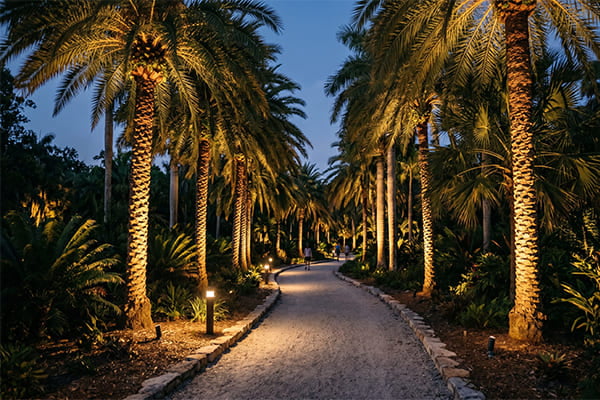
For roads, the priority is always safety. We use recessed, anti-glare in-ground lights to create a clear visual rhythm for drivers. In parks and scenic spots, we can be more creative, using light to tell a story with techniques like silhouetting and dynamic color changes.
A. Municipal Roads and Boulevards
On roadsides, lighting serves two main purposes: guidance and safety. The entire design must prevent any glare that could impair a driver's vision6. That's why I almost always specify deep-recessed in-ground uplights7. This keeps the fixtures out of the way of pedestrians and vehicles. It's also critical that these fixtures are "load-bearing" in case a car accidentally drives over them. By spacing the lights consistently along a row of palms, we create a strong sense of rhythm and depth, which helps drivers understand the road's direction from a distance. Most importantly, every fixture must be equipped with a honeycomb louver or an anti-glare shield8. This ensures the light goes straight up the tree and never sideways into the eyes of drivers or pedestrians.
B. Tourist Attractions and Parks
In these spaces, we can be more artistic. The goal is to create layers and a memorable atmosphere. One of my favorite techniques is silhouetting. If a palm tree stands in front of a brightly lit wall, a fountain, or another feature, we can light the background instead of the tree. This turns the palm into a striking black silhouette, which has a very dramatic, tropical feel. For festivals or special events, we can use RGBW smart controls to wash the trunks or canopies in color—a soft purple, a cool blue, or a warm gold can completely transform the space. For exceptionally tall and majestic palms, a circular "tree ring light" that clamps around the trunk can be a great solution for evenly illuminating the wide canopy from below.
What Technical Specs and Eco-Friendly Practices Should You Follow?
Choosing the wrong technical specifications can ruin the look of a project. An incorrect color temperature can make healthy green fronds look sickly, while low-quality fixtures will fail quickly.
Beyond aesthetics, we have a responsibility to be environmentally conscious. Poorly aimed lights contribute to sky glow, harming nocturnal wildlife and wasting energy9. Following modern standards ensures a beautiful, durable, and sustainable lighting installation.
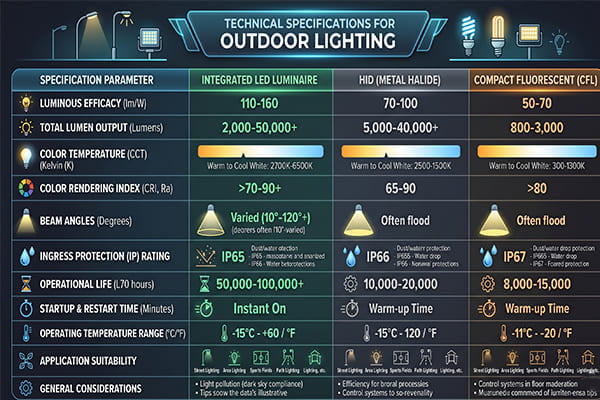
Based on my experience and looking ahead to future standards, there are a few key parameters I always insist on. These specifications ensure the palm trees look their best while the installation remains efficient and environmentally friendly for years to come.
| Project Item | Recommended Parameter | Reason |
|---|---|---|
| Color Temperature | 2700K - 3000K (Warm White)10 | Best highlights the texture of the bark and the vitality of green leaves. |
| Color Rendering Index | Ra > 80 | Ensures the natural colors of the plant are not distorted. |
| Ingress Protection | IP65 or higher | IP65/IP68 is needed for coastal areas to resist salt spray and corrosion. |
| Smart Control | DALI or DMX | Allows for scheduled dimming (e.g., to 30% late at night) to save energy. |
Key Precautions and Environmental Tips
Beyond the specs, a few practical considerations are crucial. When installing tree ring lights, always leave extra room in the bracket. This allows the trunk to grow thicker without the fixture cutting into the bark. We also need to practice Dark Sky protection. All light should be aimed carefully at the tree itself, with minimal spill into the night sky to protect the habitats of birds and insects. Finally, maintenance is key. In tropical areas, in-ground lights can get covered by falling leaves. I recommend choosing cool-running LED fixtures to prevent these leaves from getting scorched onto the lens, which would block the light and create a fire hazard.
Conclusion
Roadside lighting for palm trees demands uniformity and strict glare control for safety. Scenic spots, however, call for creativity with layers and atmosphere. A narrow-beam, high-CRI, warm white LED is your best choice.
"[PDF] Campus-wide Exterior Lighting Master Plan - Los Angeles - LAVC", https://www.lavc.edu/sites/lavc.edu/files/2022-08/lavc-exterior-lighting-master-plan-11-03-11.pdf. Landscape-lighting guidance describes narrow-beam uplighting from near a tree base as a method for accentuating vertical forms and limiting spill outside the target area. Evidence role: expert_consensus; source type: institution. Supports: The best way to light a palm tree is by using a very narrow-beam 5–15 degree uplight placed at its base.. Scope note: Such guidance supports the technique generally, but exact beam angles depend on tree height, trunk diameter, fixture setback, and viewing distance. ↩
"[PDF] Outdoor Lighting Challenges and Solution Pathways", https://betterbuildingssolutioncenter.energy.gov/sites/default/files/attachments/Outdoor%20Lighting%20Challenges%20and%20Solutions%20Pathways%20Paper.pdf. Dark-sky and outdoor-lighting guidance states that careful aiming, shielding, and limiting upward or stray light reduce glare and sky glow from exterior lighting. Evidence role: mechanism; source type: institution. Supports: A narrowly aimed uplight can illuminate the palm while reducing light pollution or glare.. Scope note: The source would support the glare and light-pollution mechanism, not prove that any particular palm-tree installation eliminates these effects. ↩
"[PDF] LIGHTING STUDY - SDSU Mission Valley - San Diego State University", https://missionvalley.sdsu.edu/pdfs/eir/appendices/appendix-4-1-1-lighting-study.pdf. Lighting references on beam spread and outdoor-light control explain that wider beam distributions illuminate larger areas and, when poorly aimed, increase spill light beyond the intended surface. Evidence role: mechanism; source type: education. Supports: Wide floodlights are more likely than narrow beams to spill light beyond a slender palm trunk and into unwanted areas.. Scope note: The source would explain the optical principle; whether a specific floodlight washes out a palm trunk depends on fixture output, distance, and aiming. ↩
"SPECIAL OUTDOOR LIGHTS CREATE DAZZLING EFFECTS", https://scholar.lib.vt.edu/VA-news/ROA-Times/issues/1994/rt9408/940809/08110014.htm. Landscape-lighting guidance defines moonlighting as placing luminaires above grade and aiming them downward through branches or foliage to create soft, shadowed illumination resembling moonlight. Evidence role: definition; source type: institution. Supports: Moonlighting is a recognized landscape-lighting technique for creating a natural-looking ground effect.. Scope note: This supports the design concept, but the perceived naturalness or atmosphere is partly subjective and site-dependent. ↩
"[PDF] Lighting and Shadows", http://www.cs.cmu.edu/afs/cs/academic/class/15462-f14/www/lec_slides/lec08.pdf. Lighting-design texts describe multi-directional illumination as a method for reducing hard shadows and revealing form, which supports the use of more than one fixture for three-dimensional modeling. Evidence role: mechanism; source type: education. Supports: Using fixtures from opposite sides can reduce harsh shadows and improve three-dimensional perception of the tree.. Scope note: The effect depends on fixture placement, output ratio, surface texture, and observer position; two fixtures do not guarantee uniform appearance in all cases. ↩
"APPENDIX A. ROADWAY LIGHTING DETAILS | FHWA", https://highways.dot.gov/safety/other/visibility/roadway-visibility-research-needs-assessment/appendix-roadway-lighting. Roadway-lighting and human-factors literature identifies disability glare as stray light that reduces visibility and can impair visual performance for drivers. Evidence role: expert_consensus; source type: government. Supports: Roadside lighting must control glare because glare can impair driver vision.. Scope note: The source supports the general safety concern; actual impairment depends on glare intensity, angle, adaptation level, and driver conditions. ↩
"Louvered Glare Shields: Extreme Directional Control for Retail", https://hi-hyperlite.com/blogs/comprehensive-guides/louvered-glare-shields-retail-directional-control?srsltid=AfmBOorcjlb6mTE19M7svJqYpIwzLtOlqSRI2U_ViEu4O6MqMwRUrmA1. Luminaire-design references explain that recessed lamp positions, baffles, louvers, and shielding reduce direct view of the light source and thereby help control glare. Evidence role: mechanism; source type: institution. Supports: Deep-recessed in-ground uplights can help reduce direct glare from roadside palm lighting.. Scope note: This supports the anti-glare function of recessed optics generally; it does not establish that every recessed in-ground uplight is appropriate for roadsides. ↩
"[PDF] LIGHTING STRATEGIES FOR NIGHTTIME CONSTRUCTION AND ...", https://hammer.purdue.edu/articles/thesis/LIGHTING_STRATEGIES_FOR_NIGHTTIME_CONSTRUCTION_AND_MAINTENANCE_ACTIVITIES_ON_ROADWAYS/19663941/1/files/34926420.pdf. Lighting-control references describe louvers and shields as optical accessories that block high-angle light and reduce direct glare from luminaires. Evidence role: mechanism; source type: education. Supports: Honeycomb louvers and anti-glare shields can reduce sideways light and glare from palm uplights.. Scope note: The source would support the function of louvers and shields generally; performance depends on the accessory geometry and fixture aiming. ↩
"Artificial light at night alters behavior in laboratory and wild animals", https://pmc.ncbi.nlm.nih.gov/articles/PMC6205897/. Environmental and dark-sky studies report that upward or misdirected outdoor lighting contributes to sky glow, ecological disruption for nocturnal species, and unnecessary energy use. Evidence role: expert_consensus; source type: research. Supports: Poorly aimed outdoor lights can contribute to sky glow, harm nocturnal wildlife, and waste energy.. Scope note: The source supports the general environmental relationship; impacts vary by spectrum, intensity, timing, local ecology, and atmospheric conditions. ↩
"Text-Alternative Version: Get the Facts on LED Street Lighting", https://www.energy.gov/cmei/ssl/text-alternative-version-get-facts-led-street-lighting. Dark-sky and ecological-lighting guidance commonly favors warmer, lower-correlated-color-temperature outdoor lighting because it generally contains less short-wavelength blue light than cooler white sources. Evidence role: expert_consensus; source type: institution. Supports: Warm-white 2700–3000 K lighting is commonly recommended for environmentally sensitive outdoor lighting.. Scope note: This supports environmental and visual comfort rationale for warm CCT, not the article’s aesthetic assertion that it is always best for bark texture and green leaves. ↩