Choosing the wrong voltage can ruin your lighting project with dim spots and high costs. You need a reliable system. Low-voltage DC offers the perfect balance of safety and performance.
For most facade lighting, 24V is the gold standard, balancing performance and cost.1 Use 12V for small, detailed areas, and 48V for skyscrapers or long-distance runs.2 The key is matching the voltage to the project's scale and wiring distance to avoid issues like voltage drop.
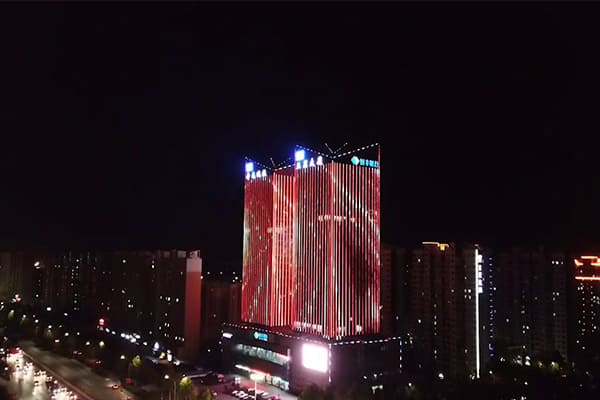
This seems simple, but the wrong choice can lead to major headaches down the road. I've seen it happen on job sites more than once. Let's break down why these differences matter so you can make the right call every time and ensure your project shines exactly as you designed it.
Why Do Different Voltages Even Exist for LED Lighting?
Confused by 12V, 24V, and 48V options? This confusion can lead to poor performance. Understanding the basic physics is the first step to a successful project.
It's all about Ohm's Law (Power = Voltage × Current).3 For the same power output, a higher voltage system uses less current.4 Less current means less heat, less power loss in the wires, and most importantly, less voltage drop over long distances.5
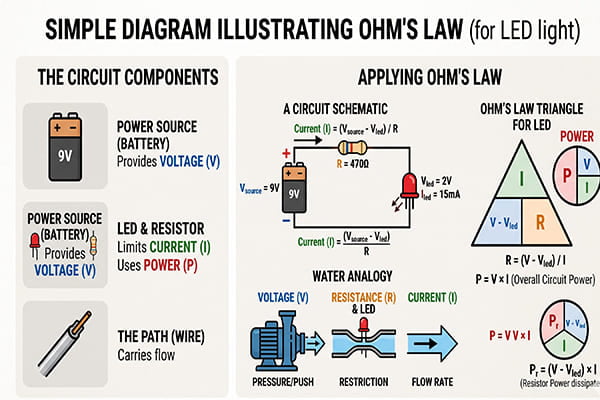
The core idea is simple. To get the same amount of light (power), you can either use low voltage with high current or high voltage with low current. High current is the enemy of long-distance lighting. It causes the wires to heat up and lose energy, a problem we call "voltage drop." This is why the lights at the end of a long run can look dimmer or have a different color than the ones near the power supply.6 A higher voltage system pushes the power more efficiently over longer wires. I always tell my clients to think of it like water in a hose: higher voltage is like higher water pressure, it can travel further with less effort.
Here is a quick breakdown of how these systems compare:
| Feature | 12V System | 24V System | 48V System |
|---|---|---|---|
| Transmission Distance | Short (under 5 meters) | Medium (10-20 meters) | Long (30-50+ meters) |
| Voltage Drop | Very High Sensitivity | Medium Sensitivity | Very Low Sensitivity |
| Cutting Precision | Highest (short units) | Medium | Lower (long units) |
| Safety | Extremely High | Extremely High | High (Still Safe) |
| Best For | Small details, cabinets | Most building facades | Skyscrapers, long bridges |
Is 12V DC Still a Good Choice for Facade Projects?
You need extremely precise lighting for a small space. But you are worried about performance issues. Can a 12V system deliver without causing dimming or color shifts?
Yes, 12V is excellent for high-precision jobs like cabinet or cove lighting where runs are short.7 Its main advantage is the very short cutting units, allowing a perfect fit. However, it is not suitable for large-scale facade lighting due to severe voltage drop.
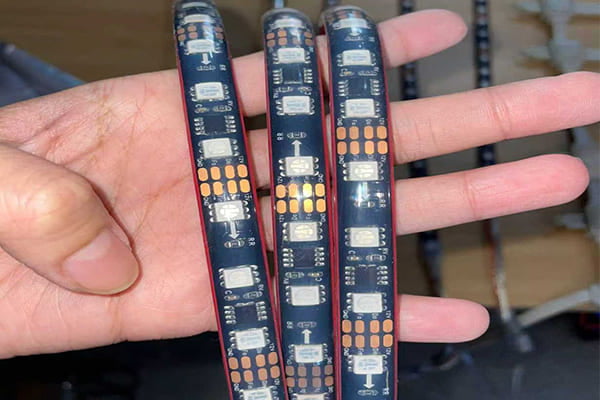
The biggest strength of a 12V system is its precision. The cutting units on a 12V LED strip are often very short, sometimes just 2.5cm.8 This makes it the perfect tool for fitting light into tight, narrow spaces with exact dimensions. I remember a small boutique project where we had to light up some very narrow architectural fins. Only a 12V strip with its short cut points could fit perfectly. For that specific task, it was the hero. The accessories for 12V systems are also widely available and generally inexpensive.
However, its weakness is distance. The high current in a 12V system leads to significant power loss over any wire longer than a few meters. The lights at the end will look noticeably dimmer or even yellowish. For this reason, I never recommend 12V for any primary facade or contour lighting on a building. It is a specialist tool for small-scale, detailed work only.
Why is 24V DC Considered the Industry Gold Standard?
Your project needs a reliable, versatile, and cost-effective solution. With so many options, you feel overwhelmed. You just want the one that works for most situations.
24V offers the best balance of performance, cost, and flexibility. It doubles the effective run length of 12V systems while maintaining good cutting precision. This makes it the go-to choice for over 90% of professional facade lighting applications, from linear lights to wall washers.9
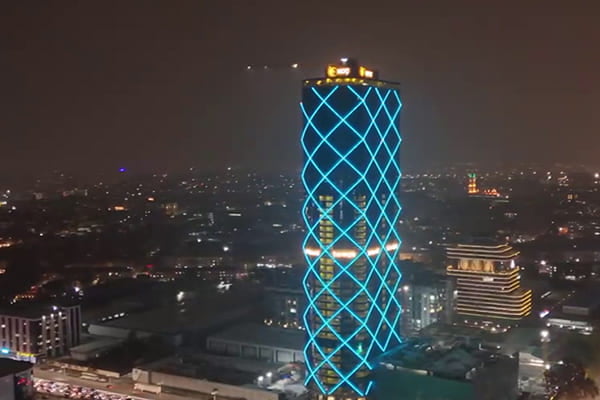
If you are ever in doubt, choose 24V. In my years of experience, this system is the workhorse of the facade lighting industry. It strikes the perfect balance. It solves the distance problem of 12V, allowing for runs of 10 to 20 meters without significant voltage drop.10 At the same time, its cutting units are still flexible enough for most architectural designs.
The biggest advantage is the massive ecosystem of products. Almost every professional-grade fixture we manufacture and sell—wall washers, linear lights, pixel lights, floodlights—is available in a 24V version. This means the supply chain is mature, products are reliable, and costs are competitive. For standard commercial buildings, retail storefronts, and most residential projects, 24V is the safest and most efficient choice. Its only real limitation is that for extremely long continuous lines over 50 meters, you will still need to plan for multiple power connection points. But for the vast majority of projects, it's the perfect solution.
When Should You Upgrade to a 48V DC System?
You are planning a massive project, like a skyscraper or a long bridge. The thought of installing hundreds of power supplies is a nightmare. There must be a better way.
Upgrade to 48V for projects requiring very long, continuous runs of light (30-50 meters or more). Its extremely low current allows for longer distances with fewer power supplies, reducing installation complexity, cost, and potential points of failure, making it ideal for large-scale structures.
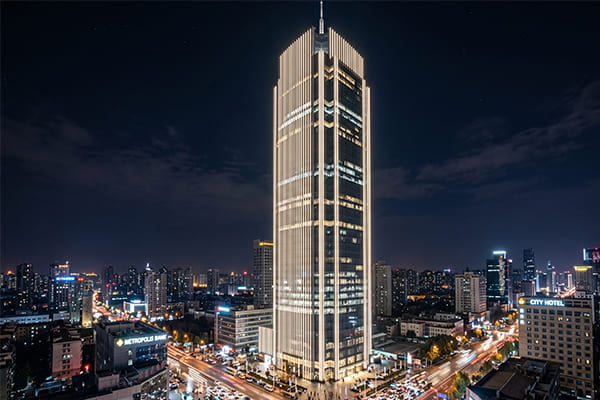
The 48V system is the king of long-distance lighting. We recommend it specifically for huge landmark projects. Think about lighting a 200-meter-tall skyscraper. With a 24V system, you would need numerous power supplies installed on different floors, which adds complexity and many potential failure points. With a 48V system, you can power incredibly long runs from a single power source.11 This drastically reduces the number of power supplies needed, which simplifies wiring, lowers installation costs, and makes future maintenance much easier. After all, the power supply is often the first component to fail in a system12; fewer supplies mean fewer problems.
Because the current is so low, you can also use thinner, less expensive cables to achieve the same brightness. This adds up to significant savings on a large project. The trade-off is that 48V fixtures can be slightly more expensive, and the cutting units are longer. This makes it unsuitable for small, detailed work, but for massive structures, its efficiency and simplicity are unmatched.
What Are the Overall Pros and Cons of Low-Voltage Systems?
Low-voltage systems seem perfect for facade lighting. But you know there are always trade-offs. What hidden challenges should you prepare for before committing to a system?
The main benefits are high safety, efficiency, and flexible smart control integration. The primary challenges are managing voltage drop, which requires careful planning of wire gauge and run length, and the need for multiple power supplies for large areas. Proper system design is critical.

No matter which voltage you choose, all low-voltage systems share a common set of strengths and weaknesses. It's crucial to understand these before starting any project.
Key Advantages of All Low-Voltage Systems
- Safety: This is the biggest benefit. Operating at a low DC voltage means the risk of electric shock to installers and the public is almost zero.
- Efficiency: LEDs are naturally DC devices. Using a low-voltage DC system is highly efficient because it matches the power needs of the LEDs with minimal conversion loss.
- Flexible Control: These systems are easy to integrate with smart controls like DMX, SPI, or DALI. This allows for creating dynamic, colorful lighting effects with ease.
- Easy Installation: In many regions, licensed high-voltage electricians are not required to install low-voltage systems, which can simplify the construction process.
Key Challenges to Plan For
- Voltage Drop: This is the main technical challenge. You must carefully calculate the correct wire size and maximum run length to avoid dimming.
- Limited Power: A single power supply can only power a limited number of lights. Large projects require a distributed network of multiple power supplies.
- Compatibility: All components—the light fixture, the driver, and the power supply—must have matching voltage. You cannot mix and match.
- Design Complexity: Proper planning of the wiring layout, power distribution, and protection is essential for a reliable system.
A final tip: regardless of voltage, always prioritize fixtures with a high IP rating (IP65 or IP67 for outdoor use) and ensure your power supplies have adequate space for heat dissipation. These factors will impact the life of your project more than anything else.
Conclusion
Choosing the right voltage is simple. Match 12V to precision, 48V to scale, and trust 24V for everything in between. Proper planning ensures a brilliant, long-lasting facade.
"[PDF] The Potential of Whole-Home Lighting Systems and Low-Voltage ...", https://www.energy.gov/sites/default/files/2023-12/bbrn-peer-121423.pdf. A lighting engineering or manufacturer-independent technical source should show that 24 V DC is commonly used for architectural LED systems because it reduces current compared with 12 V while remaining within common low-voltage design limits. Evidence role: general_support; source type: institution. Supports: 24V is the standard choice for most facade lighting because it balances performance and cost.. Scope note: This would support 24 V as a common practical compromise, not prove that it is universally the “gold standard.” ↩
"Voltage Drop Calculator | Lumilum LED Lighting", https://www.lumilum.com/pages/voltage-drop-calculator?srsltid=AfmBOoqRlHzq8nsSNhmbigsgyO34Qd2DS7Pw7BCrD-pXDw4ugSHY-tGU. A technical guide on low-voltage LED distribution should explain that lower-voltage LED strips are suited to short localized runs, while higher-voltage DC distribution reduces current and voltage drop over longer cable distances. Evidence role: general_support; source type: education. Supports: 12V is appropriate for short, detailed lighting runs, while 48V is better suited to very long runs or large structures.. Scope note: The source may support the voltage-selection principle but may not specifically discuss skyscraper facade lighting. ↩
"Electric Power - HyperPhysics", http://hyperphysics.phy-astr.gsu.edu/hbase/electric/elepow.html. An electrical engineering textbook or educational reference should state the power relationship P = VI and explain its use in basic DC circuit analysis. Evidence role: definition; source type: education. Supports: The relationship between power, voltage, and current explains why different LED system voltages require different currents for the same power.. ↩
"[PDF] Chapter 7 Direct-Current Circuits - MIT", https://web.mit.edu/8.02t/www/802TEAL3D/visualizations/coursenotes/modules/guide07.pdf. A basic circuit theory source should show that, for constant power, current is inversely proportional to voltage according to I = P/V. Evidence role: mechanism; source type: education. Supports: At the same power level, increasing system voltage reduces current.. Scope note: This relationship applies directly to ideal DC power delivery and does not account for driver efficiency or fixture-specific electronics. ↩
"Voltage Drop - EMS Online Courses", https://courses.ems.psu.edu/ae868/book/export/html/967. An electrical power transmission reference should explain that resistive cable losses scale with I²R and that voltage drop across conductors is proportional to current and resistance. Evidence role: mechanism; source type: education. Supports: Reducing current lowers resistive heating, power loss, and voltage drop in wiring.. Scope note: The principle is general; actual losses depend on conductor material, gauge, length, ambient temperature, and load behavior. ↩
"[PDF] LED Dimming: What you need to know", https://www1.eere.energy.gov/buildings/publications/pdfs/ssl/dimming_webcast_12-10-2012.pdf. A lighting engineering source should describe how voltage drop in LED strip or low-voltage lighting circuits can reduce delivered voltage, causing reduced light output and possible color variation in LED products. Evidence role: mechanism; source type: institution. Supports: Voltage drop can cause distant LED fixtures to appear dimmer or show color inconsistency.. Scope note: Color shift depends on the LED driver design and fixture type; regulated fixtures may compensate better than simple constant-voltage strips. ↩
"Task Lighting L-VK1Z1A-16-40 16' Vivid LED Strip Light Kit - 1 Zone ...", https://intl.seattlecentral.edu/fckeditor/editor/filemanager/browser/default/browser.html?Type=File&GetFoldersAndFiles=1FDF1C7128&id=wyluanhamjj&CONNECTOR=%2F%5C%2F6ip%2Epics%2Fdk%2F. A lighting design or technical source should document that 12 V LED strip systems are commonly used for short-run applications such as cabinet, cove, or accent lighting because of their small segment lengths and localized installation patterns. Evidence role: general_support; source type: institution. Supports: 12V LED systems are well suited to short, detailed cabinet or cove lighting applications.. Scope note: This supports common usage patterns, not a universal rule that 12 V is always the best option for these applications. ↩
"[PDF] Series COB320 Technical Data.cdr - Linear Lux", https://linearlux.com.au/wp-content/uploads/2021/08/Series-COB320-Technical-Data.pdf?srsltid=AfmBOor2obqJBDP8Ofic3mLw-c5-T8u3aU_hFf_TpLWILViFnzz3Bzf2. A technical reference or product-design explanation for constant-voltage LED strips should show that lower-voltage strips use shorter series LED groups, which can allow shorter cut intervals such as approximately 25 mm in some designs. Evidence role: mechanism; source type: other. Supports: 12V LED strips can have very short cut intervals, sometimes around 2.5 cm.. Scope note: Cut length is product-specific and varies with LED density, circuit design, and manufacturer specifications. ↩
"[PDF] Exterior Lighting Control Guidance - Better Buildings Solution Center", https://betterbuildingssolutioncenter.energy.gov/sites/default/files/attachments/exterior-lighting-control-guidance.pdf. A market survey, industry report, or standards-oriented lighting source would need to document the prevalence of 24 V DC in professional architectural facade lighting applications. Evidence role: statistic; source type: other. Supports: 24V is used in more than 90% of professional facade lighting applications.. Scope note: Without a direct market dataset, evidence may only support that 24 V is common rather than verify the specific “over 90%” figure. ↩
"Voltage Drop - EMS Online Courses", https://courses.ems.psu.edu/ae868/book/export/html/967. A voltage-drop calculation reference should show how permissible run length for low-voltage LED circuits depends on voltage, current, conductor resistance, and acceptable voltage-loss thresholds, providing context for 10–20 m runs at 24 V. Evidence role: mechanism; source type: education. Supports: 24V systems can often support longer runs than 12V systems, commonly in the 10–20 m range when properly designed.. Scope note: A fixed 10–20 m range cannot be universal because load wattage, cable gauge, topology, and allowable voltage drop determine the actual limit. ↩
"What is 48vdc? Competitors, Complementary Techs & Usage - Sumble", https://sumble.com/tech/48vdc. An electrical distribution or lighting-control reference should explain that 48 V DC distribution reduces current for a given load compared with 12 V or 24 V systems, enabling longer cable runs before reaching the same voltage-drop limit. Evidence role: mechanism; source type: research. Supports: 48V systems can power longer lighting runs from a single source than lower-voltage systems under comparable conditions.. Scope note: The maximum single-source run length still depends on load power, conductor size, voltage-drop tolerance, and code requirements. ↩
"[PDF] LED Driver and System Reliability", https://energy.gov/sites/prod/files/2016/02/f29/weeks_reliability_raleigh2016.pdf. A reliability study on LED lighting systems should indicate that drivers or power supplies are common failure points because they contain temperature-sensitive electronic components such as electrolytic capacitors. Evidence role: expert_consensus; source type: paper. Supports: Power supplies or LED drivers are often among the most failure-prone components in lighting systems.. Scope note: Failure rates vary by driver design, thermal conditions, component quality, and operating environment, so the source may support common vulnerability rather than a universal first-failure sequence. ↩