Confused about lumens and watts when choosing lights? This confusion can lead to picking the wrong bulb, costing you money and leaving your project looking dim. Let's clear it up.
Lumens (lm) measure the total brightness of a light source, while watts (W) measure how much power it consumes.1 To choose the right light, use lumens to determine brightness and watts to gauge energy efficiency. For modern LEDs, lumens are the most important metric for brightness.2
I’ve seen this confusion between lumens and watts cause major headaches on job sites for years. A contractor might install hundreds of fixtures based on wattage, only to find the building facade is too dim. It's an expensive mistake. But once you understand the simple difference, you can avoid these problems forever. Let's break it down so you can choose the perfect light for every project, every single time.
How Did Watts Become the Wrong Way to Judge Brightness?
Remember when a 100W bulb was the brightest you could get? Sticking to that old thinking today will cost you money and lead to poor lighting performance on your projects.
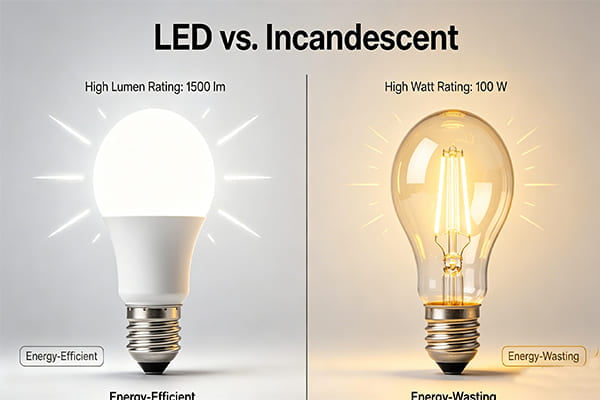
In the past, with incandescent bulbs, higher wattage always meant more brightness.3 But with modern LED technology, high brightness no longer requires high power. This big change is all because of something called luminous efficacy, which is the new standard for judging a light's performance.
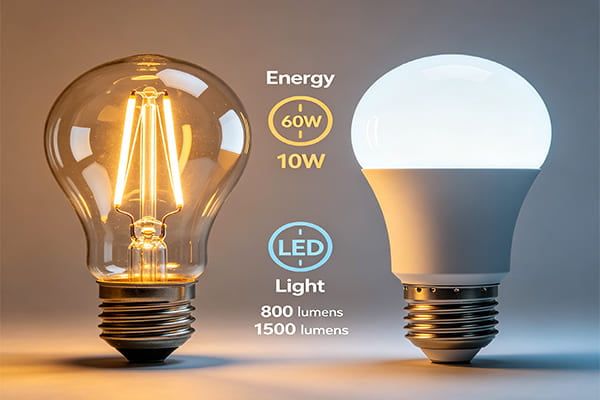
In my early days in the lighting industry, everything was about watts. It was simple. If you wanted more light, you got a higher-wattage bulb. Those old incandescent bulbs were very inefficient. They worked by heating a tiny wire until it glowed. Most of the energy, about 90%, was wasted as heat, not light.4 So, you needed to pump a lot of power (watts) into them to get a decent amount of brightness.
Then, LED technology changed everything. LEDs are much more efficient. They create light without all that waste heat. This efficiency is measured by luminous efficacy, which is lumens per watt (lm/W). The higher the lm/W value, the more light you get for every watt of electricity used.5 For example, a traditional 60W incandescent bulb produces around 800 lumens.6 We can now produce that same 800 lumens with an LED light that uses only 8 to 10 watts.7
Here is a simple comparison:
| Feature | Incandescent Bulb | JUXUANLED LED Bulb |
|---|---|---|
| Brightness | ~800 lumens | ~800 lumens |
| Power Used | 60 Watts | 8-10 Watts |
| Efficacy | ~13 lm/W | 100-80 lm/W |
| Primary Output | Heat | Light |
As you can see, focusing on watts is an old habit from an outdated era. Today, it’s all about getting the most lumens for the lowest wattage.
How Should You Choose Lights for Your Project Using Lumens and Watts?
Choosing the wrong light can ruin a project's effect. It might be too dim, or it could be wastefully bright and expensive. This mistake can lead to unhappy clients and budget problems.
There is a simple, two-step process to get it right. First, decide how bright you need the light to be by choosing a lumen level. Then, from the lights that meet that brightness, pick the one with the lowest wattage to save the most energy.
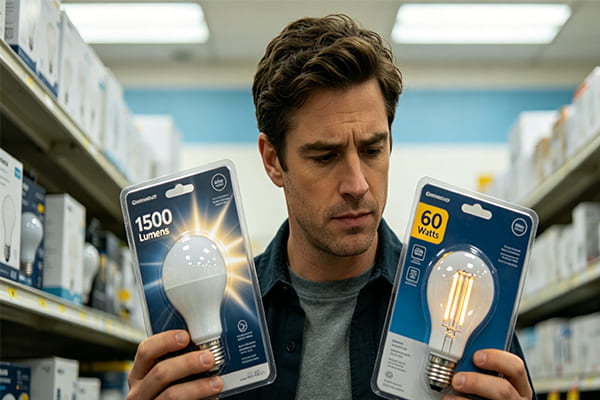
When we help clients with lighting design, we always follow this two-step method. It ensures they get the visual effect they want without wasting money on electricity.
First, define the brightness you need in lumens. The right lumen level depends entirely on the application.8
- Low Lumens (e.g., under 500 lm): This is perfect for creating atmosphere and ambient lighting. Think of gentle path lights in a garden or soft accent lights on a building's architectural details.
- Medium Lumens (e.g., 500 - 2000 lm): This range is good for general-purpose lighting in most indoor and some outdoor spaces, like office lobbies, retail stores, or building entrances.
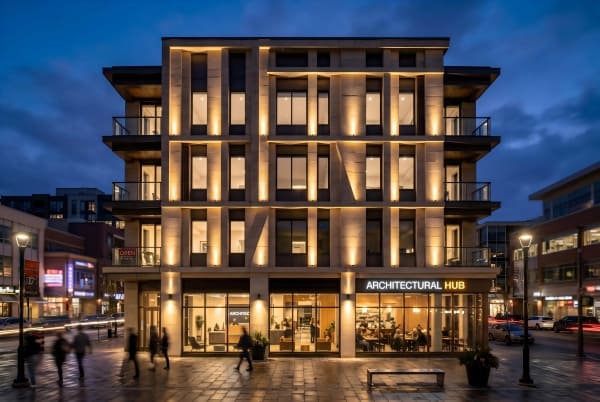
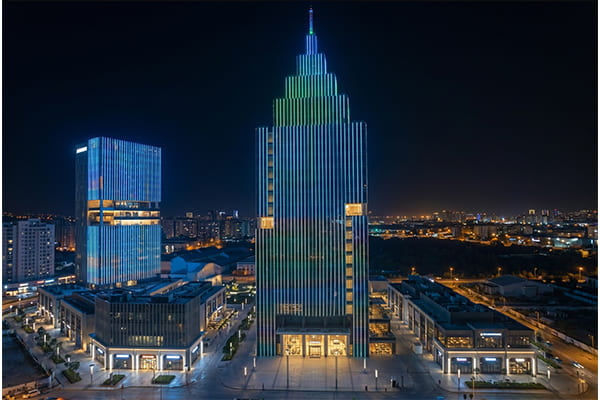
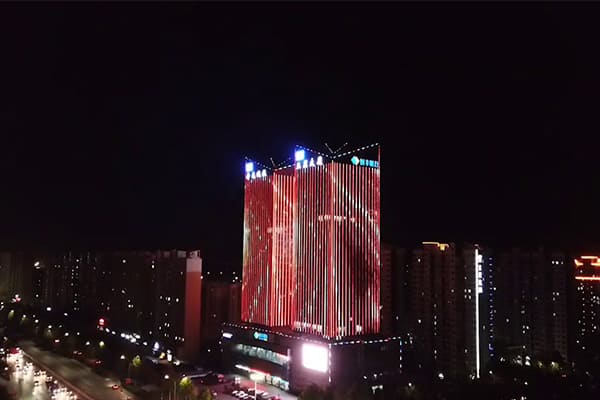
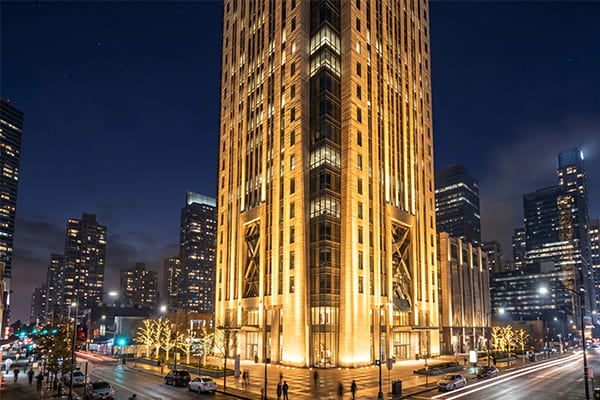
- High Lumens (e.g., 2000 lm+): You need high lumens for large areas or when you need to project light over a long distance. This is what we use for facade lighting on high-rise buildings, stadium lighting, and large public squares.
Second, compare energy use by looking at watts. Once you know the lumen target, your goal is to achieve it with the least amount of power. If two products both offer 1000 lumens, but one is 10W and the other is 15W, the 10W fixture is the more efficient choice. For a large project with hundreds of lights, this difference adds up to huge savings on electricity bills and a smaller carbon footprint.9 Lower wattage also means less heat, which can extend the life of the fixture and lower maintenance costs.10
How Do Lumens and Watts Affect Wall Washer Performance?
Have you ever specified a wall washer for a tall building, only to see the light fade out after a few meters? This is a common and expensive problem in facade lighting.
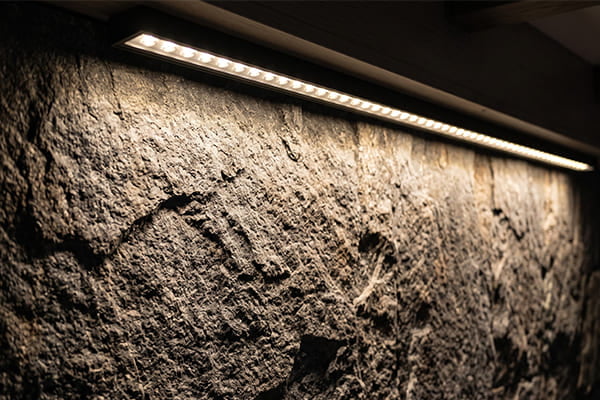
For fixtures that need to throw light a long distance, like our wall washers, higher power (watts) is critical. A higher wattage allows for a higher total lumen output, which is needed to overcome light decay and powerfully illuminate surfaces far away.
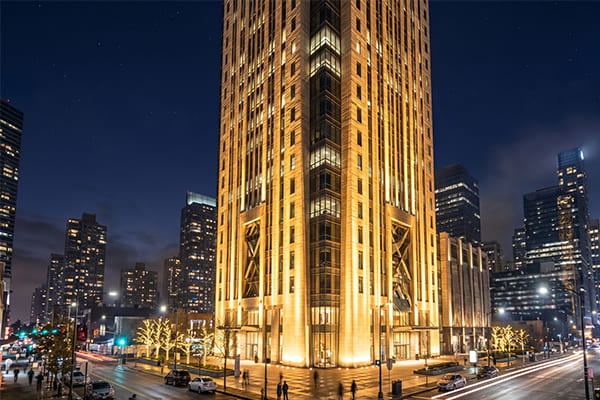
In our business of outdoor landscape lighting, this is a question we answer every day. A client will show us a 20-meter-tall building and ask which wall washer to use. While lumens technically define brightness, we often use wattage as a practical guide for projection distance. Here’s why.
Light loses its intensity as it travels.11 This is called attenuation. For a wall washer to light up a surface 10 meters away, it needs to be incredibly powerful at the source. The total amount of light a fixture can possibly create is limited by its power input (watts). A higher wattage gives our engineers the ability to design a fixture that produces a massive amount of lumens. This high light density is what allows the beam to "punch" through the air and remain bright and even at a distance.
Here’s a practical rule of thumb we use when recommending our wall washers:
- Low Power (e.g., 12W - 18W): These fixtures have a limited amount of total light energy. Even with excellent optics, they are best for illuminating surfaces 1-3 meters away. They are great for low walls, garden features, and signs.
- High Power (e.g., 36W - 54W or more): These are the workhorses. They have the power needed to generate a very high lumen output. This allows them to maintain a strong, uniform brightness on surfaces 3-5 meters away, and sometimes even higher, depending on the optics.
So, when planning a facade project, we look at the wattage to ensure the light has enough energy to do the job. It's a reliable shortcut that connects the engineering of a fixture to the real-world results you see on a building.
Conclusion
Choosing the right light is simple when you know what to look for. Use lumens to find the brightness you need for your eyes, and check the watts to manage the cost for your wallet.
"Lumens and the Lighting Facts Label - Department of Energy", https://www.energy.gov/energysaver/lumens-and-lighting-facts-label. A standards or energy-agency source defines the lumen as a measure of luminous flux and the watt as a unit of power, supporting the distinction between light output and electrical consumption. Evidence role: definition; source type: institution. Supports: Lumens measure total light output, while watts measure power consumption.. ↩
"Lumens and the Lighting Facts Label - Department of Energy", https://www.energy.gov/energysaver/lumens-and-lighting-facts-label. An energy-efficiency or consumer-labeling authority explains that light output is indicated in lumens rather than watts for efficient bulbs, supporting the use of lumens as the primary brightness metric for LEDs. Evidence role: expert_consensus; source type: government. Supports: For modern LEDs, lumens are the primary metric to use when comparing brightness.. Scope note: This supports consumer and specification guidance generally; it does not prove that lumens are the only relevant metric for every lighting design application. ↩
"Lumens and the Lighting Facts Label - Department of Energy", https://www.energy.gov/energysaver/lumens-and-lighting-facts-label. A lighting reference describing incandescent lamp operation and ratings supports that, within the same lamp technology, higher-wattage incandescent bulbs generally produced greater luminous flux. Evidence role: historical_context; source type: education. Supports: Higher-wattage incandescent bulbs generally produced more light, making watts a historical proxy for brightness.. Scope note: The relationship is technology-specific and approximate; lamp design, voltage, and bulb type can affect actual light output. ↩
"[PDF] Comparing Light Bulbs - Department of Energy", https://www1.eere.energy.gov/education/pdfs/efficiency_comparinglightbulbs.pdf. An energy-agency source states that incandescent lamps convert most input energy into heat rather than visible light, supporting the approximate 90% heat-loss statement. Evidence role: statistic; source type: government. Supports: Incandescent bulbs waste roughly 90% of their energy as heat rather than visible light.. Scope note: The exact percentage varies by lamp design and operating conditions, so the figure should be treated as an approximate efficiency comparison. ↩
"Luminous efficacy - Wikipedia", https://en.wikipedia.org/wiki/Luminous_efficacy. A technical reference on luminous efficacy explains that a higher lumen-per-watt value indicates more luminous flux per unit of electrical power, supporting this efficiency interpretation. Evidence role: mechanism; source type: research. Supports: A higher lumens-per-watt value means greater light output per watt of electrical input.. Scope note: This describes source or fixture efficacy; real installed performance also depends on optics, controls, and application conditions. ↩
"[PDF] In L Prize Competition, Everyone's a Winner - Department of Energy", https://www.energy.gov/sites/prod/files/2020/06/f75/ssl-lprize-article-feb2012.pdf. A consumer lighting guide or regulatory label table gives typical lumen equivalents for common incandescent bulbs, supporting that a 60-watt incandescent lamp is commonly associated with about 800 lumens. Evidence role: statistic; source type: government. Supports: A traditional 60 W incandescent bulb typically produces about 800 lumens.. Scope note: The value is a typical equivalence rather than a universal measurement for every 60 W incandescent product. ↩
"Purchasing Energy-Efficient Light Bulbs", https://www.energy.gov/cmei/femp/purchasing-energy-efficient-light-bulbs. An energy-efficiency source lists LED replacements for a 60-watt incandescent bulb at roughly 8–10 watts for similar light output, supporting the stated wattage range. Evidence role: statistic; source type: government. Supports: An LED can produce roughly 800 lumens while using about 8 to 10 watts.. Scope note: Actual wattage varies by LED product generation, color temperature, driver design, and efficacy rating. ↩
"1926.56 - Illumination. | Occupational Safety and Health Administration", http://www.osha.gov/laws-regs/regulations/standardnumber/1926/1926.56. Illuminating-engineering guidance frames lighting quantity requirements by task, space type, and visual conditions, supporting the claim that appropriate lumen levels depend on application rather than one universal value. Evidence role: expert_consensus; source type: institution. Supports: Appropriate brightness levels vary by lighting application and visual task.. Scope note: Such guidance is usually expressed in illuminance targets such as lux or foot-candles, not direct fixture lumen ranges. ↩
"Lighting Choices to Save You Money - Department of Energy", https://www.energy.gov/energysaver/lighting-choices-save-you-money. An energy-efficiency or emissions source explains that lower electrical consumption reduces operating cost and electricity-related greenhouse gas emissions, supporting the cost and carbon implications of choosing lower-wattage fixtures at scale. Evidence role: mechanism; source type: government. Supports: Using lower-wattage fixtures across many lights can reduce electricity costs and carbon emissions.. Scope note: The size of savings depends on operating hours, electricity price, grid emissions intensity, and controls, so the source supports the mechanism rather than a specific savings amount for this project. ↩
"[PDF] LED LUMINAIRE LIFETIME: Recommendations for Testing and ...", https://www1.eere.energy.gov/buildings/publications/pdfs/ssl/led_luminaire-lifetime-guide.pdf. Research on LED thermal management shows that junction temperature and heat affect LED degradation and lifetime, supporting the link between reduced heat load and longer fixture life. Evidence role: mechanism; source type: paper. Supports: Reducing heat in LED fixtures can help extend lifetime and reduce maintenance needs.. Scope note: Lower wattage does not automatically guarantee lower operating temperature; fixture design, heat sinking, ambient temperature, and driver efficiency also determine thermal performance. ↩
"Light intensity does not always decay with the inverse of the square ...", https://arxiv.org/html/2501.00622v1. A physics or optics source explains the inverse-square relationship for irradiance or illuminance from a point source, supporting the general statement that measured light intensity decreases with distance. Evidence role: mechanism; source type: education. Supports: Light intensity decreases with distance from the source.. Scope note: Architectural fixtures are not ideal point sources; lenses, beam angle, reflections, and surface geometry affect the exact distance falloff. ↩