Your building looks static and lifeless at night. You struggle to attract visitors and create a memorable experience. Imagine turning your architecture into a living, breathing entity that engages everyone.
Interactive lighting transforms commercial buildings by using sensors and smart controls to react to people and the environment1. This creates dynamic, engaging experiences that attract visitors, boost business, and make your property stand out.
I've seen this transformation happen firsthand. A few years ago, we worked on a project for a large shopping mall that felt dated. They wanted something more than just static floodlights. They wanted to create a destination. This led us down the path of interactive lighting, and the results were incredible. It’s more than just pretty lights; it's a complete system with specific parts that work together. Let's explore how it all comes together.
What Are the Core Components of an Interactive Lighting System?
You want to create an interactive experience, but the technology seems complex. It's hard to know where to start. We can break it down into three simple, core layers.
An interactive lighting system has three main parts. The sensing layer detects movement. The control layer sends signals to the lights. And the content engine creates the visual effects. These parts work together to bring the interactive experience to life.
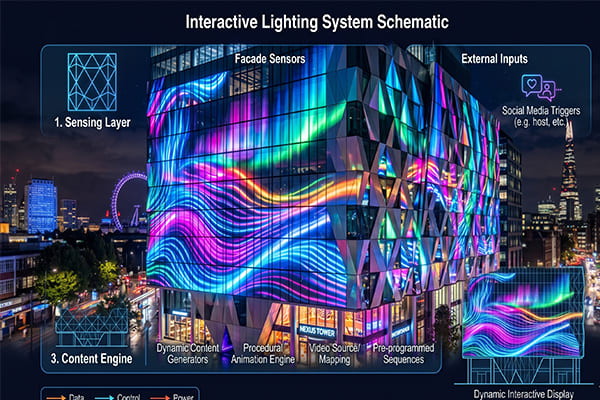
When my team and I design one of these systems, we think of it like building a living organism. It needs senses, a nervous system, and a brain to function. Each part has a specific job.
The Sensing Layer: The System's Eyes and Ears
This is how the lighting system "sees" or "feels" the world around it. We use different types of sensors depending on the goal. PIR sensors are simple and detect if someone is present. Millimeter-wave radar is more advanced; it can track a person's movement and position accurately2. For the most detailed applications, we use LiDAR, which creates a 3D map of the environment. This layer is all about gathering data. It answers the question: "What is happening around me?"
The Control Layer: The Nervous System
Once the sensors detect something, that information needs to go to the lights. This is the job of the control layer. We use different protocols for this. For a tall building facade, we often use DMX512 because it sends signals reliably over long distances3. For a ground display with thousands of tiny lights close together, we use SPI protocol. SPI is perfect for controlling high-density pixels individually4.
| Protocol | Best Use Case | Key Advantage |
|---|---|---|
| DMX512 | Building facades, long runs | Reliable over long distances |
| SPI | High-density pixel displays | Fast control of many lights |
The Content Engine: The Brain
This is where the magic really happens. The content engine is the software that takes the sensor data and turns it into beautiful, dynamic light shows. Software like TouchDesigner or Madrix allows us to create real-time animations. We can program the lights to swirl, follow people, or react to music. This is the creative heart of the system, turning simple data into an emotional, visual experience.
Where Can You Apply Interactive Lighting for Maximum Impact?
You have a great building, but it gets lost in the city skyline at night. You want to make it a landmark. Interactive lighting can be applied in key areas to achieve this.
For the biggest impact, use interactive lighting on building facades, in ground-level landscapes, and in large indoor atriums. Each area offers a unique way to engage people, from large-scale media displays to playful "light-follows-you" effects.
Thinking about where to place interactive lighting is just as important as the technology itself. We've found that focusing on a few key areas delivers the best results for our clients. It's about creating moments of surprise and delight.
Building Facades as Urban Canvases
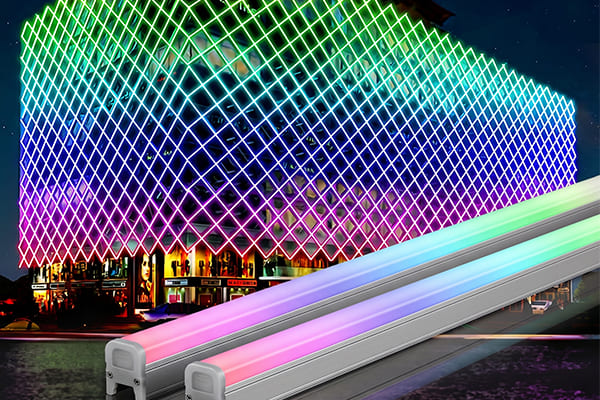
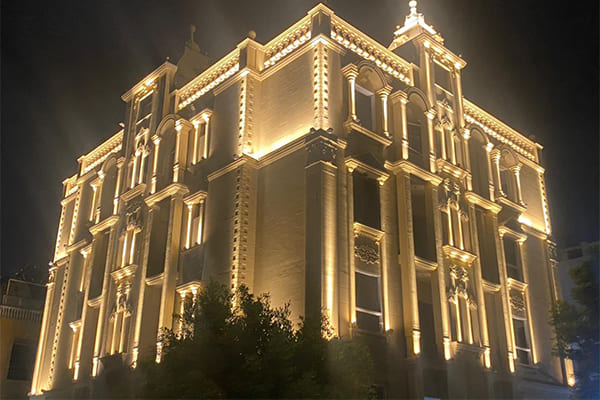
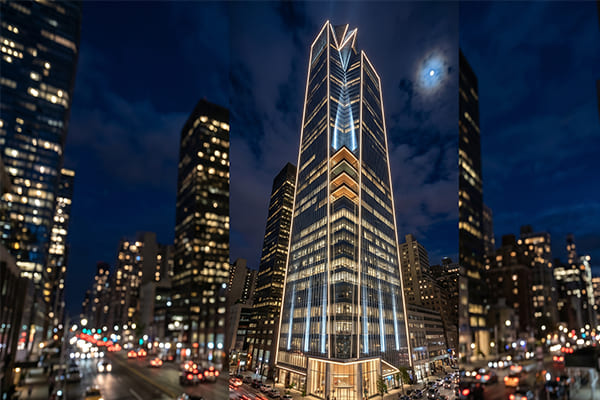
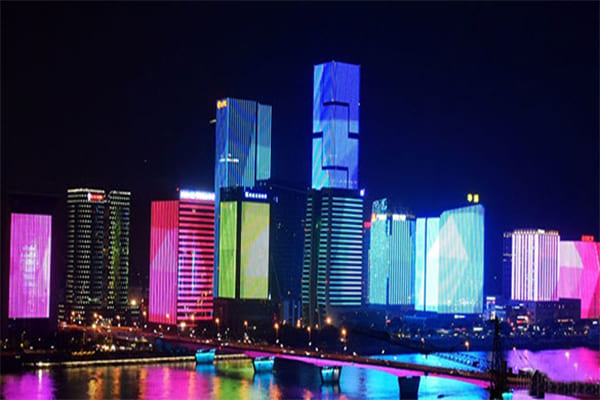
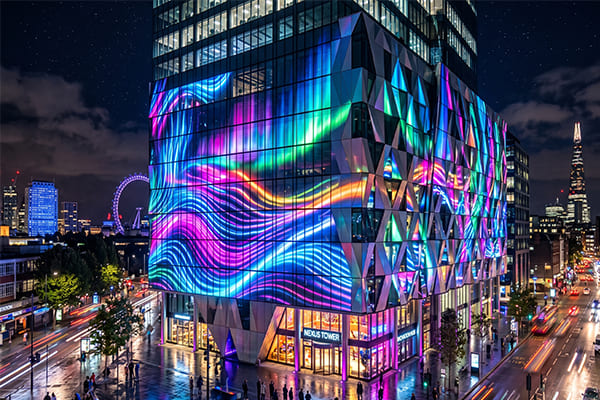
The entire face of a building can become a giant screen5. We use high-density LED pixel lights, like our Juxuanled pixel products, and control them with the DMX512 protocol. This allows us to create massive media facades. These aren't just for showing logos. We can program them to display beautiful digital art or even connect them to live city data. Imagine a facade that shows a visual representation of the current weather or changes color based on traffic flow. The building stops being just a structure and starts a conversation with the city.
Groundscapes that Play with You
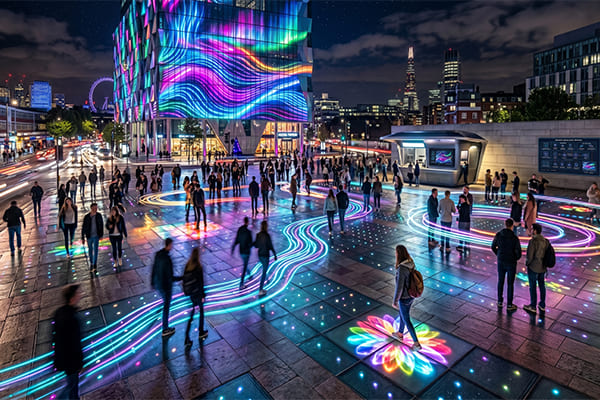
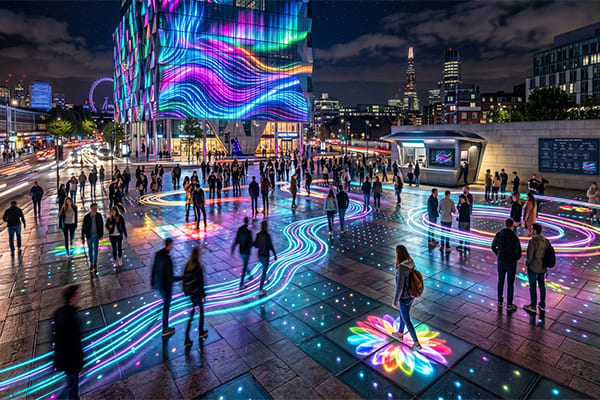
Plazas, walkways, and public squares are perfect for interactive lighting. Here, we often use SPI-controlled pixel lights installed directly into the ground. By pairing these with radar tracking systems, we can create the "light follows you" effect. As people walk, the lights under their feet illuminate, leaving a trail of light. I remember a project where we installed this in a public square. We watched as kids and adults spent hours just running around, playing with the light. It turned an empty space into a destination.
Indoor Atriums as Dynamic Sculptures
Large indoor spaces like atriums can feel empty and cold. Interactive lighting can transform them into immersive art installations. We can combine our RGBW fixtures with mechanical systems, like computer-controlled winches (CNC), to create moving light sculptures. These can be programmed to react to sound or even hand gestures. Imagine walking into a lobby where a constellation of lights gently rises and falls, changing color in response to the ambient noise. It creates a powerful and memorable first impression.
What Is the Real Business Value of Interactive Lighting?
Investing in advanced lighting seems expensive. You're not sure if the return is worth the cost. The business benefits are surprisingly direct and measurable.
Interactive lighting delivers real value. It can increase the time customers stay by up to 40% and boost social media sharing. It also saves energy and can even generate revenue through advertising, making it a smart financial investment.
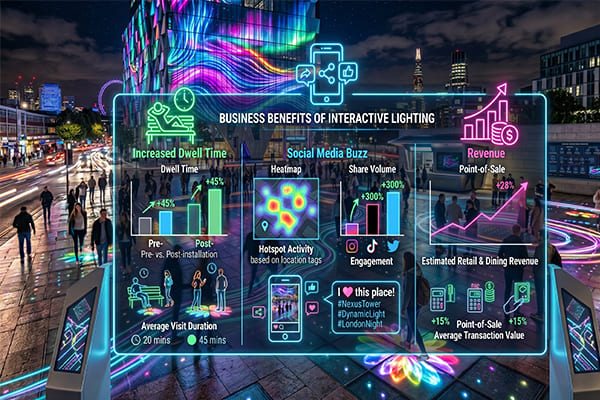
When I talk to project contractors and building owners, the conversation always comes around to cost versus benefit. Many are surprised to learn that interactive lighting isn't just an expense; it's an investment that pays for itself in multiple ways. The value goes far beyond just aesthetics.
Enhancing Customer Experience and Engagement
The first and most obvious benefit is how it affects people. Studies and our own project data show that engaging environments can increase customer dwell time by 30-40%6. For a shopping mall or retail district, that's huge. When people stay longer, they are more likely to shop, eat, and spend money7. Beyond that, unique lighting creates "Instagrammable moments."8 People love to take photos and videos of cool experiences and share them online. Your building becomes free advertising on social media, reaching thousands of potential new visitors.
Creating New Revenue Streams
An interactive facade is a valuable asset. We help clients set up their systems for dual purposes.
| Time Period | Facade Content | Business Goal |
|---|---|---|
| Off-Peak | Artistic animations | Brand enhancement, beauty |
| Peak Hours | Paid advertisements | Direct revenue generation |
During evenings or less busy times, the facade can display beautiful, branded art content. During peak traffic hours, it can be switched to show advertisements for tenants or outside companies. This creates a direct revenue stream. This feature also acts as a premium amenity, allowing building owners to justify higher rental rates.
Improving Operational Efficiency
Finally, "smart" lighting is also efficient lighting. Because the system is interactive, lights are often at full power only when people are present and engaging with them. The rest of the time, they can be dimmed or turned off. This smart control can lead to energy savings of 30-60% compared to traditional static lighting9 that runs at 100% all night. Over the life of the system, this adds up to significant operational savings.
How Do You Successfully Implement an Interactive Lighting Project?
You're ready to start a project but worried about technical failures or poor results. A complex system can be hard to maintain. Success comes from focusing on a few key fundamentals.
A successful implementation requires durable hardware with at least an IP65 rating and good heat management. Focus on system stability and easy maintenance over overly flashy effects. The goal is an intelligent system that can perceive, think, express, and interact reliably.
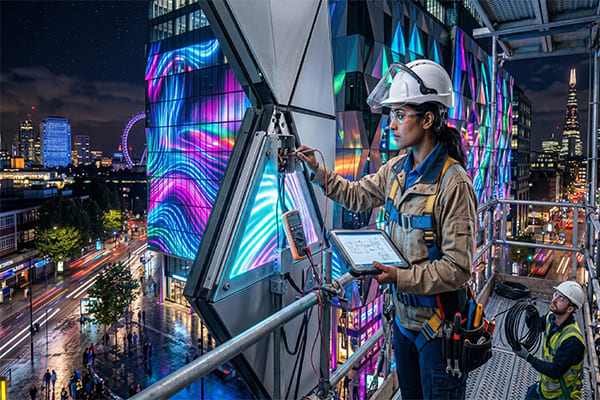
A great idea is only as good as its execution. Over the years, I've learned that the most successful interactive lighting projects are the ones that get the basics right. Fancy effects are exciting, but reliability and durability are what matter in the long run.
Choosing the Right Hardware
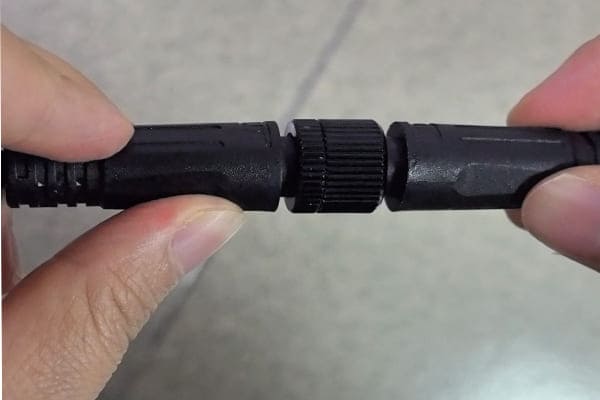
This is non-negotiable. For any outdoor project, the fixtures must be tough. I always insist on products with at least an IP65, and preferably an IP67, rating10. This means they are fully protected from dust and can withstand powerful jets of water or even temporary submersion. The other critical factor is heat dissipation. LEDs generate heat, and if that heat isn't managed, their lifespan plummets. I always tell my clients that high-quality extruded aluminum housing isn't a luxury; it's what ensures the fixtures will last for their rated 50,000 hours. Poor heat management is the number one killer of LED products.
Balancing Art and Function
It's easy to get carried away and design something that is overly flashy. But more is not always better. A constant barrage of bright, fast-moving lights can cause visual fatigue and become an annoyance rather than an attraction. A great design enhances the architecture, it doesn't overpower it. Just as important is planning for stability and maintenance from day one. A system that is constantly breaking down or is difficult to service is a failure. We focus on building robust systems and providing our clients with the training and support to keep them running smoothly.
The Goal: An Intelligent Building
Ultimately, a successful project creates what we call an "intelligent building." The goal is to build a system that achieves four things: Perception, Thought, Expression, and Interaction. The lighting perceives its environment, thinks about how to respond based on its programming, expresses itself through light and motion, and interacts with the people around it. This is the future of architectural lighting that we are so passionate about building at Juxuanled. It's about bringing buildings to life.
Conclusion
Interactive lighting turns buildings into dynamic landmarks. It boosts engagement, creates business value, and when done right, defines the future of architecture. It’s a powerful tool for any project.
"[PDF] A Novel Floor Display System Based on Luminous Modular Units", https://scholarspace.manoa.hawaii.edu/bitstreams/81c8b2d7-103c-4b7f-be9a-5a618a456617/download. A neutral building-controls or lighting-engineering source should support that interactive lighting systems use sensors, controllers, and programmed outputs to alter illumination in response to occupancy or environmental inputs. Evidence role: definition; source type: education. Supports: Interactive lighting transforms commercial buildings by using sensors and smart controls to react to people and the environment.. Scope note: This would support the technical definition of interactive lighting, not the article’s broader commercial-performance claims. ↩
"Advanced Millimeter-Wave Radar System for Real-Time Multiple ...", https://ui.adsabs.harvard.edu/abs/2024Senso..24.3660S/abstract. A research or technical source on millimeter-wave radar should support that mmWave sensing can estimate human motion, range, and position for indoor tracking applications. Evidence role: mechanism; source type: research. Supports: Millimeter-wave radar can track a person's movement and position accurately.. Scope note: Accuracy depends on sensor configuration, environment, signal processing, and deployment conditions. ↩
"DMX512 - Wikipedia", https://en.wikipedia.org/wiki/DMX512. A standards or technical reference on DMX512 should support that the protocol is widely used for digital lighting control and is specified for wired control over substantial cable runs in stage and architectural lighting contexts. Evidence role: general_support; source type: institution. Supports: DMX512 is used for building facades because it can send lighting-control signals reliably over long distances.. Scope note: Reliability over distance depends on compliant cabling, termination, topology, and electromagnetic conditions. ↩
"ALITOVE WS2811 12mm Diffused Digital RGB LED Pixel Light 5V ...", https://www.amazon.com/ALITOVE-LED-Individually-Addressable-Waterproof/dp/B01AG923GI. A technical reference on SPI-based LED pixel control should support that serial peripheral interfaces and related serial LED protocols can address many closely spaced LEDs or pixels with rapid data transfer. Evidence role: mechanism; source type: education. Supports: SPI is suitable for controlling high-density pixel displays individually.. Scope note: The statement “perfect” is evaluative; the source would support suitability for dense pixel control, not superiority in all installations. ↩
"(DOC) Media Facades: When Buildings Perform - Academia.edu", https://www.academia.edu/41515986/Media_Facades_When_Buildings_Perform. A source on media facades or architectural LED displays should support that building envelopes can be fitted with addressable lighting or display elements to function as large-scale urban screens. Evidence role: historical_context; source type: research. Supports: Building facades can function as large-scale media displays or urban screens.. Scope note: This supports the feasibility and concept of media facades, not the suitability of every building facade for display use. ↩
"Secret of Dwell Time in Retail | Giken Trastem Co., Ltd.", https://www.trastem.co.jp/eng/case_study/retail/dwell_time.html. A peer-reviewed retail-environment or environmental-psychology study should support the broader relationship between engaging atmospherics and increased customer dwell time; any precise 30–40% figure should be cited only if the source reports a comparable measured range. Evidence role: statistic; source type: paper. Supports: Engaging environments can increase customer dwell time by 30–40%.. Scope note: The percentage may vary by retail format, intervention, location, and measurement method; a contextual study would not prove the same uplift for all lighting projects. ↩
"Retail Dwell Time - the Route to Higher Spending - Metrics to Measure", https://www.retailsensing.com/people-counting/retail-dwell-time-metric/. A retail analytics or consumer-behavior study should support that longer dwell time is associated with higher purchasing likelihood or spending in retail and hospitality environments. Evidence role: expert_consensus; source type: paper. Supports: Longer customer dwell time is associated with greater likelihood of shopping, eating, or spending money.. Scope note: Association between dwell time and spending does not necessarily prove that lighting alone causes higher revenue. ↩
"[PDF] Visual Content Analysis of Instagram posts: The case of an Alpine ...", https://scholarworks.umass.edu/bitstreams/80083ba2-8593-4d2b-9a61-01d72a1d4e1d/download. A tourism, place-branding, or consumer-culture study should support that visually distinctive built environments and installations encourage photography and social-media sharing. Evidence role: general_support; source type: paper. Supports: Unique lighting installations can encourage visitors to take and share photos or videos on social media.. Scope note: The source would support the general relationship between visual distinctiveness and sharing behavior, not guarantee social-media reach for a specific building. ↩
"[PDF] A Meta-Analysis of Energy Savings from Lighting Controls in ...", https://eta-publications.lbl.gov/sites/default/files/a_meta-analysis_of_energy_savings_from_lighting_controls_in_commercial_buildings_lbnl-5095e.pdf. A government or energy-efficiency source should support that lighting controls such as occupancy sensing, dimming, and scheduling can substantially reduce lighting energy use; the cited source should match or contextualize the 30–60% savings range. Evidence role: statistic; source type: government. Supports: Smart lighting controls can reduce energy use by 30–60% compared with static lighting operation.. Scope note: Actual savings depend on baseline operating hours, control strategy, fixture efficiency, occupancy patterns, and commissioning quality. ↩
"IP code - Wikipedia", https://en.wikipedia.org/wiki/IP_code. An IEC ingress-protection reference or standards-based source should support that IP65 and IP67 ratings describe specified levels of protection against dust and water ingress. Evidence role: definition; source type: institution. Supports: Outdoor lighting fixtures should use IP65 or IP67-rated enclosures for protection against dust and water exposure.. Scope note: IP ratings describe laboratory-tested ingress protection and do not by themselves establish overall fixture durability, corrosion resistance, or long-term outdoor reliability. ↩