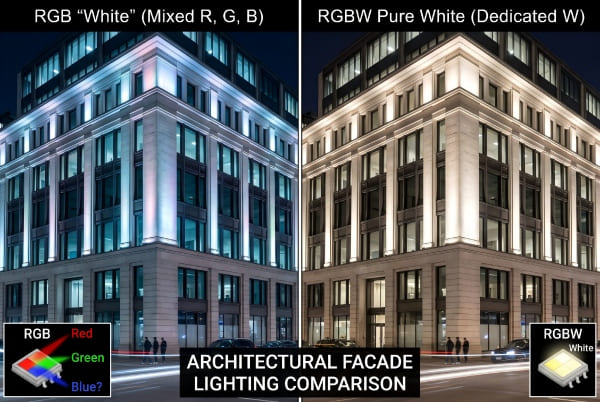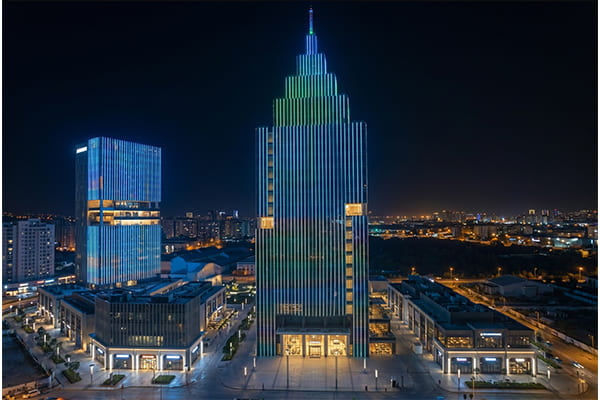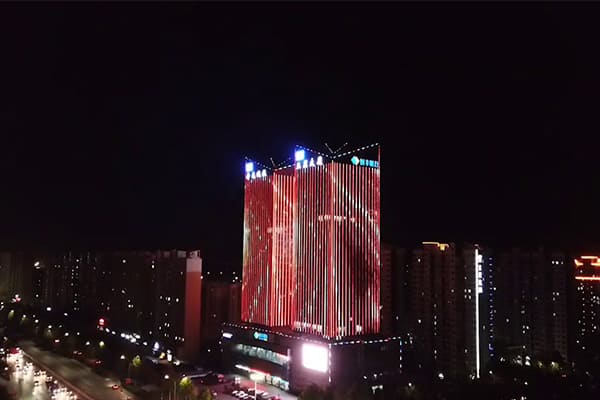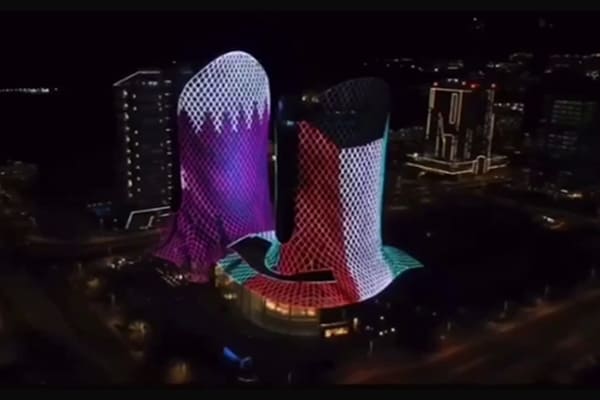
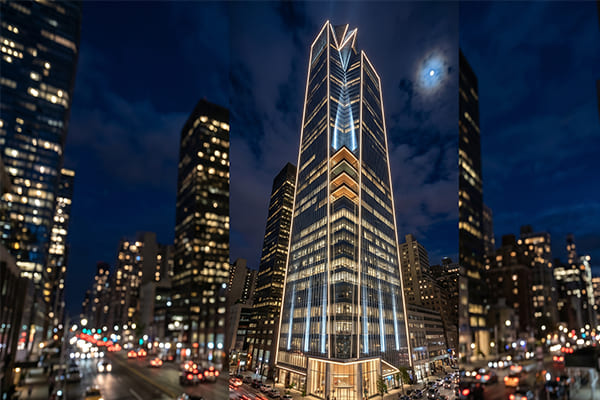
Your building's design is stunning, but what happens when the sun sets? Poor lighting can make it disappear or, worse, look cheap. This happens when light is just an afterthought.
The best lighting designers work with architects from the very beginning1 of a project. They treat light as a building material2. This collaboration ensures the lighting enhances the architecture, creating a unified and powerful nighttime identity3 instead of just being tacked on at the end.
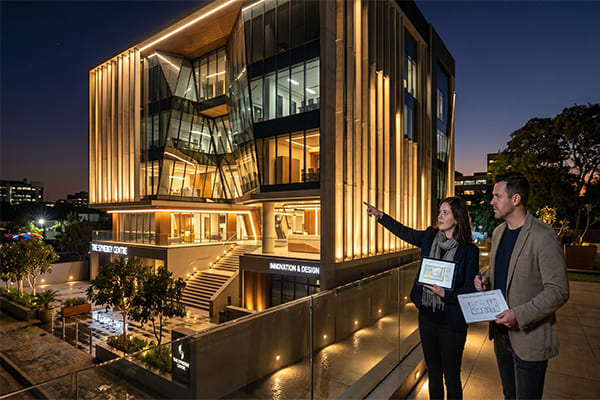
I've been in the lighting business for a long time, and I've seen it all. I’ve seen incredible architectural plans fall flat at night because of poor lighting choices made too late. The secret to avoiding this is a deep, respectful partnership between the architect and the lighting designer. This partnership isn't just about picking fixtures; it's about building a shared vision. Let's break down how this crucial relationship works and what makes it successful.
How Does the Collaborative Process Unfold in Practice?
Many projects treat lighting as a final step, leading to last-minute problems4. This approach causes budget overruns5 and ugly installations. A structured, phased approach6 is the only way to succeed.
The collaboration happens in stages, starting with the concept. Here, we define the "light language." Then, we move to design development for technical integration. Finally, the construction drawing phase finalizes all details.
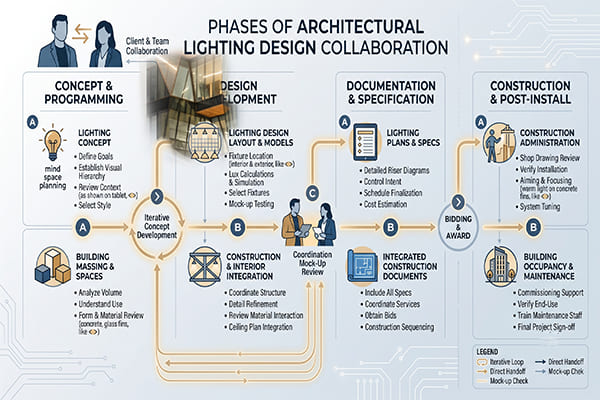
At my company, JUXUANLED, we believe in getting involved early. Real success in outdoor lighting comes from a process that integrates light into the very fabric of the building. It’s a journey with distinct phases, and each one is critical.
From Concept to Construction
The process isn't a single event. It's a conversation that evolves over three main stages.
-
Concept Phase: This is where the magic begins. The lighting designer must first listen. We need to understand the architect's vision, the story the building is supposed to tell. We translate their "language of space" into our "language of light." What is the building's purpose? What mood should it evoke at night? Here, we define the visual hierarchy and overall atmosphere7. It's not unusual for us to develop a complete lighting plan for a client two or three years before the building is even ready for installation. This early planning is the foundation for everything.
-
Design Development Phase: Now we get technical. We work side-by-side with the architects to solve integration challenges. Our goal is always to achieve the "invisible fixture" effect, where you see the beautiful light, not the hardware that creates it. This means meticulously planning every detail: Where will the fixtures be mounted? How much space do we need? Where will the cables run? We co-design installation nodes and reserve cavities within the structure itself.
-
Construction Drawing Phase: This is the final blueprint. We create detailed lighting layouts and control system diagrams. We must also work closely with the MEP8 (Mechanical, Electrical, and Plumbing) engineers. We need to confirm that the building's electrical system can handle the load and that our smart control systems can integrate smoothly.
| Phase | Key Activity | Goal |
|---|---|---|
| Concept | Translate architectural vision into light | Define nighttime atmosphere & hierarchy |
| Design Development | Co-design fixture installation & wiring | Achieve "invisible fixture" effect |
| Construction | Coordinate with MEP, finalize all drawings | Ensure flawless technical execution |
What Are the Biggest Challenges in This Collaboration?
Even with the best intentions, architects and lighting designers can run into conflicts. These clashes can derail timelines, inflate budgets, and compromise the final design vision. You can avoid this by preparing for them.
The biggest hurdles are usually conflicts over structural space, how building materials react to light, and the complexity of control systems9. Proactive planning and on-site testing are the only way to overcome them.
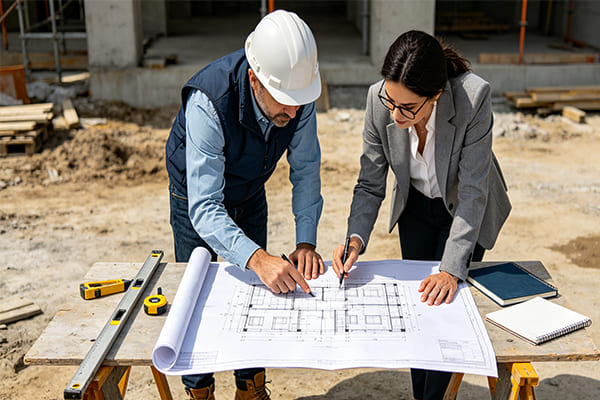
In any great partnership, there will be friction. The key is to see these challenges not as roadblocks, but as puzzles to be solved together. In my experience, three main conflicts come up again and again. Knowing what they are is half the battle.
1. The Battle for Space
An architect wants to maximize usable interior space. A lighting designer needs space within the walls, ceilings, and facade to hide fixtures. This is a classic conflict. In the past, this led to frustrating compromises on-site. Today, we have a powerful tool: Building Information Modeling (BIM). By creating a detailed 3D digital model of the entire building, we can "virtually" install every single light fixture. We can see exactly where a wall washer might clash with a ventilation duct or where we don't have enough depth for a recessed fixture. BIM allows us to resolve these spatial conflicts10 on a computer screen months or years before construction even starts, saving enormous amounts of time and money.
2. The Material-Light Mismatch
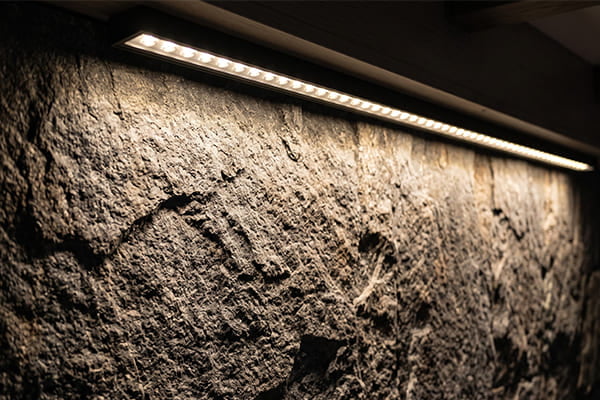
An architect chooses a facade material for its texture, color, and durability in daylight. But how will it look at night under a specific type of light? This is often a huge surprise. A material that looks smooth and uniform can reveal every tiny imperfection under a tight beam of light.11 A dark, matte material can absorb so much light that it requires double the fixtures to illuminate. There is no substitute for on-site testing. We always insist on creating mock-ups. We take the actual fixtures we plan to use to the site and test them on samples of the actual building materials. This is the only way to see how the light and materials will truly interact.
3. Taming the Controls
Modern lighting systems are incredibly powerful. We can change colors, dim lights, and run complex animated scenes. But this power brings complexity. An architect might have a feeling they want to create, like "I want it to feel warm and inviting in the evening, but dynamic and exciting for holidays." It's our job to translate that feeling into a clear "control narrative." This means defining the technical parameters: What exact color temperature is "warm"? What scenes do we need? How will the user interact with the system? We have to write a clear script that turns an artistic vision into a functional, easy-to-use control system that the building staff can actually manage.
What Does a Perfectly Lit Building Look Like?
Many buildings are just bright, lacking any subtlety or art. This over-lighting creates light pollution and fails to highlight the building's best features. A successful project uses light to reveal the building's soul.
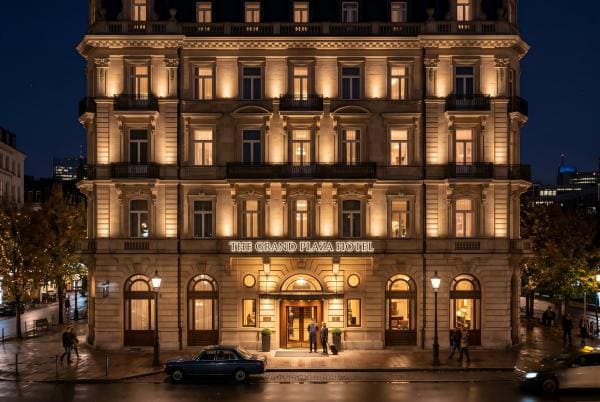
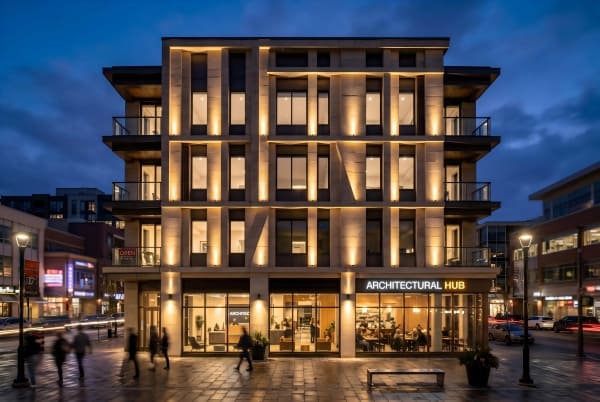
A perfectly lit building has fixtures that are invisible during the day. At night, it seems to glow naturally from within. It uses layers of light to create a clear visual hierarchy and a distinct identity.
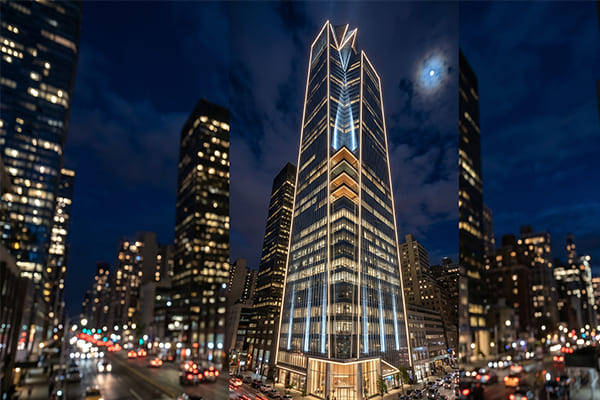
So, what is the ultimate goal? What is the standard we are all striving for? It’s not just about making a building visible at night. It's about giving it a second life after dark. The standard of success is when light becomes an inseparable part of the architecture itself.
The first rule is simple: during the day, the lighting fixtures should be completely hidden. They should not disrupt the architect's clean lines and intended facade texture. Then, at night, the building shouldn't look like it has lights stuck onto it. It should appear to radiate light from within, as if it is naturally luminous. This is achieved by creating different layers of light that work together. We don't just blast the building with one big floodlight. We paint with light using a more nuanced palette.
| Lighting Layer | Purpose | Common JUXUANLED Fixtures |
|---|---|---|
| Ambient | Sets the base mood and general brightness | Wide-beam Floodlights |
| Accent | Highlights specific architectural details | Spotlights, Pixel Lights |
| Wall Washing | Creates a smooth, uniform luminous surface | High-power Wall Washers |
| Contour | Outlines the building's shape and silhouette | IP68 Linear Lights |
By using these layers—ambient light for mood, accent lighting for details, wall washing for surfaces, and contour lighting for shape—we create depth and visual interest. The result is a building that has a clear identity at night. It becomes a landmark, a visual anchor for the city, telling its story through the language of light.
Conclusion
True collaboration makes light an integral part of the architecture. It's not just a decorative layer added on top. This partnership turns a building into a living, breathing nighttime landmark.
"Architectural lighting design - Wikipedia", https://en.wikipedia.org/wiki/Architectural_lighting_design. Professional lighting-design guidance describes architectural lighting as an integrated design discipline that benefits from coordination during early concept and design stages, rather than after architectural decisions are fixed. Evidence role: expert_consensus; source type: institution. Supports: The best lighting designers collaborate with architects from the earliest stages of a building project.. Scope note: The source would support early integration as accepted practice, not prove that every successful project requires it. ↩
"Color, Light, and Material Studies", https://archenvironment.uoregon.edu/interior-architecture/research/color-light-material-studies. Architectural lighting scholarship and professional literature commonly describe light as an active component of spatial perception and architectural form, supporting the article’s framing of light as more than an applied fixture layer. Evidence role: expert_consensus; source type: education. Supports: Lighting designers can treat light as a fundamental architectural design element comparable to a material.. Scope note: This is conceptual support for the design approach, not a measurable technical requirement. ↩
"Historic Urban Settings, Led Illumination and Its Impact on Nighttime ...", https://www.academia.edu/112103645/Historic_Urban_Settings_Led_Illumination_and_Its_Impact_on_Nighttime_Perception_Visual_Appearance_and_Cultural_Heritage_Identity. Urban-design and architectural-lighting literature recognizes exterior lighting as a factor in nighttime legibility, identity, and perception of buildings and public places. Evidence role: general_support; source type: paper. Supports: Integrated lighting can help a building create a coherent nighttime identity.. Scope note: Such sources usually provide contextual support for identity formation rather than direct proof for this specific building type or project. ↩
"Design Changes in Construction Projects -Causes and Impact on ...", https://www.academia.edu/144051752/Design_Changes_in_Construction_Projects_Causes_and_Impact_on_the_Cost. Research on building-design coordination and late design changes shows that unresolved design issues discovered during construction can increase rework, delays, and coordination costs. Evidence role: general_support; source type: paper. Supports: Treating lighting as a late-stage item can contribute to coordination problems during construction.. Scope note: The evidence would support late coordination problems in construction generally; it may not isolate lighting as the only cause. ↩
"Impact of Design Changes in Construction Project - Academia.edu", https://www.academia.edu/85315528/Impact_of_Design_Changes_in_Construction_Project. Construction-management studies identify design changes, poor coordination, and rework as recurrent contributors to cost overruns in building projects. Evidence role: statistic; source type: paper. Supports: Late or poorly coordinated design decisions can contribute to budget overruns.. Scope note: This would substantiate the general cost-overrun mechanism, not quantify lighting-specific overruns unless a lighting-focused source is found. ↩
"Defining the architect's basic services | AIA", https://www.aia.org/resource-center/defining-the-architects-basic-services. Standard architectural and engineering design processes divide projects into phases such as concept, design development, construction documentation, and construction coordination, supporting the article’s phased collaboration model. Evidence role: definition; source type: institution. Supports: Lighting collaboration can be organized through structured design phases from concept to construction documentation.. Scope note: The source would validate the phased process framework, not the claim that it is the only possible route to success. ↩
"Reimagining Ceiling Design: The Fifth Wall in Interiors - RMCAD", https://www.rmcad.edu/blog/reimagining-ceiling-design-the-fifth-wall-in-interiors/. Lighting-design references describe hierarchy, contrast, brightness distribution, and atmosphere as core tools for directing visual attention and shaping spatial perception. Evidence role: expert_consensus; source type: institution. Supports: Concept-stage lighting design commonly defines visual hierarchy and atmosphere.. Scope note: The source would support these as recognized design concepts, not prescribe a single hierarchy for every facade. ↩
"[PDF] MEP Coordination in Building and Industrial Projects", https://stacks.stanford.edu/file/druid%3Avn180wh3959/WP054.pdf. Building-services guidance treats lighting, electrical load, controls, and related infrastructure as coordinated MEP concerns during design documentation and construction coordination. Evidence role: mechanism; source type: institution. Supports: Lighting designers need to coordinate with MEP engineers to confirm electrical capacity and control-system integration.. Scope note: The source would support the need for coordination in principle; project-specific electrical requirements still depend on the building design. ↩
"[PDF] cdot-lighting-design-guideline.pdf", https://www.codot.gov/safety/traffic-safety/assets/documents/cdot-lighting-design-guideline.pdf. Architectural lighting guidance discusses luminaire integration, surface reflectance and texture, and control systems as major technical considerations in exterior and architectural lighting design. Evidence role: general_support; source type: institution. Supports: Structural integration, material-light interaction, and lighting-control complexity are common issues in architect–lighting designer coordination.. Scope note: A single source may cover these topics separately rather than rank them as the biggest collaboration challenges. ↩
"Cost-benefit analysis of BIM-enabled design clash detection and ...", https://www.academia.edu/77715233/Cost_benefit_analysis_of_BIM_enabled_design_clash_detection_and_resolution. BIM research and government guidance describe clash detection as a method for identifying conflicts among building systems in a digital model before construction. Evidence role: mechanism; source type: government. Supports: BIM can be used to identify and resolve spatial conflicts between lighting fixtures and other building systems before construction.. Scope note: The source would support BIM clash detection generally; realized savings vary by project and implementation quality. ↩
"Grazing-Incidence Telescopes for X-Ray Astronomy - NASA ADS", https://adsabs.harvard.edu/full/1969SSRv....9....3G. Lighting and optics references explain that grazing or narrow-angle illumination can increase the visibility of surface texture and irregularities by creating shadows and contrast. Evidence role: mechanism; source type: education. Supports: Directional facade lighting can make surface imperfections more visible.. Scope note: The effect depends on angle, beam distribution, surface finish, and viewing position. ↩