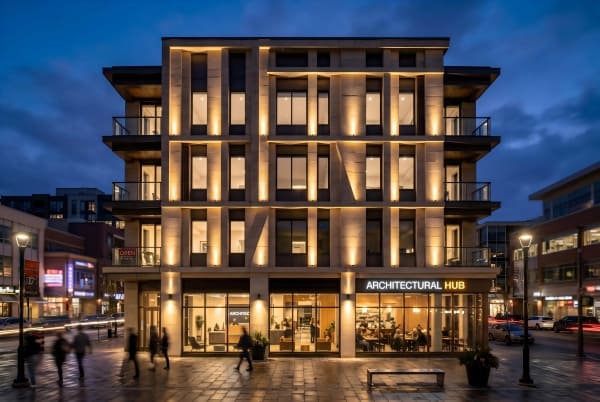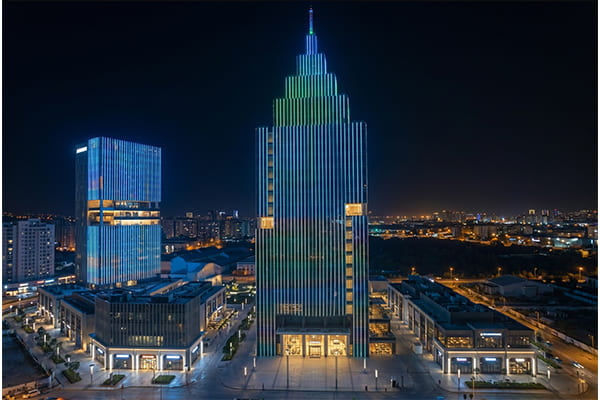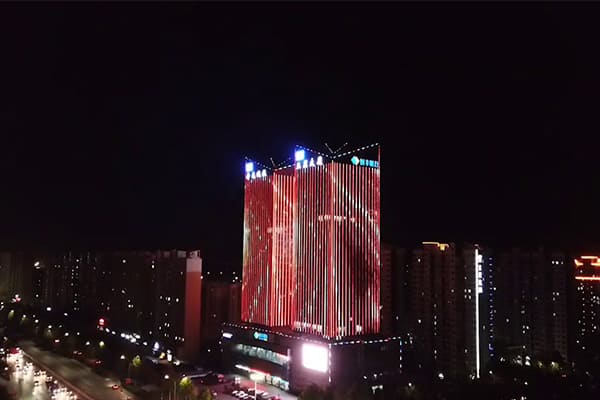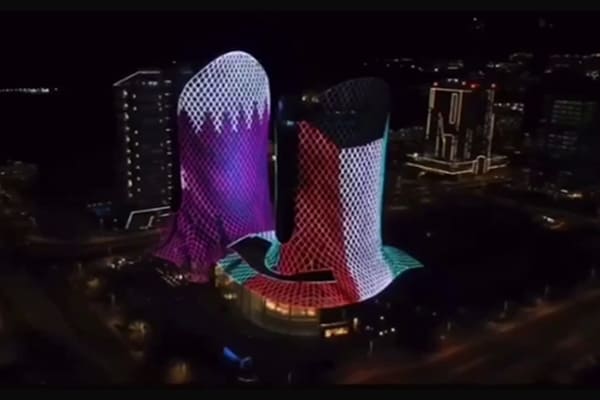
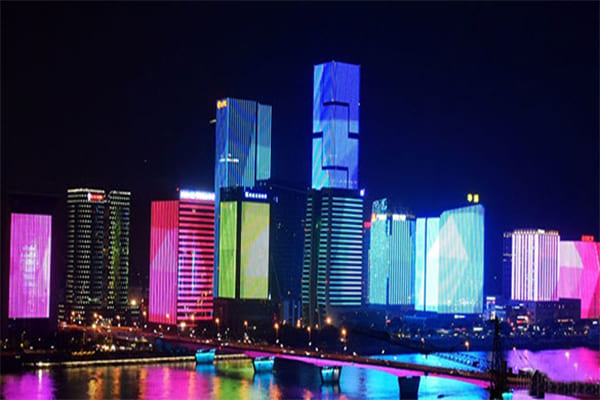
Tired of buildings that just sit there at night? Static lighting is outdated and boring. Imagine turning your project into a living, breathing landmark that captivates everyone.
Programmable LEDs transform buildings by turning them into digital canvases. Using systems like DMX512, you can control individual lights to create dynamic color changes, animations, and even video displays1. This makes the architecture interactive and expressive, going far beyond simple illumination.
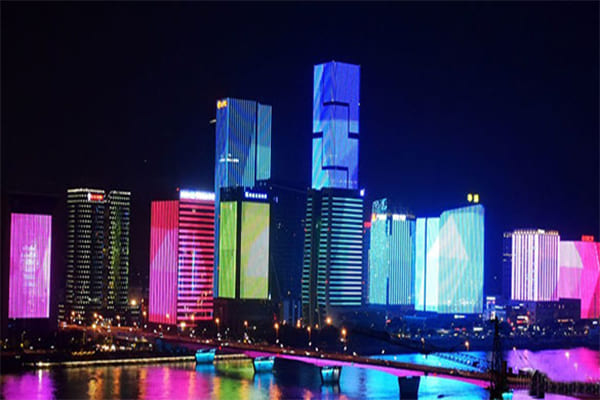
I've seen this transformation firsthand on many projects. Buildings are no longer just lit up; they communicate. But how does this technology actually work, and what makes it so powerful? Let's break it down to see how you can apply it to your next project.
What Makes Programmable LED Systems the Core of Dynamic Facades?
Your building blends into the night, unnoticed. Old lighting methods just wash it out with one color. You need a way for your structure to stand out and tell a story.
Programmable LED systems are the core because they are pixel-based. Each light, whether a dot, strip, or mesh node, acts as a single pixel2. With control protocols like DMX512 or Art-Net3, we can command each pixel individually, creating complex visual effects and animations.
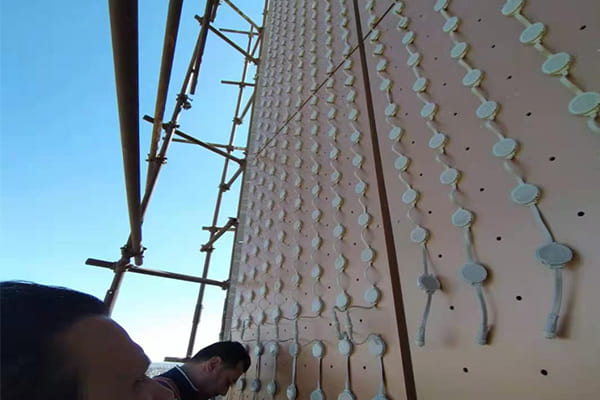
The real magic happens when you treat a building's surface like a giant digital screen. This is a huge shift from traditional lighting, which was all about flooding a surface with static light. Today, we use thousands of individual light points to create motion and narratives. At my company, JUXUANLED, we help contractors and designers achieve this by providing the right hardware and control systems. The system starts with the lights themselves. These could be individual pixel lights, linear light bars, or even flexible media mesh screens. Each light is a "pixel" in your design. Then, a central controller sends signals to every single pixel, telling it what color to be and how bright to be at any given moment. This is how you create smooth animations, video playback, and even effects that sync with music4.
Key Components and Control Protocols
The combination of different fixtures and control protocols gives you ultimate creative freedom. For one project, we used thousands of our pixel lights on a skyscraper. Each light was mapped in our programming software. Using a DMX controller, the client could instantly switch from a simple, elegant color fade for regular nights to an animated dragon display for a national festival. This level of control is simply impossible with traditional lighting. It turns the facade into a true media platform5.
| Component | Function | Common Control Protocol |
|---|---|---|
| Pixel Lights | Individual points of light for high-resolution effects and detailed patterns. | DMX512, SPI |
| Linear Lights | Continuous lines of light for outlining structures and wall grazing. | DMX512,SPI |
| Media Mesh | A flexible grid of LEDs for covering large, irregular surfaces with video. | Art-Net, sACN,SPI,DMX512 |
How Does Optical Design Affect the Final Visual Impact?
Bad lighting can make expensive materials look cheap. The wrong beam angle creates glare or uneven light. You want to highlight the building's texture and form, not wash it out.
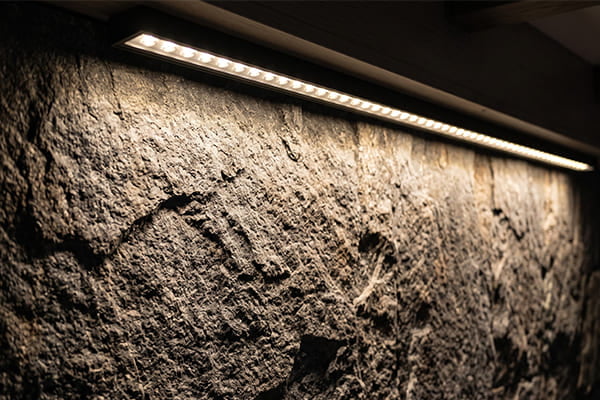
Optical design is crucial. It determines how light interacts with surfaces6. A narrow beam angle creates a "grazing" effect that highlights textures.7 A wider beam angle provides a smooth "wall wash."8 The right choice makes the architecture's details pop and ensures the final look is polished.
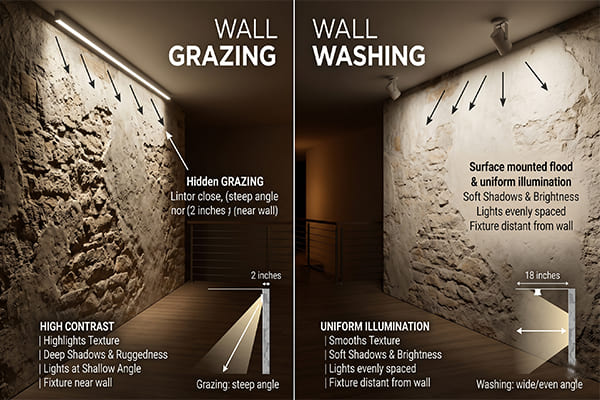
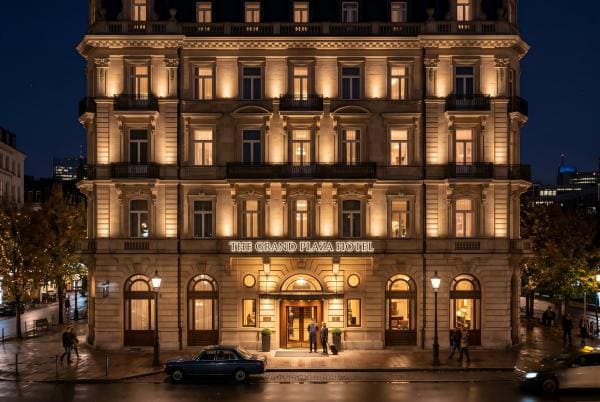
It’s not enough to just put lights on a building. How the light leaves the fixture is just as important as the light itself. This is where optics come in. The lens on an LED fixture shapes the light into a specific beam. This decision directly impacts whether you reveal or hide the architectural details. For a project with textured materials like rough stone or corrugated metal, you want to use a grazing technique. This means placing the light close to the surface and using a very narrow beam. The light skims across the surface, creating dramatic shadows that reveal the material's depth and texture. On the other hand, for a smooth, modern facade, you might want a perfectly even coat of light. This is called wall washing, and it requires a wider beam angle from a fixture placed further from the wall.
Choosing the Right Optics for Different Surfaces
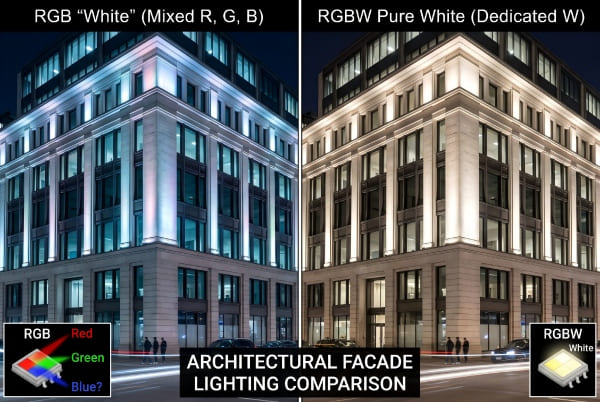
I remember a hotel project where the architect wanted to emphasize the rough-cut stone columns. We used our linear lights with a very narrow 10-degree beam. The light grazed the surface, creating deep shadows that made the texture look incredibly rich and expensive. For the smooth plaster walls in between, we used wide-beam floodlights to create a uniform glow. The contrast was stunning and made the building feel very sophisticated. Another key factor is the light quality itself. We often recommend RGBW fixtures9. The "W" stands for a dedicated white LED chip. This means you can create vibrant, saturated colors for dynamic shows, but also produce a pure, high-quality white light10 for a more classic and elegant look.
| Effect | Beam Angle | Best For |
|---|---|---|
| Wall Grazing | Narrow (e.g., 10-15°) | Highlighting textures like stone, brick, and metal panels. |
| Wall Washing | Wide (e.g., 45-60°) | Creating smooth, uniform light on flat, even surfaces. |
| Accent Lighting | Very Narrow (e.g., 5°) | Pinpointing specific features like columns, statues, or logos. |
Can Dynamic Lighting Also Be Smart and Sustainable?
Large-scale lighting projects often mean high energy bills and complex maintenance. You worry about the long-term operational costs. What if your dynamic facade could actually save you money?
Absolutely. Modern programmable LEDs are incredibly energy-efficient. When combined with smart control systems, they can reduce energy use by over 60% compared to old methods11. These systems allow for remote monitoring, scheduling, and automatic dimming12, lowering both energy bills and maintenance costs.
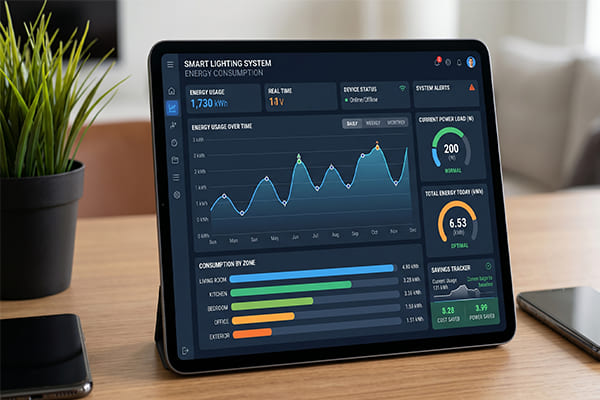
A dynamic facade is not just visually impressive; it's also a core part of a modern smart building. The same control system that runs the animations can be integrated with other building management systems (BMS) and IoT sensors. This opens up a world of possibilities for efficiency and automation. For example, you can program the lighting to automatically dim to 20% brightness after midnight to save energy and reduce light pollution. You can link it to sensors that change the lighting colors based on the weather, or even connect it to a public event calendar to automatically display team colors during a big game. This intelligence also extends to maintenance. Our systems can provide remote diagnostics, sending an alert if a fixture or power supply fails. This means you can fix problems proactively instead of waiting for someone to notice a dark spot on the building.
Balancing Visuals with Responsibility
This smart integration is what delivers major long-term value. We've seen clients reduce their facade lighting energy consumption by over 60% just by replacing old high-pressure sodium or metal halide lamps with a scheduled LED system. But being smart also means being responsible. A major challenge with facade lighting is the potential for light pollution. That's why good design is about more than just impact. We work with our clients to ensure the system is considerate of its environment. This includes using precise optics that keep light on the building and out of the night sky (Dark Sky compliance). It also means using reliable, IP67-rated fixtures that can withstand dust and water for years, reducing waste and maintenance headaches. A truly smart system is one that is brilliant, efficient, and durable.
Conclusion
Programmable LEDs are not just about lighting; they turn buildings into dynamic, smart, and communicative landmarks. This technology allows architecture to tell stories and truly come alive at night.
"(DOC) Media Facades: When Buildings Perform - Academia.edu", https://www.academia.edu/41515986/Media_Facades_When_Buildings_Perform. A technical source on DMX512, Art-Net, or media-facade systems can support that addressable lighting controls allow individual luminaires or pixels to be assigned intensity and color values for animated displays; this does not by itself verify the performance of any specific installation. Evidence role: mechanism; source type: institution. Supports: Programmable LED systems can control individual lights to create dynamic color changes, animations, and video-like displays.. Scope note: Supports the control principle, not the visual quality or reliability of a particular project. ↩
"A framework for designing complex media facades - Academia.edu", https://www.academia.edu/67172508/A_framework_for_designing_complex_media_facades. Research on media facades describes LED nodes or luminaires as pixel-like elements mapped onto architectural surfaces, supporting the characterization of facade lighting systems as low- or high-resolution displays; the comparison is conceptual and depends on pixel density and viewing distance. Evidence role: definition; source type: paper. Supports: In programmable facade systems, individual LED dots, strips, or mesh nodes can function as pixels in a larger architectural display.. Scope note: The source may describe media facades generally rather than the exact fixtures discussed in the article. ↩
"DMX512 - Wikipedia", https://en.wikipedia.org/wiki/DMX512. Protocol documentation for DMX512 and Art-Net can substantiate that these systems transmit lighting-control data to addressed devices or universes used in architectural and entertainment lighting; protocol support does not imply that every fixture can be controlled without compatible hardware and programming. Evidence role: definition; source type: institution. Supports: DMX512 and Art-Net are control protocols used to command lighting devices or pixels in programmable facade systems.. Scope note: Supports protocol capability, not universal compatibility across all products. ↩
"Media Façade Lighting: Pixel Mapping & Control Protocols", https://ditra-solutions.com/wiki/what-is-media-facade-lighting. Technical literature on architectural media displays and show-control systems can support that mapped LED arrays can render timed animation, video-derived content, and synchronized audiovisual cues; this is contextual support and does not prove that all facade controllers provide these functions out of the box. Evidence role: mechanism; source type: research. Supports: Central controllers can coordinate LED pixels to produce animations, video playback, and synchronized effects.. Scope note: Feature availability depends on controller software, fixture resolution, and integration design. ↩
"(DOC) Media Facades: When Buildings Perform - Academia.edu", https://www.academia.edu/41515986/Media_Facades_When_Buildings_Perform. Media-architecture scholarship documents that building facades equipped with networked LED elements can function as public media displays for patterns, information, and visual narratives; this supports the media-platform concept but not the effectiveness of any specific creative content. Evidence role: general_support; source type: paper. Supports: Programmable LED facades can operate as media platforms rather than merely static illumination systems.. Scope note: The source would support the general concept, not a measured audience impact. ↩
"[PDF] Chapter 11 Table of Contents", https://www.intrans.iastate.edu/wp-content/uploads/sites/15/2018/09/Chapter_11-2014.pdf. Lighting-design references explain that optical distribution, beam angle, fixture placement, and surface properties determine illuminance patterns, shadows, and perceived texture; such evidence supports the design principle rather than prescribing one universal layout. Evidence role: mechanism; source type: education. Supports: Optical design determines how light interacts with architectural surfaces.. Scope note: The exact visual result varies with surface material, mounting distance, fixture output, and ambient conditions. ↩
"The Art of Grazing - QTL Lighting", https://www.qtl.lighting/blog/the-art-of-grazing/. Architectural lighting guidance describes wall grazing as placing luminaires close to a surface, often with narrow distributions, to emphasize surface relief through highlights and shadows; this supports the mechanism while leaving exact beam angles project-specific. Evidence role: mechanism; source type: education. Supports: Narrow-beam grazing light can highlight textured architectural surfaces.. Scope note: The appropriate beam angle depends on fixture setback, surface relief, and desired contrast. ↩
"What is Wall Wash Lighting? | Lumato", https://lumato.com/wall-washer-lighting-removes-shadows-and-provides-even-lighting-for-enhanced-visibility/. Lighting-design sources distinguish wall washing from grazing by describing it as more uniform illumination over a vertical surface, typically using broader distributions and greater spacing from the wall; this supports the principle but not a fixed beam-angle rule. Evidence role: definition; source type: education. Supports: Wider beam distributions are commonly used for wall-washing effects that produce smoother, more uniform illumination.. Scope note: Uniformity depends on luminaire spacing, distance from the wall, mounting height, and surface reflectance. ↩
"Hello, what's the difference in RGB and RGBW? Surely rgb can go ...", https://www.facebook.com/groups/mobiledjnetwork/posts/10024059084301396/. Color-mixing references explain that RGBW luminaires add a dedicated white emitter to red, green, and blue channels, enabling white-light output without relying solely on RGB color mixing; this supports the technical distinction but not subjective judgments of beauty or elegance. Evidence role: definition; source type: research. Supports: RGBW fixtures include a dedicated white LED channel in addition to red, green, and blue channels.. Scope note: White-light quality still depends on LED binning, spectrum, optics, and control calibration. ↩
"Watch this before buying LEDs - YouTube", https://www.youtube.com/watch?v=LdpvCepML-E. Studies and technical reports on multichannel LED lighting can show that adding a white channel can improve white-light rendering or efficiency compared with RGB-only mixing under certain designs; this is conditional support because color quality depends on spectrum, color rendering metrics, and calibration. Evidence role: mechanism; source type: paper. Supports: A dedicated white channel in RGBW fixtures can improve the ability to produce white light compared with RGB-only systems.. Scope note: A white channel does not automatically guarantee high color rendering or consistent white across all products. ↩
"LED Lighting | Department of Energy", https://www.energy.gov/energysaver/led-lighting. Government energy-efficiency sources report that LED lighting can use substantially less energy than legacy lighting technologies and that controls such as dimming and scheduling can produce additional savings; a citation can contextualize a 60% reduction, but actual savings depend on baseline lamps, operating hours, and control strategy. Evidence role: statistic; source type: government. Supports: Replacing older lighting with LED systems and controls can reduce lighting energy use substantially, potentially around or above 60% in some contexts.. Scope note: The exact percentage is project-dependent and may not apply to every facade retrofit. ↩
"Lighting Controls | Department of Energy", https://www.energy.gov/energysaver/lighting-controls. Connected-lighting research from energy agencies or laboratories documents that networked lighting controls can provide scheduling, dimming, monitoring, and fault-detection functions that reduce operating energy and support maintenance; the evidence is general and does not quantify savings for this specific facade. Evidence role: general_support; source type: government. Supports: Smart lighting control systems can enable remote monitoring, scheduling, and automatic dimming to improve operations and energy management.. Scope note: Actual maintenance and energy benefits depend on system design, sensor accuracy, commissioning, and operating policies. ↩