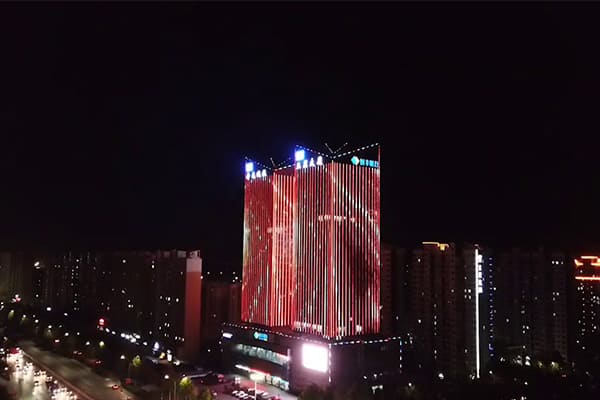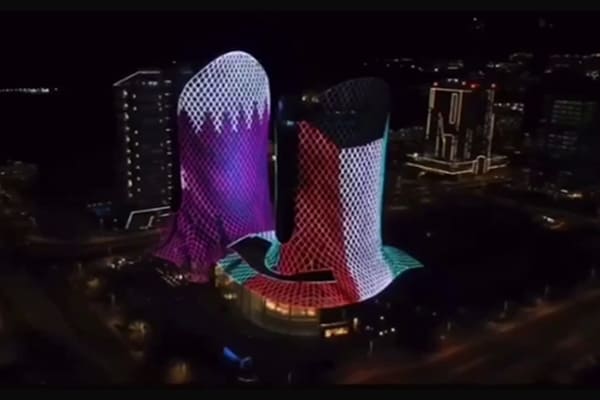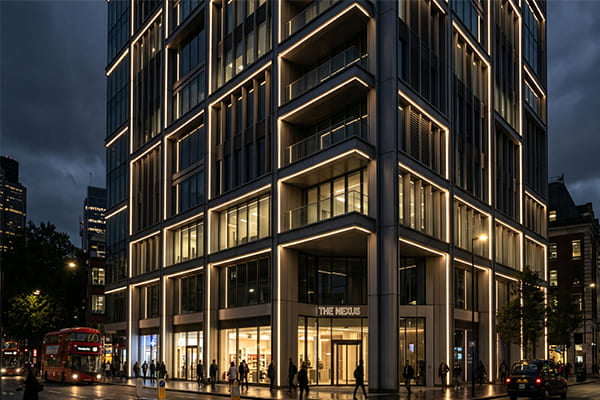
Choosing the right facade lighting can feel overwhelming. A wrong decision can ruin your project's aesthetic and budget. I will help you understand the key differences to make the perfect choice.
For most high-quality projects, RGBW lighting is the better choice. It provides pure, high-quality white light for daily use and vibrant colors for special events. RGB is a good option for budget-focused projects where dynamic color is the main priority over white light quality.
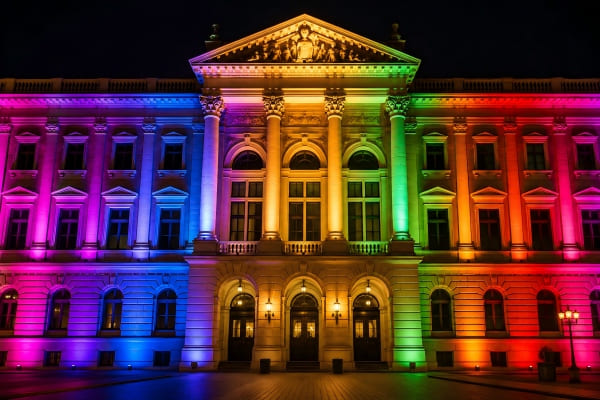
As a specialist in outdoor lighting, I’ve seen this question come up on almost every project. The decision between RGB and RGBW seems small, but it has a huge impact on the final look and long-term value of a building. Your choice depends entirely on your project's goals, the building's materials, and your budget. Let's break it down so you can choose with confidence and avoid costly mistakes. This is about getting the best result not just for opening night, but for every night that follows.
What's the Real Technical Difference Between RGB and RGBW Lights?
Are you confused about what RGB and RGBW actually mean? Many people think they are similar, but a small technical difference creates a huge visual impact. Let's clarify it.
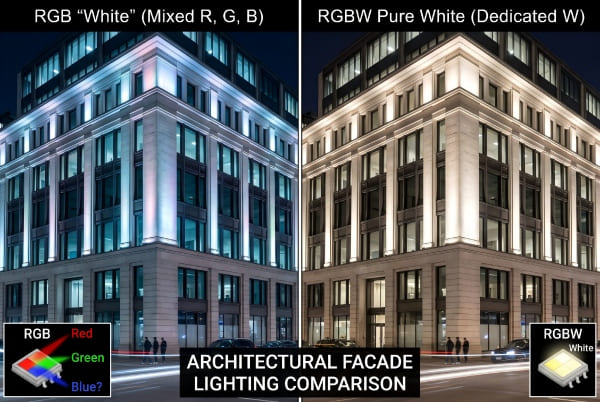
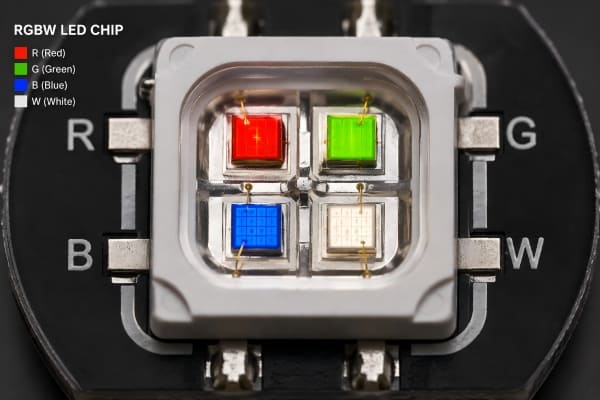
The main difference is a dedicated white chip. An RGB fixture mixes Red, Green, and Blue light to create colors, including a version of white. An RGBW fixture adds a fourth, separate White chip, allowing it to produce a pure, high-quality white light directly.
The Core Technology: 3 Chips vs. 4 Chips
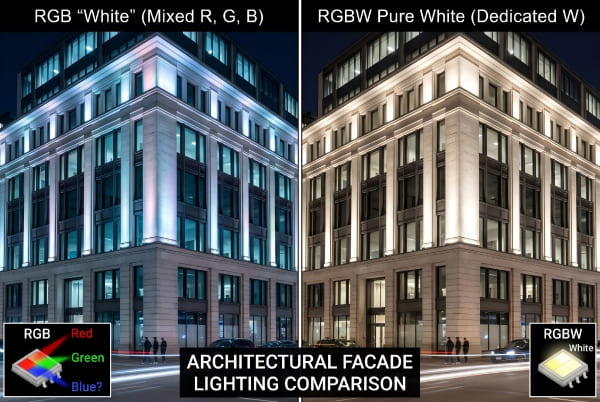
Let's look at this more closely. Think of an RGB LED light as having three tiny light sources inside: one red, one green, and one blue. By controlling the brightness of each of these three sources, we can mix them together to create a huge spectrum of colors. It's based on an additive color model1. When you turn all three colors on to full brightness, their light combines to produce a color that looks like white. However, I can tell you from experience, this mixed white is never truly pure. It often has a slight bluish or pinkish tint2. It gets the job done for color effects, but it doesn't look natural for general illumination.
Now, an RGBW LED light takes this a step further. It has the same red, green, and blue chips, but it adds a fourth, dedicated white chip. This is a game-changer. When you need white light, the fixture doesn't need to mix colors. It simply turns on the white chip. This gives you a crisp, clean, and high-quality white light, just like a standard white-only fixture. This means you get the best of both worlds: full-color mixing capabilities for special effects and a high-performance white light for everyday use.
How Do RGB and RGBW Compare in Performance and Cost?
Your project's success depends on performance, but your budget is always a reality. It's frustrating when you have to choose between the two. Let's see how they stack up directly.
RGBW lights offer superior white light quality, better color accuracy, and more energy efficiency in white mode. RGB lights are simpler to control and cost 10-30% less, making them a strong budget-friendly option for color-focused applications. The choice depends on balancing performance needs with cost.
A Head-to-Head Comparison
I’ve spent years specifying and installing both systems, and the performance differences are clear on site. To make it simple, I've put the key differences into a table. This is the same kind of breakdown I provide my clients to help them make an informed decision.
| Feature | RGB System | RGBW System |
|---|---|---|
| White Light Quality | Fair. Mixed white often has a color tint. | Excellent. Pure, natural white from a dedicated chip. |
| Color Rendering (CRI) | Lower. Colors may not look true to life. | High. Accurately reveals the true colors of surfaces. |
| Color Performance | Strong, high-saturation colors. | Richer color palette, including pastel shades. |
| Energy Consumption | High when producing white light. | Very energy-efficient in white light mode3. |
| Upfront Cost | Lower, typically by 10-30%. | Higher. |
| Control Complexity | Simpler, uses 3 DMX channels4. | More complex, uses 4 DMX channels. |
When we talk about White Light Quality, the difference is something you can see immediately. The white from an RGB fixture is a compromise. For a five-star hotel that needs to look elegant and clean, that slight color tint is unacceptable. The pure white from an RGBW system looks professional and high-end. Related to this is the Color Rendering Index (CRI)5. In simple terms, CRI tells you how "real" colors look under the light. RGBW's high CRI means a building's beautiful stone or paint colors will look just as rich and true at night as they do during the day6. RGB's lower CRI can make those same materials look dull or slightly off-color. Finally, while RGB is great for bold, vibrant colors, the added white chip in RGBW allows for a wider, more subtle range of colors, including soft pastels and macaron shades7, which gives designers more artistic freedom.
When Should You Choose RGB Lighting for Your Building?
Working with a tight budget but still need a big visual impact? RGB lighting might be the perfect solution if dynamic color is your primary goal. Sometimes, it's the smarter choice.
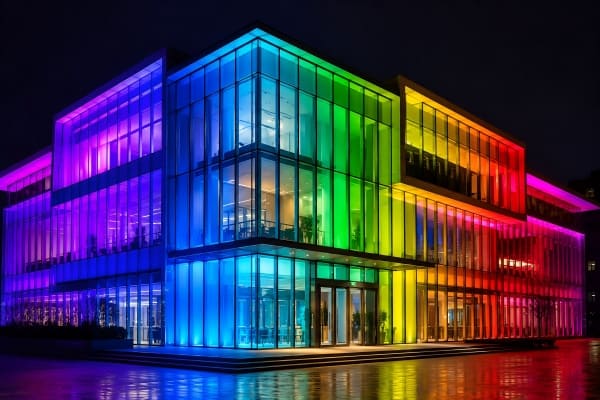
Choose an RGB system when your project is budget-sensitive or the main purpose is creating dynamic, saturated color effects. It's ideal for entertainment venues, theme parks, and modern facades like glass curtain walls or metal panels where pure white light isn't the priority.
The Right Scenarios for RGB
Based on my experience, there are very specific situations where I recommend an RGB system to a client. It's all about matching the technology to the project's core mission.
1. When the Budget is the Top Priority
Let's be practical. Sometimes, the budget is the biggest constraint. An RGB system can be 10% to 30% cheaper than an equivalent RGBW system. I remember a project for a large commercial plaza where the client wanted to add dynamic lighting but had a very strict budget. We used RGB wall washers to highlight the main architectural lines. This saved them a significant amount on the initial investment, which they used for other parts of the project. The result was a vibrant, eye-catching building that met their budget.
2. For Entertainment and High-Energy Venues
Think about theme parks, nightclubs, concert stages, or casinos. What do they all have in common? They need to create an atmosphere of excitement and energy. For these applications, high-saturation, fast-changing, and intense colors are the goal. The quality of white light is a very low priority. RGB systems excel at producing these powerful, punchy colors. The simpler 3-channel control also makes it easier to program the fast, dynamic scenes these venues require.
3. On Modern Glass and Metal Facades
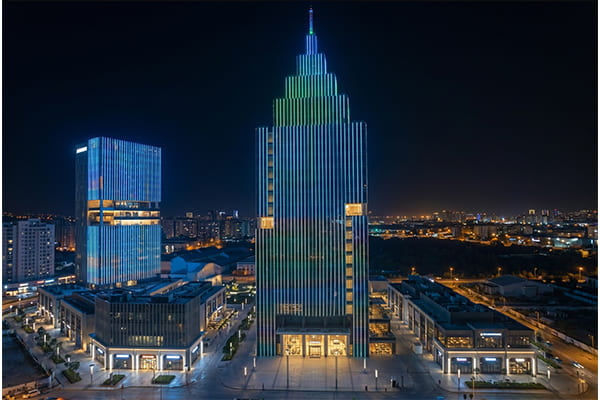
The surface of your building matters. For modern buildings with glass curtain walls or reflective metal panels, RGB lighting can be very effective. These surfaces reflect the light in a way that enhances the pure, saturated colors8. The slight imperfections in the mixed-white light are less noticeable on these highly reflective, non-textured surfaces. The focus is on the color and movement, not the subtle texture of the building material.
When is an RGBW System the Superior Choice for Facade Lighting?
Do you need your building to look sophisticated and high-end every single day, not just during holidays? This is where an RGBW system proves its worth as a long-term investment.
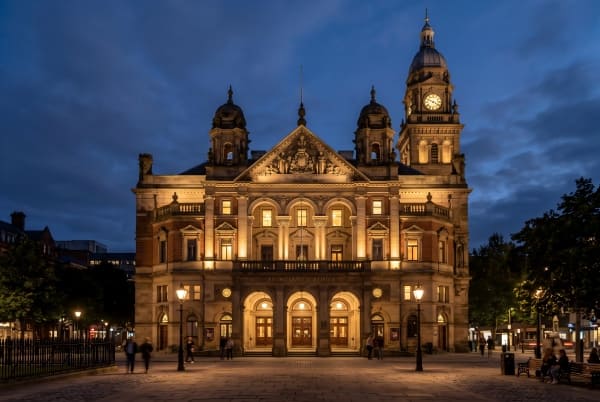
An RGBW system is the superior choice for high-end projects where both quality daily lighting and festive color options are needed. It's perfect for luxury hotels, landmark buildings, and historic sites where material integrity and a premium feel are essential.
Investing in Quality and Versatility
For the majority of the high-end facade projects we handle at JUXUANLED, RGBW is the standard recommendation. It's not just a product; it's a long-term strategy. The reason is simple: versatility and quality.
1. For High-End and Landmark Properties
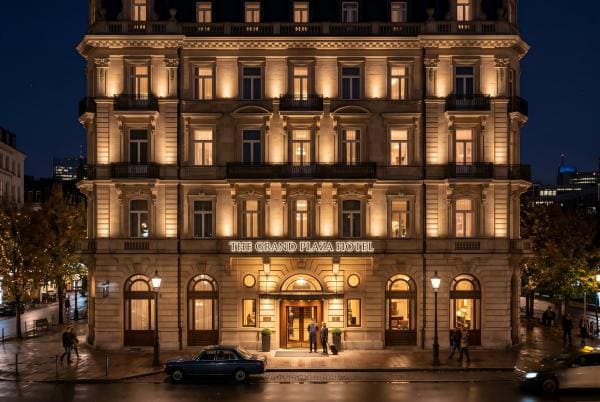
Think about five-star hotels, Class-A office buildings, and major corporate headquarters. These buildings are symbols of quality and prestige. They require a lighting solution that reflects that. On a typical evening, they need to be bathed in a flawless, elegant white light. The pure, high-CRI white light from an RGBW system achieves this perfectly. It makes the building look clean, modern, and sophisticated. Then, during a national holiday or a special event, the same system can switch to a dynamic, full-color display. This "dual-function" capability is what I call "one system, double function." It provides exceptional value.
2. For Historic Buildings and Natural Materials
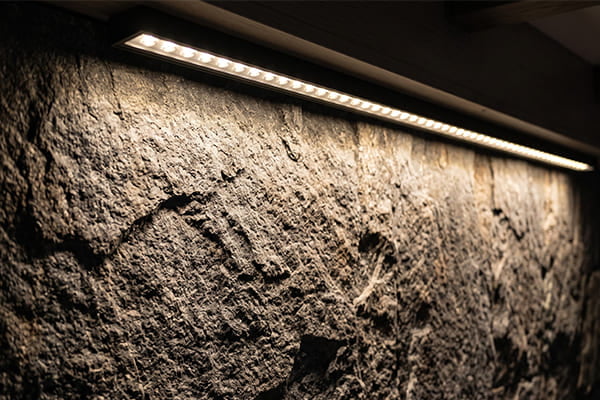
I recently consulted on a project for a historic municipal building made of natural limestone. The goal was to highlight its beautiful texture and classic architecture respectfully. Using an RGB system's mixed white would have been a disaster; the bluish tint would have made the warm stone look cold and unnatural. We specified an RGBW system with a warm white chip (3000K)9. The result was stunning. The high-CRI white light brought out the natural warmth and detail of the stone. An RGBW system is essential for any project with natural stone, textured concrete, or other materials where color accuracy is critical.
The most important insight I can share is this: over 80% of our clients' architectural projects use white light for daily operation10. The colored scenes are reserved for festivals and special occasions, which might only be 10-20 days a year. Investing in an RGBW system ensures your building looks its absolute best for the other 345 days, while still giving you the flexibility for celebration. It’s the ultimate no-compromise solution.
Conclusion
Choose RGBW for projects demanding premium white light and color versatility for long-term value. Opt for RGB when the budget is tight and the main goal is vibrant, dynamic color.
"RGB color model - Wikipedia", https://en.wikipedia.org/wiki/RGB_color_model. The additive color model, as described in color science, produces white light by combining red, green, and blue light sources at full intensity; see 'Additive color' in standard references on color theory. Evidence role: definition; source type: encyclopedia. Supports: The additive color model combines red, green, and blue light at varying intensities to produce a spectrum of colors, with full-intensity combination yielding white.. ↩
"[PDF] LED Color Characteristics", https://www.energy.gov/sites/prod/files/2016/08/f33/led-color-characteristics-factsheet.pdf. Research on LED spectral characteristics demonstrates that RGB-mixed white light exhibits spectral discontinuities between the three narrow emission peaks, leading to reduced color rendering and perceptible color shifts compared to broadband phosphor-converted white LEDs. Evidence role: mechanism; source type: research. Supports: RGB LED mixing produces white light with spectral gaps between the narrow-band red, green, and blue peaks, resulting in lower color quality compared to phosphor-converted white LEDs.. Scope note: The degree of tinting varies by LED bin quality, driver calibration, and specific phosphor chemistry used in comparison white LEDs. ↩
"RGB vs RGBW strip for cool AND warm white", https://www.reddit.com/r/led/comments/1njvsgh/rgb_vs_rgbw_strip_for_cool_and_warm_white/. Phosphor-converted white LEDs typically achieve luminous efficacies exceeding 150 lm/W in current commercial products, whereas producing equivalent white light by mixing RGB sources requires all three channels at high power, resulting in lower system-level efficacy due to Stokes losses and spectral mismatch with the human visual response curve. Evidence role: mechanism; source type: research. Supports: Dedicated white LEDs achieve higher luminous efficacy than RGB mixing for white light because phosphor-converted white emitters do not suffer from the spectral inefficiencies of combining three narrow-band sources.. Scope note: Actual efficiency gains depend on specific LED components, driver efficiency, thermal management, and operating conditions of the installation. ↩
"DMX512", https://en.wikipedia.org/wiki/DMX512. DMX512, standardized as ANSI E1.11, allocates one channel per controllable parameter; an RGB fixture thus requires a minimum of three channels (one per color), while an RGBW fixture requires a minimum of four. Evidence role: definition; source type: encyclopedia. Supports: DMX512 is a digital communication standard used to control lighting, where each independently controllable parameter (such as an LED color channel) requires one DMX channel.. Scope note: Many commercial fixtures use additional DMX channels beyond the color channels for functions such as dimming, strobing, and program selection. ↩
"Color rendering index", https://en.wikipedia.org/wiki/Color_rendering_index. The Color Rendering Index is defined by the International Commission on Illumination (CIE) as a measure of a light source's fidelity in rendering object colors relative to a standard reference illuminant (CIE 13.3-1995). Evidence role: definition; source type: institution. Supports: The Color Rendering Index (CRI) is a quantitative measure, standardized by the CIE, of a light source's ability to reveal the true colors of objects compared to a reference illuminant.. ↩
"Color Rendering Index (CRI) and LED Lighting", https://flexfireleds.com/color-rendering-index-cri-and-led-lighting-what-is-cri/?srsltid=AfmBOoro2vq5ei6CRV1bRH6aLywMwo2wCcCQnPrrMdCqKKTTDPJ8e7tT. Studies in architectural lighting demonstrate that light sources with CRI values above 80 significantly improve the perceived naturalness and fidelity of illuminated surface colors compared to lower-CRI sources (see IES Lighting Handbook, 10th edition). Evidence role: general_support; source type: research. Supports: Higher CRI light sources more faithfully reproduce the appearance of surface colors, which is critical in architectural lighting applications where material appearance must be preserved.. Scope note: CRI has known limitations as a metric; the newer TM-30 (IES) color fidelity and gamut metrics may provide more accurate assessments for specific material types. ↩
"Additive & Subtractive Color Models > DINFOS Pavilion > Article", https://pavilion.dinfos.edu/Article/Article/2355687/additive-subtractive-color-models/. In LED color mixing, the addition of a dedicated white emitter allows for systematic desaturation of any hue by blending it with broadband white light, thereby enabling pastel and low-saturation color reproduction that three-channel RGB systems cannot achieve with comparable uniformity. Evidence role: mechanism; source type: research. Supports: Adding a white channel to RGB LEDs enables controlled desaturation of colors, expanding the reproducible palette to include pastel and tinted-white hues not achievable with three-channel mixing alone.. Scope note: The specific pastel quality depends on the white LED's spectral profile and the precision of the multi-channel driver. ↩
"Lighting Design: Techniques to Transform Interior Spaces", https://marymount.edu/blog/lighting-design-techniques-to-transform-interior-spaces/. Architectural lighting research indicates that specular surfaces primarily reflect the spectral content of the incident light without the diffuse scattering that reveals color rendering deficiencies, making them more forgiving of narrow-band RGB sources than textured or matte materials. Evidence role: mechanism; source type: research. Supports: Specular and highly reflective surfaces such as glass and polished metal tend to preserve the spectral characteristics of incident colored light while being less sensitive to CRI deficiencies than matte, textured surfaces.. Scope note: This principle applies primarily to direct and specular reflection; diffuse secondary reflections from surrounding surfaces may still reveal color quality issues. ↩
"Color temperature", https://en.wikipedia.org/wiki/Color_temperature. Per IES and CIE classifications, correlated color temperatures at or below 3000K are categorized as 'warm' light; heritage lighting guidelines frequently recommend warm-white sources (2700K–3000K) to complement natural stone and traditional materials. Evidence role: definition; source type: institution. Supports: A correlated color temperature of 3000K falls within the 'warm white' classification and is commonly recommended for lighting historic structures and natural stone surfaces.. Scope note: Optimal color temperature for heritage buildings depends on local regulations, stone type, and surrounding context; some preservation authorities may specify different values. ↩
"Exterior Lighting Scoping Study", https://www.pnnl.gov/main/publications/external/technical_reports/pnnl-20579.pdf. The International Association of Lighting Designers (IALD) and professional lighting design guidelines generally recommend that permanent architectural lighting installations default to white illumination for everyday use, employing color sparingly for planned events. Evidence role: statistic; source type: institution. Supports: Professional architectural lighting guidelines recommend white light as the default mode for most building facades, with dynamic color reserved for programmed events and celebrations.. Scope note: The specific 80% figure cited in the article appears to be derived from the author's client portfolio rather than a representative industry-wide survey. ↩