Struggling to make your stadium project a true landmark? Your lighting design feels functional but lacks that "wow" factor. This leaves your venue feeling forgettable and just another building.
The best stadium lighting inspiration comes from integrating light directly into the architecture. The goal is a "light without fixtures" effect, using hidden linear lights, dynamic RGBW floodlights, and media facades to make the stadium a living, breathing landmark that captivates audiences.
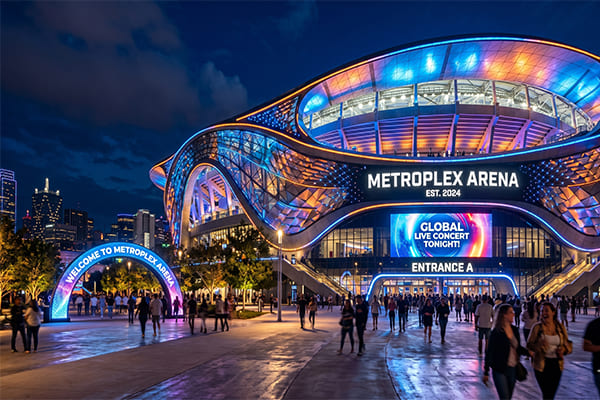
Modern stadium lighting has moved far beyond simply illuminating the field.1 It’s now a complex system that blends architectural beauty, broadcast requirements, and immersive entertainment2. The most advanced designs make the building itself the source of light3, creating a structure that feels alive at night. It's about telling a story with light and creating an unforgettable experience for everyone, from the players on the field to the fans in the stands and the city around it. Let's explore how the world's most iconic stadiums achieve this.
What are the main types of modern stadium lighting design?
Are you having trouble defining a clear design vision for your project? Without a strong concept, your stadium risks looking like a random collection of ideas, failing to make a powerful statement.
Modern stadium lighting concepts generally fall into four categories: Minimalist Architectural Glow, immersive Media Facades, iconic Urban Landmarks, and dynamic Entertainment Hubs. Each approach gives the stadium a unique identity and purpose.
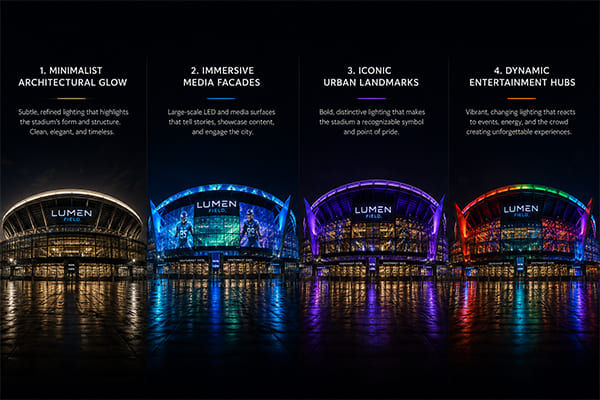
When I work with project contractors, the first thing we discuss is the stadium's primary identity. Do you want it to be a subtle architectural masterpiece or a vibrant media spectacle? The answer defines the entire lighting strategy. We've seen these four main approaches dominate the industry. Each one uses light in a fundamentally different way to achieve its goal. For example, some clients want the focus to be on the clean lines of the building, while others want a canvas for advertising and team branding. It's crucial to choose a direction early on.
Here’s a breakdown of these four popular design types:
Exploring the Four Key Design Strategies
| Design Type | Core Concept | Example Project | Our Role & Products |
|---|---|---|---|
| Minimalist Glow | Emphasizes the building's form. Light sources are hidden to make the structure itself glow from within. | Allianz Arena, Germany4 | We provide hidden linear lights and wall washers to create a seamless, uniform wash of light. |
| Media Facade | Turns the entire exterior into a massive video screen for dynamic content and sponsorship. | SoFi Stadium, USA5 | Our pixel lights and media mesh systems, managed by Art-Net, are perfect for creating these large-scale video displays. |
| Urban Landmark | The lighting design aims to create a powerful, static visual that becomes an icon on the city skyline. | Lusail Stadium, Qatar6 | We use high-power, precision floodlights to sculpt the building with light and shadow, creating a dramatic effect. |
| Entertainment Immersion | Focuses on creating a dynamic show for fans with synchronized lights, music, and on-field action. | Crypto.com Arena, USA | Our RGBW fixtures and DMX control systems are used to create thrilling light shows and goal celebration sequences. |
I remember a project where the client was torn between a minimalist design and a media facade. We helped them find a hybrid solution, using our linear lights to accentuate the architecture while integrating a media mesh screen on the main entrance. This gave them the best of both worlds: an elegant building that could transform into a dynamic screen when needed.
What are the key technical requirements for today's stadiums?
Are you worried your lighting will fail to meet modern broadcast standards? Poor lighting with flicker or bad color rendering can ruin a multi-million dollar broadcast and disappoint fans watching from home.
The most critical technical needs are high uniformity and low glare for players7, combined with broadcast-ready lighting. This means high CRI and TLCI ratings8 and completely flicker-free performance to support 4K and 8K slow-motion cameras9, all managed by robust control systems.
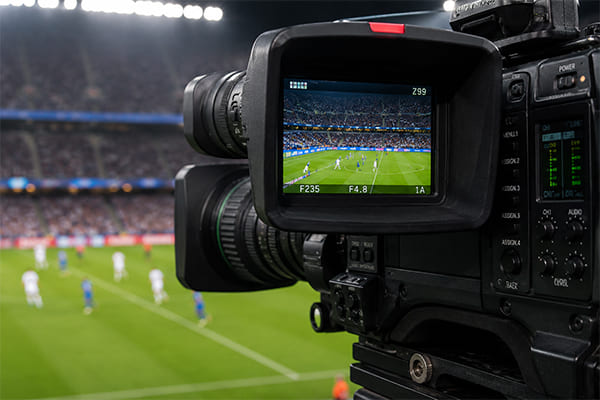
I can't stress this enough: the technical details make or break a stadium project. It's not just about brightness anymore. A broadcast director once told me, "If your lights flicker even slightly during a slow-motion replay, the shot is unusable." That's why we focus so heavily on flicker-free drivers and high-quality LED chips in our products. Beyond the broadcast, you also have to consider the experience inside the venue. Different areas have vastly different lighting needs, from the high-performance demands of the playing field to the comfortable, welcoming atmosphere of the VIP lounges.
Balancing Performance and Atmosphere
We have to light for two different audiences: the machines (cameras) and the humans (players and fans). This means creating a technical balance.
| Zone | Key Technical Requirement | JUXUANLED Solution |
|---|---|---|
| Playing Field | - High Illuminance & Uniformity: Ensures clear visibility for players. <br> - Low Glare: Prevents discomfort and performance issues. <br> - High CRI/TLCI (>90): For accurate color on broadcast. <br> - Flicker-Free: Essential for 4K/8K slow-motion replays. | We use specialized high-power LED floodlights with precision optics and broadcast-certified drivers to meet these strict standards. |
| Audience & Facade | - Atmosphere: Warmer color temperatures and dynamic color create an immersive experience. <br> - Control: DMX512 or Art-Net for dynamic effects10 like light shows, goal celebrations, and team color themes. <br> - Smart Systems: IoT integration for scheduling, energy management, and remote diagnostics. | Our RGBW wall washers, pixel lights, and linear fixtures are all compatible with DMX and Art-Net controllers, giving designers full creative freedom. |
The control system is the brain of the operation. With protocols like DMX512 and Art-Net, we can program lighting to react in real-time. Imagine the entire stadium flashing the home team's colors the instant a goal is scored. That's the level of immersion we help our clients create. It connects the fans to the game in a powerful, emotional way.
What are the future trends in stadium lighting?
Do you want your stadium design to be innovative and future-proof? A design that looks great on opening day can quickly become outdated if it doesn't account for where the industry is heading.
The future of stadium lighting is dynamic, intelligent, and sustainable. Key trends include the universal adoption of RGBW dynamic lighting, full-scale media facades, smart energy-saving controls, and a deep focus on ESG (Environmental, Social, and Governance) principles.
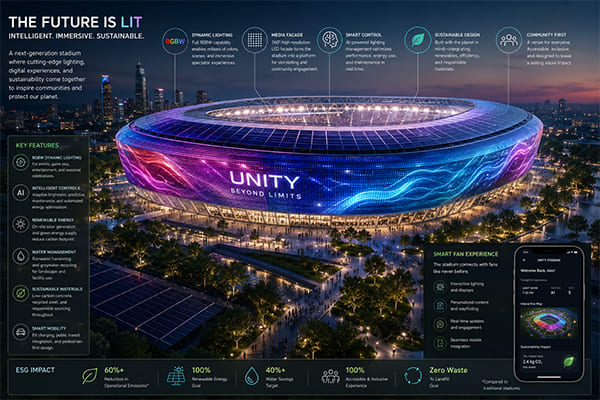
Looking ahead, we're seeing a clear shift. Static, white light is becoming a thing of the past. Every surface of the stadium is now a potential canvas. More importantly, clients are demanding solutions that are not only spectacular but also efficient and sustainable. I've been on many calls recently with contractors and designers, especially from the Middle East, and their requirements are shaping the future of our product development. Markets like the United Arab Emirates, Saudi Arabia, and Qatar have unique challenges and ambitions. They are building some of the most advanced venues in the world, and they need lighting that can perform in extreme conditions while delivering on a grand vision.
Embracing the Next Generation of Lighting
These future trends are already becoming today's standards for high-profile projects.
-
Dynamic RGBW Everywhere: It's no longer just for special effects. Full-color dynamic lighting is becoming standard for facades, seating areas, and even the roof.11 This allows the stadium to change its entire personality for different events, from a soccer match to a concert.
-
The Rise of the Media Facade: More stadiums will be built with integrated media facades from day one. This turns the building into a massive revenue-generating asset through advertising and sponsorships, making it a key part of the business model.
-
Smart Controls & Energy Efficiency: With rising energy costs, intelligent control is a must. We are integrating IoT technology into our systems, allowing facility managers to monitor energy usage, schedule lighting scenes remotely, and perform diagnostics from a cloud dashboard. This drastically reduces operational costs.12
-
ESG & Sustainable Design: This is a huge focus. It means using fewer fixtures more effectively, choosing long-lasting products to reduce waste, and minimizing light pollution. Our precision optics are designed to put light exactly where it's needed, protecting the night sky and respecting the surrounding community.
For our clients in the Middle East, the demands are even more specific: they need ultra-high-power fixtures that are IP66/IP67 rated, extremely heat-resistant, and feature advanced anti-glare technology. We've engineered our products specifically to thrive in these harsh environments, ensuring reliability for the world's most ambitious projects.
Conclusion
Ultimately, great stadium lighting isn't about using more fixtures. It's about using precise, intelligent light to shape a powerful city icon, create an unforgettable fan experience, and maximize commercial value.
"5.6 Technical Systems and Services | FIFA Publications", https://publications.fifa.com/de/football-stadiums-guidelines/technical-guideline/stadium-guidelines/technical-systems-and-services/. International sports-lighting guidance treats stadium lighting as a system serving player visibility, spectator comfort, safety, and television production, supporting the claim that modern stadium lighting extends beyond basic field illumination. Evidence role: expert_consensus; source type: institution. Supports: Modern stadium lighting has moved beyond simply illuminating the field.. Scope note: Such standards define functional requirements and do not by themselves prove the architectural or entertainment value of a specific design. ↩
"4K Broadcast Sports LED Lighting | High-Definition Stadium Lights", https://www.nationalled.com/4k-broadcast-sports-led-lighting-solutions/. Sports-venue and lighting-design literature describes contemporary stadium lighting as combining architectural expression, broadcast-quality illumination, and event presentation functions, which contextualizes this multidimensional framing. Evidence role: general_support; source type: institution. Supports: Modern stadium lighting blends architectural beauty, broadcast requirements, and immersive entertainment.. Scope note: The source would support the general convergence of these functions, not the quality of any individual stadium project. ↩
"RGBW LED Stadium Light Fixtures - Olympia Lighting", https://olympialighting.com/rgbw-led-stadium-architectural-lighting/. Published descriptions of illuminated stadium envelopes, such as membrane or facade systems using integrated LED lighting, show how some venues are designed so the building skin appears to emit light. Evidence role: case_reference; source type: education. Supports: Some advanced stadium lighting designs make the building itself appear to be the source of light.. Scope note: This supports the claim through representative examples rather than establishing that all advanced stadiums use this approach. ↩
"Allianz Arena - Wikipedia", https://en.wikipedia.org/wiki/Allianz_Arena. Reference sources and architectural accounts identify Allianz Arena as a stadium known for its illuminated exterior membrane, supporting its use as an example of a minimalist glowing facade. Evidence role: case_reference; source type: encyclopedia. Supports: Allianz Arena is an example of a stadium whose lighting emphasizes a glowing architectural exterior.. Scope note: The source would verify the stadium’s illuminated facade, not the article’s supplier role or product choices. ↩
"SoFi Stadium - Wikipedia", https://en.wikipedia.org/wiki/SoFi_Stadium. Sources describing SoFi Stadium’s large-scale integrated digital displays and video-board systems can support its use as a stadium example associated with media and digital display infrastructure. Evidence role: case_reference; source type: encyclopedia. Supports: SoFi Stadium is a relevant example for a media-oriented stadium lighting or display concept.. Scope note: This would support SoFi Stadium as a media-rich venue, but may not prove that the entire exterior functions as a single media facade. ↩
"Lusail Stadium - Wikipedia", https://en.wikipedia.org/wiki/Lusail_Stadium. Architectural and event documentation describes Lusail Stadium’s distinctive bowl form and illuminated exterior, supporting its use as an example of a stadium designed as a highly visible urban landmark. Evidence role: case_reference; source type: institution. Supports: Lusail Stadium is an example of a stadium lighting or architecture concept intended to function as an urban landmark.. Scope note: The evidence would establish landmark intent or visibility, not quantify public recognition on the skyline. ↩
"5.6 Technical Systems and Services | FIFA Publications", https://publications.fifa.com/de/football-stadiums-guidelines/technical-guideline/stadium-guidelines/technical-systems-and-services/. Sports-lighting standards specify illuminance uniformity and glare-control criteria for competition venues, supporting the claim that these are core technical requirements for player visibility and comfort. Evidence role: expert_consensus; source type: institution. Supports: High uniformity and low glare are critical technical requirements for stadium lighting used by players.. Scope note: Exact thresholds vary by sport, competition level, and governing body. ↩
"Color rendering index - Wikipedia", https://en.wikipedia.org/wiki/Color_rendering_index. Broadcast-lighting guidance and color-rendering standards explain that CRI and television-oriented color indices such as TLCI are used to evaluate how accurately lighting renders colors for cameras. Evidence role: definition; source type: institution. Supports: High CRI and TLCI ratings are important for broadcast-ready stadium lighting.. Scope note: The source would define and contextualize CRI/TLCI; required rating values depend on broadcaster specifications. ↩
"[PDF] Flicker: Understanding the New IEEE Recommended Practice", https://www.energy.gov/sites/default/files/2022-11/ssl-miller-lehman_flicker_lightfair2015.pdf. Broadcast-engineering sources note that flicker from lighting can become visible at high frame rates and in slow-motion capture, supporting the need for flicker control in modern sports broadcasting. Evidence role: mechanism; source type: research. Supports: Flicker-free lighting performance is important for 4K/8K slow-motion stadium broadcasts.. Scope note: The evidence supports the technical mechanism; acceptable flicker thresholds depend on camera frame rate, shutter settings, and broadcast standards. ↩
"DMX512 - Wikipedia", https://en.wikipedia.org/wiki/DMX512. Technical references define DMX512 as a digital lighting-control standard and Art-Net as a protocol for transmitting DMX-style lighting data over Ethernet, supporting their relevance to programmable dynamic lighting effects. Evidence role: definition; source type: institution. Supports: DMX512 and Art-Net are used for dynamic lighting control effects.. Scope note: The source would establish protocol capabilities generally, not verify a specific stadium installation. ↩
"Stadium lighting - Beyond the field | Signify Company Website", https://www.signify.com/global/lighting-academy/browser/webinar/stadium-lighting-beyond-the-field. Reports on contemporary sports-venue lighting describe increasing use of color-changing LED systems for facades, seating bowls, and event presentation, supporting the trend toward dynamic full-color lighting. Evidence role: general_support; source type: institution. Supports: Full-color dynamic lighting is increasingly used in multiple stadium zones, including facades and seating areas.. Scope note: The word “standard” is stronger than most evidence is likely to prove; the source may show increasing adoption rather than universal practice. ↩
"Lighting Controls", https://www.energy.gov/energysaver/lighting-controls. Energy-management and lighting-control studies show that scheduling, dimming, occupancy control, and monitoring can reduce lighting energy use and maintenance interventions, providing contextual support for lower operating costs. Evidence role: mechanism; source type: government. Supports: Smart lighting controls can reduce stadium or facility operational costs through energy management and remote monitoring.. Scope note: The magnitude of cost reduction depends on baseline energy use, control strategy, tariffs, and maintenance practices; the source may not support the word “drastically” for every stadium. ↩