Starting a facade lighting project1 can feel complex. You see formulas and hear about software, worrying that one mistake will ruin the final look. But what if there's a simpler way?
The best approach combines science with experience. While Lux calculations provide a starting point, for most buildings (3-20 stories), an experienced-based method2 is faster. It focuses on the desired effect, building size, and deep product knowledge to choose the right fixture power and achieve stunning results.
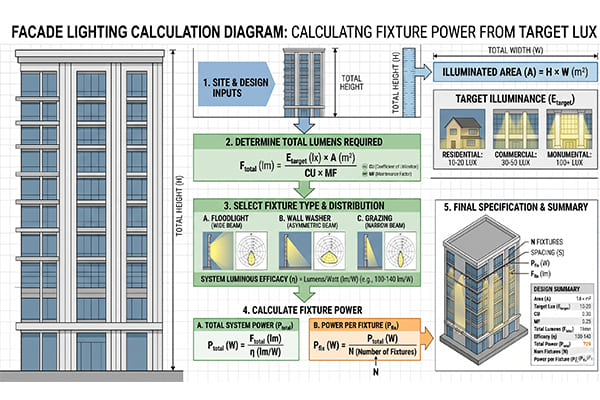
I've been in the outdoor lighting business for over a decade. In that time, I've seen many contractors get stuck on complex calculations. They spend weeks trying to get the math perfect. The truth is, there are two main ways to approach a project: the textbook way and the way we do it in the real world. It's important to understand the textbook method first, as it builds a solid foundation. But then, I want to show you the practical, experience-driven approach we use at JUXUANLED3. This method has helped us deliver amazing results for our clients, time and time again, without getting lost in complicated theory.
How do you calculate the right Lux for a building facade?
Choosing the right brightness for a building is a challenge. If it's too dim, no one will see it. If it's too bright, it becomes a public nuisance.
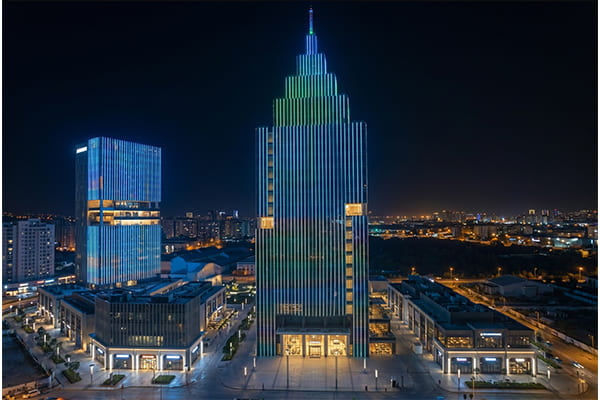
To find the right Lux level, you must first classify the building and its location. A landmark in a busy city center may require 150-300 Lux to stand out, while a commercial building in a quieter area might only need 100 Lux. This target is your starting point.
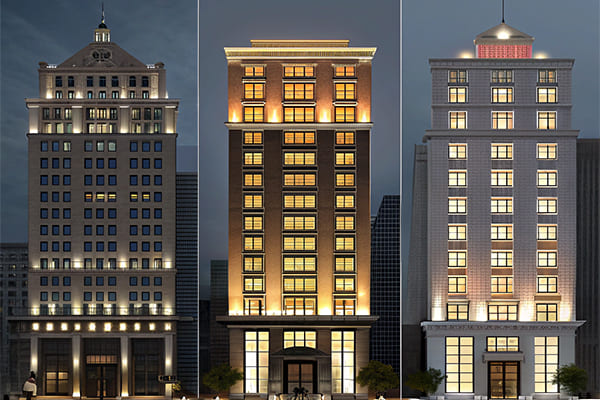
The first step in any professional lighting plan4 is to define the goal. We're not just throwing light at a wall; we're trying to achieve a specific effect. The target illuminance, measured in Lux (lx), is the technical term for the brightness we want to see on the facade surface. This isn't a random number. It's determined by the building's importance and its surroundings. A building that is meant to be a city landmark needs to command attention, so we aim for a higher Lux level. For a standard office or hotel, the goal is to create a pleasant and inviting atmosphere, not to compete with every other light in the city. Wall material also plays a huge role. A dark, rough brick wall will absorb a lot of light, so we might need to increase our target Lux to compensate. A light-colored, smooth facade reflects light well, so we can use a lower target.
Target Illuminance (E) by Building Type
| Building Type / Location | Typical Average Illuminance (Lux) | Reason |
|---|---|---|
| National Landmark | 200 - 300 lx | High visual impact, needs to stand out. |
| City Center Commercial | 150 - 200 lx | Competes with high ambient light levels. |
| Suburban Commercial | 80 - 120 lx | Creates presence without being overpowering. |
| Residential High-Rise | 30 - 50 lx | Aesthetic highlighting, avoids light spill. |
What is the formula for calculating wall washer fixture requirements?
You have your target Lux, but how do you turn that number into an actual list of light fixtures? The math can seem intimidating, with unfamiliar terms and multiple factors to consider.
The core calculation uses the Lumen Method5. The formula is: Total Lumens6 = (Target Lux × Area) ÷ (Utilization Factor7 × Maintenance Factor8). This tells you the total light output needed from all your fixtures to properly illuminate the facade and achieve your target brightness.
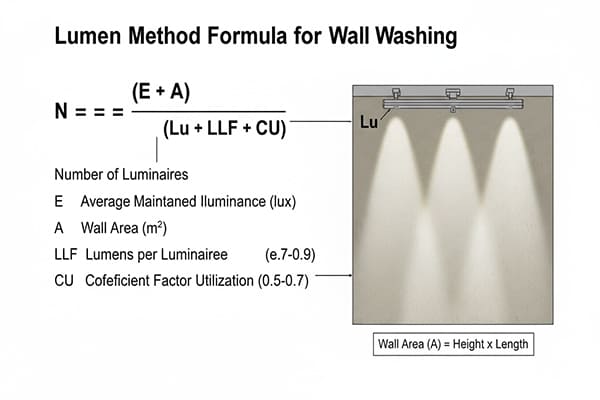
This formula is the classic engineering approach to lighting design. It's a great way to get a solid estimate for your project's needs, especially in the early stages. Let's break it down into simple parts. Think of it like filling a bucket with water. The "Total Lumens6" is the total amount of water you need. The "Target Lux" is how wet you want the ground to be, and the "Area" is the size of the ground you need to cover. The other two factors account for real-world inefficiencies, like water splashing outside the bucket or evaporating over time. By using this formula, you can move from a simple brightness target to a concrete number: the total amount of light your fixtures need to produce. From there, you can figure out how many fixtures you'll need.
Breaking Down the Lumen Method5
- Total Luminous Flux (Lumens): This is the total quantity of light you need. It's the final number we are solving for.
- Target Lux (E): We already discussed this. It's the desired brightness on the wall surface.
- Area (A): This is the total surface area of the facade you want to light, measured in square meters.
- Utilization Factor7 (UF): This number represents efficiency. It tells you what percentage of the light from the fixture actually lands on the wall. It's affected by the fixture's beam angle9 and its distance from the wall. A typical value is between 0.6 and 0.8.
- Maintenance Factor8 (MF): Light fixtures get dimmer over time. Dirt builds up, and the LEDs themselves lose a bit of brightness. The MF accounts for this, ensuring the building still looks good years later. A common value is 0.7 to 0.8.
Why does experience often beat complex calculations in real projects?
You've done the math and have a total lumen number. But the formula doesn't tell you where to put the lights or what beam angle9 to use for a smooth, even wash.
For most facade projects, especially buildings from 3 to 20 stories high, our practical experience is more effective than any software. We focus on the client's vision, the building's plans, and our deep product knowledge to create a perfect lighting solution without complex simulations.

Here's a secret from someone who does this every day: for the vast majority of facade lighting project1s, the goal is atmosphere and decoration10, not perfect scientific uniformity. The client wants the building to look amazing, not to hit a specific Lux number on every square meter. This is where relying solely on formulas and software like Dialux can be overkill and sometimes misleading. I've seen projects that looked perfect in a simulation but ended up with ugly hotspots and dark patches in reality. That’s because software can't always account for unexpected textures, reflections, or on-site installation challenges. This is why we developed a more practical approach at JUXUANLED3. It's a method honed over hundreds of successful projects, and it puts the client's desired visual effect at the center of the process.
The JUXUANLED3 Practical Approach
Our method is simple, fast, and effective. We've found it delivers exactly what our clients—who are often busy contractors and project managers—need.
| Aspect | Textbook Method | Our Experience-Based Method |
|---|---|---|
| Starting Point | Target Lux and Uniformity Ratios | The client's desired visual effect and mood. |
| Key Inputs | Wall Reflectance, Maintenance Factor8s | Building CAD files11, desired color, budget. |
| Primary Tool | Dialux or other simulation software | Our team's deep knowledge of our fixtures. |
| Focus | Technical data and calculations | Creating a beautiful rendering the client loves. |
| Result | A technically correct simulation. | A practical plan and a visual of the final look. |
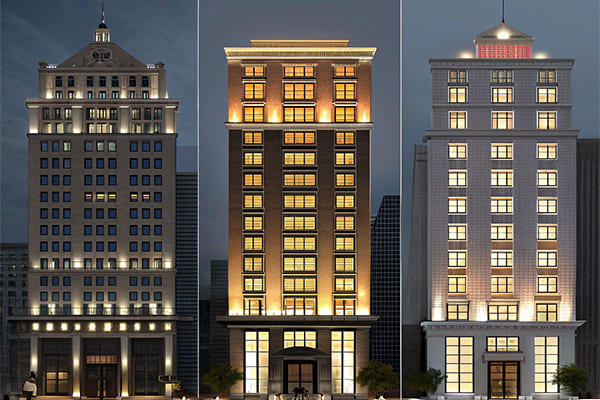
Instead of starting with a number, we start with a conversation. We ask the client what they want the building to feel like. Then, we look at the building's plans (CAD files11 are best). Based on the building's height, materials, and the desired effect, I and my team know exactly which of our wall washers will work best. We know their real-world performance, how their beams spread, and how they render color. We use this knowledge to create a visual rendering12 of the final project. This shows the client exactly what they will get. This method has never let us down.
Conclusion
Understanding lighting formulas is valuable, but real-world success comes from experience. Partnering with a supplier who knows their products is the surest way to achieve a stunning facade lighting result.
Explore expert insights on initiating a facade lighting project effectively. ↩
Discover how an experienced-based method can simplify your facade lighting approach. ↩
Explore the unique services offered by JUXUANLED for facade lighting projects. ↩
Discover steps to create a professional lighting plan for your project. ↩
Get to know the Lumen Method and how it aids in lighting calculations. ↩
Find out how to calculate Total Lumens for effective facade lighting. ↩
Learn about the Utilization Factor and its role in lighting efficiency. ↩
Explore the significance of the Maintenance Factor in maintaining lighting quality. ↩
Understand how beam angle influences the effectiveness of facade lighting. ↩
Learn how to create atmosphere and decoration through effective lighting design. ↩
Find out how CAD files can enhance your lighting design process. ↩
Explore the concept of visual rendering and its importance in lighting design. ↩