Are your 100W halogen bulbs1 making your energy bills skyrocket and getting too hot to touch? This constant cycle of high costs and frequent replacements is frustrating. Switching to LED is the solution.
To replace a 100W halogen bulb, choose a 14-18W LED bulb2 that produces 1000-1600 lumens3. You must match the base type, like E27 or GU104, and voltage. For 12V systems5, you also need to check if the old transformer is compatible to avoid flickering.
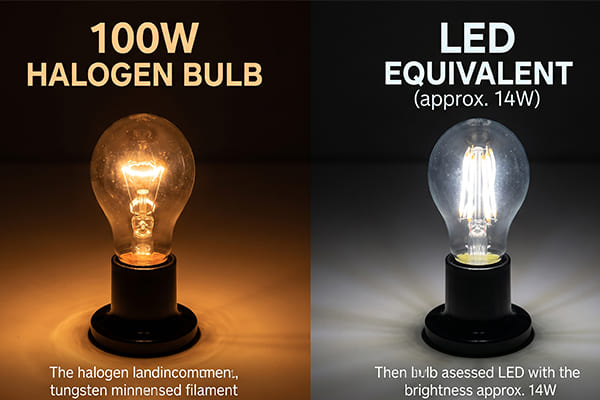
That's the quick answer, but a truly successful conversion depends on getting a few more details right. As a lighting professional, I've managed countless retrofit projects, and I know that paying attention to the small things prevents big headaches later. This guide will walk you through the entire process, step-by-step. Let's make sure your upgrade is smooth, effective, and gives you the perfect lighting result you expect.
How do you choose the right LED brightness and color?
Are you confused by terms like lumens and kelvins? Choosing the wrong LED can leave a room feeling too dim or uncomfortably harsh. Let's make sure your new lighting feels just right.
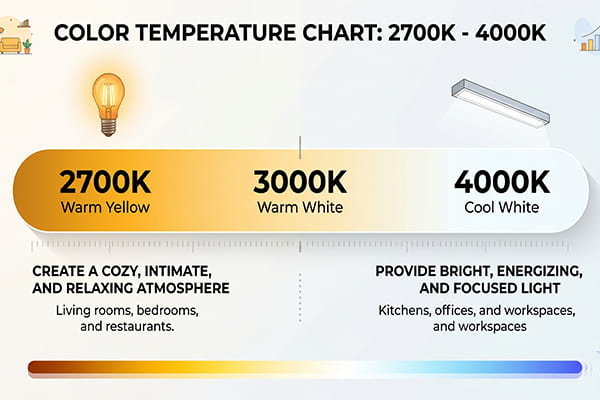
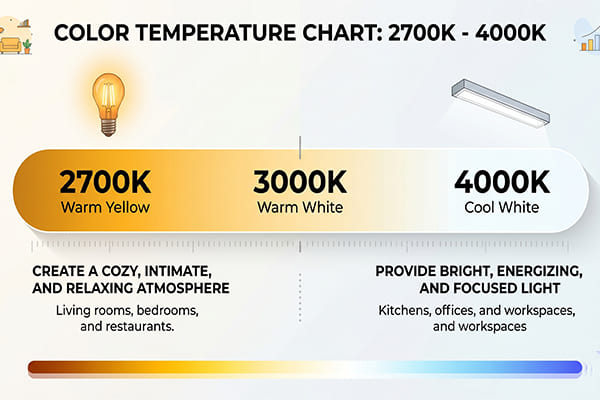
To match a 100W halogen's brightness, look for an LED with 1000-1600 lumens3 (lm). For a similar warm, cozy glow, choose a color temperature6 of 2700K-3000K. A cooler, brighter white is around 4000K. Always use lumens, not watts, to judge brightness.
In the past, we all used watts to measure how bright a bulb was. A 100W bulb was brighter than a 60W one. This worked for old incandescent and halogen bulbs, but it doesn't work for LEDs. Watts measure energy use, not light output. Since LEDs are so much more efficient, a 15W LED can be as bright as a 100W halogen.
The correct unit to use for brightness is the lumen (lm). More lumens mean more light. When I work with clients, this is the first thing we clarify. We don't guess based on watts; we match the lumens to ensure the new lighting is just as bright as the old. For a standard 100W halogen, you are looking for an LED in the 1000-1600 lumen range.
Here is a simple table to help you:
| Halogen Power | Equivalent LED Power | Recommended Lumens |
|---|---|---|
| 75W | 10W - 13W | 800 - 1100 lm |
| 100W | 14W - 18W | 1000 - 1600 lm |
| 150W | 20W - 25W | 2000 - 2600 lm |
Next, you need to think about color temperature6, measured in Kelvin (K)7. This tells you if the light will be warm and yellow or cool and blue. Halogen bulbs have a warm, cozy glow, which is around 2700K to 3000K. If you want to replicate that feeling, choose an LED in that same Kelvin range. If the project requires a cleaner, more neutral white for an office or workspace, 4000K is a great choice.
Will your existing dimmer switches work with new LEDs?
You just installed a new LED bulb, but now it flickers or makes a strange buzzing sound when you dim it. This is a very common problem. It can be frustrating, but there is a clear reason for it.
Most old dimmer switches, which were made for halogens, are not compatible with LEDs. You must use an LED bulb specifically labeled as "Dimmable." You may also need to replace the wall switch with a modern LED-compatible dimmer8 to prevent flickering or buzzing9 noises.
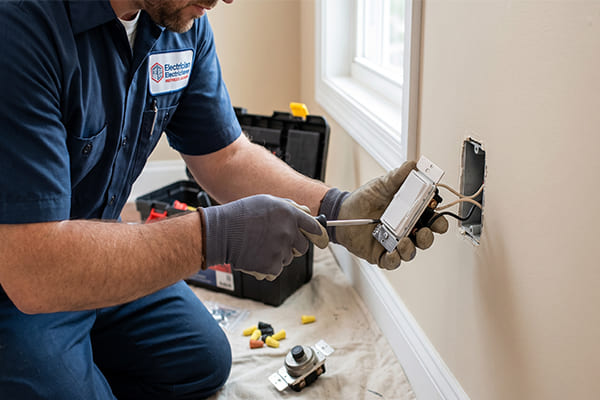
The technology inside a dimmer switch is key here. Older dimmers are usually "leading-edge" dimmers. They were designed for the high-power, simple resistive load of a halogen bulb. LEDs are different. They are complex electronic devices with an internal component called a driver, and they use very little power. This mismatch causes the flickering and buzzing you see.
The solution has two parts. First, always buy LED bulbs that say "Dimmable" on the box. A non-dimmable LED10 will not work on a dimmer circuit and can even be damaged by it. Second, you often need to replace the dimmer switch itself with a modern "trailing-edge" or universal dimmer designed for LEDs. These switches are built to handle the low power and electronic nature of LEDs, giving you smooth, silent dimming.
I remember a project in a high-end restaurant where the client wanted to switch to LEDs to save energy. After we installed the new bulbs, the entire dining room flickered. The problem was the old dimmer system. We had to replace every single dimmer switch with LED-compatible models. It was an extra step, but it was necessary for the system to work perfectly.
Here is a quick guide to solving dimming problems:
| Problem | Likely Cause | Solution |
|---|---|---|
| Flickering at low levels | Incompatible dimmer switch | Replace with an LED-compatible dimmer8. |
| Buzzing or humming | Incompatible dimmer or bulb | Ensure both bulb and switch are LED-compatible. |
| Won't turn on at all | Bulb not "Dimmable" | Replace the bulb with a dimmable model. |
| Doesn't dim smoothly | Dimmer range mismatch | Adjust the dimmer's low-end trim setting if available. |
What about replacing 12V low-voltage halogen bulbs?
You tried to swap a 12V halogen bulb, like an MR16, but the new LED bulb won't turn on or it flashes like a strobe light. This is a common issue in low-voltage systems. The old transformer is almost always the hidden culprit.
When you replace 12V halogens, the existing electronic transformer often does not work with low-power LEDs. Its minimum load requirement11 might be too high. If you see flickering or failure, you must replace the old transformer with a dedicated LED driver for stable power.
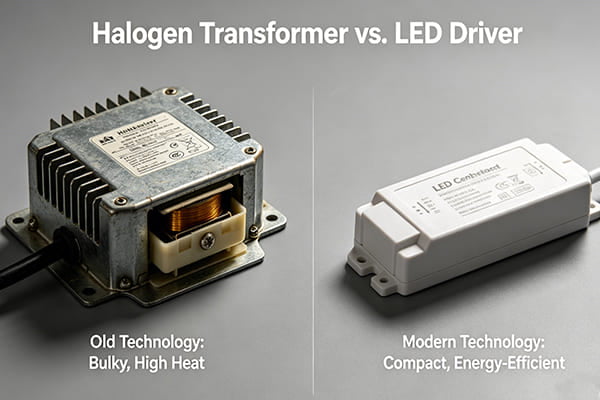
Low-voltage lighting systems use a transformer to step down the main voltage (e.g., 220V) to 12V. The transformers designed for halogen bulbs have a minimum load requirement11. For example, a transformer designed for a 100W halogen might need at least 20W of power draw to function correctly. A new 15W LED replacement bulb does not draw enough power to meet this minimum. As a result, the transformer can't provide a stable current, which causes the LED to flicker or not work at all.
The best and most reliable solution is to replace the old halogen transformer with a modern constant voltage LED driver12. These drivers are specifically designed for the low power draw and sensitive electronics of LEDs. They don't have a high minimum load, so they provide clean, stable 12V power. This guarantees your new LED lights will perform perfectly without any issues.
On a recent landscape lighting project, we were tasked with upgrading dozens of 12V halogen spotlights in a garden. A simple bulb swap wasn't enough; half the lights were flickering. We traced the problem back to the old magnetic transformers. By replacing all of them with new, compact LED drivers, we created a reliable and energy-efficient system that will last for years.
When you do this work, safety is number one. Always turn off the power at the main circuit breaker before you touch any wiring or attempt to replace a transformer. If you are not comfortable with electrical work, it is always best to hire a qualified electrician.
Conclusion
Replacing 100W halogens with LEDs is a smart move. It saves energy, reduces heat, and lasts much longer. Just remember to match lumens, check for dimmer and transformer compatibility, and choose the right color.
Explore the drawbacks of 100W halogen bulbs to understand why switching to LEDs is beneficial. ↩
Learn about the wattage equivalence of LED bulbs to make informed lighting choices. ↩
Discover the right lumen output for your space to achieve optimal brightness. ↩
Understand the differences between E27 and GU10 bases to ensure compatibility with your fixtures. ↩
Find out the challenges of 12V systems to better prepare for your lighting upgrades. ↩
Explore how color temperature influences the ambiance of your space. ↩
Understand the significance of Kelvin in lighting to choose the right color temperature. ↩
Get tips on selecting the right dimmer for your LED lights to ensure compatibility. ↩
Find out the causes of flickering or buzzing in LED lights and how to fix them. ↩
Learn about dimmable LEDs and how they can enhance your lighting experience. ↩
Understand minimum load requirements to avoid flickering issues with LED bulbs. ↩
Learn about constant voltage LED drivers and their role in low-voltage lighting systems. ↩