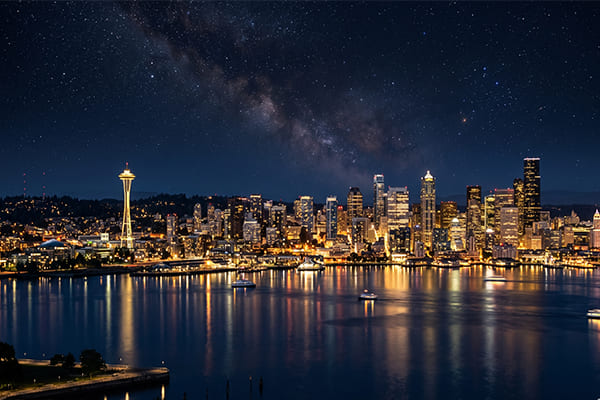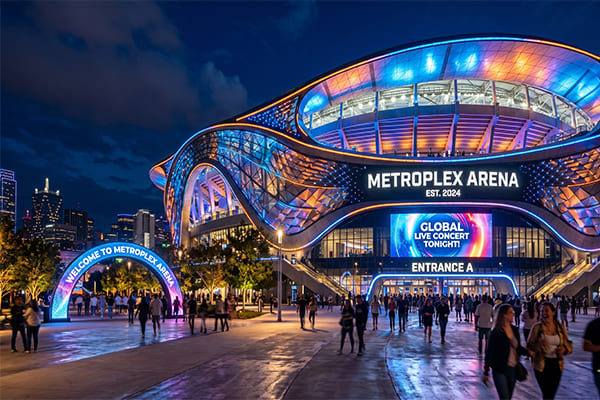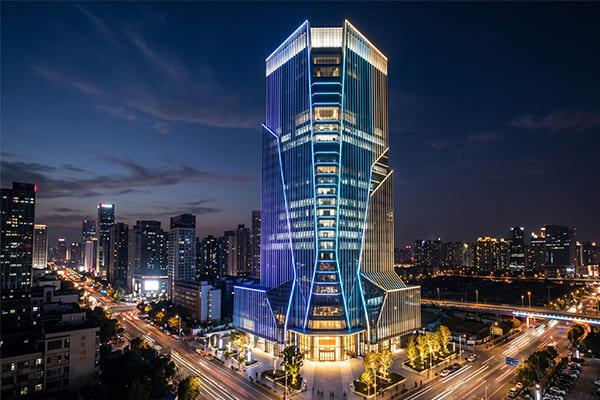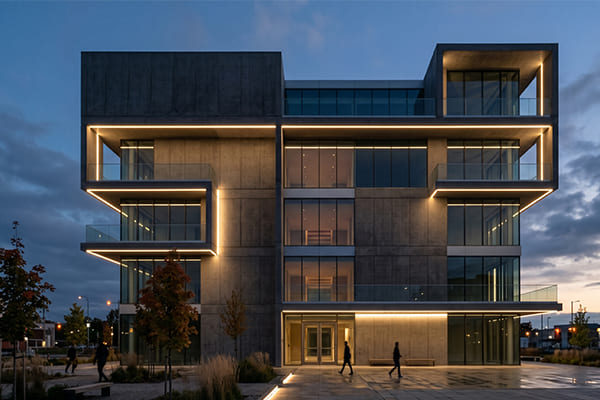
Your building is a daytime masterpiece but disappears after sunset. This invisibility costs you presence and impact. Architectural facade lighting is the key to giving it a brilliant nighttime identity.
Architectural facade lighting is the art and science of using light to redefine a building's appearance at night.1 It's not just about illumination; it's about sculpting with light and shadow to create a unique visual identity that enhances both the building and the city's nightscape.
I've seen countless projects, and the best ones always start with a solid understanding of the fundamentals. It's more than just pointing some lights at a wall. To truly make a building shine, you need to know the right techniques, technologies, and principles. Let's dive into the core methods that bring a facade to life.
What Are the Main Techniques for Facade Lighting?
You want to light your building's facade but aren't sure which approach to take. The wrong choice can create a flat, boring look or even highlight imperfections. Understanding the core techniques is the first step toward a stunning result.
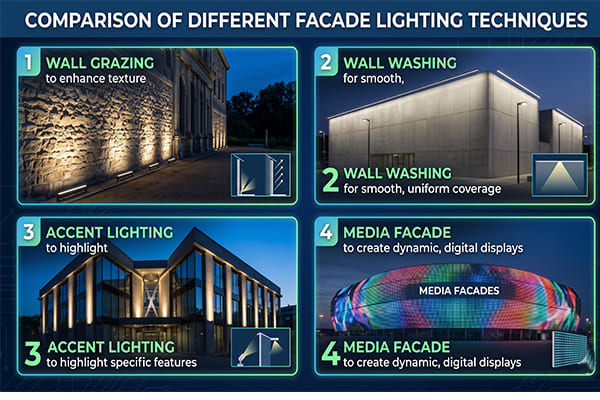
The primary techniques are Wall Grazing to enhance texture, Wall Washing for smooth, uniform coverage, Accent Lighting to highlight specific features, and Media Facades to create dynamic, digital displays.2 Each serves a different purpose and creates a distinct effect.
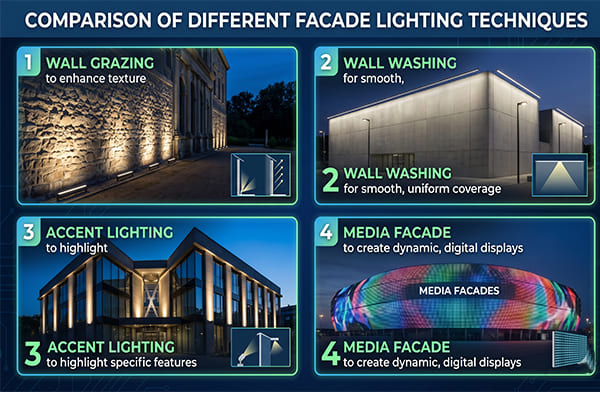
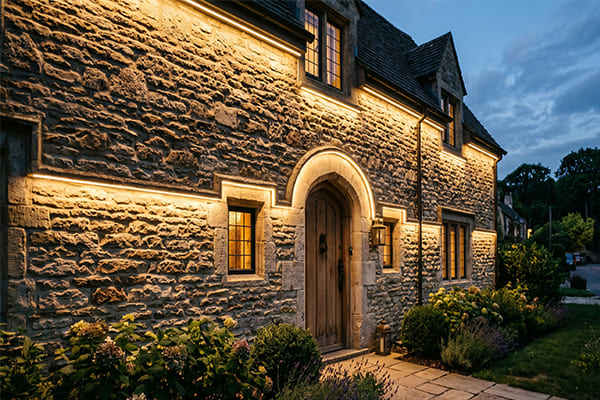
Choosing the right technique is about matching the lighting effect to the architectural material and the desired mood. I remember a project with a historic stone building. The client wanted to emphasize its age and texture. We used wall grazing, placing our linear lights very close to the surface3. The way it created deep shadows and brought out the ruggedness of every single stone was just incredible. The client was amazed that light could reveal so much character. These four methods are the foundation of all facade lighting design.
Key Lighting Application Methods
| Technique | Best For | Effect | Fixture Placement |
|---|---|---|---|
| Wall Grazing | Rough surfaces (stone, brick) | Creates strong shadows, enhances texture | Very close to the wall (<30cm) |
| Wall Washing | Smooth surfaces (glass, metal) | Provides even, uniform illumination | Further from the wall with a wide beam |
| Accent Lighting | Architectural details (columns, arches) | Draws attention to key features | Hidden, with a narrow beam |
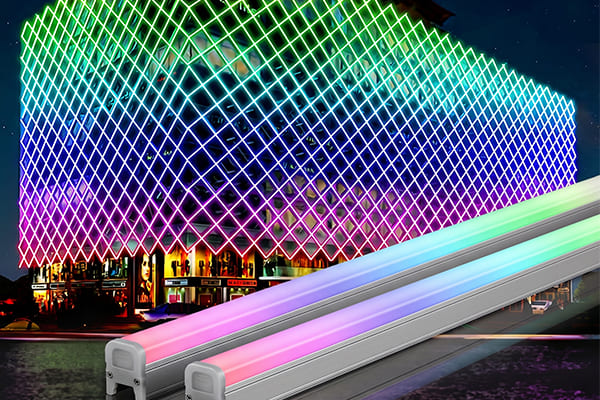
| Media Facade | Large, modern building faces | Dynamic video and graphic displays | A grid of pixel lights on the surface |
What Key Technical Specs Should You Know?
The world of lighting is full of technical terms like CCT, IP rating, and beam angle. Ignoring these can result in a project with the wrong mood or lights that fail in the first rainstorm. Let’s clarify the essentials.
You must understand Color Temperature (CCT)4 for the light's color, IP Rating for weather and dust protection, and Beam Angle for the light's spread. Getting these right is crucial for the project's aesthetic success and long-term durability.
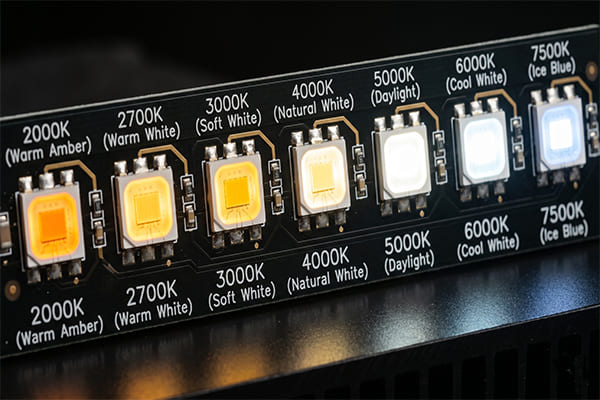
These specifications are not just numbers on a data sheet; they are the tools we use to achieve a precise artistic vision. At JUXUANLED, we always guide our clients through these choices. For a modern skyscraper in a city like Dubai, we will almost always recommend a cool white light around 4000K to 5000K. It gives the building a crisp, contemporary, and powerful look. On the other hand, for a historic hotel in Europe or a cultural landmark, a warm 2700K light is essential. This warmer tone is inviting and respects the building's heritage, giving it a soft, golden glow. Choosing the right beam angle is just as important. A narrow 5-degree beam can shoot a blade of light up a 100-meter column, while a wide 60-degree beam is needed to wash a broad wall evenly from a short distance.
Essential Technical Parameters
| Parameter | What It Is | Why It Matters |
|---|---|---|
| Color Temperature (CCT) | The color of the white light, from warm (yellowish) to cool (bluish). | Sets the entire mood. Warm (2700-3000K) feels traditional and cozy. Cool (4000-5000K) feels modern and energetic.5 |
| IP Rating | Ingress Protection. A two-digit number indicating protection against solids and liquids. | Ensures durability. Outdoor fixtures need at least IP65. In-ground or underwater fixtures need IP67 or IP68. |
| Beam Angle | The angle at which light spreads from the fixture.6 | Determines coverage. A narrow angle (3°-10°) is for focused accents or tall structures. A wide angle (60°-90°) is for washing large areas. |
How Do You Control a Facade Lighting System?
Your lights are installed, but how do you bring them to life with color changes and effects? Static lighting is fine, but dynamic control seems complicated. It really comes down to two main systems that are easier to understand than you think.
Control is typically handled by two main protocols: DMX512 and SPI. DMX512 is the industry standard for stable, long-distance control of architectural outlines and wall washers.7 SPI is used for high-speed control of high-density media facades and pixel lights.8
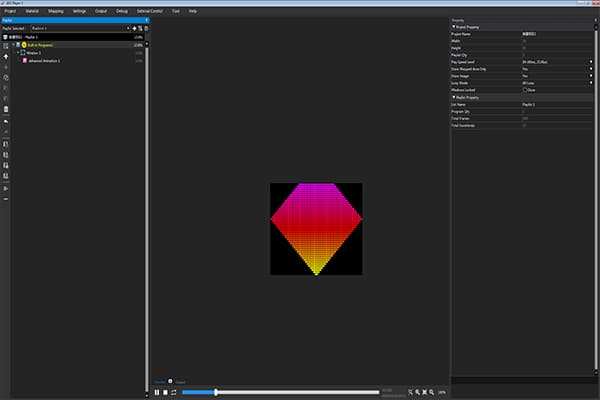
Think of the control system as the brain of the lighting installation. It tells every single light what to do and when to do it. We often use a hybrid approach on large projects to get the best results. I recall a large hotel project we supplied in Southeast Asia. We used the DMX512 protocol for all the linear wall washers and contour lights that wrapped around the building's floors. DMX is incredibly stable over the long cable runs needed for a skyscraper, ensuring every light changes color in perfect synchronization. For the grand entrance canopy, which featured a large media screen made of our pixel lights, we used an SPI control system. The high refresh rate of SPI was necessary to play smooth welcome animations and video content. The combination delivered the best of both worlds: rock-solid stability for the overall building and high-speed performance for the dynamic media feature.
DMX512 vs. SPI
| Protocol | Primary Use | Key Advantages | Key Limitations |
|---|---|---|---|
| DMX512 | General architectural lighting (wall washers, linear lights) | Highly stable, reliable, long transmission distance, industry standard. | Lower refresh rate, not ideal for high-density video content. |
| SPI | High-density pixel lighting (media facades, screens) | Very high refresh rate for smooth video, simpler wiring. | Shorter transmission distance, susceptible to signal interference. |
What Common Mistakes Should You Avoid in Facade Lighting?
A beautiful lighting concept can quickly turn into a nightmare if you're not careful. Common mistakes can lead to light pollution, excessive energy bills, and dangerous maintenance work. Let's cover how you can easily avoid these major problems.
The biggest mistakes are creating light pollution that bothers neighbors, over-illuminating the building instead of using contrast, and poor planning for future maintenance. A successful project avoids these by design, focusing on precision, balance, and practicality.
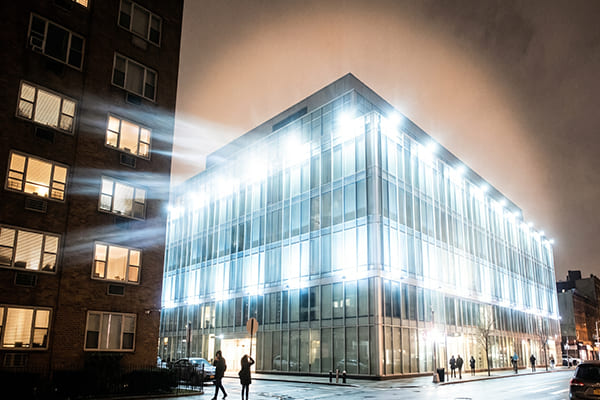
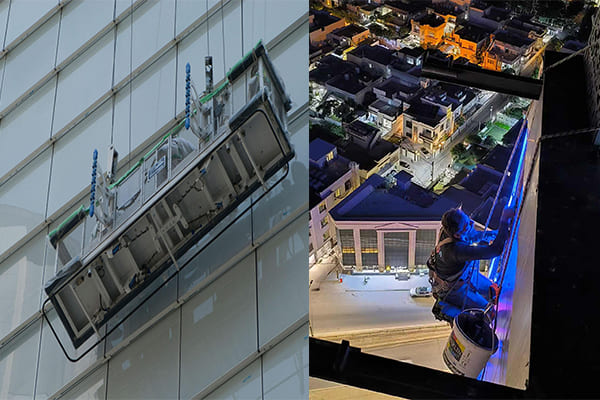
I have been called in to fix projects where these mistakes were made, and it's always more costly than doing it right the first time. The most sensitive issue is light pollution. No one wants a spotlight shining into their bedroom window. We solve this by using fixtures with anti-glare accessories like shields and louvers and by carefully aiming every light to keep the illumination strictly on the facade. Another common issue is "brute force" lighting, where the entire building is blasted with light. This is not good design. Great lighting is about the interplay between light and shadow. By leaving some areas dark, you create contrast that makes the illuminated parts stand out more dramatically. Lastly, I've seen fixtures placed in locations where you'd need a specialized climbing team just to replace one. We always plan our fixture layouts in consultation with the building's facility managers to ensure every light is accessible for safe and efficient long-term maintenance.
Avoiding Common Pitfalls
| Mistake | The Problem | The Solution |
|---|---|---|
| Light Pollution | Stray light spills into windows and the night sky, causing annoyance and wasting energy.9 | Use anti-glare shields and louvers. Aim fixtures precisely onto the target surface.10 |
| Over-Illumination | Lighting everything brightly creates a flat, boring look with no visual interest. | Use contrast. Emphasize key features and allow shadows to create depth and drama. Less is often more. |
| Difficult Maintenance | Placing fixtures in inaccessible locations makes repairs expensive and dangerous. | Plan fixture placement with future access in mind. Prioritize locations that can be reached safely. |
Conclusion
Great facade lighting blends art and engineering. It's about defining a building's nighttime identity by balancing aesthetics, function, and long-term maintenance to create a true landmark.
"Lighting Methods And Products Used In Architectural Facade Lighting", https://www.colorsled.com/blog/main-lighting-methods-and-products-used-in-architectural-facade-lighting. A lighting-design reference from an educational or professional institution can support that architectural lighting combines technical illumination practice with aesthetic treatment of built form; this contextual source would not prove that every facade-lighting project successfully redefines a building’s appearance. Evidence role: definition; source type: education. Supports: Architectural facade lighting combines artistic and technical methods to alter or define a building’s nighttime appearance.. Scope note: Contextual definition only; it does not validate the quality or impact of a specific project. ↩
"Wall washing and wall grazing light | What's the difference?", https://boca.lighting/create-stunning-visual-spaces-with-wall-washing-and-wall-grazing-light/. A professional lighting-design guide can document common facade-lighting methods such as grazing, washing, accent lighting, and media facades; the source would establish terminology and typical uses rather than rank these as the only primary techniques. Evidence role: expert_consensus; source type: institution. Supports: Wall grazing, wall washing, accent lighting, and media facades are recognized facade-lighting techniques with different visual purposes.. Scope note: The support is for common professional terminology and applications, not an exhaustive taxonomy. ↩
"The Art of Grazing - QTL Lighting", https://www.qtl.lighting/blog/the-art-of-grazing/. A lighting-design text describing wall grazing can support that fixtures placed close to a textured surface create pronounced shadows and reveal surface relief; it would not independently verify the described project example. Evidence role: mechanism; source type: education. Supports: Wall grazing uses close fixture placement to emphasize texture through shadows.. Scope note: Supports the lighting mechanism generally, not the anecdotal project outcome. ↩
"Color temperature - Wikipedia", https://en.wikipedia.org/wiki/Color_temperature. A standards-based or encyclopedic source can support that correlated color temperature describes the apparent color of white light in kelvins, ranging from warmer yellowish tones to cooler bluish tones; it does not prescribe which CCT is best for a particular building. Evidence role: definition; source type: encyclopedia. Supports: Correlated color temperature is a technical measure of the apparent color of white light.. Scope note: Defines CCT, but does not validate the article’s design preferences for specific architectural styles. ↩
"Effect of warm/cool white lights on visual perception and mood in ...", https://pmc.ncbi.nlm.nih.gov/articles/PMC8481791/. Research on lighting perception can support that lower-CCT light is commonly perceived as warmer or more relaxing and higher-CCT light as cooler or more alerting; such findings are perceptual generalizations and do not prove that all viewers associate these ranges with traditional or modern architecture. Evidence role: expert_consensus; source type: paper. Supports: Different correlated color temperatures are associated with different perceived moods, with warm-white and cool-white light producing different impressions.. Scope note: Perceptual associations vary by culture, context, adaptation, and individual preference. ↩
"What Is Beam Angle? Guide to Light Distribution for Buyers", https://www.commercial-lighting.net/what-is-beam-angle-guide-to-light-distrubtion/. A photometry or lighting-engineering source can support that beam angle describes the angular spread of light from a luminaire, commonly based on luminous intensity distribution; the source would define the measurement rather than specify the ideal angle for a facade. Evidence role: definition; source type: education. Supports: Beam angle is the angular spread of light emitted by a fixture.. Scope note: Defines beam angle but does not determine project-specific beam selection. ↩
"DMX512 - Wikipedia", https://en.wikipedia.org/wiki/DMX512. The ANSI E1.11 DMX512-A standard, maintained through entertainment-technology standards bodies, establishes DMX512 as a widely used digital control protocol for lighting equipment; it supports the protocol’s standardization but not every claim of superior stability in all installations. Evidence role: definition; source type: institution. Supports: DMX512 is a standardized and widely used protocol for controlling lighting equipment, including architectural lighting fixtures.. Scope note: Supports DMX512 as a standardized lighting-control protocol; performance depends on cabling, topology, equipment, and installation quality. ↩
"SPI LED Pixel Strips | Complete Guide for Designers & Engineers", https://www.sunroleds.com/blog/spi-controlled-led-pixel-strip/. Technical references on addressable LEDs and serial peripheral interfaces can support that SPI-like serial data methods are used to control dense pixel arrays at high data rates; this is contextual because architectural media facades may use varied proprietary or networked control architectures. Evidence role: mechanism; source type: research. Supports: SPI or SPI-like serial protocols are used for high-speed control of dense pixel-light arrays.. Scope note: Supports the general control mechanism for pixel LEDs, not a universal rule for all media-facade systems. ↩
"[PDF] What are Dark Skies? Why do Dark Skies Matter? Dark Sky Friendly?", https://emigration.utah.gov/_files/ugd/e1a144_2e9d7d84aab9435cb3eeea3610633456.pdf?index=true. Guidance from CIE or DarkSky International can support that obtrusive light includes light trespass into windows, skyglow, glare, and wasted upward light; it does not quantify the impact of the particular facade described in the article. Evidence role: general_support; source type: institution. Supports: Stray exterior lighting can create light trespass, contribute to skyglow, annoy occupants, and waste energy.. Scope note: Supports the general environmental and nuisance effects of stray light, not the magnitude for a specific project. ↩
"Obtrusive Light: the CIE-150 Document - NASA ADS", http://ui.adsabs.harvard.edu/abs/2004AAS...204.8905C/abstract. Obtrusive-light guidance from lighting institutions or government planning agencies can support shielding, cutoff control, and accurate aiming as methods for reducing glare, light trespass, and upward spill; the source would not guarantee compliance without photometric analysis of the installation. Evidence role: mechanism; source type: government. Supports: Shielding, louvers, and precise fixture aiming help reduce unwanted light spill and glare in exterior lighting.. Scope note: Supports mitigation methods generally; actual effectiveness depends on fixture photometry, aiming, mounting height, and site geometry. ↩