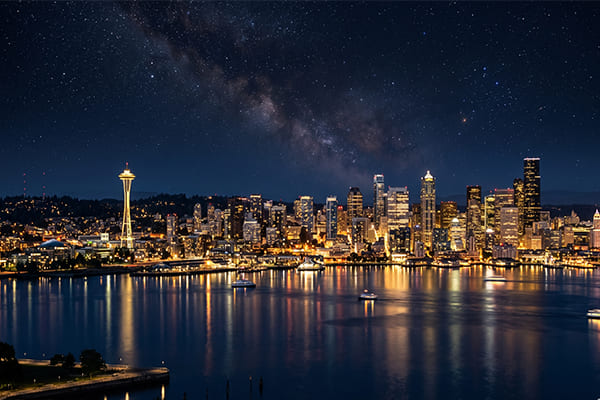
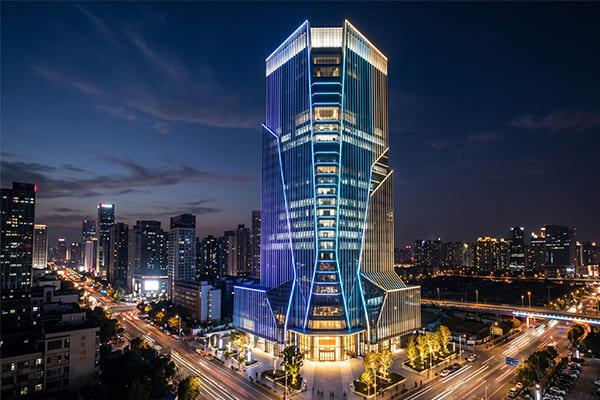
Your building looks flat and overly bright at night. This approach wastes energy1 and misses the mark. Learn how proper design can reshape a building's soul with light.
Exterior architectural lighting is more than just illumination.2 It's about using light to sculpt a building's nighttime identity, create visual layers, and enhance its value. It combines art with engineering3, focusing on aesthetics, optics, and smart control systems to create a memorable nightscape.
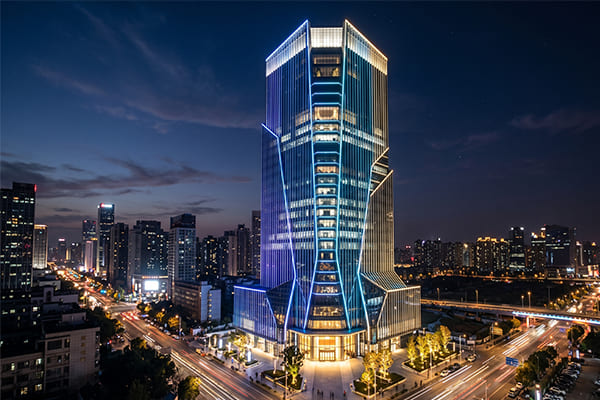
I've seen countless projects over the years. Some are breathtaking, and others... not so much. The difference almost always comes down to a few core principles. It's not about having the biggest budget, but about having the right knowledge. This is not just about making a building visible. It's about giving it a new life after the sun goes down. So, let’s break down what separates a good lighting project from a great one.
How can you achieve that 'see the light, not the lamp' effect?
Clunky, visible light fixtures ruin a building's look during the day. This visual clutter detracts from the architecture. But with smart integration, you can make the fixtures disappear completely.
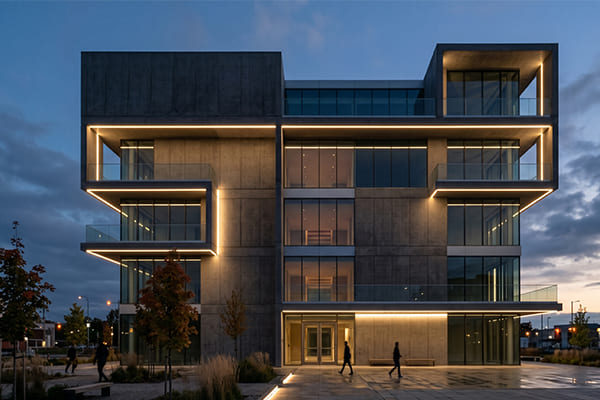
To achieve a "see the light, not the lamp" effect, you must hide the fixtures. Install them within architectural elements like curtain wall mullions, panel gaps, grilles, or structural recesses.4 This ensures that only the pure effect of the light is visible at night.
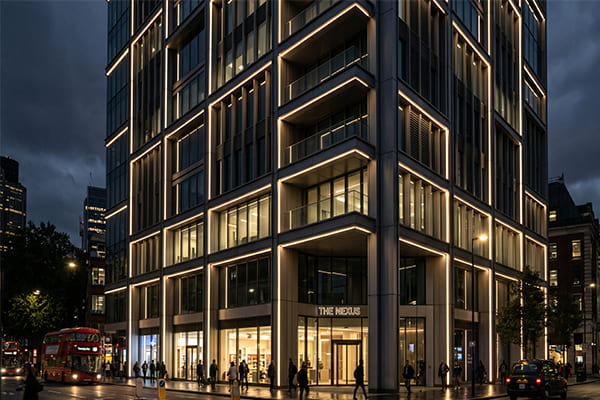
The goal here is elegance and subtlety. During the day, the building should look exactly as the architect designed it, without any distracting hardware. At night, the building should come alive with light that seems to emanate from the structure itself. This is what we mean by "see the light, not the lamp." It requires careful planning during the design phase5, long before installation begins. In my work, I collaborate closely with architects and builders to find the perfect hiding spots for our fixtures. For example, our slim JUXUANLED linear lights are designed to fit inside the narrow gaps between aluminum panels or within curtain wall frames. This makes them completely invisible from the ground during the day. Another common technique is to place powerful wall washers in specially designed coves or on structural ledges. This method hides the light source while casting a smooth, even layer of light across the surface. It is all about seamless integration.
| Integration Method | Best For | Key Consideration |
|---|---|---|
| Conceal in Mullions | Glass Facades | Fixture size and heat dissipation |
| Place in Panel Gaps | Solid/Metal Facades | Uniformity of gaps, waterproofing |
| Install in Recesses/Coves | Stone or Concrete | Creating soft, indirect light |
| Integrate into Grilles | Vents, Decorative Screens | Beam angle to avoid glare |
Is brighter always better in facade lighting?
You want your building to be noticed, so you make it as bright as possible. But this often leads to a glaring, one-dimensional mess. A truly high-end result comes from contrast.
No, brighter is not always better. The best facade lighting uses contrast, rhythm, and visual hierarchy.6 It's about creating depth by highlighting key features while subtly illuminating others. A sophisticated design is defined by its strategic use of light and shadow, not just sheer brightness.
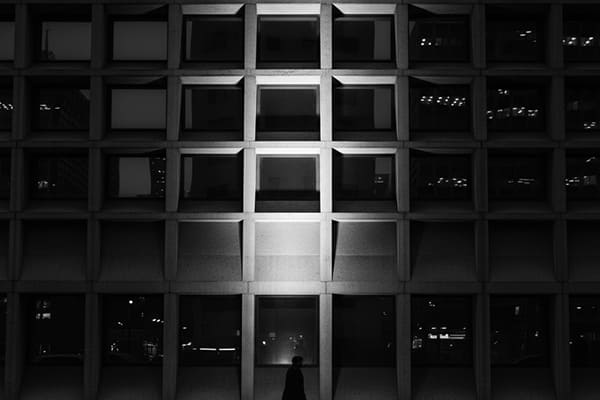
Think of it like painting a picture. A painter doesn't use the same bright color for every part of the canvas. They use light and shadow to create depth, guide the eye, and establish a focal point.7 The exact same principle applies to architectural lighting. A truly premium nightscape is not about flooding a building with light. It’s about being selective and artistic. In my experience, the most successful projects have a clear visual hierarchy. We decide what the most important parts of the building are and make them the heroes of the nighttime story. A flatly lit building is just a bright object in the dark. A dynamically lit building becomes a work of art that people remember.
Creating a Focal Point
We often emphasize the main entrance, the crown of the building, or strong vertical and horizontal lines. These areas receive more focused or intense light. This draws the eye and immediately communicates the building’s most important features. For example, using spotlights on columns can create a sense of grandeur and strength.
Adding Depth with Shadows
At the same time, we intentionally use less light on less important areas. These can include mechanical floors or large, empty wall surfaces. This contrast between the bright, highlighted areas and the darker, shadowed sections is what gives the building a three-dimensional, sculptural quality at night. It guides the viewer's eye and tells a story about the architecture.
How do different building materials affect lighting choices?
Using the wrong light on a specific material can be a disaster. It can cause harsh glare, create ugly hotspots, or just look bland. You need to match the light to the surface.
Every material interacts with light differently.8 Glass reflects, so you must control glare.9 Stone is perfect for washing or grazing. Metal can create hotspots, requiring diffused light.10 The material dictates the necessary color temperature, beam angle, and installation method for the best result.
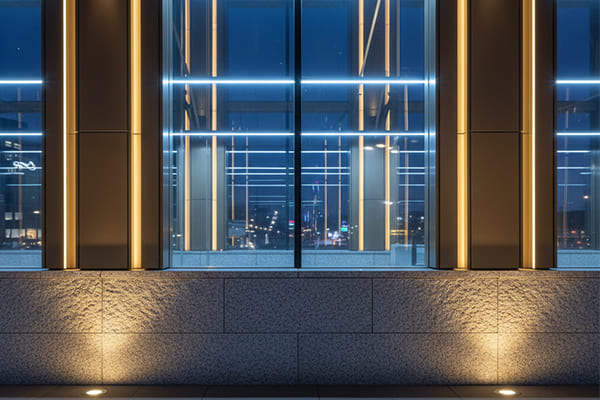
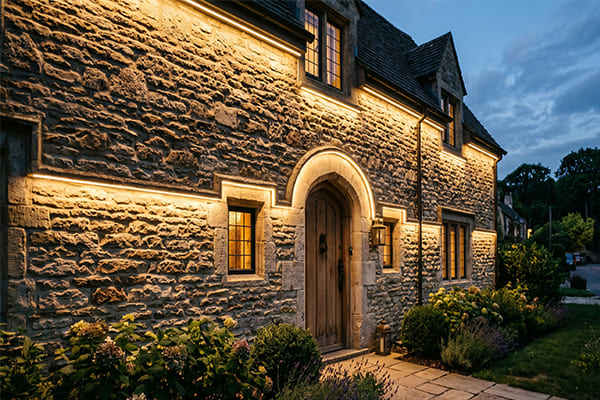
This is a step that many people overlook, but it's absolutely critical. You can't just pick a fixture you like and expect it to work everywhere. The building's "skin" is a critical part of the lighting equation. We have to test and analyze how it will react to our light. On a project I consulted for with a large glass curtain wall, we had to be extremely careful. The goal was to light the building's frame, not create a giant mirror or disturb the people inside. We used fixtures with precise optics and anti-glare shields to aim the light exactly where it was needed. For stone facades, the texture is your friend. A wall grazing technique, where light is aimed almost parallel to the surface, can bring out beautiful, dramatic textures in rough stone.11 For smooth stone, a wall wash from a distance creates a clean, elegant, and even look.
| Material | Common Technique | Key Challenge | Our Solution |
|---|---|---|---|
| Glass | Frame Lighting | Reflection & Internal Glare | Precise optics, anti-glare louvers |
| Stone (Textured) | Wall Grazing | Hotspots & Uniformity | Narrow beam angle fixtures, close placement |
| Metal Panels | Wall Washing | Specular Reflection | Wide beam angles, diffused lenses |
| Wood | Accent Lighting | Color Rendering & Warmth | High CRI, warm CCT (2700K-3000K) |
What are the common techniques and future trends in architectural lighting?
Is your building's lighting stuck in the past? A static, unchanging design can feel dated and boring. Smart controls can transform your facade into a dynamic, adaptable, and engaging landmark.
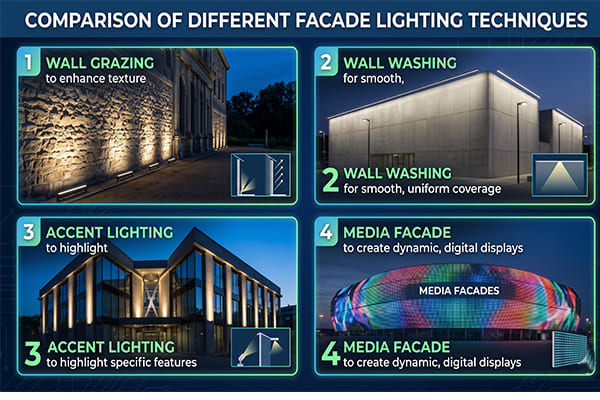
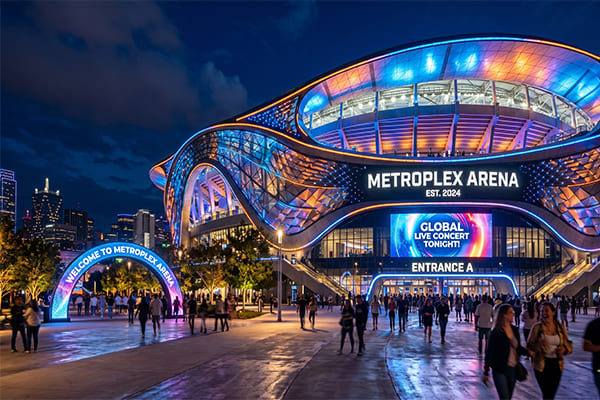
Common techniques include linear lighting, wall washing, and accenting. The major trend is the shift to digital and smart control systems like DMX and SPI Pixel. This allows for dynamic light shows, remote management, and turns the building itself into a media interface for the city.
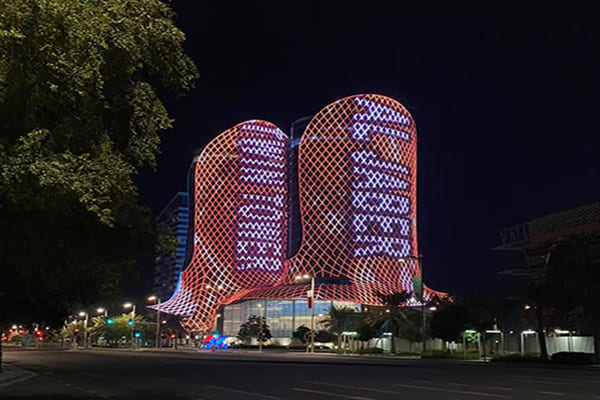
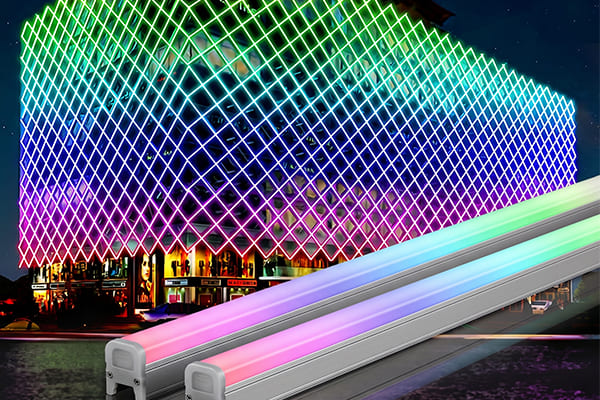
We have a whole toolbox of lighting techniques we use to shape a building at night. Linear lights are perfect for defining edges and creating clean lines of light. Wall washers provide smooth, even illumination on large surfaces. Accent lights, or spotlights, draw attention to specific details like statues or architectural features. But the real game-changer in recent years is not the lights themselves, but how we control them. Gone are the days of a simple on/off switch. The industry has fully embraced digitalization.
The Power of Smart Control
We now use powerful control systems to create complex, dynamic lighting scenes. A popular protocol is DMX, which is the standard for professional stage lighting.12 It allows us to program shows where colors change, fade, and move across the facade. Imagine your building changing to festive colors for a national holiday or displaying a flowing water animation. With SPI Pixel lighting, like our JUXUANLED pixel dot series, every single light point can be controlled individually. This technology turns the entire facade into a low-resolution screen, creating a true media facade.
The Future is Interactive
This is the future of architectural lighting. Buildings are no longer just passive, illuminated objects. They are becoming active, digital parts of the urban landscape. They can convey information, express emotion, and interact with the city and its people. A well-executed media facade makes a building a true landmark and a destination. It's about creating a memory and an experience, not just a lit surface.
Conclusion
Great architectural lighting is not about brightness. It is about thoughtful design, smart integration, and using light to reveal the building's soul and create a lasting urban memory.
"[PDF] 2022 Solid-State Lighting R&D Opportunities - Department of Energy", https://www.energy.gov/sites/default/files/2022-02/2022-ssl-rd-opportunities.pdf. A lighting-energy or light-pollution source can support that excessive or poorly directed nighttime exterior lighting increases electricity use and contributes to wasted light output. Evidence role: general_support; source type: government. Supports: Overly bright or poorly designed nighttime building lighting wastes energy.. Scope note: This would support the general relationship between over-lighting and energy waste, not the performance of any specific building shown or described in the article. ↩
"Illuminating Engineering Society - Integrated Lighting Campaign", https://integratedlightingcampaign.energy.gov/node/29. An architectural lighting textbook, standards body, or university source can establish that architectural lighting design addresses visual perception, architectural expression, safety, and spatial experience in addition to basic illumination. Evidence role: definition; source type: education. Supports: Exterior architectural lighting includes design and experiential goals beyond simply making a building visible.. Scope note: The source would define the broader professional scope of architectural lighting, rather than proving the article’s aesthetic judgment for every project. ↩
"Architectural lighting design - Wikipedia", https://en.wikipedia.org/wiki/Architectural_lighting_design. A professional lighting-design or academic source can support that architectural lighting integrates aesthetic design decisions with technical considerations such as optics, photometry, controls, and energy performance. Evidence role: definition; source type: institution. Supports: Architectural lighting combines artistic design concerns with engineering and technical lighting methods.. Scope note: The source would substantiate the interdisciplinary nature of the field, not the quality of any particular lighting scheme. ↩
"Building Facade Lighting: Techniques & LED Solutions - COLORS ...", https://www.colorsled.com/blog/building-facade-lighting-techniques-led-solutions. A façade-lighting design guide or architectural lighting reference can document concealed integration of luminaires within architectural details as a recognized method for reducing visual clutter and emphasizing the lighting effect. Evidence role: mechanism; source type: institution. Supports: Concealing exterior luminaires in façade elements can help create a 'see the light, not the lamp' effect.. Scope note: Such evidence would support the design principle generally; feasibility depends on the façade system, maintenance access, thermal conditions, and waterproofing details. ↩
"Emerging trends and innovations in engineering for ...", https://salasobrien.com/news/innovation-engineering-for-lighting-design/. A building-design or lighting-commissioning source can support that lighting integration is most effective when coordinated early with architectural, structural, electrical, and maintenance requirements. Evidence role: expert_consensus; source type: institution. Supports: Concealed and integrated façade lighting requires planning during the design phase.. Scope note: The source would support early coordination as a best practice, not prove that late-stage integration is impossible in all projects. ↩
"Designing Visual Hierarchies: Guiding the Viewer's Eye Through ...", https://www.rmcad.edu/blog/designing-visual-hierarchies-guiding-the-viewers-eye-through-composition/. An architectural lighting or visual-design reference can support that contrast, rhythm, and hierarchy are established compositional principles used to organize perception and emphasize architectural features. Evidence role: expert_consensus; source type: education. Supports: Effective façade lighting often relies on contrast, rhythm, and visual hierarchy rather than uniform brightness.. Scope note: The source would support these as accepted design principles, while 'best' remains a qualitative judgment dependent on project goals and context. ↩
"Luminance contrast provides metric depth information - PMC", https://pmc.ncbi.nlm.nih.gov/articles/PMC9929495/. A visual perception or architectural lighting source can support that luminance contrast and shadow help viewers perceive depth, direct attention, and identify focal areas in a composition. Evidence role: mechanism; source type: paper. Supports: Light and shadow can create perceived depth, guide attention, and establish focal points.. Scope note: The source would explain the perceptual mechanism generally; actual viewer response varies with geometry, context, adaptation level, and cultural expectations. ↩
"Measuring the Optical Properties of Highly Diffuse Materials - PMC", https://pmc.ncbi.nlm.nih.gov/articles/PMC10422425/. A lighting or materials reference can support that surface properties such as reflectance, texture, gloss, and color affect how incident light is reflected, scattered, or absorbed. Evidence role: mechanism; source type: education. Supports: Different façade materials interact with light differently because of their optical surface properties.. Scope note: The evidence would support the physical principle generally; the exact effect depends on the specific material finish, angle of incidence, and luminaire photometry. ↩
"Specular reflection - Wikipedia", https://en.wikipedia.org/wiki/Specular_reflection. A lighting-engineering source can support that glass has specular reflective properties that can produce reflected glare, making glare control and luminaire aiming important in façade lighting near glazed surfaces. Evidence role: mechanism; source type: institution. Supports: Glass façades can reflect light and require glare-control measures in exterior lighting design.. Scope note: The source would support the risk of reflected glare from glass generally; actual glare depends on glass type, viewing angle, luminance, and surrounding brightness. ↩
"Material category of visual objects computed from specular image ...", https://pmc.ncbi.nlm.nih.gov/articles/PMC10365995/. A lighting or optical-materials source can support that glossy or specular metal surfaces can produce bright reflected highlights, and that diffusion or broader beam control can reduce concentrated luminance. Evidence role: mechanism; source type: education. Supports: Metal façade panels can create lighting hotspots, and diffused light can help reduce concentrated reflections.. Scope note: The source would support the optical tendency of reflective metals; matte, coated, or perforated metals may behave differently. ↩
"Outdoor Lighting 101: Wall Washing Vs. Wall Grazing - CAST Lighting", https://cast-lighting.com/blog/post/outdoor-lighting-101-wall-washing-vs-wall-grazing. An architectural lighting guide can support that wall grazing places luminaires close to a surface at a shallow angle to emphasize texture and surface relief. Evidence role: mechanism; source type: institution. Supports: Wall grazing can emphasize the texture of rough stone façades.. Scope note: The source would support the technique’s textural effect generally; aesthetic quality depends on stone texture, fixture spacing, beam angle, and desired uniformity. ↩
"DMX512 - Wikipedia", https://en.wikipedia.org/wiki/DMX512. A standards or encyclopedia source can support that DMX512 is a widely used digital communication protocol for controlling stage and entertainment lighting equipment. Evidence role: definition; source type: encyclopedia. Supports: DMX is a standard digital control protocol in professional stage lighting.. Scope note: This supports DMX’s established role in entertainment lighting; it does not by itself show adoption rates in architectural façade lighting. ↩