Choosing durable outdoor LEDs feels like a gamble. A bad choice fails quickly, ruining your project and reputation. The key is understanding what truly makes a fixture last.
To guarantee durability, you must look beyond the basic IP rating1. While an IP65 rating2 is a good start for dust and water protection, true longevity depends on the fixture's structural design, including thermal management3, anti-UV materials4, corrosion resistance5, and electrical surge protection6.
An IP rating1 is just a number. It's a critical starting point, but it doesn't tell you the whole story. I've seen too many projects where a light with the "right" IP rating1 failed prematurely because other crucial factors were ignored. Let's break down what these numbers mean and, more importantly, what they don't tell you about a fixture's real-world survival. It’s the details beyond the rating that separate a good light from a great one that will last for years.
What Do IP Ratings Actually Mean for Your Outdoor LEDs?
IP rating1s like IP65 or IP677 can be confusing. Picking the wrong one leads to water damage and failed lights, causing major headaches for your project. Let's decode these numbers.
An IP (Ingress Protection) rating uses two digits. The first (0-6) measures dust protection, where 6 is total protection. The second (0-8) measures water protection. For example, IP65 resists water jets, while IP688 allows for continuous submersion in water.
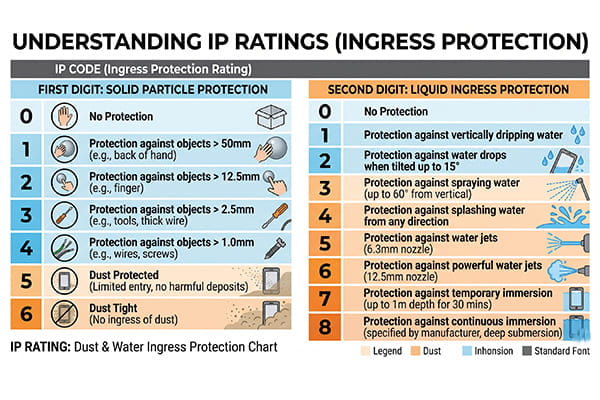
The IP rating1 is a standardized way to measure how well a fixture is sealed against foreign objects, both solid and liquid. For any outdoor application, you should only consider fixtures with a first digit of '6'. This means they are completely dust-tight9, which is essential because dust and dirt are everywhere and can cause heat buildup10 and failure over time.
The second digit is where you need to pay close attention to your specific application.
Decoding the Second Digit: Water Protection
| IP Rating Suffix | Protection Against | Common Application |
|---|---|---|
| IPx5 | Water jets | Wall washers, lights on poles, general outdoor areas. |
| IPx6 | Powerful water jets | Coastal areas, places with frequent heavy storms. |
| IPx7 | Temporary immersion | In-ground lights, areas prone to temporary flooding. |
| IPx8 | Continuous immersion | Underwater lights for pools, fountains, and ponds. |
So, an IP65-rated wall washer is perfect for mounting on a building facade where it will be exposed to rain. But if you're installing an in-ground uplight in a lawn that might get flooded, you absolutely need IP677 or IP688.
What Makes an LED Fixture Truly Weatherproof Beyond Its IP Rating?
You specified an IP677 light, but it still failed after six months. You feel cheated, and your project is now facing delays and extra costs. The secret lies in factors beyond the IP rating1.
True durability comes from smart engineering. This includes thermal management3 to prevent condensation, anti-UV materials4 that don't crack, corrosion-resistant coatings for harsh environments, and surge protection6 against electrical spikes11. These features determine a fixture's real lifespan.
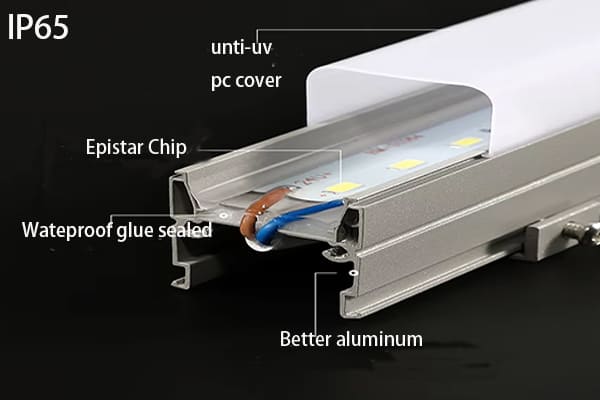
A high IP rating1 only proves a fixture passed a test in a controlled lab. Real-world conditions are far more brutal. A light endures constant temperature swings, relentless UV radiation12, and potential chemical exposure. This is where quality engineering and materials make all the difference.
Thermal Balance and Material Science
A light heats up when on and cools down when off. This cycle can create negative pressure, causing the fixture to "breathe" in moist air, leading to internal condensation and failure. High-quality fixtures solve this with a breather valve, which equalizes pressure without letting water in. The materials are also critical. I remember a project back in 2020. A client in Japan was testing our 4227 DMX512 RGBW linear light. After three months of UV testing, they found the PC cover had started to yellow. While it didn't affect the light output yet, it was a clear sign of future failure. That experience pushed us to upgrade our process. Now, every single fixture we make, even our most affordable models, has an anti-UV treatment on its PC components to prevent yellowing and cracking.
Corrosion Resistance in Harsh Environments
If your project is near the coast or in an area with acidic soil, standard aluminum isn't enough. Salt spray and chemicals will eat away at the housing and cause it to fail. For these environments, you need superior materials like 201, 304, or even 316 stainless steel, or a housing with a special marine-grade powder coating13. We handled a large project in Dubai right on the coast. The client needed thousands of 3000K linear lights. We manufactured them with a special anti-salt spray treatment on the surface. Years later, those lights are still performing perfectly, and the client continues to specify that same treatment for all their new projects in Dubai.
Essential Electrical Protection
Outdoor fixtures are vulnerable to power surges from lightning strikes or grid fluctuations. A surge can instantly destroy the driver and LED chips. That's why professional-grade outdoor lights must have built-in surge protection6, typically between 2kV and 4kV. This small component acts as a vital shield, protecting your investment from unpredictable electrical events and ensuring the fixture's long-term reliability.
How Do You Choose the Right IP-Rated Fixture and Install It Correctly?
You know the theory, but now you need to make a practical choice. One wrong selection or a single installation mistake can compromise the entire lighting system. Here’s a simple guide to get it right.
For most general outdoor areas exposed to rain, IP65 is your go-to standard. For any in-ground or underwater use, you must choose IP677 or IP688. During installation, always use IP688 connectors and create a "drip loop14" to prevent water from running down the cable.
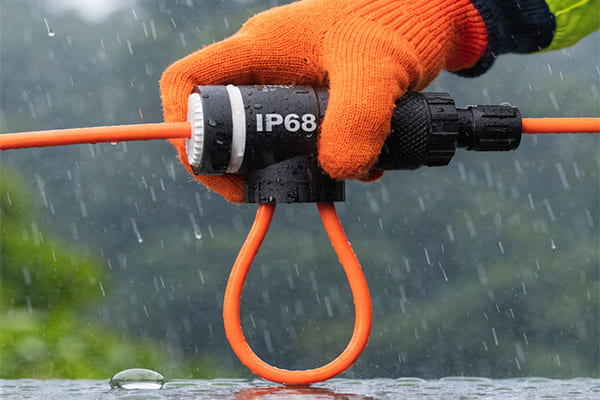
Choosing the right fixture is half the battle; installing it correctly is the other half. Even the best IP688 light will fail if the connections aren't waterproof. I've seen countless failures caused by installers using simple electrical tape15, which just isn't designed to withstand moisture and temperature changes over time.
Matching IP Ratings to Your Scene
Here is a quick reference table to help you select the right IP rating1 for common outdoor scenarios.
| Usage Scenario | Recommended IP Rating | Why? |
|---|---|---|
| Under Eaves, Porches | IP44 | Protected from direct rain, but needs splash protection. |
| Exposed Walls, Poles | IP54, IP65 | Must withstand direct rain and wind-driven water jets. IP65 is best. |
| Coastal, Stormy Regions | IP66 | Needs protection against powerful jets of water. |
| In-Ground, Lawn Lights | IP677 | Must survive temporary flooding and standing water. |
| Pools, Fountains | IP688 | Designed for continuous submersion in water. |
For areas with potential standing water like lawns, always choose a fixture rated for immersion (IP677/IP688) and consider models that are fully potted with resin. This provides a second layer of defense if the outer seal is ever compromised.
Installation Details That Matter
Proper installation is non-negotiable. Two things are absolutely critical. First, always use IP688-rated waterproof connectors for all cable joints. Do not cut corners with electrical tape15. Second, you must create a drip loop14. This is a simple loop in the cable just before it enters the fixture or connector. Gravity will cause any water running down the cable to drip off the bottom of the loop instead of flowing directly into the connection point. It's a simple, free technique that can save a fixture's life.
Conclusion
An IP rating1 gets you in the game. But superior materials, smart structural design, and proper installation are what win the long-term battle for outdoor LED durability. Choose wisely.
Understanding IP ratings is crucial for selecting durable outdoor LEDs, ensuring your investment lasts. ↩
Explore the significance of IP65 ratings to ensure your outdoor lights withstand the elements. ↩
Learn about thermal management to prevent condensation and extend the lifespan of your outdoor LEDs. ↩
Discover how anti-UV materials can prevent cracking and yellowing in outdoor lighting fixtures. ↩
Find out how corrosion resistance can protect your fixtures in harsh environments and ensure longevity. ↩
Understand the importance of surge protection to safeguard your outdoor lights from electrical spikes. ↩
Explore the benefits of IP67 ratings for fixtures exposed to temporary flooding or standing water. ↩
Understand the significance of IP68 ratings for fixtures designed for continuous submersion. ↩
Explore the importance of dust-tight features to ensure the longevity of your outdoor LEDs. ↩
Learn about heat buildup and its impact on the performance and lifespan of outdoor lighting. ↩
Learn about the risks of electrical spikes and how to protect your outdoor lighting investments. ↩
Understand the effects of UV radiation on outdoor lighting and how to mitigate potential damage. ↩
Discover how marine-grade powder coating enhances durability in coastal and harsh environments. ↩
Learn the simple technique of creating a drip loop to protect your outdoor lighting connections. ↩
Discover why using electrical tape can lead to failures in outdoor lighting and what to use instead. ↩