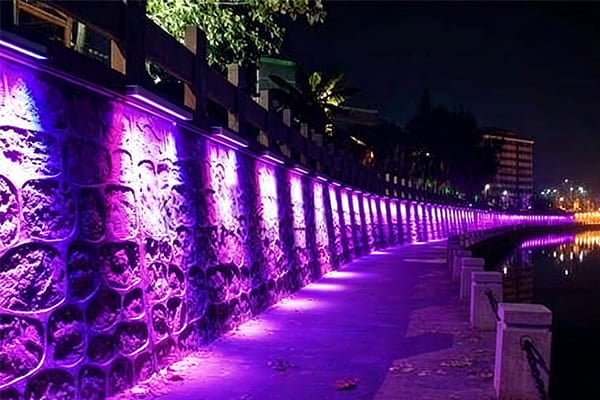
Struggling with confusing lighting regulations? Non-compliance can stop your project cold. I'll show you the key rules to ensure your design gets approved and shines brightly.
Modern compliance focuses on eco-friendly lighting1. This means strict control over light pollution with shielded fixtures, using warm color temperatures (≤3000K)2, meeting energy limits (LPD)3, and using smart controls for curfews4. The goal is a low-carbon, beautiful, and non-intrusive nightscape.
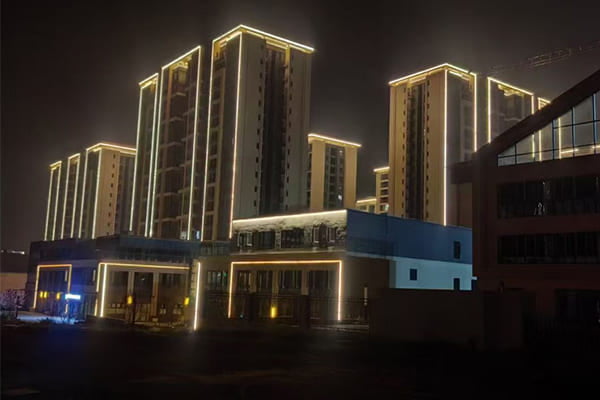
These rules might seem complex, but they are changing how we design for the better. We're moving away from just making things bright and toward creating lighting that is smart, responsible, and beautiful. Let’s break down exactly what you need to know to make your next project a success, starting with the very first step: getting approval.
Why Is Planning and Approval More Than Just Paperwork Now?
Think your design is perfect but worried the city won't agree? The approval process is tougher than it used to be. Let's look at how to align your project with city plans.
Approval now requires your project to fit into the city's master lighting plan5. It's not just about aesthetics. You must prove your design respects historical areas and ecological zones by limiting dynamic effects and using appropriate, warmer color temperatures to get the green light.
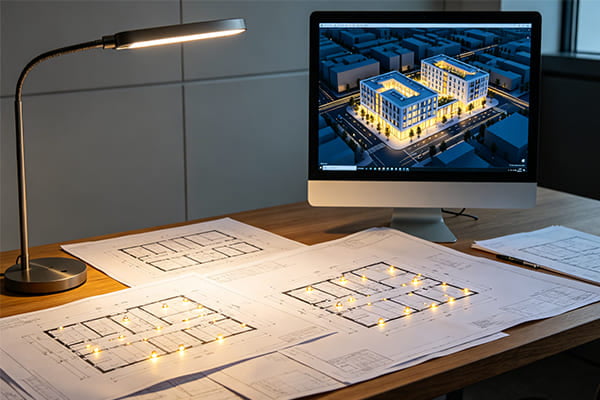
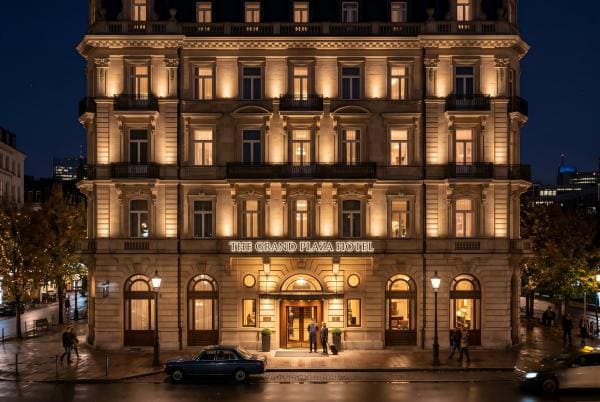
This is a big shift I've seen in my years in the industry. In the past, as long as a lighting design looked good and was electrically safe, it would likely get approved. Now, city planners look at the bigger picture. They ask us, "How does this project contribute to our city's overall lighting identity and environmental goals?" I remember a project for a historic building where the client initially wanted a vibrant, color-changing display. We had to work together to redesign the concept. We used a warm, static 2700K light that highlighted the architecture's beautiful details without overwhelming its historic character. The city loved it. This experience taught me that compliance is now a creative partnership.
Key Approval Considerations
- Master Plan Alignment: Your design must match the city's designated lighting character for that area. Is it a quiet historic district or a bustling commercial hub?
- Sensitive Zone Restrictions: Historical buildings, natural parks, and protected landmarks have very strict rules6. Expect limitations on brightness, color, and any movement in the lighting. Static, warm light is often the only option.
- Thorough Documentation: You'll need to provide detailed lighting plots, fixture specifications, and simulation reports showing light spill, energy consumption, and glare levels.
How Can You Master Light Pollution and Dark Sky Compliance?
Afraid of complaints about glare or light spilling into windows? Bad lighting can ruin a project's reputation and lead to costly fixes. I'll explain how to keep light exactly where you want it.
To control light pollution, you must prevent light from going upwards or into windows. This means using fixtures with zero upward light (U-0), proper shielding, and careful aiming7. Different zones, from nature preserves to city centers, have different brightness limits you must follow.
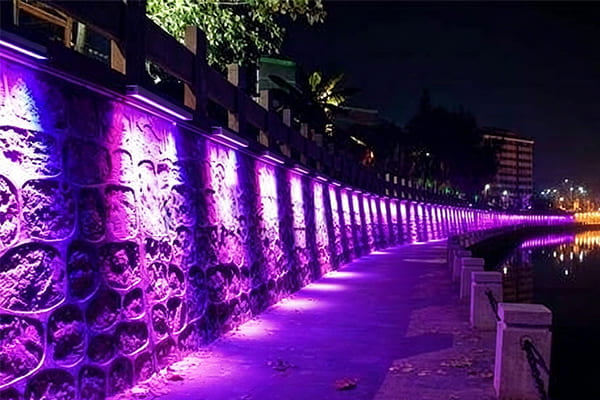
This is where technical details really matter. "Dark Sky" isn't just a buzzword; it's a set of standards that cities are adopting very quickly. The core idea is simple: light the ground and the building, not the sky or your neighbor's bedroom. We achieve this by focusing on fixture design and placement. For example, our wall washers are designed with precise optics and optional shields to cut off light sharply. This prevents that hazy sky glow and stops light from trespassing into areas where it isn't wanted. One of the most important tools for this is the Environmental Zone system. We always help our clients understand which zone their project is in so we can select products that meet the specific requirements. It’s a proactive way to avoid problems later.
Environmental Lighting Zones8 Explained
| Zone | Description | Lighting Standard |
|---|---|---|
| E0 | Protected Areas (National Parks) | No permanent lighting. Intended for pristine night skies. |
| E1 | Natural/Rural Areas | Very low ambient brightness. Light must be minimal and targeted. |
| E2 | Suburban/Residential Areas | Low ambient brightness. Strict controls on glare and light trespass. |
| E3 | Urban Areas | Medium ambient brightness. Lighting is common, but still controlled. |
| E4 | City Centers/Commercial Zones | High ambient brightness. More lighting is allowed, but uplight is still bad. |
Are Your Color Temperature and Energy Choices Future-Proof?
Choosing bright, cool lights might seem powerful, but it's quickly becoming a compliance problem. Using too much energy is also a major red flag for regulators. Let's pick specs that last.
Future-proof designs use warm color temperatures, almost always 3000K or less, to protect wildlife and human health from harmful blue light. They also meet strict Lighting Power Density (LPD) limits by using high-efficiency LED fixtures, ensuring your project is both beautiful and sustainable.
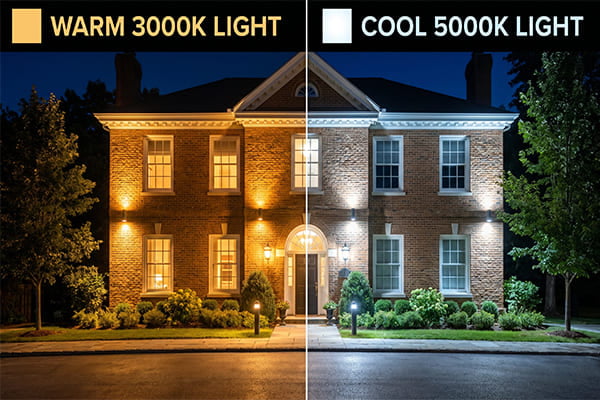
The conversation around color temperature has completely changed. We used to talk about what "looks good," but now we talk about what is "healthy" for the environment and for people. Scientific studies have shown how blue-rich light from cool CCTs (4000K and above) can disrupt nocturnal animals and human sleep patterns9. That's why the ≤3000K rule is now so common in city codes worldwide. For energy, it’s all about Lighting Power Density, or LPD. This is measured in watts per square meter or per linear foot.10 Your project will have a maximum LPD it cannot exceed. This forces us to be smarter, not just brighter. We work with designers every day to select the most efficient fixtures, like our JUXUANLED linear lights, that deliver the required light levels with the lowest possible energy use. This isn't a limitation; it's a design challenge to be more precise and efficient.
What Role Do Smart Controls and Safety Play in Modern Projects?
Leaving lights on at full power all night is wasteful, outdated, and often illegal. And of course, ignoring safety is a risk you can never afford to take. Here is how to make your project smart and secure.
Smart controls are now a compliance essential. You must use systems for time-based dimming and scheduling "curfews" to reduce light levels late at night. On the safety side, all fixtures must have proper certifications, waterproofing (IP rating), corrosion resistance, and secure grounding.
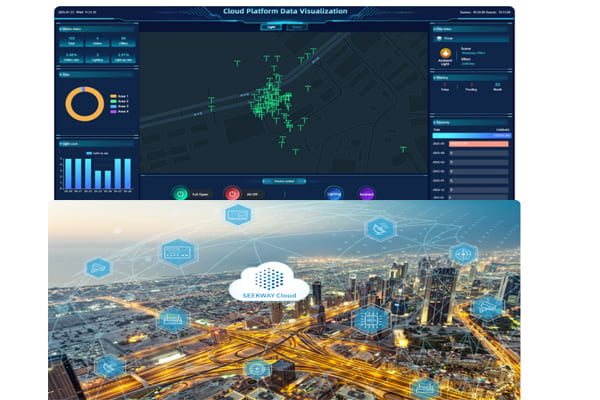
I see smart controls as the brain of a modern lighting project. They allow us to meet compliance rules dynamically and save our clients a lot of money on electricity. For instance, a building facade can be lit beautifully until 11 PM, then the system can automatically dim the lights to 30% brightness for the rest of the night. This "curfew" approach is becoming standard in many city codes because it saves energy and reduces sky glow. But none of this matters if the system isn't safe. Safety is the foundation of everything we do. We ensure our products have the necessary certifications for the regions they are sold in. We always talk to contractors about the importance of using IP66 or IP67 rated fixtures for weatherproofing11, and using corrosion-resistant materials in coastal areas. Proper grounding isn't just a suggestion; it's a critical safety measure to protect people and property. We treat safety as absolutely non-negotiable.
Conclusion
Compliance has evolved. It’s no longer about restrictions, but about creating responsible, sustainable, and truly beautiful nightscapes. Following these rules makes your project better for everyone.
"NY State Assembly Bill 2025-A1686", https://www.nysenate.gov/legislation/bills/2025/A1686. A lighting-policy or dark-sky guidance source can support that contemporary outdoor-lighting compliance increasingly addresses energy use, skyglow, glare, and ecological impacts rather than only visual appearance. Evidence role: general_support; source type: institution. Supports: Modern lighting compliance increasingly emphasizes environmental performance and reduced light pollution.. Scope note: This would support the broad policy trend, not prove that every jurisdiction applies the same requirements. ↩
"OUTDOOR LIGHTING FIXTURES MODEL ORDINANCE.", https://idadb.cals.arizona.edu/statutory/outdoor-lighting-fixtures-model-ordinance. A dark-sky or municipal-lighting guidance source can document that many outdoor-lighting recommendations and ordinances use warm-white limits, commonly 3000 K or lower, to reduce blue-rich light impacts. Evidence role: expert_consensus; source type: institution. Supports: Warm color temperatures of 3000 K or lower are commonly recommended or required in outdoor lighting to reduce blue-rich light impacts.. Scope note: Color-temperature limits vary by jurisdiction and application, so the source should be framed as evidence of a common recommendation rather than a universal rule. ↩
"[PDF] 2018 IECC Commercial Electrical Power and Lighting Systems", https://www.energycodes.gov/sites/default/files/2019-09/2018_IECC_commercial_requirements_lighting.pdf. An energy-code source can support that lighting power density is used in building and exterior-lighting standards to limit installed lighting wattage by area or application. Evidence role: definition; source type: government. Supports: Lighting power density limits are a common mechanism for regulating lighting energy use.. Scope note: The exact LPD values depend on the adopted code edition, building type, and jurisdiction. ↩
"[PDF] Chapter 6 - Lighting - California Energy Commission", https://www.energy.ca.gov/filebrowser/download/5128. A lighting-control or model-lighting-ordinance source can support that outdoor-lighting rules often require or recommend time-based controls, dimming, or shutoff after curfew hours to reduce energy use and obtrusive light. Evidence role: mechanism; source type: institution. Supports: Smart controls and curfews are used to reduce late-night light levels and support lighting compliance.. Scope note: The term and timing of a curfew are locally defined, so evidence should be presented as a common compliance mechanism rather than a fixed global requirement. ↩
"[PDF] Municipal High Performance Building Guidelines City of ...", https://www.phila.gov/media/20250103125854/Municipal-High-Performance-Building-Guidelines_V1.5.pdf. Urban-lighting planning literature can support that city lighting master plans establish area-specific goals for visual identity, safety, energy use, and environmental protection. Evidence role: historical_context; source type: education. Supports: Lighting projects may be evaluated against broader city lighting master plans or urban-lighting strategies.. Scope note: This supports the planning concept generally; approval procedures differ substantially among cities. ↩
"Outdoor Lighting Principles - Night Skies (U.S. National Park Service)", https://www.nps.gov/subjects/nightskies/outdoor-lighting-principles.htm. Heritage-conservation and protected-area guidance can support that lighting near historic sites and protected natural areas is often subject to stricter controls to limit visual intrusion, ecological disturbance, and skyglow. Evidence role: general_support; source type: institution. Supports: Sensitive heritage and ecological locations often face stricter outdoor-lighting controls.. Scope note: The degree of restriction depends on the protected designation and local authority. ↩
"Obtrusive Light: the CIE-150 Document - NASA ADS", http://ui.adsabs.harvard.edu/abs/2004AAS...204.8905C/abstract. Dark-sky and outdoor-lighting guidance can support that shielding and aiming luminaires downward reduce uplight, glare, and light trespass. Evidence role: mechanism; source type: institution. Supports: Shielding and careful aiming help reduce light pollution and light trespass.. Scope note: Actual performance depends on luminaire photometry, mounting height, site geometry, and maintained light levels. ↩
"5 Considerations Concerning Lighting Systems | FHWA", https://highways.dot.gov/safety/other/visibility/fhwa-lighting-handbook-august-2012/5-considerations-concerning-lighting. CIE guidance on obtrusive light can support the use of environmental zones from intrinsically dark areas to high-brightness urban areas as a framework for setting lighting limits. Evidence role: definition; source type: institution. Supports: Environmental lighting zones classify locations by ambient brightness and sensitivity for outdoor-lighting limits.. Scope note: Zone labels and thresholds may be adapted by national or local codes, so the cited framework should not be treated as a single universal ordinance. ↩
"Artificial light at night alters behavior in laboratory and wild animals", https://pmc.ncbi.nlm.nih.gov/articles/PMC6205897/. Peer-reviewed research can support that short-wavelength-rich artificial light at night affects circadian physiology in humans and can alter behavior or physiology in nocturnal wildlife. Evidence role: mechanism; source type: paper. Supports: Blue-rich artificial light at night can affect human circadian rhythms and nocturnal wildlife.. Scope note: CCT is an imperfect proxy for spectral power distribution, and biological effects depend on intensity, duration, timing, and species. ↩
"[PDF] Lighting System Performance - | Building Energy Codes Program", https://www.energycodes.gov/sites/default/files/2021-10/Lighting_System_Performance.pdf. An energy-code or lighting-standard source can support that lighting power density expresses installed lighting power normalized by area, and some exterior applications may use linear or application-specific allowances. Evidence role: definition; source type: government. Supports: LPD is a metric for installed lighting power normalized to area or other application dimensions.. Scope note: The units used for compliance vary by code and lighting application; many building codes primarily express LPD as watts per unit area. ↩
"IP code - Wikipedia", https://en.wikipedia.org/wiki/IP_code. The IEC ingress-protection standard can support that IP66 and IP67 ratings indicate specified levels of dust protection and water resistance for electrical enclosures. Evidence role: definition; source type: institution. Supports: IP66 and IP67 ratings are used to specify dust and water ingress protection for outdoor lighting fixtures.. Scope note: An IP rating describes tested ingress protection, not overall product durability, corrosion resistance, or installation quality. ↩