Your building's facade looks flat and lifeless at night. Standard lighting washes out architectural details, making your project blend in. This fails to create the stunning visual impact you envisioned.
The best way to enhance a building's hierarchy and create a 3D effect is through strategic under eave lighting. This involves layering brightness levels, using varied beam angles, and controlling color temperature1. These techniques work together to sculpt the facade with light and shadow.
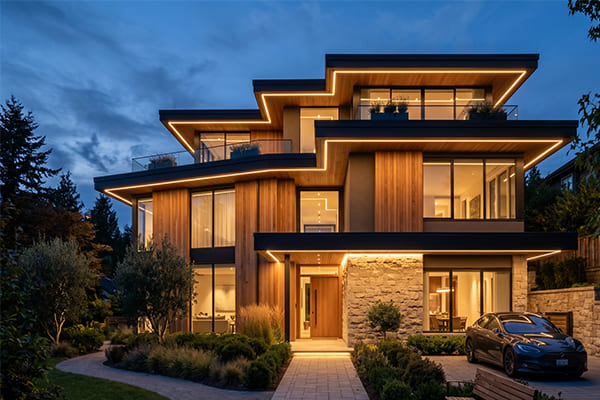
This sounds good in theory, but you might wonder how to apply these concepts to your own projects. The secret is not just about choosing bright lights; it's about a careful, deliberate process. Let's break down the professional techniques we use to turn a flat surface into a three-dimensional work of art.
What Are the Core Techniques for Eave Light Layout and Angle Control?
Placing lights without a plan often leads to harsh glare and ugly hot spots. This amateur mistake can ruin the building's appearance at night. A systematic approach is the only way forward.
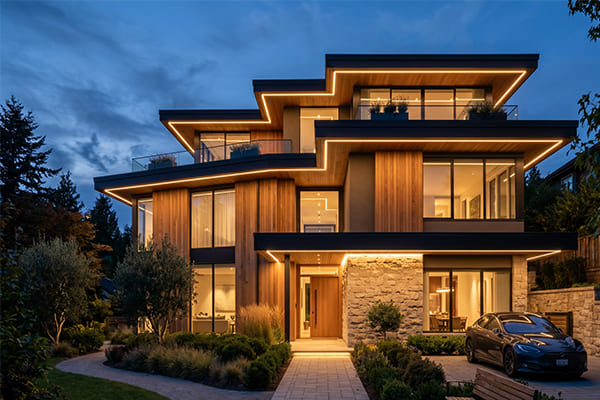
The key is to install lights 15-30cm from the wall at a 30-45° angle2. We hide fixtures in the eave for a "see the light, not the lamp" effect3. Use narrow beams for details and wide beams for washing walls4 to create contrast.
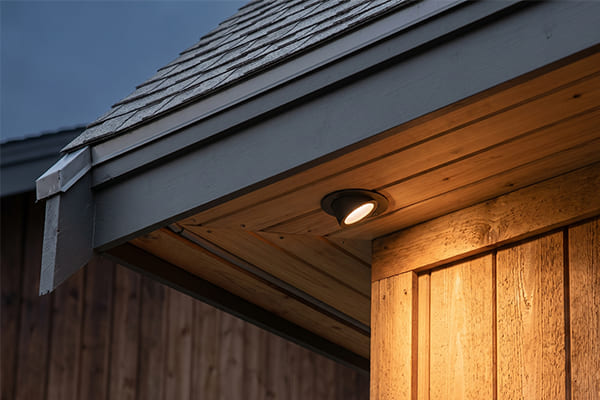
In my experience, getting the layout right is 80% of the battle. It’s the foundation for every other effect you want to create. When we talk about layout, we're really focusing on two main things: where you put the light and what kind of light beam you use. Hiding the light source is a mark of high-end design. On a recent project in Vietnam, we worked with an architect who designed a small groove into the eave structure. We tucked our slim linear lights right inside. At night, the building appeared to glow from within. The focus was entirely on the beautiful light effect, not the hardware. This is the ultimate goal.
Then, we must select the right beam angles. This is how you "paint" with light.
Beam Angle Strategy for Depth
Different beam angles serve different purposes. A narrow beam is like a fine-point pen, while a wide beam is like a broad brush. You need both to create a masterpiece.
| Beam Type | Angle | Best Use Case | Desired Effect |
|---|---|---|---|
| Narrow Beam | 5-15° | Columns, window frames, architectural details | Creates sharp, dramatic highlights and defines vertical lines. |
| Wide Beam | 40-60° | Broad wall surfaces, secondary areas | Provides a soft, even wash of light, acting as a base layer. |
By combining these, you start building a visual hierarchy. The narrow beams pull important details forward, making them pop. The wide, gentle wash of light on the main walls pushes them back visually.5 This simple contrast is the first step to creating real depth and avoiding a flat, boring facade.
How Do You Create Depth with a Layered Lighting Strategy?
Just lighting an entire building with the same brightness makes it look one-dimensional. This approach wastes energy and lacks any artistic feeling. A layered strategy uses different brightness levels to build depth6.
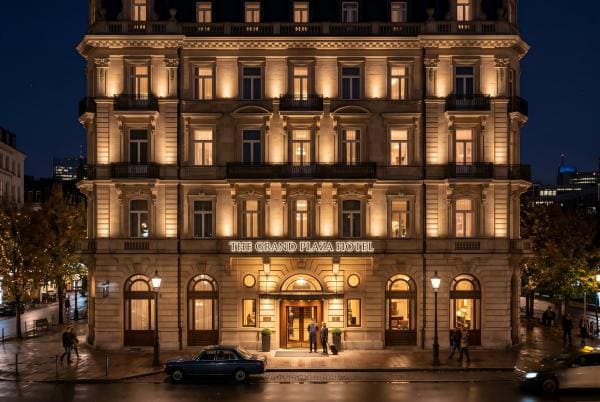
Create three distinct brightness layers7. The eave outline should be the highest brightness, the wall transition a medium brightness, and some areas left as dark shadows. Use warmer light (3000K-3500K) for focal points to guide the eye8 and create a sense of depth.
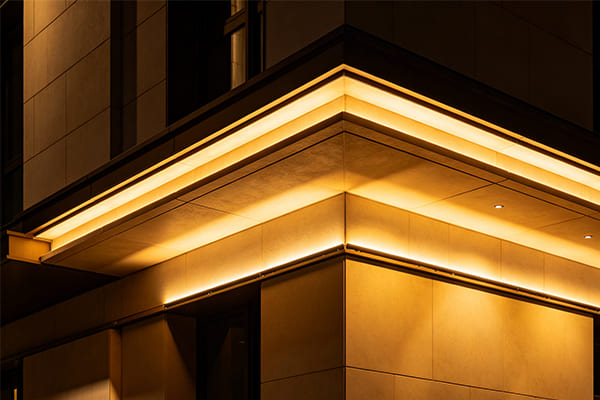
Think of lighting a building like a stage set. Not everything should be equally lit. You need to guide the viewer's eye to the most important parts. I always tell my clients to avoid the "one-brightness-fits-all" mistake. It’s like trying to paint a portrait with only one color. To create a truly dynamic and engaging facade, you need to use a full palette of light levels and even different color temperatures. This is where we apply the principles of brightness and color zoning.
The Three-Tier Brightness Rule
This is a simple but powerful rule we follow on our projects. We divide the facade into three zones of light.
- Level 1 (High Brightness): This is for the eave edge or main outlines. This bright line defines the building's silhouette against the night sky.
- Level 2 (Medium Brightness): This is for the main wall surfaces under the eaves. It's a transitional layer that connects the bright outline to the shadows.
- Level 3 (Low/No Light): These are the planned shadows. These dark areas are just as important as the lit ones because they create contrast and definition.
Color Temperature Zoning
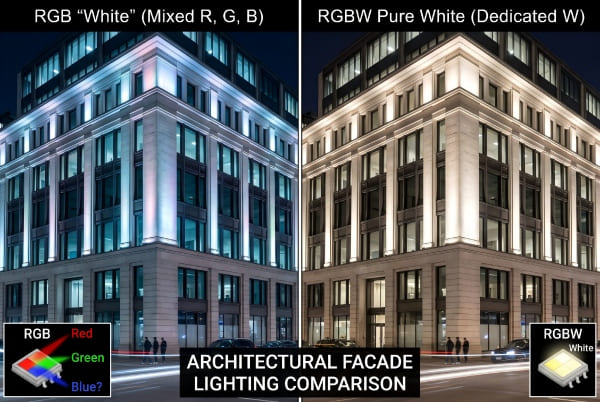
Color temperature also affects how we perceive distance.9 On a hotel project we supplied in the Middle East, we used this to our advantage. We lit the grand entrance canopy with our 3000K wall washers. This warm, welcoming light made the entrance feel close and inviting. For the long wings of the building, we used a slightly cooler 3500K. This subtle shift made the entrance stand out while giving the rest of the facade a grander, more distant scale. It's a simple trick that guides the eye and adds a layer of sophistication.
Which Light and Shadow Techniques Best Reveal a Building's Texture?
Your building has beautiful materials like stone, brick, or wood. But at night, they can look like a simple, flat surface. You're missing a big opportunity to show the quality of the structure.
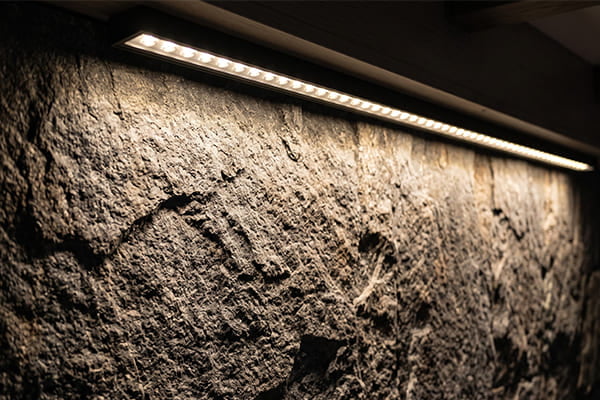
Use grazing by placing lights very close to the wall (10-30cm) to bring out texture.10 Use reflective lighting by aiming light at the eave's underside for a soft, "floating" look. Most importantly, strategically leave some areas dark to create rhythm and contrast.
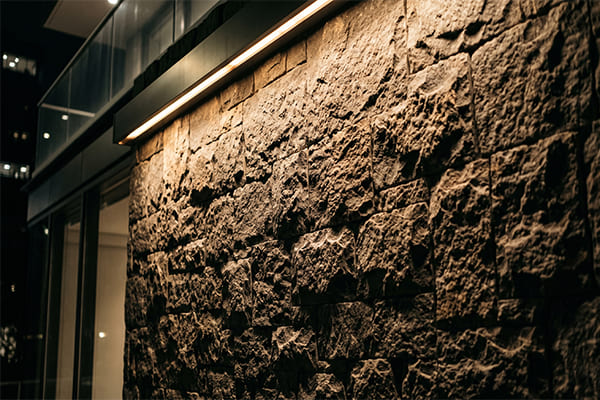
Light doesn't just illuminate; it reveals. The right technique can make a simple brick wall look like a piece of art. It’s all about the angle and direction of the light. Three techniques are essential in our work: grazing, reflection, and the strategic use of shadow. These are the finishing touches that elevate a project from simply "lit" to "masterfully designed." We use our DMX512 control systems to fine-tune these effects, ensuring the perfect balance.
Grazing for Texture
Grazing is a technique where the light source is placed very close to a surface and aimed at a sharp angle. This light "grazes" the surface, creating long shadows from every tiny bump and groove. This is perfect for highlighting materials like rough-cut stone, wood grain, or textured concrete. It transforms a flat surface into a rich, three-dimensional landscape. For all our projects, we recommend IP65+ rated fixtures with anti-glare shields for this, ensuring durability and visual comfort.
Reflective Light for "Floating" Effects
Instead of always pointing light down onto the wall, sometimes we point it back and up. We aim the light at the underside of the eave, which is called the soffit. The soffit then becomes a large, soft, indirect light source.11 This technique washes the top of the wall in gentle, diffused light. I remember a project with a very heavy, imposing roofline. By using reflective lighting on the soffit, we visually separated the roof from the walls. It made the whole structure feel lighter, more elegant, and almost like it was floating.
The Power of Planned Shadows
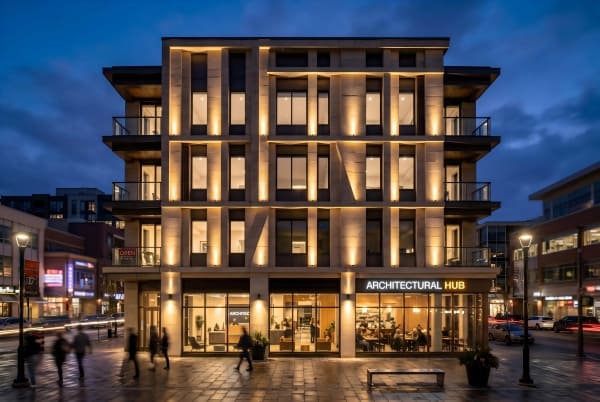
Finally, never forget that what you don't light is as important as what you do light. Shadows are not a mistake; they are a tool. By intentionally leaving recessed areas or the spaces between columns dark, you make the lit parts stand out more. Shadows create rhythm, depth, and drama.12 They are the silent partner to light, working together to sculpt the building's form. Uniformly spacing fixtures about 1.8 to 3 meters apart helps create a smooth transition between these light and dark areas.
Conclusion
A great under eave lighting design combines smart layout, layered brightness, and texture-enhancing techniques. This planned approach is how you turn a simple building into a nighttime architectural sculpture.
"[PDF] Lighting Design Manual", https://www.cfm.va.gov/til/dManual/dmLighting.pdf. Architectural lighting guidance explains that luminance contrast, beam distribution, and color appearance are principal variables used to model architectural form and depth at night. Evidence role: expert_consensus; source type: institution. Supports: Layering brightness levels, varying beam angles, and controlling color temperature can enhance hierarchy and create a three-dimensional facade effect.. Scope note: This supports the general design principle, not a single universal formula for every facade. ↩
"2026 Guide to LED Wall Wash Lights | Design & Top Picks", https://www.litelees.com/article/led-wall-wash-lights-guide/. Facade-lighting design references describe close-offset, oblique mounting as a common method for washing or grazing vertical surfaces, with exact setback and aiming angles adjusted to fixture optics and surface geometry. Evidence role: expert_consensus; source type: institution. Supports: Under-eave fixtures are commonly positioned close to the wall and aimed obliquely to control wall illumination and texture.. Scope note: The cited guidance may give ranges or principles rather than confirming the exact 15–30 cm and 30–45° values for all fixtures. ↩
"Architectural Lighting | Visual Comfort & Co.", https://www.visualcomfort.com/architectural/?srsltid=AfmBOooSWPmT99g8WsAQvhOFqzce_UQ5zdkpe_guk-eQVqD4LwXWgckx. Lighting-design literature identifies source concealment and glare control as methods for improving visual comfort and emphasizing the illuminated architectural surface rather than the luminaire. Evidence role: mechanism; source type: institution. Supports: Concealing fixtures in an eave can reduce visual distraction and shift attention to the light effect rather than the hardware.. Scope note: The phrase itself is a design maxim; evidence will typically support the underlying glare-control and source-concealment principle. ↩
"(PDF) Architectural Lighting Design A PRACTICAL GUIDE", https://www.academia.edu/38978051/Architectural_Lighting_Design_A_PRACTICAL_GUIDE. Lighting optics references distinguish narrow beam distributions, which concentrate light for accenting objects or details, from wide beam distributions, which spread light over larger surfaces for wall washing. Evidence role: definition; source type: education. Supports: Narrow beams are suited to architectural details, while wider beams are suited to wall washing.. Scope note: The source will support typical beam-function relationships; final selection still depends on mounting height, distance, surface reflectance, and fixture photometry. ↩
"[PDF] DEPTH PERCEPTION AS A FUNCTION OF LIGHTING, TIME AND ...", https://faculty.washington.edu/inanici/Publications/Tai-depth_perception_lighting_time_spatiality1.pdf. Research and design guidance on visual perception in lighting indicate that luminance contrast and focused accent lighting can direct attention and increase perceived salience against a lower-contrast background. Evidence role: mechanism; source type: paper. Supports: Contrasting narrow accent beams with broader background washes can make selected facade details appear more visually prominent.. Scope note: The evidence is perceptual and contextual; it supports the mechanism of visual emphasis rather than guaranteeing the same perception on every facade. ↩
"Hotel Lighting Strategies Using Layered Architectural Illumination", https://boca.lighting/lighting-design-for-luxury-hotels-key-principles-and-layering-strategies/. Architectural lighting references describe layered lighting and luminance hierarchy as techniques for organizing visual attention and giving built forms apparent depth after dark. Evidence role: expert_consensus; source type: institution. Supports: Using different brightness levels can help create visual hierarchy and perceived depth in facade lighting.. Scope note: This supports the design approach generally; it does not prove one specific brightness ratio for the project described. ↩
"[PDF] LIGHTING DESIGN", https://www.engr.psu.edu/ae/thesis/portfolios/2005/nmy105/nmy105_FinalReport_files/06_Lightingdesign.pdf. Lighting-design guidance commonly organizes architectural illumination into layered zones or hierarchies of brightness to separate focal, transition, and low-light areas. Evidence role: expert_consensus; source type: institution. Supports: Dividing a facade into distinct brightness layers is a recognized method for creating hierarchy and contrast.. Scope note: The source may support layered luminance hierarchy without prescribing exactly three layers as a universal rule. ↩
"Effect of warm/cool white lights on visual perception and mood in ...", https://pmc.ncbi.nlm.nih.gov/articles/PMC8481791/. Studies and lighting references on correlated color temperature report that warm-white illumination is commonly associated with comfort, visual emphasis, and hospitality settings, which can help establish focal areas when contrasted with adjacent lighting. Evidence role: general_support; source type: paper. Supports: Warmer white light in the 3000K–3500K range can be used to emphasize focal points in architectural lighting.. Scope note: The evidence supports associations and design practice, not a deterministic rule that 3000K–3500K will always guide attention. ↩
"Warm versus cool colors and their relation to color perception", https://pmc.ncbi.nlm.nih.gov/articles/PMC12025320/. Research on color and spatial perception discusses how warm and cool hues can influence apparent advancing or receding qualities in visual scenes. Evidence role: mechanism; source type: paper. Supports: Color temperature or hue can influence perceived spatial distance and depth.. Scope note: Most evidence concerns color perception broadly or controlled visual experiments, so application to facade lighting is contextual rather than direct proof. ↩
"[PDF] Summary Book - Architecture, Lighting, Electrical, Acoustics", https://www.engr.psu.edu/ae/thesis/portfolios/2009/YXH150/Spring/HAN_Final%20Summary%20Book.pdf. Architectural lighting references describe grazing as placing luminaires close to a textured surface so oblique light casts small shadows that reveal surface relief. Evidence role: definition; source type: education. Supports: Close-positioned grazing light can emphasize wall texture by creating shadows across surface relief.. Scope note: The source will support the grazing mechanism; the exact 10–30 cm spacing may vary by luminaire size, beam angle, and wall texture. ↩
"Planning indirect lighting: diffuse light", https://www.erco.com/en_us/designing-with-light/lighting-knowledge/lighting-design/indirect-lighting-7497/. Lighting-design sources define indirect illumination as light reflected from a ceiling or overhead surface, producing a broader and more diffuse source than direct point illumination. Evidence role: definition; source type: education. Supports: A soffit can act as a soft indirect light source when light is aimed at and reflected from its underside.. Scope note: This supports the optical principle; the perceived 'floating' effect depends on the building geometry and brightness contrast. ↩
"(DOC) Interplay of light n shadows - Academia.edu", https://www.academia.edu/7340375/Interplay_of_light_n_shadows. Architectural and lighting-design theory treats shadow as an active compositional element, using contrast between illuminated and unilluminated areas to articulate form, rhythm, and spatial depth. Evidence role: expert_consensus; source type: education. Supports: Planned shadows can contribute to rhythm, depth, and drama in architectural lighting.. Scope note: The source supports the design concept qualitatively rather than measuring a universal amount of shadow needed. ↩