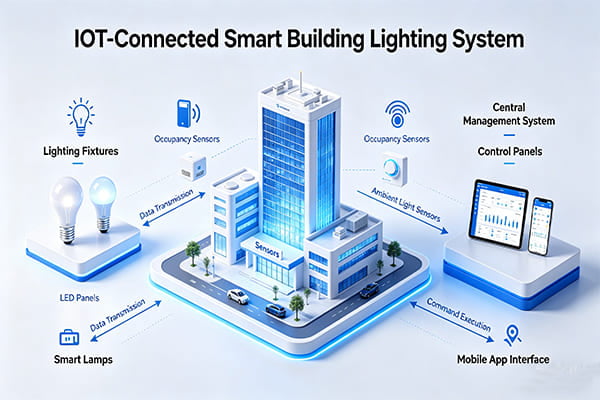
Your building's lighting feels outdated and dumb. This wastes huge amounts of energy and creates static spaces. IoT is making lights smart, responsive, and truly integrated into your architecture.
The future of architectural lighting is a shift from a simple "lighting tool" to a "digital backbone." It uses the Internet of Things (IoT) and AI to create intelligent, human-centric, and data-driven environments. This integration makes buildings more efficient, comfortable, and responsive to occupants' needs.1
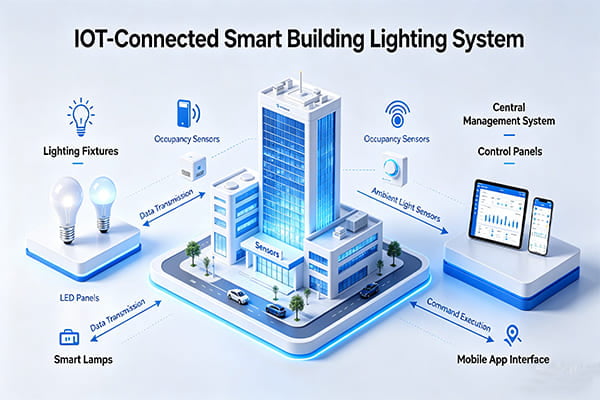
This sounds like a big leap, and it is. I remember a project in Dubai where we first started exploring these concepts. The client wanted more than just light; they wanted an experience. This pushed us at JUXUANLED to look beyond the fixture itself and into the system that controls it. This journey showed us that the future is already here, changing how we think about light. So, how does this future actually work? Let's break down the key features that are defining this new era of architectural lighting.
Will lighting become truly invisible and intelligent?
Constantly reaching for switches or opening an app is frustrating. It feels outdated in a modern building and breaks the flow of the experience. Smart systems now use ambient intelligence to react before you do.
Yes, lighting will become invisibly intelligent. It will use Ambient Intelligence and machine learning to predict user needs2. The system will provide light actively and automatically, making traditional switches and apps obsolete3. Light will simply follow people and adapt to their activities without any direct command.
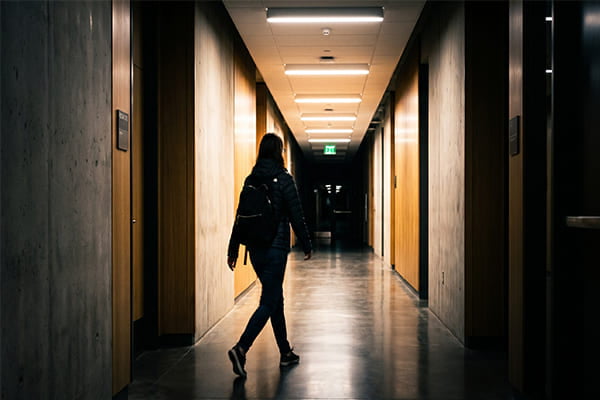
The core idea here is what we call Ambient Intelligence, or AmI. The lighting system is no longer waiting for a command from a person. Instead, it's always learning from the environment. We integrate sensors directly into our fixtures that gather data on occupancy, movement, and even the time of day4. This data feeds a machine learning algorithm. Over time, the system learns the building's usage patterns. For example, it knows that a particular conference room is typically used from 9 AM to 11 AM on Tuesdays. It will prepare the lighting accordingly, even before anyone arrives. This proactive approach is a game-changer for our clients. It’s not just about turning on a light when someone enters a room. It's about adjusting the intensity and color based on the predicted activity.
From Reactive to Proactive
This shift fundamentally changes how we interact with our environment. The goal is a "zero-touch" experience, where the technology disappears into the background, creating a seamless and intuitive space for occupants.
| Feature | Traditional Lighting | Intelligent Lighting |
|---|---|---|
| Control | Manual (Switch/App) | Automatic (AI/Sensors) |
| Response | Reactive | Proactive & Predictive |
| User Action | Required | None Required |
This level of automation makes the building feel alive and responsive, which is a key value proposition for high-end architectural projects.
Can lighting actually improve our health and well-being?
Harsh, static indoor lighting can disrupt our natural body clock. This is a common problem in many office buildings, and it leads to poor sleep and reduced focus for the people working inside. Human-Centric Lighting solves this by syncing with our biological needs.
Absolutely. Human-Centric Lighting (HCL) is designed to support our natural circadian rhythms5. The system automatically adjusts color temperature and brightness throughout the day to mimic the sun's path. This can enhance concentration, improve sleep quality6, and create healthier indoor environments for everyone.
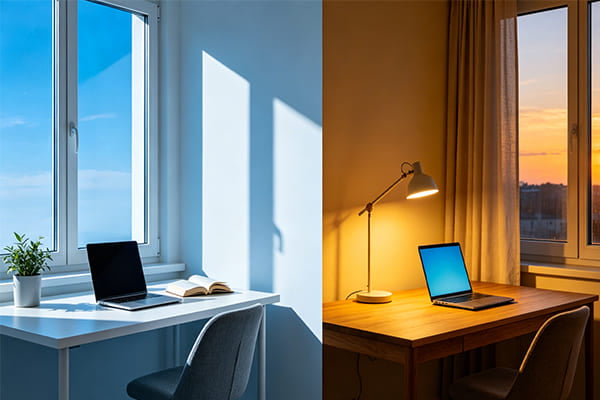
Our bodies are tuned to the 24-hour cycle of the sun. This is our circadian rhythm. For years, architectural lighting ignored this biological fact. We bathed our offices and homes in a single, unchanging color of light all day long. HCL changes that completely. In the projects we work on, we program our systems to automatically shift the light's characteristics. In the morning, the light is bright and cool, around 6500K, to mimic the morning sun. This helps suppress melatonin and increases alertness7. As the day progresses, the light gradually warms up and dims, reaching a relaxing 2700K in the evening to prepare the body for sleep. This dynamic approach makes indoor spaces feel more natural and comfortable.
Tailoring Light for Specific Needs
This isn't a one-size-fits-all solution. Different environments have different needs. We work with our clients, like contractors and designers, to create custom lighting profiles for their specific projects.
| Environment | Goal | Typical CCT Range |
|---|---|---|
| Office | Boost Focus & Productivity | 4000K - 6500K (Day) |
| Hospital | Aid Recovery & Support Staff | 3000K - 5000K (Dynamic) |
| Elderly Care | Improve Visibility & Safety | 3500K - 4000K (Higher Brightness) |
This level of control allows us to design spaces that actively contribute to the health and well-being of the people inside them, turning lighting into a strategic asset.
Is a light fixture just a light fixture anymore?
Your building has many systems, like HVAC, security, and lighting. But often, each part doesn't talk to the others. This creates waste and inefficiency. We are now turning lights into the sensory organs of a building.
No, a modern luminaire is a powerful data center. By integrating various sensors, it becomes a key data collection point for the entire building. It can monitor environmental conditions like CO2 levels and temperature, and even provide precise indoor positioning using technologies like Li-Fi8.
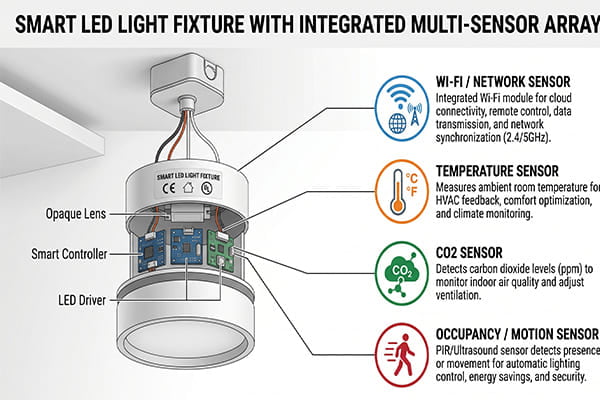
Think about it. Every building already has a power grid for lighting that reaches every single room. This is the perfect infrastructure to build a sensory network on. At JUXUANLED, we are now embedding more than just LEDs into our fixtures. We integrate a suite of sensors that can detect CO2 levels, temperature, humidity, and occupancy. This data is no longer siloed within the lighting system. It's shared across the building's management platform. For example, if sensors in a meeting room detect high CO2 levels and multiple occupants, the system can automatically tell the HVAC system to increase ventilation.9 This creates a smarter, more efficient building and can lead to energy savings of 15% to 50%10.
Beyond Environment: Location and Integration
This data integration creates a closed-loop system for efficiency. The building can react in real-time to how it is being used.
| Sensor Data | Integrated System | Action |
|---|---|---|
| Occupancy | HVAC System | Reduce heating/cooling in empty rooms |
| CO2 Levels | Ventilation System | Increase fresh air supply when high |
| Bluetooth Beacon | Asset Tracking System | Locate equipment within the building |
We can even use technologies like Li-Fi or Bluetooth beacons for centimeter-level indoor positioning. This is invaluable for retail analytics or asset tracking in a large facility. The light fixture is no longer just for illumination; it's the eyes and ears of the smart building.
How does smart lighting change sustainability and design?
Bulky light fixtures create visual clutter and end up in landfills. They are often a design compromise that architects have to make. New approaches focus on sustainability and making the light source itself disappear.
Smart lighting revolutionizes both. For sustainability, it enables a circular economy through predictive maintenance, reducing waste. Aesthetically, it allows for a "light without the fixture" approach, where LEDs are deeply integrated into building materials, creating dynamic and responsive architectural surfaces.11
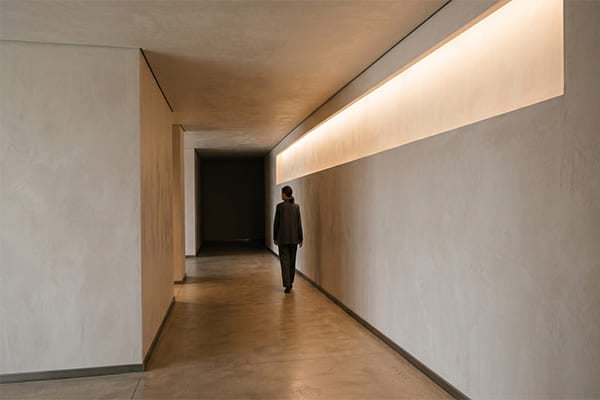
Sustainability is more than just energy savings. It's about the entire lifecycle of a product. With smart systems, we can monitor the performance of every single fixture. The system can predict when a component might fail, allowing for predictive maintenance instead of costly, wasteful replacements12. This is a core principle of the circular economy. On the design side, the technology allows us to achieve a minimalist aesthetic that architects have always dreamed of: "seeing the light, not the lamp." We can now integrate our linear LED products, like wall washers and pixel lights, directly into architectural materials. This creates clean lines and allows the architecture itself to shine.
Light as an Architectural Material
Imagine light that flows along a wall, or steps that illuminate as you walk on them. Light becomes a building block of the design itself.
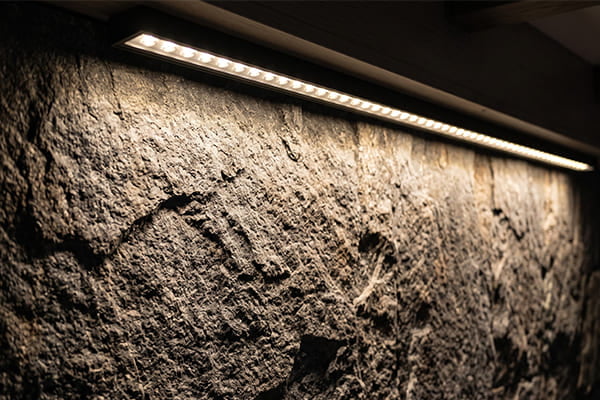
- Integrated Coves: We can hide the light source in architectural coves to create a soft, indirect glow that defines a space.
- Luminous Surfaces: We can turn entire walls or ceilings into a low-resolution display, creating dynamic ambient effects.
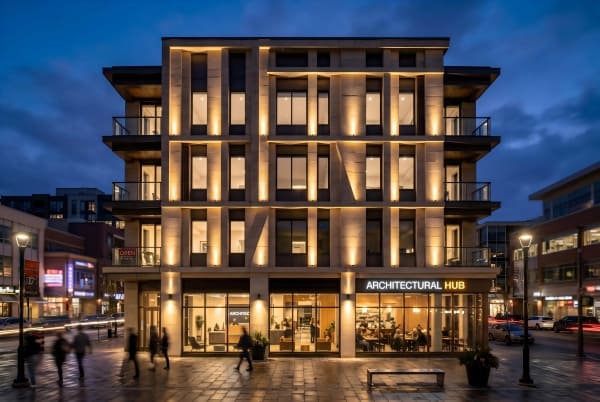
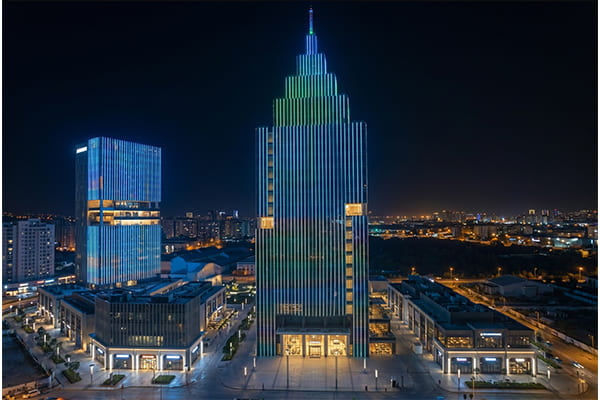
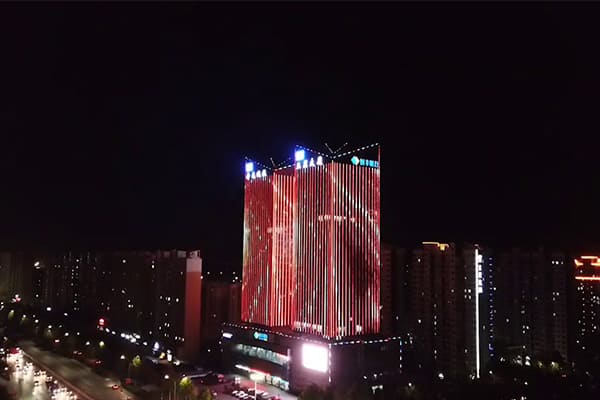
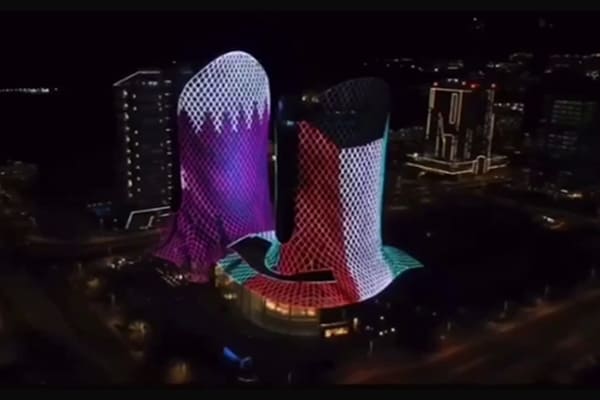
- Dynamic Facades: We use our pixel lights to create large-scale media displays that can respond to data, events, or the time of day.
Light is no longer an object you hang from the ceiling. It is a flexible, dynamic material that we can use to shape space and create memorable experiences.
Conclusion
In summary, future lighting is an intelligent and strategic asset. It uses data to boost efficiency and acts as the interactive layer between a building and its occupants.
"[PDF] Smart Buildings: A Foundation for Safe, Healthy & Resilient Cities", https://pages.nist.gov/GCTC/uploads/blueprints/2020-SBSC-blueprint.pdf. A building-automation or smart-building source can document that IoT-enabled lighting and control systems are commonly used to improve operational efficiency and occupant-responsive environmental control; this supports the general direction of the claim rather than proving outcomes for every building. Evidence role: general_support; source type: institution. Supports: IoT and AI integration in architectural lighting can make buildings more efficient, comfortable, and responsive to occupants' needs.. Scope note: Evidence is likely to be contextual because efficiency and comfort outcomes depend on system design, commissioning, and occupant behavior. ↩
"(PDF) Ambient Intelligence and Smart Environments: A State of the Art", https://www.academia.edu/25672797/Ambient_Intelligence_and_Smart_Environments_A_State_of_the_Art. Academic literature on ambient intelligence describes environments that use embedded sensing, context awareness, and adaptive computation to anticipate or respond to user needs; this supports the conceptual basis of predictive lighting control, though not necessarily the article's specific implementation. Evidence role: definition; source type: paper. Supports: Ambient intelligence and machine learning can be used to predict user needs in smart lighting environments.. Scope note: The source may define ambient intelligence generally rather than architectural lighting specifically. ↩
"Occupancy and Time-Based Lighting Controls in Open Offices", https://eta.lbl.gov/publications/occupancy-and-time-based-lighting. Research on occupancy-based and context-aware lighting control can show that automated systems reduce the need for manual switching in some environments; this offers contextual support but does not establish that switches or apps will become universally obsolete. Evidence role: general_support; source type: paper. Supports: Automated intelligent lighting may reduce reliance on traditional switches and app-based controls.. Scope note: The claim is forward-looking and absolute, so available evidence will likely support reduced manual interaction rather than complete obsolescence. ↩
"Lighting Controls", https://www.energy.gov/energysaver/lighting-controls. Smart-lighting and building-control research identifies occupancy, motion, daylight, and temporal data as common inputs for automated lighting control; this supports the listed sensor categories, with exact sensor packages varying by product and installation. Evidence role: mechanism; source type: paper. Supports: Integrated lighting sensors can gather occupancy, movement, and time-related data for automated control.. Scope note: The evidence would support common technical practice, not confirm the specific fixtures described in the article. ↩
"Effects of light on human circadian rhythms, sleep and mood", https://pmc.ncbi.nlm.nih.gov/articles/PMC6751071/. Chronobiology and lighting guidance sources describe light as a principal environmental cue for human circadian regulation, supporting the rationale for circadian-oriented lighting design. Evidence role: expert_consensus; source type: institution. Supports: Human-centric lighting is intended to support human circadian rhythms.. Scope note: Such sources support the biological mechanism, while health outcomes depend on timing, spectrum, intensity, duration, and individual differences. ↩
"Human-Centric Lighting: Foundational Considerations and a Five ...", https://pmc.ncbi.nlm.nih.gov/articles/PMC7873560/. Peer-reviewed studies and reviews on light exposure, circadian entrainment, and workplace lighting report associations between appropriately timed light and alertness or sleep-related outcomes; this supports the plausibility of the claim but not guaranteed benefits in all HCL installations. Evidence role: expert_consensus; source type: paper. Supports: Dynamic human-centric lighting can enhance concentration and improve sleep quality under appropriate conditions.. Scope note: Effects vary with lighting dose, timing, participant population, and study design. ↩
"Blue-Enriched Light Enhances Alertness but Impairs Accurate ...", https://pmc.ncbi.nlm.nih.gov/articles/PMC5962740/. Human-subject studies show that exposure to bright or short-wavelength-enriched light can acutely suppress melatonin and increase alertness, supporting the stated biological mechanism. Evidence role: mechanism; source type: paper. Supports: Bright, cool light can suppress melatonin and increase alertness.. Scope note: Magnitude of effect depends on illuminance, spectrum, duration, prior light exposure, and time of day. ↩
"A Survey on Indoor Visible Light Positioning Systems - arXiv", https://arxiv.org/html/2401.13893v1. Research on visible-light communication and Li-Fi-based positioning documents that LED lighting infrastructure can be used for indoor localization, supporting the feasibility of lighting-based positioning systems. Evidence role: mechanism; source type: paper. Supports: Modern luminaires can support indoor positioning through technologies such as Li-Fi.. Scope note: Precision varies by hardware, algorithms, room geometry, and line-of-sight conditions. ↩
"Ultra-Low SWaP CO2 Sensing for Demand Control Ventilation", https://www.energy.gov/cmei/buildings/articles/ultra-low-swap-co2-sensing-demand-control-ventilation. Demand-controlled ventilation guidance explains that CO2 and occupancy signals can be used to modulate ventilation rates in buildings, supporting the described integration between room sensing and HVAC response. Evidence role: mechanism; source type: government. Supports: CO2 and occupancy sensing can trigger HVAC ventilation adjustments in occupied spaces.. Scope note: Actual operation depends on HVAC controls, ventilation standards, sensor calibration, and commissioning. ↩
"[PDF] Advanced Lighting Control System Performance: A Field Evaluation ...", https://betterbuildingssolutioncenter.energy.gov/sites/default/files/DLC_Advanced-Lighting-Controls_Final-Report_PNNL%20%281%29.pdf. Energy-efficiency studies and agency reports on advanced lighting controls document that savings can fall within broad ranges depending on occupancy sensing, daylighting, scheduling, and baseline conditions; this supports the range as contextual rather than universal. Evidence role: statistic; source type: government. Supports: Smart lighting and integrated controls can lead to energy savings in the approximate range of 15% to 50%.. Scope note: The percentage range is highly dependent on building type, baseline system efficiency, control strategy, climate, and user behavior. ↩
"Integrated Dynamic Photovoltaic Facade for Enhanced Building ...", https://pmc.ncbi.nlm.nih.gov/articles/PMC11351624/. Architectural lighting and media-facade literature documents the integration of LED systems into building envelopes and surfaces to create dynamic luminous effects; this supports the design concept, with specific performance depending on materials and control systems. Evidence role: general_support; source type: education. Supports: LEDs can be integrated into architectural materials or surfaces to create dynamic, responsive lighting effects.. Scope note: The evidence is likely to support the architectural trend rather than verify the article's particular products or projects. ↩
"[PDF] Circular Economy: A Product Life Cycle Perspective on Engineering ...", https://tsapps.nist.gov/publication/get_pdf.cfm?pub_id=933397. Maintenance and circular-economy literature describes predictive maintenance as a strategy that uses condition monitoring to extend asset life and reduce unnecessary replacement; this supports the waste-reduction rationale but not the economics of a specific lighting installation. Evidence role: mechanism; source type: paper. Supports: Predictive maintenance can reduce unnecessary replacements and support waste reduction in lighting systems.. Scope note: Cost and waste reductions depend on component reliability, repairability, maintenance logistics, and product design. ↩