Planning a big lighting project is tough. Unclear MOQs and lead times can wreck your budget and schedule, causing a lot of stress. I'll break down how it all really works.
For standard LED fixtures, the Minimum Order Quantity (MOQ) is often just one set, with a production lead time of 2-7 days. For custom orders, the MOQ typically rises to 50-200+ sets, and the lead time extends to 2-8 weeks, depending on the complexity.1
These numbers are just a starting point. The real answer always depends on your specific project needs. To help you plan better and avoid any surprises, we need to look at the details. Let's dig into what influences these numbers so you can approach your next project with total confidence.
How Do Standard and Custom Orders Affect MOQ and Lead Time?
You've found the perfect light, but is it a standard item or a custom one? This choice dramatically impacts your order size and wait time, making project planning difficult. Let's clarify the difference.
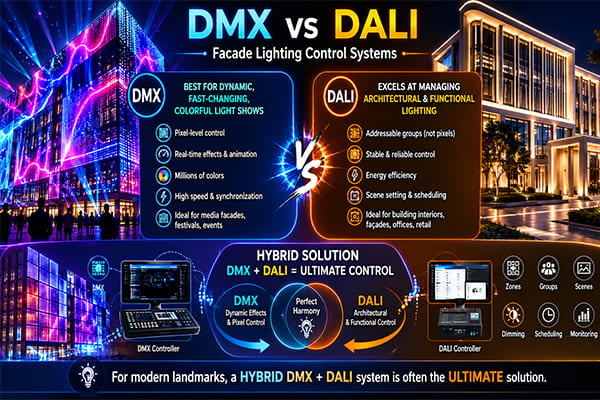
Standard products like our common LED linear lights have an MOQ as low as one set and a 2-7 day production lead time. Customizations like special colors or DMX controls raise the MOQ to 50-500+ sets and extend the lead time to 7-15 days or more.2
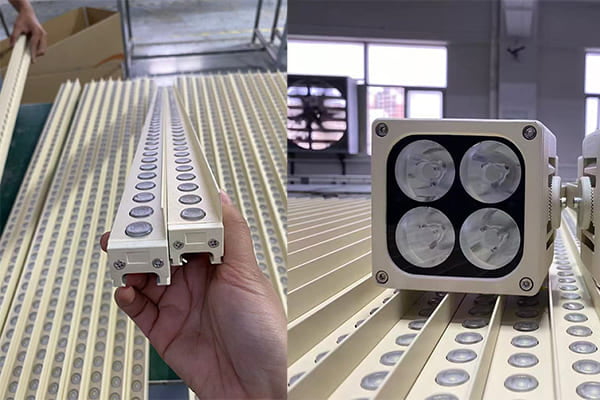
The distinction between standard and custom is one of the first things we discuss. As an outdoor architectural lighting expert, I always start here because it sets the foundation for the entire project timeline. A standard product is something we manufacture regularly. We have the materials in stock and our production line is already set up for it. This is why we can offer a very low MOQ, sometimes just a single unit for a sample or a small replacement, and turn it around in a few days.
Custom orders are a different story. They involve changes that require special attention. I remember a hotel project I worked on in Dubai. The architect wanted a unique brushed bronze finish on all the wall washers to match the building's metallic accents. This was a beautiful idea, but it meant we had to create a custom production run. This required a higher MOQ to make the special finishing process cost-effective and added about two weeks to the standard lead time. This is why early communication about any unique requirements is so important.
The Impact of Customization
Here’s a simple table to show the difference:
| Feature | Standard Products | Custom Products |
|---|---|---|
| Typical MOQ | 1+ sets | 50–500+ sets |
| Production Lead Time | 2–7 days | 7–15+ days |
| Common Examples | Stock linear lights, wall washers, floodlights | Custom lengths, special optical lenses, DMX512 control, unique housing colors, OEM branding |
What Does the Full Production Journey for a Lighting Project Look Like?
You've placed your order, but what really happens next? The factory process can seem like a black box, leaving you uncertain about when your lights will actually ship. Let's open that box up.
A lighting project moves through five key stages: project review, raw material purchasing, manufacturing, quality testing, and finally, packaging and shipping. For large projects, we add light simulation, DMX commissioning, and 24–48 hour aging tests, extending the cycle to 2–8 weeks.
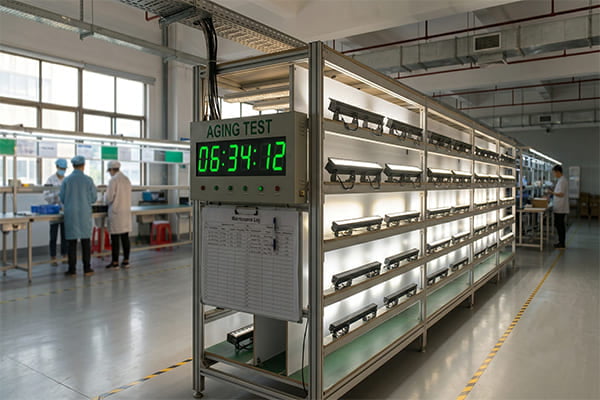
Understanding this process helps you see why quality takes time. It’s not just about assembling parts; it’s about building a reliable system that will last for years. I always walk my clients through these steps so they know exactly what to expect.
From a Concept to a Crate
Here's how we turn your order into a finished product ready for shipment:
- Project Review: First, our engineering team double-checks every detail of your order. We confirm the fixture model, beam angle, color temperature, and control method to make sure it matches your project's goals.
- Raw Material Procurement: Next, we order the core components. This includes the LED chips, drivers, aluminum housings, lenses, and cables. The availability of these parts is a key factor in the overall timeline.
- Production & Assembly: Our skilled technicians begin manufacturing. The fixtures are assembled, wired, and sealed to meet IP67 or IP68 waterproof standards, which is critical for outdoor lighting3.
- Quality Control & Testing: This is the most important stage. Every single light is tested. For large-scale architectural projects, we perform a mandatory 24–48 hour aging test.4 This means we run the lights continuously to catch any potential failures before they leave our factory. This step once saved a client on a major bridge project. We found a single faulty driver during the aging test and replaced it, preventing a costly on-site failure.
- Packaging & Shipping: Finally, we carefully pack your order to withstand international shipping and send it on its way.
For complex facade projects with dynamic lighting, we also perform DMX programming and commissioning in-house5 to ensure everything works perfectly together. This journey takes time, but it guarantees you receive a flawless product.
What Key Factors Really Determine Your Project's Timeline and Cost?
You have a quote, but what hidden factors could still cause delays or cost overruns? Understanding these variables is the key to keeping your project on track and on budget from start to finish.
Your MOQ is mainly affected by product complexity and if special components are needed. Your lead time is driven by the order size, supply chain stability, and the level of quality testing required. Don't forget that international shipping adds significant time.
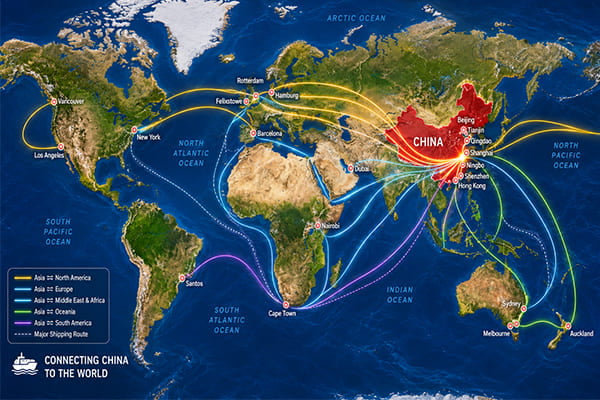
Over the years, I've seen many projects get delayed by small details that were overlooked early on. The two main things to watch are the factors that influence your MOQ and the factors that shape your lead time. They are connected, but distinct. For example, a request for a highly specialized LED chip might not only increase the lead time because it’s hard to source, but it will also increase the MOQ because the chip supplier will only sell it in large quantities.
Factors Driving Your MOQ
The minimum order quantity isn't an arbitrary number. It’s based on the economics of manufacturing. If your custom light requires a specific component that we have to buy in a bulk quantity of 1,000 units, it becomes impractical for us to produce just 10 lights for you.6 This is why higher levels of customization often come with higher MOQs. It's simply a reality of the global supply chain. The more standard the product, the more flexibility we have.
Factors Shaping Your Lead Time
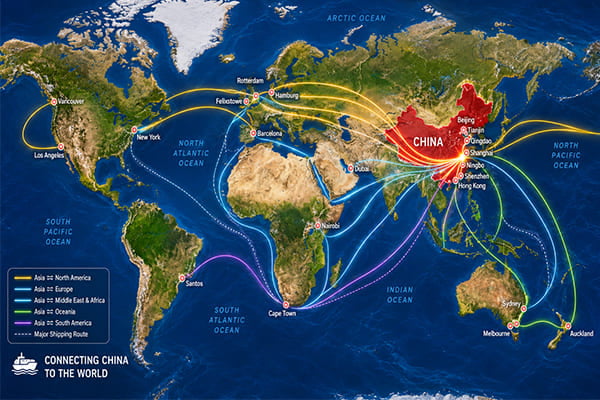
Several things determine how long it takes from order to delivery. A massive order of 10,000 linear lights will naturally take longer to produce than an order of 100. The global supply chain also plays a big role. A worldwide shortage of a specific electronic component can add weeks to a timeline.7 Finally, there's shipping. We always discuss this with our clients to find the right balance between speed and cost.
| Shipping Method | Typical Transit Time | Best For |
|---|---|---|
| Express (DHL/FedEx) | 3–7 Days8 | Urgent samples, small parts, and small orders |
| Air Freight | 5–12 Days9 | Time-sensitive projects and medium-sized orders |
| Sea Freight | 20–40 Days10 | Large, heavy orders where cost is a priority |
How Can You Speed Up Your LED Lighting Project?
Project delays are frustrating and expensive. You can feel stuck waiting for decisions or products, watching your deadline get closer and closer. The good news is there are simple, proactive steps you can take.
To shorten your project timeline, confirm all technical details like the model, color temperature, and control protocol as early as possible. Approve any required samples quickly. I also strongly advise ordering 3-10% spare units and adding a 1-2 week buffer for shipping delays.

The most successful projects I've worked on have one thing in common: a decisive and well-prepared client. Being proactive is the best way to save time and avoid stress. Instead of reacting to problems, you can prevent them from happening in the first place. Think of it as front-loading your decisions. The more you clarify at the beginning, the smoother everything will run later on.
Your Proactive Project Checklist
I give this checklist to all my clients to help them stay ahead.
- Finalize Technical Details Early: Before you even request a final quote, try to lock in your decisions on the product model, fixture lengths, color temperature (CCT), beam angle, and control protocol (e.g., ON/OFF, DMX512). Changing these specs mid-production is a sure way to cause delays.
- Confirm Samples Fast: If your project requires a custom sample, test and approve it as quickly as possible. Your approval is our green light to start mass production. The longer it takes, the longer the final delivery will be.
- Order Spares: This is my most important piece of advice. Order 3% to 10% extra fixtures as spares.11 I had a client managing a large facade installation who was hesitant to add spares to save on cost. I convinced him to order an extra 5%. Sure enough, two fixtures were accidentally damaged by another contractor during a difficult installation. He was able to use the spares immediately and finish the project on time. Without them, he would have faced a three-week delay waiting for replacements. Always plan for the unexpected.
- Buffer Your Timeline: Add a 1-2 week buffer to your schedule specifically for logistics.12 Customs clearance, port congestion, or bad weather can all delay shipments. A little buffer gives you peace of mind.
Conclusion
Standard products offer low MOQs and fast lead times, while custom projects need more planning. Clear communication and early, decisive action are the best tools to ensure your lighting project's success.
"2020 LED Manufacturing Supply Chain | Department of Energy", https://www.energy.gov/cmei/ssl/articles/2020-led-manufacturing-supply-chain. A source on manufacturing logistics can support the claim that custom orders generally have higher MOQs and longer lead times than standard products due to factors like unique material procurement and specialized production setups. Evidence role: general_support; source type: other. Supports: The typical differences in Minimum Order Quantity (MOQ) and production lead times between standard and custom-manufactured products in the electronics or lighting industry.. Scope note: The source may provide general principles of manufacturing economics rather than the exact figures for the LED lighting industry mentioned in the article. ↩
"Dmx Lights Controller Manufacturers, Suppliers, Dealers & Prices", https://www.tradeindia.com/manufacturers/dmx-lights-controller.html. A source discussing custom manufacturing can explain that features like special color finishes or the integration of control protocols like DMX require separate production runs and component sourcing, which increases both the minimum viable order size and the production timeline. Evidence role: mechanism; source type: other. Supports: The reasons why specific customizations, such as non-standard colors or adding complex control systems like DMX, increase manufacturing complexity, cost, and therefore MOQ and lead time.. Scope note: The source would likely explain the general mechanism rather than confirming the specific MOQ (50-500+ sets) or lead time (7-15+ days) figures. ↩
"IP code - Wikipedia", https://en.wikipedia.org/wiki/IP_code. The International Electrotechnical Commission (IEC) standard 60529 defines IP ratings. An IP67 rating indicates the enclosure is dust-tight and protected against immersion in water up to 1 meter, while IP68 indicates protection against continuous immersion, making them suitable for outdoor and wet environments. Evidence role: definition; source type: institution. Supports: The definition of IP (Ingress Protection) ratings, specifically IP67 and IP68, and their suitability for outdoor and waterproof applications.. ↩
"Appendix Seven: Reliability - Component Engineering & Assurance", https://parts.jpl.nasa.gov/asic/Appendix.7.html. Research in electronics reliability explains that aging or 'burn-in' testing is a process used to stress components to accelerate the appearance of latent defects and screen for 'infant mortality' failures, thereby increasing the reliability of the products that are shipped. Evidence role: mechanism; source type: paper. Supports: The purpose of burn-in or aging tests in electronics manufacturing is to detect early-life failures.. Scope note: The source would describe the general principle of burn-in testing and may not specify a 24-48 hour duration as a universal standard for LED lighting. ↩
"DMX512 - Wikipedia", https://en.wikipedia.org/wiki/DMX512. A source on lighting control protocols can define DMX512 as a standard for digital communication networks that are commonly used to control stage lighting and effects, including complex, dynamic color-changing and dimming sequences in architectural facades. Evidence role: definition; source type: encyclopedia. Supports: The definition and application of the DMX (Digital Multiplex) protocol in the context of professional and architectural lighting.. ↩
"Economies of scale", https://en.wikipedia.org/wiki/Economies_of_scale. Sources on supply chain management explain that MOQs are set by suppliers to cover fixed costs associated with a production run, such as machine setup and labor, and to align with the bulk purchasing requirements of raw material providers, thereby achieving economies of scale. Evidence role: mechanism; source type: education. Supports: The economic principles behind Minimum Order Quantities (MOQs) in manufacturing and supply chains.. ↩
"The U.S. Consumer Electronics Supply Chain - Boise State University", https://www.boisestate.edu/cobe/blog/2025/03/us-consumer-electronics-supply-chain-challenges-andtransformations/. Reports from government bodies and industry analysts on the 2020-2023 global semiconductor shortage document how widespread deficits in electronic components led to significant production delays and increased lead times across numerous industries, including automotive, consumer electronics, and lighting. Evidence role: case_reference; source type: research. Supports: The real-world impact of component shortages on global supply chains and manufacturing lead times.. ↩
"I thought Priority Mail Express International is supposed to take 3-5 ...", https://www.reddit.com/r/usps_complaints/comments/u69rds/i_thought_priority_mail_express_international_is/. Major international couriers like DHL or FedEx publish estimated transit times for their express services, which typically range from 3 to 7 business days for major international routes, although these times are not guaranteed and can be affected by customs and other delays. Evidence role: statistic; source type: other. Supports: The typical transit times for international express shipping services.. Scope note: The actual transit time for any specific shipment depends on the origin, destination, customs processing, and the specific service level chosen. ↩
"Instant Freight Transit Time Calculator | Air, Ocean & Trucking", https://www.freightos.com/freight-resources/transit-time-calculator/. Logistics industry sources indicate that standard international air freight transit times, including ground handling and customs clearance, typically range from 5 to 12 days, depending on the route, carrier, and level of port congestion. Evidence role: statistic; source type: other. Supports: The typical door-to-door transit times for international air freight.. Scope note: This is an average range; actual times can vary based on flight availability, customs efficiency, and last-mile delivery logistics. ↩
"Instant Freight Transit Time Calculator | Air, Ocean & Trucking", https://www.freightos.com/freight-resources/transit-time-calculator/. Data from freight forwarders and maritime industry reports show that port-to-port transit times for sea freight between major continents like Asia and North America or Europe commonly range from 20 to 40 days, with total door-to-door time being longer due to ground transport and customs. Evidence role: statistic; source type: other. Supports: The typical transit times for international sea freight.. Scope note: These times are highly variable and subject to significant delays from port congestion, weather, and customs inspections, as seen in global supply chain disruptions. ↩
"[PDF] Attic Stock Spreadsheet", https://smd.alabama.gov/wp-content/uploads/2020/03/01-78-46_Attic-Stock-Spreadsheet.pdf. Project management and construction industry guidelines often recommend allocating a percentage of the budget or material order for contingency, including spare parts (sometimes called 'attic stock') to cover potential damage during installation, failures, or future replacement needs. Evidence role: general_support; source type: education. Supports: The practice of ordering additional materials or components (attic stock) as a contingency for large-scale installation projects.. Scope note: While the principle of ordering spares is standard, the specific 3-10% figure may vary by project type and component fragility, and a source may not cite this exact range. ↩
"What Are the Various Risks in Supply Chain Management?", https://www.apu.apus.edu/area-of-study/business-and-management/resources/what-are-the-various-risks-in-supply-chain-management/. Project management methodologies, such as those outlined by the Project Management Institute (PMI), advocate for including 'buffers' or 'contingency reserves' in project schedules to absorb the impact of unforeseen delays, such as those in shipping and logistics, without affecting the final deadline. Evidence role: general_support; source type: institution. Supports: The project management practice of including time buffers or contingency time in schedules to account for uncertainty and risk.. Scope note: The source would support the concept of a schedule buffer but may not specify a 1-2 week duration, as the appropriate amount of buffer time is dependent on the specific project's risk assessment. ↩