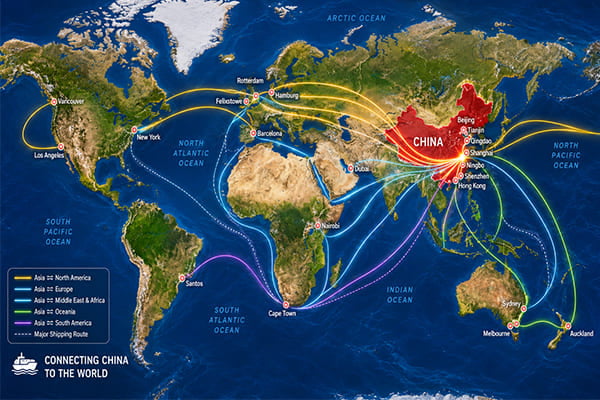
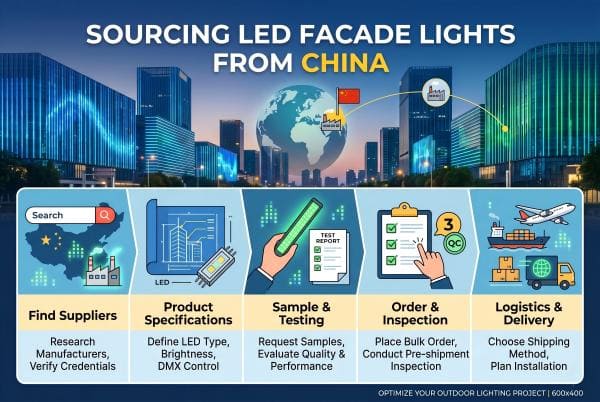
Sourcing from China is smart, but a bad supplier choice can wreck your project. The wrong partner leads to delays, fixture failures, and soaring maintenance costs.
To successfully source LED facade lights from China, you must avoid five key red flags: exceptionally low prices, incomplete certifications, a lack of project experience, vague durability claims, and poor communication. Focusing on a supplier's reliability and support over just the cost ensures project success.
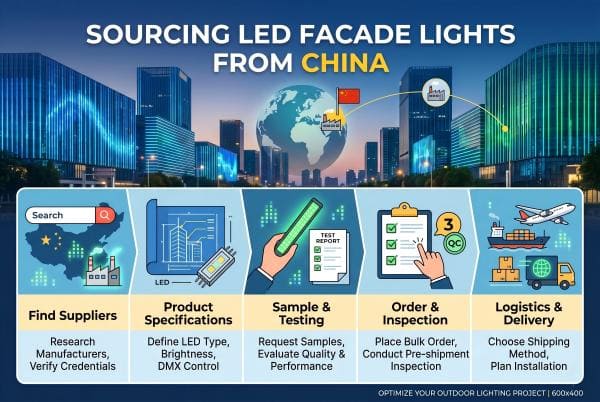
I've been in the architectural lighting business for over a decade. China's manufacturing ecosystem for LED lights is the best in the world1. You can find anything here. But that's also the problem. The quality of suppliers varies wildly. One wrong decision in sourcing can turn a landmark project into a long-term headache.
A successful facade lighting project isn't just about buying lights; it's about building a vision that lasts. The real value comes from a partner who understands the technical challenges and stands by you from design to commissioning. Let’s walk through the warning signs I’ve learned to spot, so you can avoid them in your next project.
Is an Exceptionally Low Price a Sign of Trouble?
You've received a quote that's far below all the others. It feels like a huge win for your budget, but a part of you is worried it's too good to be true.
Yes, an exceptionally low price almost always signals trouble2. These suppliers cut corners on critical components like LED chips, drivers, and housing materials. This leads to poor performance, early failures, and high maintenance costs that erase any initial savings.
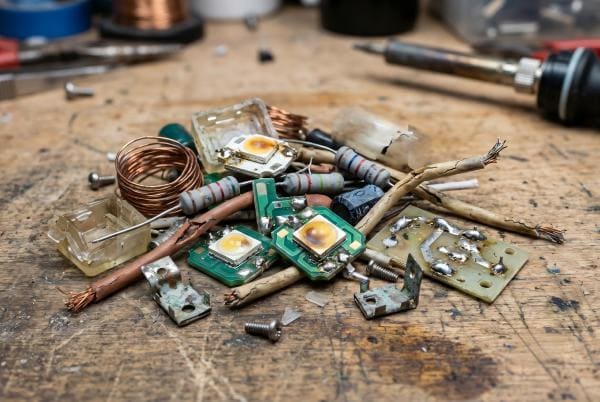
I remember a client who went with a low-cost supplier for a high-rise building project to save about 20% on the initial purchase. The price difference was tempting. However, within the first year, nearly 30% of the fixtures had failed or shown significant color shifting3. The cost of renting cranes and hiring labor to replace those lights was nearly double their initial savings. A low price is never just a low price; it's a trade-off. To get that price, the supplier has to make cuts somewhere. It's your job to figure out where.
Where a Low Price Really Costs You
A cheap light is not just a cheap light. It’s a collection of cheap components. Here is where suppliers typically cut costs:
| Component | Low-Cost Supplier Compromise | Reliable Supplier Standard |
|---|---|---|
| LED Chip | Uses unknown brands, inconsistent color bins. | Uses reputable brands (Cree, Osram)4, strict color consistency. |
| LED Driver | Low efficiency, poor power factor, short lifespan. | High efficiency, stable output, long warranty period. |
| Aluminum Housing | Thin, recycled aluminum with poor heat dissipation. | Thick, high-purity aluminum for maximum heat transfer. |
| Waterproofing | Cheap silicone glue, poorly designed seals. | Structural waterproofing, anti-aging silicone gaskets. |
The most expensive light fixture is the one you have to replace. That low initial price tag often hides much higher long-term costs.
Are Incomplete Certifications a Deal Breaker?
A potential supplier sends you a certificate, but it looks like a screenshot. You ask for the full report, and they get defensive or send another blurry image.
Absolutely. Incomplete or unverifiable certifications are a major deal breaker. A professional supplier must provide full, valid test reports for CE5, RoHS, EMC, LVD, and IP ratings. Anything less, like a screenshot, is a sign that they cannot be trusted.
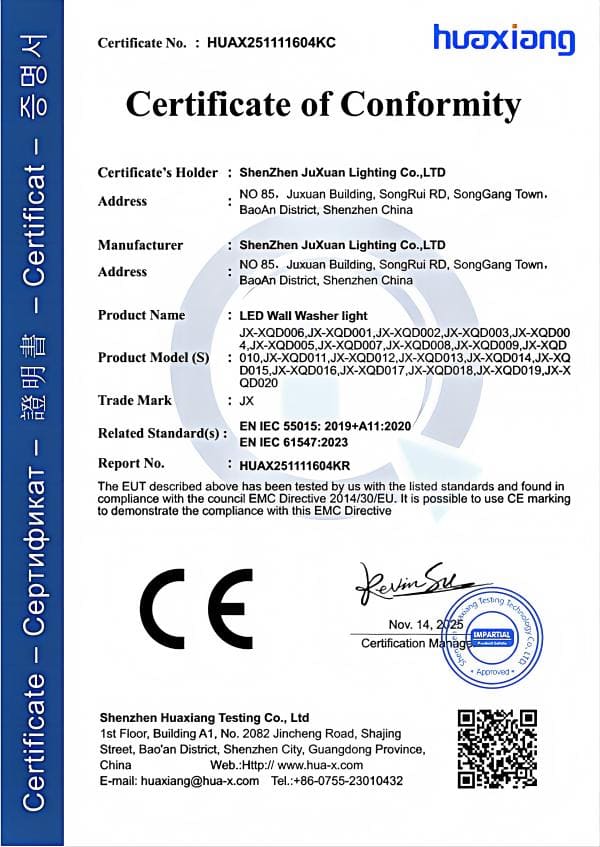
Certifications are not just pieces of paper; they are your proof that a product is safe, compliant, and performs as advertised. Using uncertified products can get your project rejected by inspectors, void your insurance, or worse, create serious safety hazards6. I have seen clients get an entire shipment of lights stuck at customs because the "CE certificate" they were given was a fake document. The supplier disappeared, and the client was left with a container of useless metal. Don't let that happen to you. Demand clear, verifiable proof.
What to Ask For
When you evaluate a supplier, don't just ask "Do you have CE?" Be specific. A professional company will have these ready.
- Full Test Reports: Ask for the complete PDF test report, not just the one-page certificate. The report contains all the data and testing parameters.
- Issuing Laboratory: Check which lab issued the report. Is it a well-known, accredited institution?
- Verifiable Report Number: Use the report number to check its validity on the laboratory's official website or by contacting them directly.
If a supplier hesitates or makes excuses when you ask for these things, walk away. It means they either don't have the certification or they are trying to hide something.
Does a Lack of Project Experience Really Matter?
You find a supplier who sells lights that look great on paper. The price is right. But when you ask for past project examples, they can only show you product photos.
Yes, project experience matters immensely. Facade lighting involves complex control systems and installation challenges. A supplier who only sells products cannot provide the crucial technical support you need to integrate everything and ensure your project succeeds.
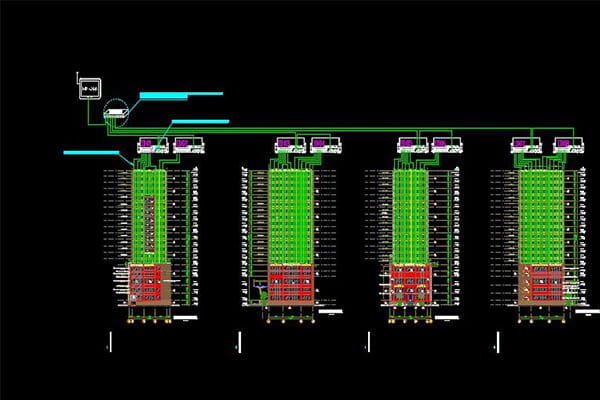
Buying facade lights is not like buying light bulbs for your house. You are purchasing a system. The lights have to communicate with controllers, often using protocols like DMX5127 or Art-Net. The power and data distribution must be planned perfectly. The lighting effects need to be programmed to bring the architect's vision to life. For a large project we supported in the Middle East, our engineers spent a week on-site just to help the local team debug the control system and fine-tune the dynamic scenes. A supplier who has never managed a real-world project simply cannot provide this level of support. They sell boxes; you need a partner.
Questions to Ask Your Supplier
To separate the product sellers from the project partners, ask these questions:
- Can you show me case studies of at least three projects similar in scale to mine?
- What is your process for programming lighting effects? Can you provide a demo?
- What kind of technical support do you offer during installation and commissioning?
- Do you have engineers who can provide remote or on-site guidance?
Their answers will quickly tell you if they are just a trader or a true engineering-focused manufacturer.
Is an IP Rating Enough for Outdoor Durability?
Your project is in a coastal city with high humidity and salty air. A supplier tells you their light is IP67, so it's "perfect for any outdoor use."
No, an IP rating alone is not enough for durability in harsh environments. The IP rating only measures protection against dust and water ingress8. It says nothing about a fixture's ability to resist corrosion, UV degradation, or extreme temperatures.
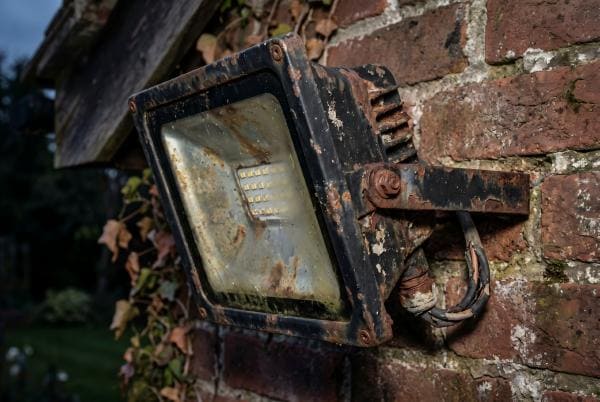
I've seen IP67-rated fixtures fail in less than two years on coastal projects. The seals were fine and no water got inside, but the housing was covered in rust, the paint was peeling, and the plastic lens had turned yellow and brittle from the sun9. The light still "worked," but it looked terrible and its performance was degraded. For a facade lighting project, appearance is everything. True durability comes from the materials and finishes used on the fixture, not just from the seals. You have to look deeper than the IP rating.
Key Factors Beyond the IP Rating
For any project exposed to salt, high humidity, or intense sun, ask your supplier about these specific details:
| Durability Factor | What to Look For | Why It Matters |
|---|---|---|
| Salt Spray Test10 | A formal test report (e.g., 1000 hours). | Simulates coastal conditions to test corrosion resistance. |
| Housing Coating | Marine-grade powder coating or fluorocarbon paint. | Provides a durable barrier against salt and chemicals. |
| Fasteners & Screws | 304 or, ideally, 316 stainless steel11. | Prevents ugly rust streaks and structural failure. |
| UV Resistance | Anti-UV lens material (e.g., PC) and cables. | Prevents yellowing, cracking, and material breakdown from sun exposure. |
Asking for a salt spray test report is one of the easiest ways to see if a supplier understands professional-grade requirements.
Why is Poor Communication a Project Killer?
You're trying to finalize technical details with a supplier. Their replies are slow. The answers are vague. You have to correct the same mistakes on drawings over and over again.
Poor communication during the sales process is one of the biggest red flags. If a supplier is slow, unclear, and inaccurate now, these problems will become ten times worse once you have paid and the project is in a critical phase. It is a direct preview of future delays and mistakes.
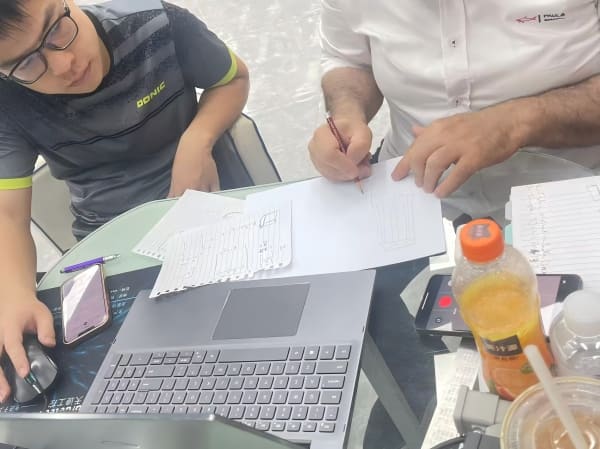
Think of the initial communication as a test. You are testing their team's professionalism, technical knowledge, and internal processes. A good supplier has experienced sales engineers who can understand your requirements and provide clear, accurate information quickly. A bad supplier has salespeople who act as a wall between you and their technical team. I once saw a client ignore these warning signs because the price was good. The supplier ended up producing 500 wall washers with the wrong beam angle because of a communication mistake. The error delayed the grand opening of the building by two months.
Early Warning Signs of Bad Communication
Look out for these signs in your first few interactions with a new supplier:
- Slow Replies: Consistently taking more than 24 hours to answer12 technical or commercial questions.
- Vague Answers: They can't provide specific data and instead say things like "our quality is very good."
- Repeated Mistakes: You have to point out the same errors on drawings or spec sheets multiple times.
- Passing the Buck: The salesperson constantly says "I have to ask the engineer" for every simple question.
Good communication is the foundation of a successful project partnership. If it's not there from the beginning, you are taking on a huge risk.
Conclusion
Sourcing from China offers huge advantages, but the cheapest price is rarely the best value. True success comes from partnering with a supplier who has proven engineering experience, reliable products, and a commitment to supporting you through the entire project.
"Key Findings from the 2020 LED Manufacturing Supply ...", https://www.energy.gov/sites/prod/files/2021/02/f82/ssl-rd21-nubbe-findings.pdf. Market research reports from firms like TrendForce or government industrial analyses often show that China holds the largest global market share in LED packaging and manufacturing, accounting for over 50% of worldwide production capacity. Evidence role: statistic; source type: research. Supports: The claim that China is the world's leading manufacturer of LED lighting products.. Scope note: While sources confirm China's dominance in production volume and market share, 'best' is subjective and does not necessarily equate to universal quality leadership. ↩
"[PDF] Price and Quality Relationships in Local Service Industries", https://www.ftc.gov/sites/default/files/documents/reports/price-and-quality-relationships-local-service-industries/wp249_0.pdf. Studies in supply chain management and procurement demonstrate that focusing solely on initial price can lead to higher total cost of ownership (TCO) due to factors like increased defects, maintenance, and replacement costs. Evidence role: general_support; source type: education. Supports: The claim that an exceptionally low price often indicates compromises in quality that lead to higher long-term costs.. ↩
"[PDF] Understanding and Controlling Chromaticity Shift in LED Devices", https://www.osti.gov/servlets/purl/1358544. Technical papers on solid-state lighting explain that chromaticity shift in LEDs can be caused by degradation of the phosphor material or the encapsulant, processes that are often accelerated in lower-quality components due to thermal stress and inferior materials. Evidence role: mechanism; source type: paper. Supports: The claim that low-quality LEDs are susceptible to color shifting.. ↩
"Osram Opto Semiconductors GmbH - Wikipedia", https://en.wikipedia.org/wiki/Osram_Opto_Semiconductors_GmbH. Industry market analysis frequently lists companies like Cree (now Wolfspeed for certain products) and Osram (ams OSRAM) as top-tier manufacturers known for their innovation, efficiency, and reliability in the solid-state lighting component market. Evidence role: general_support; source type: research. Supports: The claim that Cree and Osram are considered reputable, high-quality brands in the LED industry.. Scope note: Market position does not guarantee that every product from these brands is superior for every application, but it indicates a general reputation for quality. ↩
"CE marking - Wikipedia", https://en.wikipedia.org/wiki/CE_marking. According to the European Commission, the CE marking indicates that a product has been assessed by the manufacturer and deemed to meet EU safety, health, and environmental protection requirements. It is mandatory for products placed on the market in the European Economic Area (EEA). Evidence role: definition; source type: government. Supports: The definition and purpose of the CE marking.. ↩
"[PDF] Hazards Related to Electric Lighting Products - CPSC", https://www.cpsc.gov/s3fs-public/lightprodMarch8.pdf. Electrical safety authorities, such as the U.S. Occupational Safety and Health Administration (OSHA), mandate that many electrical products be certified by a Nationally Recognized Testing Laboratory (NRTL) to ensure safety. Use of uncertified products can violate building codes, lead to denial of insurance claims, and pose a significant risk of fire or electrical shock. Evidence role: general_support; source type: government. Supports: The claim that using uncertified electrical products can lead to insurance denial and safety risks.. ↩
"DMX Explained; DMX512 and RS-485 Protocol Detail for Lighting ...", https://community.element14.com/technologies/open-source-hardware/b/blog/posts/dmx-explained-dmx512-and-rs-485-protocol-detail-for-lighting-applications. DMX512 (Digital Multiplex) is a standard for digital communication networks that are commonly used to control stage lighting and effects. Maintained by the Entertainment Services and Technology Association (ESTA), it allows for the control of 512 individual channels per universe. Evidence role: definition; source type: institution. Supports: The definition and use of the DMX512 protocol.. ↩
"IP code - Wikipedia", https://en.wikipedia.org/wiki/IP_code. The International Electrotechnical Commission (IEC) standard 60529 defines the IP Code, which classifies the degrees of protection provided by enclosures against the intrusion of solid objects (including dust) and water. The standard does not specify tests for resistance to corrosion, UV radiation, or other environmental factors. Evidence role: definition; source type: institution. Supports: The definition of the IP rating system and what it measures.. ↩
"Photodegradation and photostabilization of polymers, especially ...", https://pmc.ncbi.nlm.nih.gov/articles/PMC4320144/. Research in materials science shows that polymers like polycarbonate (PC), commonly used for lenses, undergo photodegradation when exposed to ultraviolet (UV) radiation. This process can break down polymer chains, leading to discoloration (yellowing), reduced transparency, and loss of mechanical properties like impact strength, causing brittleness. Evidence role: mechanism; source type: paper. Supports: The claim that sun exposure causes plastic lenses to turn yellow and brittle.. ↩
"Coatings and Corrosion Laboratory (CCL) Overview | FHWA", https://highways.dot.gov/turner-fairbank-highway-research-center/labs/coatings. The salt spray test, often conducted according to standards like ASTM B117 or ISO 9227, is an accelerated corrosion test used to evaluate the resistance of coated samples to a corrosive environment. It exposes the sample to a dense saltwater fog to simulate the effects of coastal conditions over an extended period. Evidence role: definition; source type: institution. Supports: The definition and purpose of the salt spray test.. ↩
"Marine grade stainless - Wikipedia", https://en.wikipedia.org/wiki/Marine_grade_stainless. According to materials engineering resources, 316 stainless steel contains molybdenum, which is absent in the more common 304 grade. The addition of molybdenum significantly increases its resistance to corrosion, especially against chlorides and other industrial solvents, making it the preferred choice for marine and coastal applications. Evidence role: mechanism; source type: education. Supports: The claim that 316 stainless steel offers superior corrosion resistance compared to other common types.. ↩
"Managing Relationships with Suppliers and Vendors You Use", https://www.apu.apus.edu/area-of-study/business-and-management/resources/managing-relationships-with-suppliers-and-vendors-you-use/. Business and supply chain management guides emphasize that timely and clear communication is critical for successful global sourcing. While a strict 24-hour rule is not universal, a consistent pattern of delayed responses is widely cited as an indicator of poor internal processes, lack of customer focus, and a risk factor for future project delays and errors. Evidence role: general_support; source type: other. Supports: The claim that slow response times are a major red flag in supplier relationships.. Scope note: The '24-hour' benchmark is a rule of thumb rather than a formal standard, but the underlying principle of timely communication is well-supported. ↩