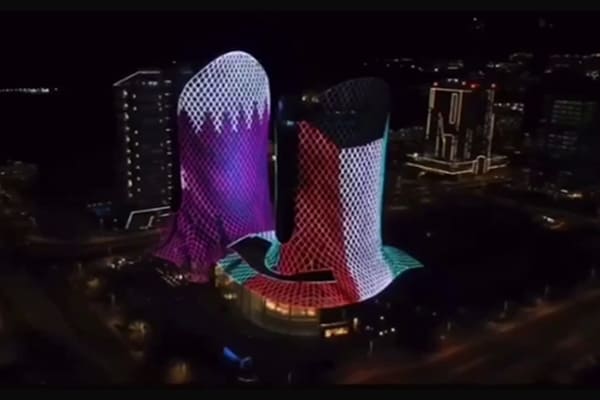
Struggling to make your building stand out at night? Traditional lighting is static and boring. You need a solution that turns your building's facade into a dynamic, unforgettable visual experience.
A smart facade lighting system turns a building's exterior into a programmable "smart light interface." It uses digitally controlled LED fixtures and advanced software1 to create dynamic visual effects, from simple color changes to full-scale video animations, enhancing both beauty and function.
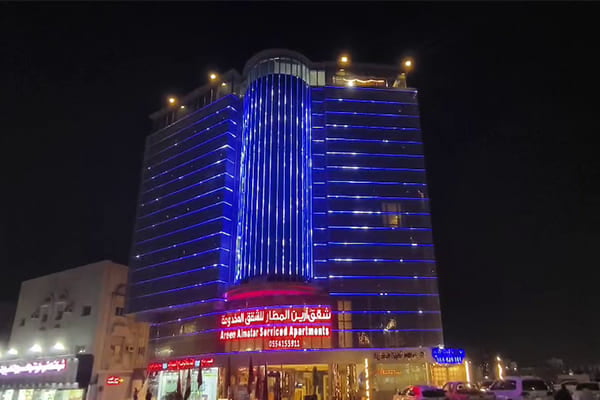
Over the years, I've seen how the right lighting can completely transform a project. It's not just about making a building visible; it's about giving it a personality and a voice. A smart system does exactly that. It's the difference between a building that simply exists and one that truly comes alive after sunset. In this post, I want to walk you through exactly how these systems work, from the core technology to the incredible creative possibilities they unlock. Let's explore how you can use this technology on your next project.
What is the Core Technology Behind Smart Facade Lighting?
Are you worried about the complexity and reliability of a dynamic lighting system? Many contractors fear that advanced systems mean more points of failure. They want a solution that is both powerful and durable.
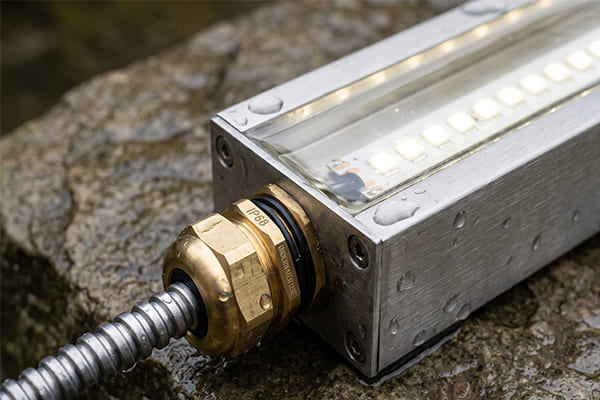
The core technology is a combination of robust hardware and intelligent control systems. It uses high-protection (IP65-IP68) LED fixtures like linear lights and wall washers, which are managed by stable protocols like DMX512 or the flexible SPI for pixel-heavy media facades.
Let's break down the technical backbone of these systems. It's actually more straightforward than many people think. I always explain to my clients that it comes down to three key parts: the lights themselves, the brain that controls them, and the sensors that make them smart.
Hardware: The Foundation of Light
The lights are the most visible part of the system. We almost always use LED fixtures for their efficiency and long life2. Key types include linear lights, wall washers, and pixel lights. The most important factor here is the IP rating. An IP rating tells you how well a fixture is protected against dust and water.3 For outdoor facades, we never go below IP65. For projects in harsh climates or near the sea, we insist on IP67 or IP684 to guarantee longevity. These fixtures also come in RGB or RGBW, which allows you to create millions of colors. RGBW adds a dedicated white chip, which gives you purer, higher-quality white light when you need it.
Control Systems: The Brain of the Operation
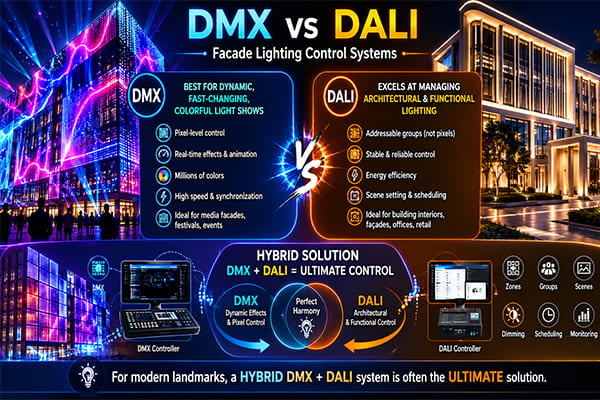
The control system tells each light what to do. The two main industry standards are DMX512 and SPI. I've used both on countless projects, and each has its place.
| Protocol | Best For | Key Characteristics |
|---|---|---|
| DMX512 | Large, stable projects like towers, bridges, hotels | Very reliable, industry standard. Each "universe" controls 512 channels.5 |
| SPI | High-density media facades, complex animations | Faster data transfer, allows for video. Signals are passed from one pixel to the next.6 |
For a large government building where reliability was the top priority, we used a DMX512 system. For a modern shopping mall that wanted a full-media facade to show advertisements, an SPI system was the better choice.
Smart Sensing: Making the System Reactive
This is where the "smart" part really comes in. We can integrate various sensors to make the lighting react to its environment. Astronomical clocks know the exact time of sunrise and sunset in your location7, so the lights turn on and off automatically. Light sensors can dim the lights on a bright, moonlit night to save energy.8 Motion sensors can even be used to create interactive effects where the lighting follows people as they walk by.
How Do You Make the Lights Themselves Invisible?
Do you want stunning light effects without seeing ugly fixtures bolted to your building? Many architects and designers hate when bulky lights ruin the clean lines of their design during the day.
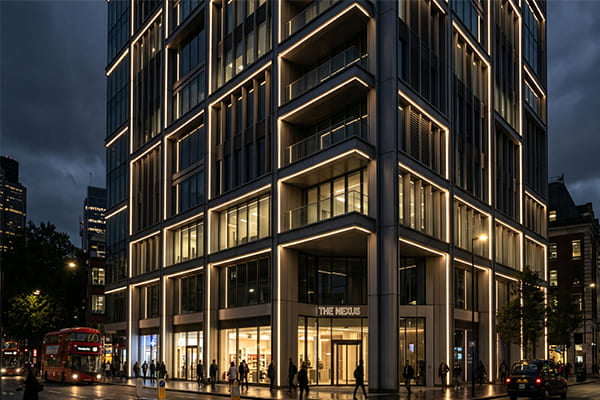
The key design philosophy is "see the light, not the lamp.9" This is achieved by integrating fixtures directly into the building's structure, like in window frames or stone joints, and custom-coating the housing to perfectly match the facade's color and texture.
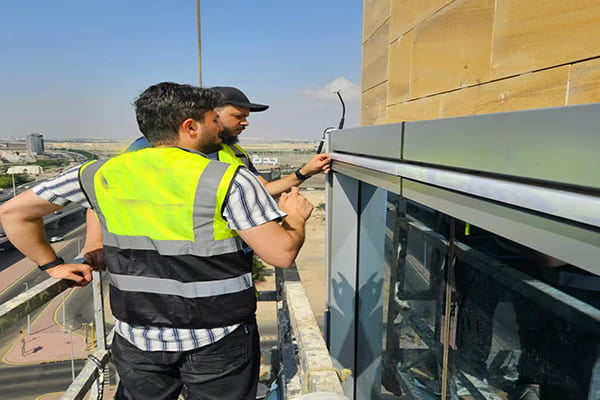
This is one of my favorite topics to discuss with design firms. A truly elegant lighting project looks just as good during the day as it does at night. The goal is for the lighting hardware to completely disappear, becoming part of the architecture itself. I've spent years perfecting this approach with my team, and it's a game-changer for high-end projects. There are three main techniques we use to achieve this seamless integration.
Structural Embedding
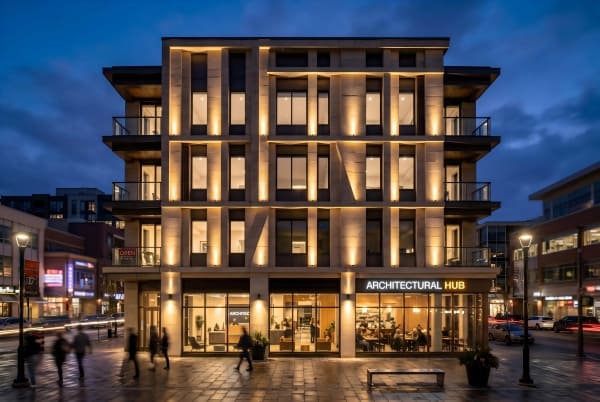
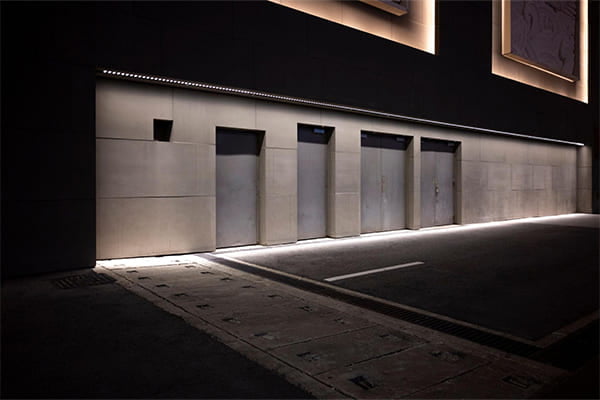
The best method is to plan for the lighting during the architectural design phase. We work with the architects to hide the fixtures inside the building's elements. For example, we can recess our linear lights into the metal curtain wall profiles. We can also place them within the seams between stone panels. When you look at the building during the day, you see the beautiful facade material, not a row of lights. This requires close collaboration, but the final result is incredibly clean and professional. It shows that the lighting was a core part of the vision, not an afterthought.
Custom Color and Finish
Sometimes, embedding isn't possible, especially on existing buildings. In these cases, we make the fixture blend in by camouflaging it. We can get the exact RAL color code for the building's facade material—whether it's aluminum, stone, or concrete. Then, we produce the aluminum housing of our fixtures with a powder coating that is a perfect match. From a distance, the fixture becomes visually indistinguishable from the surface it's mounted on. It's a simple trick, but it makes a world of difference.
Glare Control with Narrow Beams
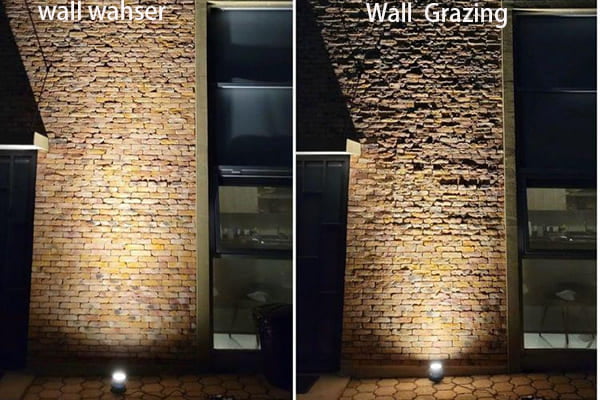
A major concern is light pollution and glare, especially for the people inside the building. No one wants a bright light shining into their office or hotel room. To solve this, we use fixtures with very narrow beam angles, often as tight as 3 to 5 degrees. We can install these lights on the exterior of a window frame, aimed perfectly to wash the architectural surface next to it without spilling any light inside10. This technique, often called "inner light transmission," illuminates the facade structure while keeping the interior comfortable and dark.
What Advanced Functions Can These Systems Perform?
Thinking that smart lighting is just about changing colors? Modern systems go far beyond simple effects. They can turn your building into a media platform, an energy-saving asset, and a self-monitoring system.
Advanced systems offer media facade capabilities to play animations, smart energy management that adapts to seasons and time, and cloud-based maintenance that automatically detects faults and allows for remote monitoring, fully integrating with the building's management system (BMS).
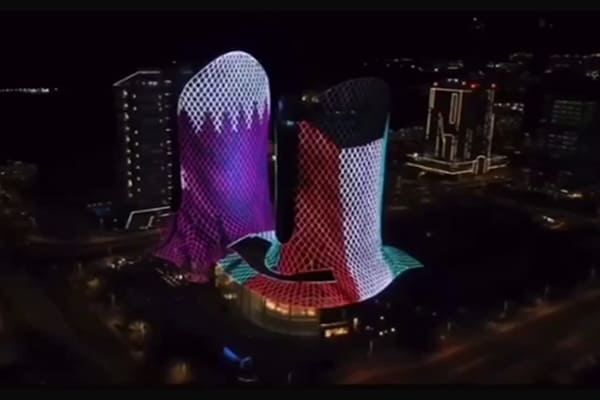
This is where things get really exciting. Once you have the core technology in place, you can unlock a whole new level of functionality. We're not just installing lights; we're giving the building a digital brain. These advanced features provide immense value to building owners and operators, turning a capital expense into a functional asset. Let me share some of the most powerful applications we are implementing for our clients right now.
Media Facade Functionality
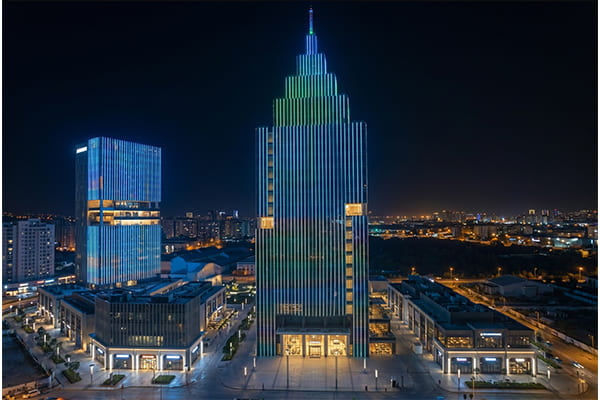
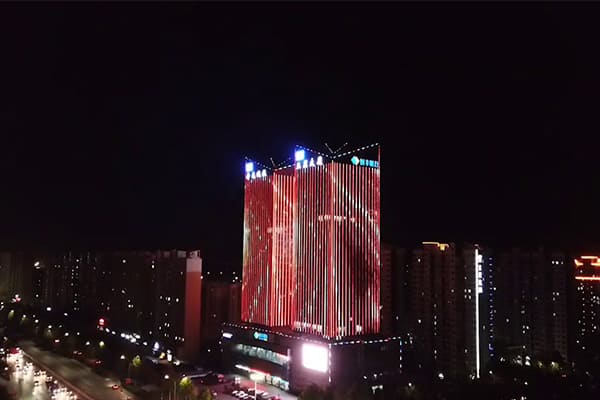
With high-density pixel lights and an SPI control system, the entire building facade can become a low-resolution screen11. This is what we call a "media facade." Using a technique called pixel mapping, we can take a video or animation file and map it across the thousands of individual lights on the building. You can use it for artistic light shows, to celebrate national holidays with a flag animation, or even to display text and advertisements. For one of our hotel clients in a major tourist area, their media facade became a local landmark and a huge marketing tool.
Smart Energy Management
A smart system is also an energy-efficient system. We program it to be intelligent about how it uses power. For example, we can link the color temperature to the seasons.
| Season | Time of Year | Recommended Color Temperature | Perceived Effect |
|---|---|---|---|
| Summer | May - August | 5000K - 6000K | Cool, crisp white |
| Winter | Nov - Feb | 2700K - 3000K | Warm, cozy white |
This subtle shift makes the building feel more in harmony with the environment. More importantly, we program a "deep night" mode. After midnight, when foot traffic is low, the system can automatically dim to 30% brightness or switch to a static, low-power state, cutting energy costs significantly12.
Cloud-Based Operations and Maintenance
For large-scale projects, maintenance used to be a huge headache. How do you know when one light out of 10,000 has failed? Our modern systems can be connected to the cloud. They can run self-diagnostics and automatically report any faults. The maintenance team gets an alert that says "Fixture #57 on Floor 23 is not responding." This allows for predictive and targeted maintenance instead of costly manual checks. We can also integrate our lighting control system with the main Building Management System (BMS), allowing the facility manager to monitor and control everything from one central dashboard.
Conclusion
Smart facade lighting transforms buildings from static structures into dynamic landmarks. It enhances aesthetics, saves energy, and offers new possibilities for communication, making it an essential part of modern architecture.
"A framework for designing complex media facades - Academia.edu", https://www.academia.edu/67172508/A_framework_for_designing_complex_media_facades. A source on media façades or architectural lighting controls can support that dynamic façade lighting commonly combines individually controllable LED luminaires with software-based control to produce programmed visual effects; this is contextual support rather than validation of any specific product configuration. Evidence role: definition; source type: research. Supports: A smart facade lighting system uses digitally controlled LED fixtures and advanced software to create dynamic visual effects.. Scope note: The source may describe the general architecture of media façade systems, not the exact system proposed in the article. ↩
"LED Lighting - Department of Energy", https://www.energy.gov/energysaver/led-lighting. A U.S. Department of Energy or similar institutional source can document that LED lighting generally has higher energy efficiency and longer rated life than many conventional lighting technologies; it does not prove the performance of every façade fixture. Evidence role: expert_consensus; source type: government. Supports: LED fixtures are commonly used in façade lighting because of their efficiency and long life.. Scope note: LED lifetime and efficiency vary by product design, thermal management, and operating conditions. ↩
"IP code - Wikipedia", https://en.wikipedia.org/wiki/IP_code. The IEC ingress protection classification defines IP codes as ratings for degrees of protection provided by enclosures against solid objects, dust, accidental contact, and water; this supports the general meaning of IP ratings. Evidence role: definition; source type: institution. Supports: An IP rating indicates how well a lighting fixture enclosure is protected against dust and water.. ↩
"Ingress Protection (IP) ratings - IEC", https://www.iec.ch/ip-ratings. An enclosure-rating or outdoor-lighting standard source can show that higher IP ratings indicate greater protection against water ingress, supporting the rationale for selecting IP65–IP68 fixtures outdoors; the source may not prescribe these exact thresholds for all coastal façade projects. Evidence role: general_support; source type: institution. Supports: Outdoor façade lighting commonly requires high ingress-protection ratings, with harsher or wetter environments calling for higher IP protection.. Scope note: The cited standard defines protection levels but does not by itself determine the correct rating for every environment or installation detail. ↩
"DMX512 - Wikipedia", https://en.wikipedia.org/wiki/DMX512. The ANSI E1.11 DMX512 standard and technical summaries state that one DMX512 data link transmits up to 512 control slots, commonly referred to as a universe; this directly supports the channel-count claim. Evidence role: definition; source type: institution. Supports: A DMX512 universe controls 512 channels or slots.. ↩
"2.1.35. Exercise: WS2801 RGB LED SPI Module", https://courses.ideate.cmu.edu/16-223/f2016/text/ex/Arduino/WS2801-LED-SPI/WS2801-LED-SPI.html. Technical documentation or an educational source on addressable LED strips can support that many SPI-style addressable LED systems transmit serial data along a chain of pixels, with data propagated from one device to the next; this is a mechanism-level explanation rather than proof that all SPI implementations behave identically. Evidence role: mechanism; source type: education. Supports: In many SPI-controlled pixel lighting systems, data signals are passed from one pixel or driver to the next.. Scope note: SPI is a broad serial communication method, and exact signaling behavior depends on the LED driver chipset and wiring topology. ↩
"BN-LINK 7 Day Programmable in-Wall Timer Switch for Lights", https://www.amazon.com/BN-LINK-Programmable-Wall-Switch-Lights/dp/B0GW871YJD. A lighting-control or building-automation source can document that astronomical time clocks calculate local sunrise and sunset times from date and geographic location to schedule lighting operation; this supports the described automation function. Evidence role: mechanism; source type: institution. Supports: Astronomical time clocks can use location and date information to schedule lighting around local sunrise and sunset.. ↩
"Lighting Controls | Department of Energy", https://www.energy.gov/energysaver/lighting-controls. Energy-efficiency guidance on photosensors and lighting controls can support that light-level sensors enable automatic dimming and can reduce lighting energy use; the moonlit-night example is an application-specific extrapolation. Evidence role: mechanism; source type: government. Supports: Light sensors can be used to dim lighting in response to ambient light levels and thereby reduce energy use.. Scope note: Most evidence addresses daylight or ambient-light-responsive dimming generally, not specifically façade lighting under moonlight. ↩
"Lighting Design: Techniques to Transform Interior Spaces", https://marymount.edu/blog/lighting-design-techniques-to-transform-interior-spaces/. Architectural lighting design references can support the principle that luminaires are often integrated or concealed so that the visual emphasis is on illuminated surfaces and effects rather than on the hardware; this supports the design philosophy, not a measurable performance outcome. Evidence role: expert_consensus; source type: education. Supports: A common architectural lighting design goal is to emphasize the light effect while minimizing the daytime visibility of the luminaire.. Scope note: Design principles vary by project style, maintenance needs, and architectural intent. ↩
"Protecting the Night Sky at Your Home and Community", https://www.nps.gov/subjects/nightskies/athome.htm. Lighting-design guidance on glare and light trespass can support that careful optical control, shielding, aiming, and beam selection reduce unwanted light entering adjacent spaces; this contextual source does not prove that a 3–5 degree beam will solve every façade condition. Evidence role: mechanism; source type: institution. Supports: Narrow, well-aimed façade lighting can reduce unwanted light spill into building interiors.. Scope note: Actual light spill depends on fixture photometry, aiming, mounting geometry, reflectance, glazing, and interior layout. ↩
"A framework for designing complex media facades - Academia.edu", https://www.academia.edu/67172508/A_framework_for_designing_complex_media_facades. Research on media façades describes building envelopes fitted with distributed controllable light elements as large-scale, often low-resolution displays; this supports the general characterization of a pixel-mapped façade as a screen-like medium. Evidence role: definition; source type: paper. Supports: A media façade can function as a large, low-resolution display surface when individual light points are controlled as pixels.. Scope note: Resolution and display quality depend on pixel pitch, viewing distance, brightness, and control architecture. ↩
"Lighting Controls | Department of Energy", https://www.energy.gov/energysaver/lighting-controls. Energy-efficiency research and government guidance on LED lighting controls can support that dimming and scheduling reduce lighting electricity consumption, which can lower operating costs; the magnitude of savings is project-specific and may not equal a fixed percentage. Evidence role: statistic; source type: government. Supports: Automatic dimming or low-power scheduling can reduce façade lighting energy consumption and operating costs.. Scope note: Cost savings depend on electricity prices, baseline operating hours, dimming profiles, fixture efficacy, and maintenance practices. ↩