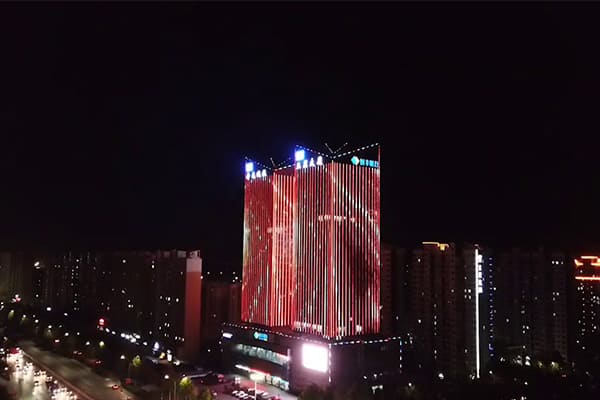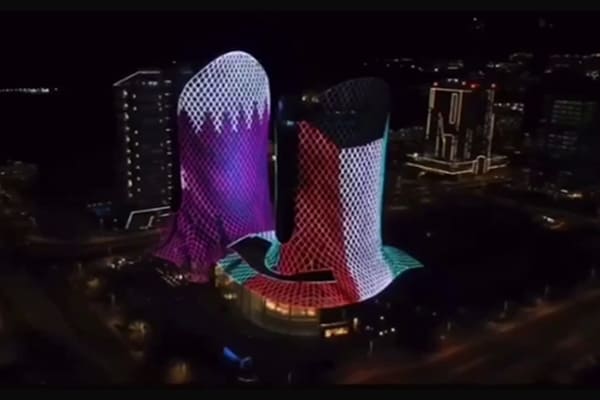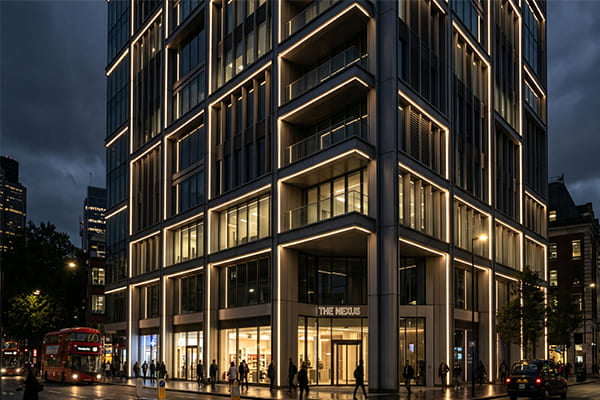
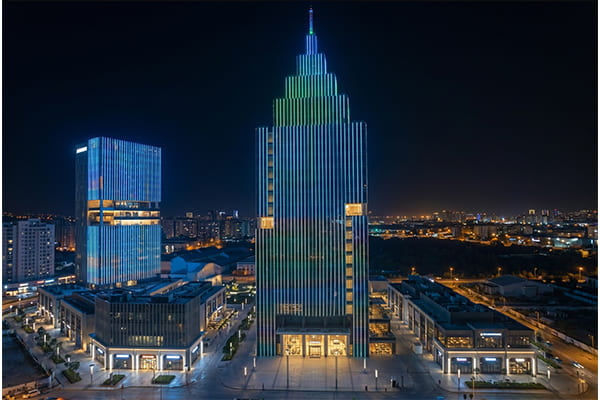
Want to make a skyscraper a nighttime landmark? Poor lighting can flatten its impressive scale. The right linear lighting strategy is the secret to a stunning visual impact.
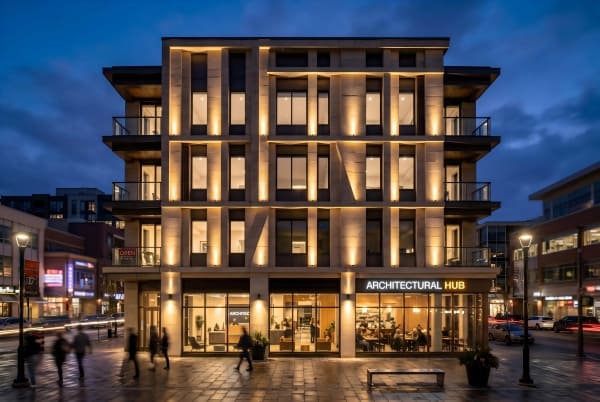
The best way is to use vertical linear lights to emphasize height.1 Conceal fixtures within the architecture. And use a mix of wall washing, grazing, and outlining techniques. This sculpts the building's form and creates a powerful nighttime identity without revealing the light source.
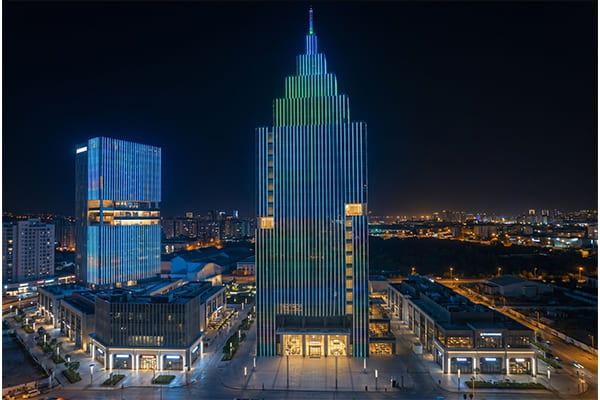
I've worked on many facade lighting projects over the years. A common mistake I see is people just throwing light at a building, hoping for the best. A successful skyscraper project needs a clear plan and a solid strategy. It's about more than just making it bright; it's about telling a story with light. Let's start with the most important part: the design strategy. This is where we build the foundation for a truly iconic project.
What Are the Core Design Strategies for Skyscraper Lighting?
Do you worry your lighting design will look messy? Too many horizontal lines can actually make a tall building look shorter.2 Let's focus on accentuating its best features.
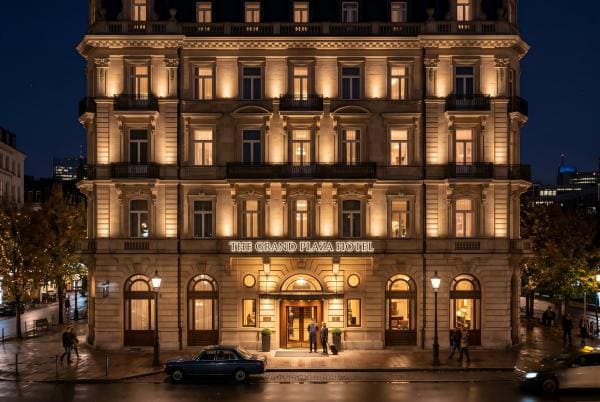
Prioritize vertical lines to emphasize height. Focus intense light on the building's crown to make it recognizable from afar.3 Use a combination of outline, wall washing, and wall grazing techniques to define the building's shape and texture, creating a cohesive and powerful design.
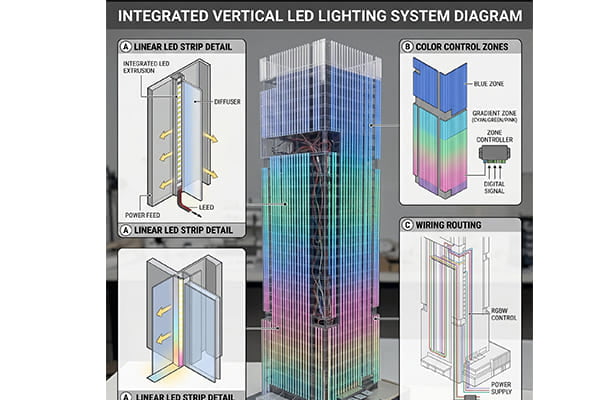
The first rule I follow is simple: make the building look taller. Our main goal for a skyscraper is to reinforce its sense of height and grandeur. We use vertical lines of light to do this. They draw the eye upward, from the base to the sky. I always advise clients to avoid too many horizontal light bands. These can visually slice the building into smaller pieces, which works against our goal of emphasizing its scale. The top of the skyscraper, its crown, is also a critical area. This is the building's signature against the night sky. We often focus more intense or dynamic lighting here to create a recognizable landmark that can be seen from miles away. To achieve a complete look, we must master three fundamental lighting techniques.
| Technique | Primary Goal | Best For |
|---|---|---|
| Outline Lighting | Define the building's shape | Enhancing recognition from a long distance,勾勒建筑的轮廓 |
| Wall Washing | Create uniform brightness | Evenly illuminating large, smooth surfaces like glass or metal |
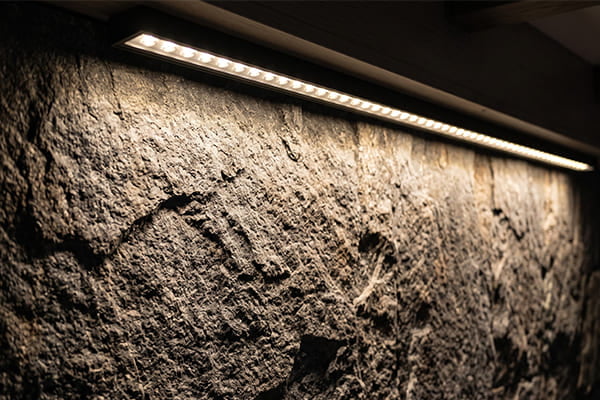
| Wall Grazing | Emphasize texture | Creating dramatic shadows on textured materials like stone or brick |
Combining these three techniques gives you a full toolkit to sculpt the building. You can use outline lighting for the edges, wall washing for the main facade, and wall grazing to highlight special architectural features. This layered approach creates depth, drama, and a truly professional result.
Which Linear Fixtures Should You Choose for Different Effects?
Choosing the wrong fixture can waste your budget and ruin the effect. You need the right tool for the right job. Let's make sure your light performs perfectly.
Use IP66+ rated fixtures. Choose LED wall washers for smooth facades like glass or metal. Use LED wall grazers for textured surfaces like stone. And use LED linear contour lights to outline the building’s edges. This ensures the best visual effect for each surface.
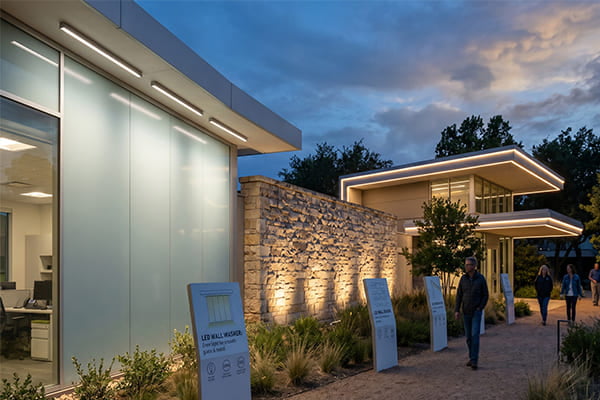
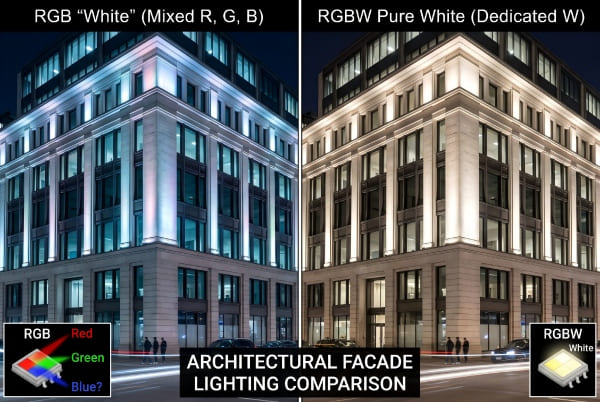
After we have a solid design strategy, we need to select the right hardware. For skyscrapers, the environment is harsh. The fixtures face wind, rain, and extreme temperatures. The first thing I check is the IP rating. For any high-rise project, IP66 is the absolute minimum4, but I always recommend IP67 or IP68 for maximum durability5. Also, consider an anti-glare grille or shield. This prevents light pollution and ensures the light only goes where you want it. For the light itself, a color temperature between 2700K and 4000K usually creates a sophisticated warm or neutral white look6. For landmark buildings that need dynamic effects, an RGBW system is the best choice7.
Here's a breakdown of which fixture to use for each application:
LED Wall Washers
These lights are designed to create a smooth, even "wash" of light across a large surface. We install them at a distance from the wall, usually over 50cm.8 This is perfect for modern skyscrapers with glass and metal curtain walls. The goal is to make the facade glow softly without creating harsh hot spots.
LED Wall Grazers
When you want to show off the texture of a building, wall grazers are your best friend. We install these very close to the surface, typically within 30cm.9 This creates sharp angles of light that produce dramatic shadows on materials like stone, brick, or textured concrete. It adds depth and a tactile quality to the facade.
LED Contour Lights (Linear Lights)
These are slim, linear fixtures used for outline lighting. We use them to trace the architectural edges, corners, and structural lines of a building. Their main job is to define the building's overall shape so it's clearly recognizable from a distance. They are essential for creating that iconic silhouette on the skyline.
Matching the fixture to the surface and the desired effect is not just a detail; it's fundamental to a successful project.
How Do You Integrate Lighting Systems and Ensure Safety?
A great design is useless if it's unsafe or impossible to control. High-rise projects have unique challenges. We must plan for safety and long-term operation from day one.
Install fixtures so they are hidden ("see the light, not the lamp"). Use a DMX512 control system for reliable programming. Ensure all fixtures and brackets pass wind load tests. Also, plan for maintenance access. This ensures safety, reliability, and easy operation for years.
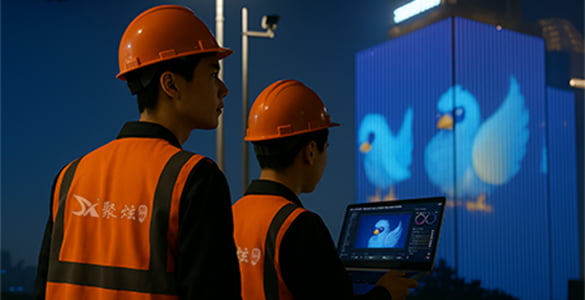
The final piece of the puzzle is integration and safety. This is where a good project becomes a great one. For our clients, who are often engineering contractors and project integrators, these details are everything. A beautiful design must also be practical, safe, and easy to maintain for many years. I always stress that we must think about these things from the very beginning of the design process, not as an afterthought. It's about building a system that is as robust as the building it illuminates.
Concealed Installation
My philosophy is "see the light, not the lamp." During the day, the lighting fixtures should be invisible. They should not interfere with the building's architecture. We work closely with architects and facade engineers to integrate fixtures directly into the structure. This could be inside curtain wall mullions, behind parapet walls, or within architectural seams. This keeps the building's daytime appearance clean and pristine.
Smart Control Systems
A modern skyscraper needs a smart brain. We use the DMX512 protocol as our standard.10 It is stable, reliable, and allows for precise control of every single fixture. For long distances across a skyscraper, we pair DMX with fiber optic cables to prevent signal loss. A smart control system allows the building manager to schedule lighting scenes, create special modes for holidays, and even monitor the system remotely. This provides flexibility and saves energy.
Safety and Maintenance
Safety is not negotiable on a high-rise project. Every bracket and fixture must be certified to withstand high wind loads.11 We use high-grade 304 or 316 stainless steel for all mounting hardware to prevent corrosion12. At the same time, we must plan for the future. How will a broken fixture be replaced 50 stories up? We design the installation with maintenance in mind, ensuring there are access paths for building maintenance units or gondolas. Using a modular design for our lights also helps, as a single module can be swapped out quickly and easily.
Conclusion
Successful skyscraper lighting doesn't just illuminate. It uses professional design and smart control to sculpt a building into a brilliant landmark for the city's skyline.
"Is the Vertical-Horizontal Illusion a Byproduct of the Environmental ...", https://pmc.ncbi.nlm.nih.gov/articles/PMC10303484/. Sources in architectural design and visual psychology explain that vertical lines naturally draw the human eye upward, a principle leveraged in facade lighting to accentuate a building's height and grandeur. Evidence role: mechanism; source type: education. Supports: The claim that vertical lines are used in architecture and design to guide the viewer's eye upward, creating an illusion or emphasis of greater height and slenderness.. ↩
"On the origin of the Helmholtz's square illusion: An attentional account", https://pubmed.ncbi.nlm.nih.gov/37157009/. Studies in visual perception, such as those related to the Helmholtz square illusion, demonstrate that an area with horizontal lines is often perceived as taller and narrower than an identical area with vertical lines, supporting the principle that horizontal banding can make a structure appear shorter. Evidence role: mechanism; source type: research. Supports: The claim that horizontal divisions on a vertical object can cause it to be perceived as shorter and wider.. ↩
"The Illuminated Skyscraper - Brown University", https://webhelper.brown.edu/joukowsky/courses/13things/7514.html. Architectural lighting design guides from professional organizations often describe the strategy of illuminating a skyscraper's crown to create a distinct silhouette, making the building a recognizable landmark on the city skyline. Evidence role: general_support; source type: institution. Supports: The claim that illuminating the top of a building is a key strategy for establishing its identity on the nighttime skyline.. ↩
"IP code - Wikipedia", https://en.wikipedia.org/wiki/IP_code. The International Electrotechnical Commission (IEC) standard 60529 defines the IP66 rating as providing complete protection against dust ingress and protection against powerful water jets from any direction, making it a common minimum specification for outdoor electrical enclosures exposed to severe weather. Evidence role: definition; source type: institution. Supports: The claim that IP66 is a minimum standard for exposed outdoor fixtures.. ↩
"IP code - Wikipedia", https://en.wikipedia.org/wiki/IP_code. According to IEC standard 60529, the IP67 rating certifies protection against temporary immersion in water, while IP68 certifies protection against continuous immersion under specified conditions. These higher ratings provide greater durability for fixtures in locations susceptible to pooling water or submersion. Evidence role: definition; source type: institution. Supports: The claim that IP67 and IP68 ratings offer higher levels of protection than IP66.. ↩
"Effect of warm/cool white lights on visual perception and mood in ...", https://pmc.ncbi.nlm.nih.gov/articles/PMC8481791/. Lighting design guides explain that Correlated Color Temperature (CCT) values around 2700K produce a 'warm white' light often associated with traditional or inviting spaces, while values near 4000K produce a 'neutral white' for a cleaner, more modern appearance. Evidence role: general_support; source type: education. Supports: The claim that the 2700K-4000K range is standard for achieving warm or neutral white aesthetics in architecture.. ↩
"RGB vs RGBW strip for cool AND warm white : r/led - Reddit", https://www.reddit.com/r/led/comments/1njvsgh/rgb_vs_rgbw_strip_for_cool_and_warm_white/. Technical sources on LED technology explain that RGBW systems incorporate a dedicated white LED alongside the red, green, and blue ones. This allows for the creation of a higher quality, more efficient pure white light and a broader palette of pastel colors compared to standard RGB systems, which produce white by mixing the three primary colors. Evidence role: mechanism; source type: paper. Supports: The claim that RGBW systems offer advantages over RGB systems for certain applications.. ↩
"Wall Washing: A Beginner's Guide to Wall Washer Lighting", https://lumenture.com/blog/wall-washing-lighting/. Lighting design handbooks state that to achieve a smooth, even wash of light, fixtures must be placed at a sufficient distance from the wall. The exact setback depends on the wall height and the fixture's beam angle, with a common rule of thumb being a setback-to-height ratio of 1:3 or 1:4, often resulting in distances greater than 50cm. Evidence role: general_support; source type: education. Supports: The claim that wall washers require a significant setback from the illuminated surface.. Scope note: The 50cm figure is a general guideline; the optimal distance is determined by specific project calculations. ↩
"Shades and Shadows in Orthographic Views - andrew.cmu.ed", https://www.andrew.cmu.edu/user/ramesh/teaching/course/48-175/lectures/9.ShadesAndShadows.pdf. Technical guides on architectural lighting explain that the wall grazing technique requires placing light fixtures very close to a surface. This creates a steep angle of incidence that casts sharp shadows, thereby revealing and accentuating the surface's texture. Placement within 30cm is a common practice to achieve this effect. Evidence role: general_support; source type: education. Supports: The claim that wall grazing requires placing fixtures very close to the surface.. ↩
"DMX512 - Wikipedia", https://en.wikipedia.org/wiki/DMX512. DMX512 (Digital Multiplex) is a communication standard developed by the Entertainment Services and Technology Association (ESTA). It is widely adopted in the entertainment and architectural lighting industries for its ability to reliably control dimmers, fixtures, and other special effects equipment from a central console. Evidence role: definition; source type: institution. Supports: The claim that DMX512 is an industry standard for lighting control.. ↩
"Wind Load Testing Facility | Penn State Engineering", https://www.phrc.psu.edu/Research-and-Labs/Laboratory-Facilities/BCERL/Wind-Load-Testing-Facility.aspx. Structural engineering standards, such as ASCE/SEI 7 in the United States, provide methodologies and data for calculating wind loads on buildings and their components. Building codes mandate that all attachments, including lighting fixtures and brackets, must be designed and tested to safely resist these calculated forces. Evidence role: general_support; source type: government. Supports: The claim that fixtures on tall buildings must be designed to withstand wind loads.. ↩
"304 vs 316 Stainless Steel: What You Need to Know - Unified Alloys", https://www.unifiedalloys.com/blog/304-316-stainless/. Materials science literature explains that while both 304 and 316 are austenitic stainless steels with good corrosion resistance, grade 316 contains molybdenum. This addition significantly increases its resistance to corrosion from chlorides, making it the preferred material for hardware in marine environments or areas where de-icing salts are used. Evidence role: mechanism; source type: paper. Supports: The claim that 316 stainless steel offers superior corrosion resistance to 304 in certain environments.. ↩