Struggling to pick a control system for your project? A wrong choice means wasted money and poor effects. Understanding the core difference between DMX and DALI is the first step.
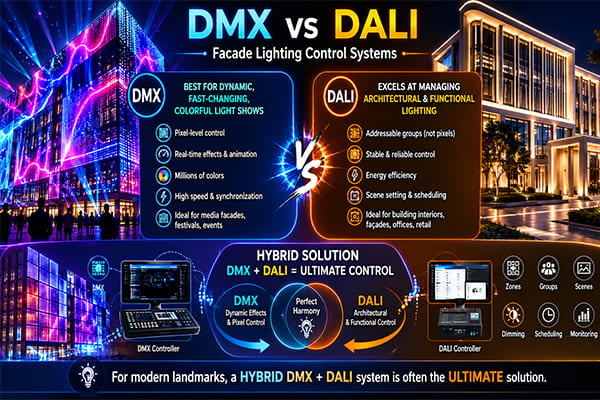
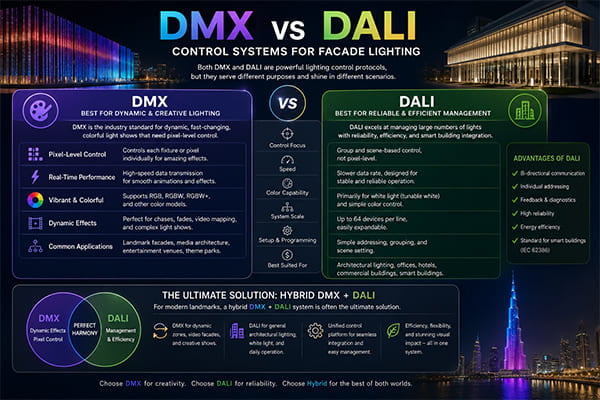
DMX is best for dynamic, fast-changing, colorful light shows that need pixel-level control1. DALI excels at managing stable, energy-efficient architectural lighting with smart features like fault detection2. For modern landmarks, a hybrid DMX + DALI system is often the ultimate solution.
Choosing the right control protocol feels like a tough technical decision, but it doesn't have to be. I get asked this question all the time by contractors and project managers. The truth is, DMX and DALI were born for very different jobs. One comes from the world of stage and performance, the other from smart building management. Let's break down which one you should use, and when.
When Should I Choose DMX512 for My Facade Project?
You want a vibrant, jaw-dropping light show on your building. But standard lighting controls are too slow and clunky. DMX512 is the protocol built for speed and dynamic color3.
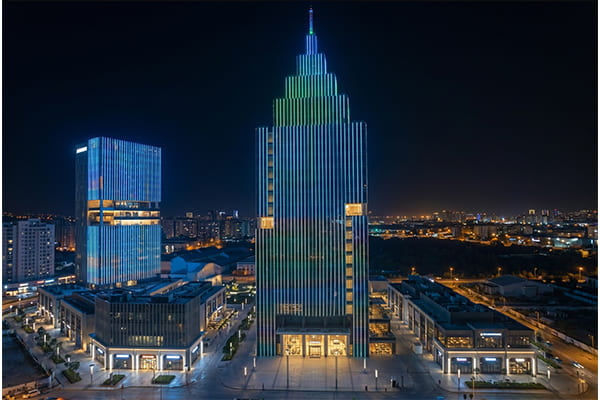
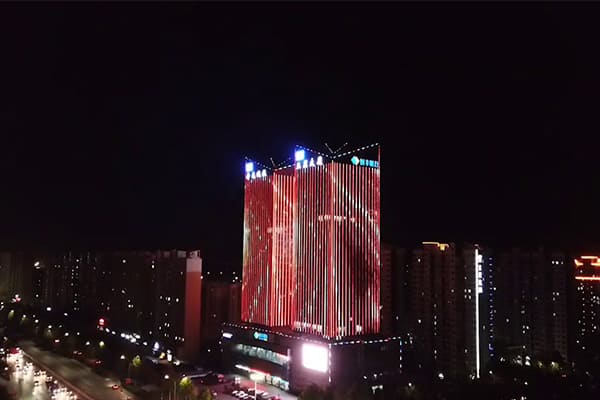
Choose DMX for media facades, pixel-level control, dynamic RGB/RGBW color changes, and light shows synchronized to music. It’s perfect for landmark buildings, bridges, and tourist attractions where creating a visual spectacle is the main goal. It delivers smooth, zero-latency animations.
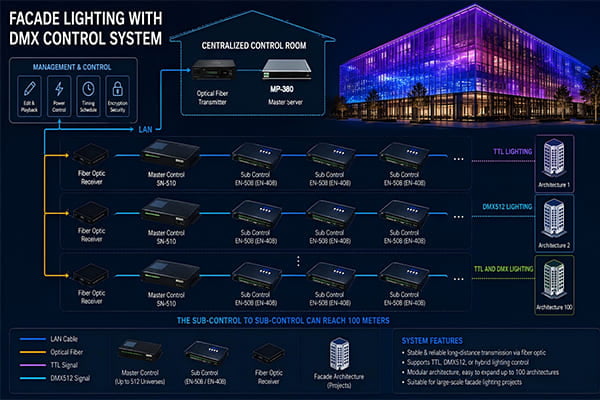
DMX512’s biggest strength is its speed. It updates lights up to 44 times per second4, which means you get perfectly smooth and fluid animations. There is no lag. This is why it's the standard for stage lighting and concerts5. I remember a bridge project where we had to sync the lights across a 500-meter span to music. Only DMX could handle that kind of perfect, real-time synchronization. It’s designed for pixel-level control, meaning you can program every single light point individually. This is essential for creating video on a media facade or complex patterns with RGB or RGBW fixtures. The main thing to remember is the wiring. DMX requires a strict "daisy-chain" connection6 from one light to the next. It’s not difficult, but it has to be done correctly, or you’ll have problems.
| Use DMX When You Need: | Why DMX is the Right Choice: |
|---|---|
| Media Facades & Pixel Control | High speed allows for video and complex pattern playback. |
| Dynamic RGB/RGBW Color Changing | Provides smooth, seamless transitions and vibrant color effects. |
| Synchronized Light Shows | Zero-latency protocol ensures perfect timing with music or events. |
| Landmark & Tourist Projects | Creates the "wow" factor needed for high-impact attractions. |
Is DALI the Smarter Choice for Architectural Lighting?
You need reliable, efficient, and easy-to-manage facade lighting. But you worry about high energy bills and difficult maintenance. DALI is the smart, stable solution for modern buildings.
DALI is perfect for static architectural lighting using single-color or tunable white fixtures. Use it for office buildings, hotels, and projects where energy management, automatic fault reporting, and integration with a Building Management System (BMS) are the top priorities.
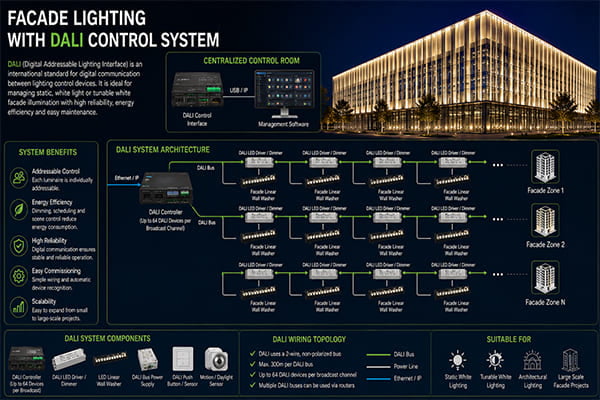
DALI’s magic is its two-way communication7. Unlike DMX which just sends commands out, DALI devices can talk back. This means the system can tell you if a driver has failed or a light has burned out8. On a high-rise building, this is a huge advantage. I once worked on an office tower where the client’s main concern was maintenance costs. With DALI, instead of sending a crew up on a lift to find a single broken light, the system tells you exactly which fixture on which floor has a problem. This saves so much time and money. The wiring is also very flexible; you can use star, tree, or line patterns9, which makes installation easier. DALI provides incredibly smooth dimming, perfect for setting a sophisticated mood. Its only limitation is speed. It's too slow for fast animations10, making it best for stable, high-quality architectural illumination.
| Use DALI When You Need: | Why DALI is the Right Choice: |
|---|---|
| Smart Building Integration | Easily connects with Building Management Systems (BMS)11. |
| Energy Efficiency | Allows for precise dimming, scheduling, and energy monitoring. |
| Low Maintenance | Two-way communication reports fixture and driver failures automatically. |
| Stable Architectural Lighting | Excels at smooth dimming for single-color or tunable white light. |
Why Not Use Both DMX and DALI Together?
You want beautiful, efficient lighting for everyday use. But you also need a spectacular light show for special events. Choosing just one system feels like a compromise, and it is.
A hybrid system is the modern solution for landmark projects. Use DALI to manage the reliable, energy-efficient base lighting. Then, use DMX to control the exciting, dynamic features for holidays and special events. A central controller unites them for the best of both worlds12.
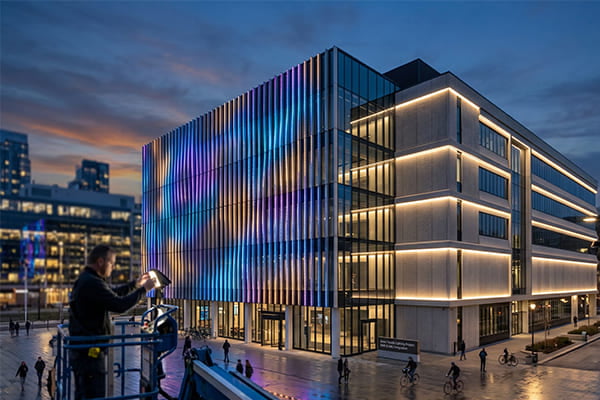
Today, about 80% of our high-end projects use a hybrid DMX + DALI approach. This strategy offers maximum flexibility and value. Here’s how it works: We use DALI to control the general floodlights and wall washers that light up the main structure of the building. This provides a beautiful, high-quality base layer of light that is energy-efficient and easy to manage day-to-day. Then, we use DMX for the "special" parts. This could be linear lights outlining the building's contours, a media screen on the podium, or pixel lights for creating festive effects. A central control system acts as the brain, allowing the building manager to run the efficient DALI program on most nights but launch a stunning DMX light show with the push of a button. This way, the building looks great every day and can put on a world-class performance when it matters most.
| System | Best For | Key Feature |
|---|---|---|
| DMX Only | Dynamic Shows, Media Facades, Fast Changes | High-Speed, Pixel Control |
| DALI Only | Static Lighting, Energy Management, Low Maint. | Two-Way Communication, Smart Diagnostics |
| DMX + DALI | Landmark Buildings, Flexible Use | Combines DALI's efficiency with DMX's impact |
Conclusion
For dynamic effects, choose DMX. For smart building management, choose DALI. For a landmark building that demands both daily elegance and show-stopping power, a hybrid system is the answer.
"DMX512 - Wikipedia", https://en.wikipedia.org/wiki/DMX512. A technical reference on DMX512 supports that the protocol is designed for digital control of entertainment lighting channels, which is consistent with fast-changing color and fixture-level effects. Evidence role: general_support; source type: institution. Supports: DMX is suited to dynamic, fast-changing, colorful light shows that require granular control.. Scope note: This supports DMX512’s suitability for dynamic lighting control in general, but not the superiority of DMX for every facade project. ↩
"Benefits of DALI for Lighting", https://www.dali-alliance.org/data/downloadables/3/2/7/diia-pwgtw020a_benefits-of-dali-for-lighting.pdf. Documentation on IEC 62386/DALI supports that DALI is a bidirectional digital lighting-control protocol used in building lighting systems and can report device status information. Evidence role: definition; source type: institution. Supports: DALI is used for stable architectural lighting and supports smart features such as device-status or fault reporting.. Scope note: The source can establish DALI’s capabilities, but energy efficiency depends on system design, sensors, schedules, and commissioning. ↩
"DMX512 - Wikipedia", https://en.wikipedia.org/wiki/DMX512. Technical descriptions of DMX512 identify it as a unidirectional serial protocol for controlling stage and architectural lighting equipment, supporting its use in rapid dynamic lighting changes. Evidence role: definition; source type: encyclopedia. Supports: DMX512 is designed for high-speed control of dynamic lighting effects, including color-changing fixtures.. Scope note: The source supports the protocol’s design and common applications, not the visual quality of any specific installation. ↩
"DMX512", https://en.wikipedia.org/wiki/DMX512. DMX512 timing specifications show that a full 512-channel packet can be transmitted at roughly 44 frames per second under standard timing assumptions. Evidence role: statistic; source type: institution. Supports: DMX512 can update a full universe at up to about 44 times per second.. Scope note: Actual refresh rate varies with the number of channels used, controller settings, and packet timing. ↩
"DMX512 - Wikipedia", https://en.wikipedia.org/wiki/DMX512. Historical and standards references describe DMX512 as a widely adopted standard for controlling theatrical and entertainment lighting equipment. Evidence role: historical_context; source type: institution. Supports: DMX512 is a standard protocol for stage and concert lighting control.. Scope note: The evidence supports widespread standardization in entertainment lighting, not exclusive use in all stage or concert systems. ↩
"DMX512 - Wikipedia", https://en.wikipedia.org/wiki/DMX512. DMX512 wiring guidance describes the network as a serial bus normally connected from controller to device to device, with termination at the end of the line. Evidence role: mechanism; source type: institution. Supports: DMX installations generally require a daisy-chain bus topology rather than arbitrary star wiring.. Scope note: Some systems use splitters or isolated branches, so the daisy-chain description is accurate for a basic DMX run rather than every engineered topology. ↩
"Digital Addressable Lighting Interface - Wikipedia", https://en.wikipedia.org/wiki/Digital_Addressable_Lighting_Interface. DALI/IEC 62386 descriptions state that DALI is a bidirectional lighting-control protocol, allowing control gear to return status information as well as receive commands. Evidence role: mechanism; source type: institution. Supports: DALI supports two-way communication between controllers and lighting devices.. Scope note: The source supports bidirectional communication as a protocol feature, but the usefulness of returned data depends on compatible devices and software. ↩
"Why do I see Lamp Failure, Emergency Lamp Failure or Control ...", https://support.zencontrol.com/hc/en-us/articles/7093947995535-Why-do-I-see-Lamp-Failure-Emergency-Lamp-Failure-or-Control-Gear-Failure-marked-against-my-lights. IEC 62386/DALI references describe queryable status and failure information from control gear, supporting the claim that DALI systems can report lamp or driver faults. Evidence role: mechanism; source type: institution. Supports: A DALI system can report certain device faults such as lamp or control-gear failures.. Scope note: The evidence supports the protocol capability; actual fault visibility depends on the luminaire, driver implementation, addressing, and monitoring software. ↩
"DALI Topology | tridem-e-t", https://www.tridem.com.tr/dali-topology. DALI installation guidance notes that DALI bus wiring can use line, tree, star, or mixed topologies within bus-length and voltage-drop limits. Evidence role: mechanism; source type: institution. Supports: DALI wiring can be installed in star, tree, or line topologies.. Scope note: Topology flexibility is subject to DALI electrical limits and commissioning requirements. ↩
"Digital Addressable Lighting Interface - Wikipedia", https://en.wikipedia.org/wiki/Digital_Addressable_Lighting_Interface. Technical sources on DALI describe its comparatively low data rate and building-lighting focus, supporting the view that it is not intended for rapid animation playback like entertainment-lighting protocols. Evidence role: mechanism; source type: institution. Supports: DALI is generally too slow for fast lighting animations compared with DMX-style control.. Scope note: The source supports a general speed limitation; simple fades or slow color changes may still be feasible with DALI depending on device support. ↩
"[PDF] DALI LIGHTING SYSTEMS", https://prod-edam.honeywell.com/content/dam/honeywell-edam/hbt/en-us/documents/literature-and-specs/datasheets/sbc/53-002_ENG_Brochure_SBC_DLS-DALI.pdf. Building-control references describe DALI as a lighting subsystem that can be integrated with building management systems through gateways or higher-level automation protocols. Evidence role: general_support; source type: institution. Supports: DALI lighting systems can be integrated with Building Management Systems.. Scope note: Integration is not automatic; it requires compatible gateways, controllers, or BMS interfaces. ↩
"DMX-DALI Gateway - Legrand Integrated Solutions", https://www.legrandintegratedsolutions.com/products/dmx-dali-gateway. Lighting-control literature describes multi-protocol controllers and gateways as a means to coordinate DALI building-lighting functions with DMX-based dynamic lighting effects. Evidence role: general_support; source type: institution. Supports: A central controller can coordinate DALI and DMX lighting subsystems in a hybrid installation.. Scope note: This supports the feasibility of integration, not that every hybrid system is optimal or cost-effective for every landmark project. ↩