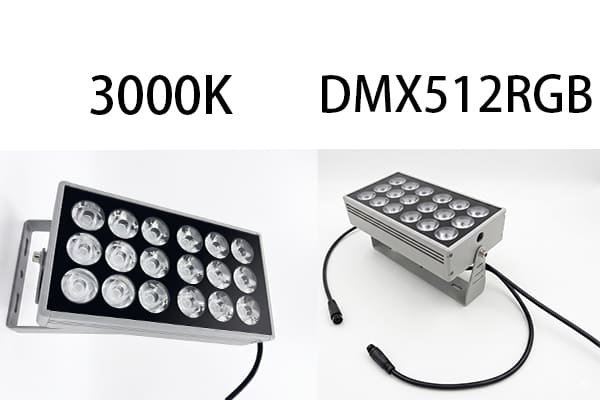
Are you choosing floodlights and feeling confused by the prices? You see a powerful DMX512 RGB version is only slightly more expensive than a basic single-color one and wonder what the catch is.
The price difference is small because both floodlights share the same high-quality body, and the cost of the premium single-color LEDs offsets the extra electronics in the RGB version. The final price gap only covers the essential DMX chip, upgraded cables, and specific testing labor.
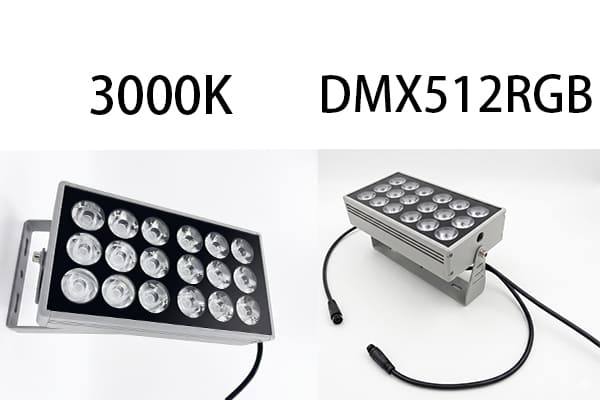
I get this question all the time from clients, especially engineers and contractors who are carefully planning their project budgets. They look at our price list and expect a big jump in cost to get full-color control. When they see how close the prices are, they're naturally skeptical. They ask me, "Are you compromising on quality to make the DMX512 version cheaper?" The answer is a firm no. The reality is much more interesting and is all about smart manufacturing and strategic component choices. Let's break down exactly why you get so much more value for such a small extra cost.
You need durable lights that will last for years outdoors. You worry that a more affordable DMX512 option might use a weaker, lower-quality housing that will fail under pressure.
Yes, they are physically identical. We use the same heavy-duty aluminum housing, integrated heat sink, and industrial-grade sealants for both the single-color and the DMX512 RGB models. This guarantees that whichever light you choose, you get the same exceptional durability and weather resistance.
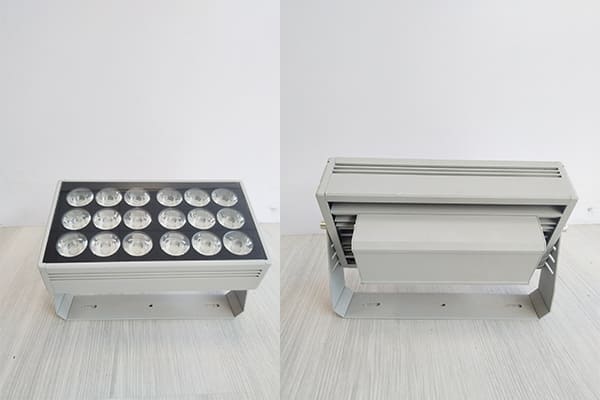
This is the most important point to understand. The foundation of any great outdoor light is its body. It has to protect the sensitive electronics inside from rain, dust, heat, and cold1. When we designed our 54W floodlight series, we started with one robust, industrial-grade blueprint. We didn't create a "good" version and a "better" version. We created one professional-grade housing for all applications.
This approach has huge benefits. Here’s a look at the shared structure:
Key Physical Components
| Component | Single-Color 3000K | DMX512 RGB | Quality Difference |
|---|---|---|---|
| Housing Material | Die-Cast Aluminum2 | Die-Cast Aluminum | None |
| Heat Sink Design | Integrated Fin Structure | Integrated Fin Structure | None |
| Sealing Method | Silicone Gasket & Potting | Silicone Gasket & Potting | None |
| Front Glass | Tempered Glass | Tempered Glass | None |
The die-cast aluminum body provides incredible strength and resists corrosion. The heat sink isn't a separate piece bolted on; it's integrated directly into the housing design3. This creates a highly efficient path for heat to escape, which is critical for keeping the LEDs cool and ensuring they have a long, stable lifespan4. We use high-quality silicone gaskets and potting compounds to achieve a high IP rating5, making the light completely waterproof and dustproof. By standardizing on this single, high-quality platform and producing it in large volumes6, we bring the unit cost down significantly. We pass those savings directly to you. You aren't paying a premium for a special "RGB body" because it doesn't exist. You get our best build quality every time.
How Do the Core Component Costs Balance Out?
You might assume that an RGB light must have more expensive parts inside. The small price difference can make you suspicious about the quality of the LEDs and driver in the DMX512 version.
It's a strategic cost-balancing act. Our single-color version uses premium, high-power 5W LEDs, which are very expensive per piece. The RGB version uses mature, mass-produced 3-in-1 LEDs. The high cost of the single-color LEDs cancels out most of the extra cost of the RGB's electronics.
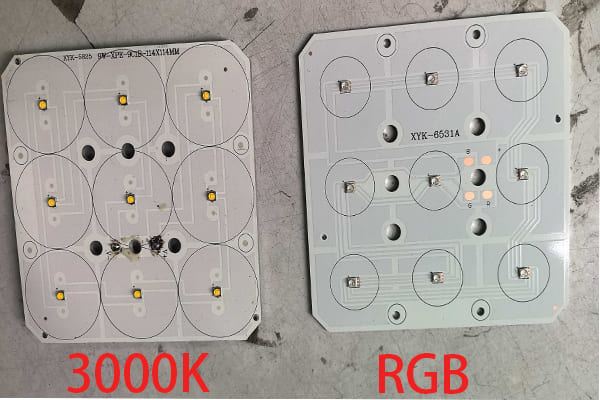
This is where the internal economics get interesting. Not all LEDs are created equal. The cost of an LED chip depends heavily on its power, efficiency, color accuracy, and production volume. We select the best technology for each application, and it just so happens that the costs end up being very similar.
Let's look at the two most important internal components: the light source and the driver.
1. The Light Source (LEDs)
For our 54W single-color 3000K floodlight, we use a small number of very high-power LEDs—typically 5W per chip. These are top-tier components sourced from leading manufacturers. They are chosen for their extreme brightness, excellent color consistency, and proven longevity. But this premium quality comes at a high unit cost.
For our 54W DMX512 RGB version, we use a larger number of 3-in-1 RGB LEDs. Each chip contains three smaller diodes (Red, Green, and Blue)7 and is typically rated at 3W total (1W per color). This technology is the industry standard for color-changing lights. It has been refined for years and is produced in massive quantities globally, which has made its unit cost very low.
So, the high cost of the few premium single-color LEDs nearly equals the lower cost of the many standard RGB LEDs.
2. The Driver
The driver is what powers the LEDs. A few years ago, DMX512 drivers were specialty items and were much more expensive than standard drivers. That is no longer the case.
- Single-Color Driver: Uses a standard high-voltage constant current driver8. This is a reliable, common, and affordable component.
- DMX512 Driver: Uses a DC24V DMX512 constant current driver. Thanks to the widespread adoption of DMX control in the architectural lighting industry9, these drivers are now mass-produced. Their cost has dropped dramatically, and today there is only a minimal price difference between a quality DMX driver and a standard one.
| Component | Single-Color 3000K | DMX512 RGB | Cost Impact |
|---|---|---|---|
| LEDs | Fewer, High-Cost (5W) | More, Lower-Cost (3W) | Costs nearly balance out |
| Driver | Standard HV Driver | DMX512 LV Driver | Minimal price difference now |
We don't compromise. We just take advantage of how the market has matured. This allows us to offer both a high-performance single-color option and a versatile RGB option without a huge price penalty.
So What Am I Actually Paying Extra For with DMX512?
You understand the main costs are similar, but there's still a small price increase. You want to know exactly where that extra money goes, with no hidden markups or marketing fluff.
The small extra cost is not a profit margin; it covers three tangible items. You're paying for the DMX512 control chip, an upgraded 5-core shielded cable with waterproof connectors, and the additional factory labor for programming and testing each light.
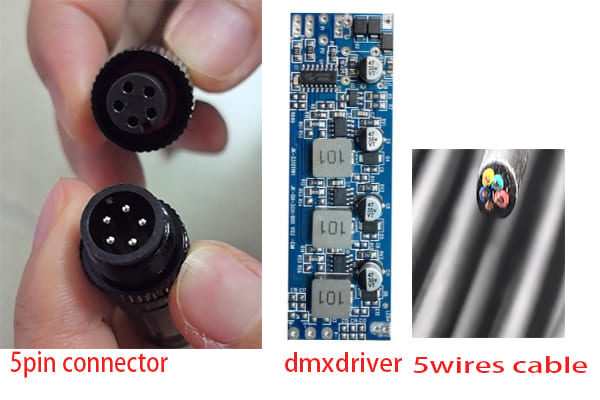
We believe in being transparent about our pricing. We don't add a "DMX technology tax." The small price difference you see is the direct cost of the hardware and labor required to give the light its color-changing intelligence. Here is the exact breakdown of what you get for that small premium.
1. The DMX512 IC Chip
This tiny microchip is the "brain" of the DMX light. A standard single-color light just needs power to turn on. But a DMX light needs to receive and interpret commands10. This chip gives the light a unique address on your DMX network11, allowing a controller to tell it precisely which color and brightness to display. This is a physical component that simply doesn't exist in a single-color fixture.
2. Upgraded Cable and Connectors
A single-color light needs a simple 2-core cable for power. A DMX512 light needs a more complex cable to handle both power and data. We use a 5-core shielded cable for our DMX models. Two cores deliver power, and three cores transmit the stable DMX signal (Data+, Data-, and Ground). The shielding is crucial—it prevents electrical interference from corrupting the data signal12, which is essential for projects with long cable runs. This cable is paired with robust, multi-pin waterproof connectors, which are more complex and costly than a simple power plug.
3. Additional Programming and Testing Labor
Preparing a DMX fixture takes more time in our factory. First, each light must be digitally programmed with a unique DMX address before it ships. Second, our quality control process is more intensive. A single-color light is tested for power and stability. A DMX RGB light must be put through a full aging test where it cycles through all colors, dimming levels, and commands to ensure the DMX chip, driver, and all LED colors work flawlessly. This extra labor ensures every light you receive works perfectly out of the box.
| Added Cost Component | Purpose | Why it's Necessary for DMX |
|---|---|---|
| DMX512 IC Chip | Receives control signals | Gives the light its unique "address" for individual control. |
| 5-Core Shielded Cable | Transmits power & data | Delivers a stable DMX signal without interference. |
| Multi-Pin Connectors | Securely connects the cable | Handles more wires and ensures a waterproof data link. |
| Addressing & Testing | Quality assurance | Ensures every light is correctly programmed and works perfectly. |
Conclusion
The small price gap is a result of our smart, standardized manufacturing. It reflects the true cost of adding advanced control, offering you incredible creative power for a minimal extra investment.
"IEC 60529 IP Ratings – Ingress Protection Standard - E-Labs, Inc.", https://e-labsinc.com/specs-ies-60529.shtml. An enclosure-protection reference explains that outdoor electrical housings are designed to limit ingress of water and dust and to protect components from environmental stress; this supports the general engineering rationale but does not evaluate this specific floodlight housing. Evidence role: general_support; source type: institution. Supports: Outdoor light housings must protect internal electronics from rain, dust, heat, and cold.. Scope note: Contextual support only; it does not verify the product’s actual environmental performance. ↩
"[PDF] Aluminum and Aluminum Alloys - NIST Materials Data Repository", https://materialsdata.nist.gov/bitstream/handle/11115/173/Aluminum%20and%20Aluminum%20Alloys%20Davis.pdf. A materials or manufacturing reference describes die casting as a process commonly used to produce strong, dimensionally stable metal components, including aluminum parts; this supports the suitability of die-cast aluminum as a robust housing material but not the quality of any individual fixture. Evidence role: definition; source type: education. Supports: Die-cast aluminum is an appropriate robust material for floodlight housings.. Scope note: The source can support general material/process properties, not this manufacturer’s alloy, thickness, or corrosion treatment. ↩
"[PDF] Solid-State Lighting Lifetime and Reliability - Department of Energy", https://www.energy.gov/sites/prod/files/2019/02/f59/davis_poster_ssl-rd2019.pdf. A thermal-management reference for LEDs explains that conductive paths from the LED package to a heat sink are central to removing heat from solid-state lighting; this supports the design logic of integrating heat sinking into the housing, although it does not prove the effectiveness of this particular geometry. Evidence role: mechanism; source type: paper. Supports: An integrated housing heat sink can provide an efficient path for heat removal in LED fixtures.. Scope note: Contextual support only; thermal performance depends on the actual design, materials, and operating conditions. ↩
"Development of a fully automated LED lifetime test system | NIST", https://www.nist.gov/publications/development-fully-automated-led-lifetime-test-system. LED reliability literature shows that elevated junction temperature accelerates lumen depreciation and failure mechanisms in LEDs; this supports the claim that cooling contributes to longer LED service life, without establishing the lifespan of the fixture discussed here. Evidence role: mechanism; source type: paper. Supports: Keeping LEDs cooler helps extend operating life and stability.. Scope note: The relationship is general; actual lifetime requires product-specific thermal and reliability testing. ↩
"IP code - Wikipedia", https://en.wikipedia.org/wiki/IP_code. The IP Code defines degrees of protection provided by enclosures against solid-object ingress and water ingress; this supports the meaning of a high IP rating but does not confirm the stated rating for this product unless paired with test certification. Evidence role: definition; source type: institution. Supports: An IP rating describes waterproof and dustproof enclosure protection levels.. Scope note: A standards source defines the rating system; it does not certify the fixture’s compliance. ↩
"Economies of Scale in Industrial Plants", https://www.journals.uchicago.edu/doi/pdf/10.1086/259293. Manufacturing-economics sources explain that higher production volumes can reduce average unit costs through economies of scale; this supports the pricing mechanism in general, but not the manufacturer’s actual cost structure. Evidence role: mechanism; source type: education. Supports: Large-volume standardized production can reduce unit cost.. Scope note: The evidence is economic context, not a direct audit of production costs. ↩
"Color Mixing | Harvard Natural Sciences Lecture Demonstrations", https://sciencedemonstrations.fas.harvard.edu/presentations/color-mixing. A technical overview of RGB LEDs explains that RGB packages combine red, green, and blue light-emitting elements to enable color mixing; this supports the description of 3-in-1 RGB LED structure, though package design varies by manufacturer. Evidence role: definition; source type: education. Supports: 3-in-1 RGB LEDs contain red, green, and blue emitters.. Scope note: The source supports the common RGB LED architecture, not the exact package used in this fixture. ↩
"Energy Savings Forecast of Solid-State Lighting in General ...", https://www.energy.gov/sites/prod/files/2019/12/f69/2019_ssl-energy-savings-forecast.pdf. A solid-state-lighting driver reference explains that LEDs are commonly powered by constant-current drivers to regulate current and protect light output and reliability; this supports the driver-function claim but not the exact topology or voltage used in the product. Evidence role: mechanism; source type: research. Supports: LED fixtures commonly use constant-current drivers to power LEDs reliably.. Scope note: General support only; the product’s driver specifications require a datasheet or test report. ↩
"DMX512", https://en.wikipedia.org/wiki/DMX512. A lighting-control reference describes DMX512 as a widely used digital communication protocol for entertainment and architectural lighting control; this supports the general adoption claim but does not quantify market penetration. Evidence role: historical_context; source type: encyclopedia. Supports: DMX512 is widely used in architectural lighting control.. Scope note: The source can establish common use, not exact adoption rates or driver pricing trends. ↩
"DMX512 - Wikipedia", https://en.wikipedia.org/wiki/DMX512. The DMX512 standard describes a unidirectional digital data stream used by controllers to send channel-level control values to lighting devices; this supports the statement that DMX fixtures receive control commands, while implementation details depend on the device electronics. Evidence role: definition; source type: institution. Supports: DMX lights receive digital control commands from a controller.. Scope note: The standard defines the protocol; it does not identify the specific IC used in this fixture. ↩
"DMX512 - Wikipedia", https://en.wikipedia.org/wiki/DMX512. DMX512 references explain that fixtures are assigned start addresses so they can map incoming channel data to device functions; this supports the addressing concept but not the manufacturer’s factory-addressing procedure. Evidence role: mechanism; source type: institution. Supports: DMX fixtures use addresses to determine which control data applies to them.. Scope note: Supports the protocol concept, not the product’s specific addressing workflow. ↩
"Shielding Strategies for EMI Prevention", https://interpro.wisc.edu/courses/shielding-strategies-for-emi-prevention/. Electromagnetic-compatibility and cabling references explain that shielded twisted-pair or shielded data cables reduce susceptibility to electromagnetic interference in data transmission; this supports the rationale for shielded DMX cabling, although actual signal integrity depends on installation practices and cable specifications. Evidence role: mechanism; source type: education. Supports: Shielded cable helps protect DMX data signals from electrical interference.. Scope note: The evidence is general to shielded data transmission and does not validate a specific cable assembly. ↩