Your stunning lighting project is a huge investment. But what happens when fixtures dim or fail? An Annual Maintenance Contract (AMC) is the key to protecting that investment.
An Annual Maintenance Contract (AMC) is a service agreement for the scheduled, professional upkeep of your architectural lighting system. It preserves visual quality, extends equipment life, ensures operational safety, and controls costs1, protecting your project from environmental wear and technical failure over time.
I've seen it many times in my career. A brilliant lighting installation looks incredible on day one, but a year later, it's plagued by dark spots, uneven colors, and failing lights. The client's investment starts to lose its value fast. This is where I always bring up the golden rule of our industry: "Lighting is 30% installation and 70% maintenance." Without a plan for that 70%, the initial 30% is at risk. Let's break down why an AMC is not just an option, but a necessity.
How Does an AMC Preserve Your Lighting's Visual Appeal?
Is your building's facade starting to look patchy and dull? Dust, grime, and color shifts can quickly ruin a beautiful design, making it look old and neglected.
An AMC preserves visual appeal through scheduled cleaning, alignment, and color calibration. Technicians remove dirt that causes "dark spots" and correct color shifts in LEDs, ensuring your lighting remains as pure, uniform, and vibrant as it was on day one.
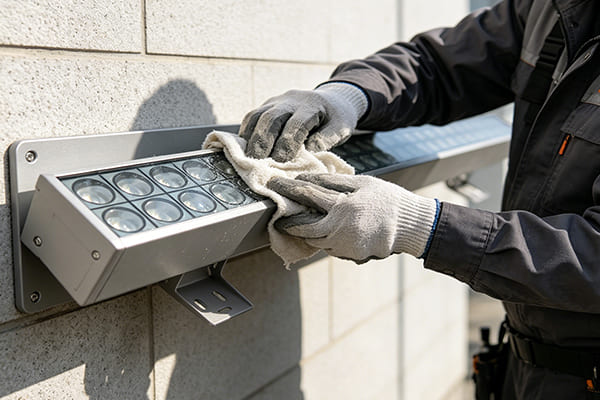
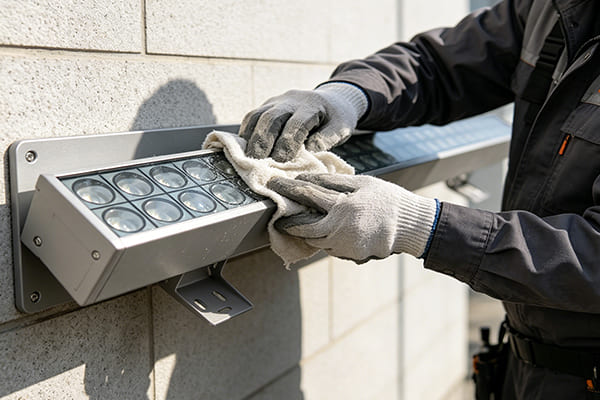
When we design a lighting scheme, we're creating a visual masterpiece. But outdoor fixtures are constantly exposed to the elements. Dust, pollution, rain streaks, and even bird nests can build up on the lenses, creating ugly shadows and dramatically reducing light output.2 An AMC is like a "preservative" that keeps the visual effect fresh and impactful year after year. It's about more than just a simple wipe-down; it's a detailed process to maintain the original design intent.
The Impact of Environmental Buildup
Outdoor fixtures face a constant battle with the environment. Without regular attention, the carefully designed lighting effect will degrade. This isn't a possibility; it's a certainty. The accumulation of dirt acts like a filter, dimming the light and sometimes changing its color. I’ve seen projects where a simple, professional cleaning restored the brightness by over 30%3.
Maintaining Color Consistency
Beyond just cleaning, LED technology itself presents challenges over time. Individual LED chips can experience slight color shifts or "drifting."4 This means a section that was once a perfect warm white might start to look slightly yellow or blue, creating a jarring, unprofessional look. A good AMC includes periodic calibration to ensure that every fixture, from the top of the building to the bottom, produces a consistent, uniform light.5
| Common Visual Problem | How an AMC Solves It |
|---|---|
| Dark spots and shadows | Regular cleaning of fixture lenses and surfaces. |
| Dim or uneven light | Removal of debris and professional output checks. |
| Inconsistent or shifting colors | Periodic light calibration and system adjustments. |
| Misaligned beams | Inspection and realignment of fixtures. |
Can an AMC Really Extend the Lifespan of Your Lighting System?
Are your expensive LED fixtures failing far too early? Constantly replacing components is frustrating and can drain your operational budget very quickly. Proactive care is the answer.
Yes, an AMC significantly extends your system's lifespan. Preventive checks on waterproofing (like IP65/68 ratings) and heat dissipation stop critical failures before they start. This proactive approach can extend the operational life of your fixtures by 50% or more6, protecting your asset.
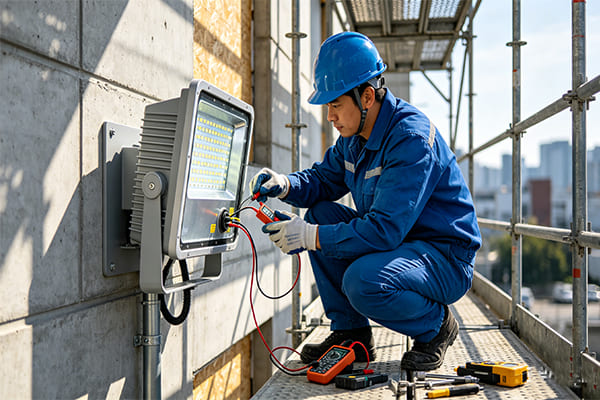
I always say that preventive maintenance is far better than "firefighting" repairs. Waiting for a fixture to fail is the most expensive way to manage a lighting system. Outdoor electronics are sensitive. Water ingress from a failed seal or overheating from a clogged heat sink can cause a chain reaction7, taking down not just one light but an entire section of your facade. An AMC is the "life extension" for your hardware. It focuses on identifying and fixing these small issues before they become catastrophic, system-wide failures.
The Power of Prevention
A technician performing an AMC check isn't just looking for broken lights. They are inspecting for potential future problems. They'll check the integrity of IP-rated seals that keep water and dust out. They'll clean heat sinks to ensure the LEDs can cool properly, which is the single most important factor in preventing premature light decay8. This simple, routine work prevents the kind of damage that leads to costly, large-scale replacements.
My Smart Spare Parts Strategy
This is also why I advise every single one of my clients to order 5-10% extra fixtures with their initial project. I tell them, "You will definitely need these over the next 5 to 10 years." Architectural lighting is often customized for a project. Trying to order a single replacement fixture three years later is a nightmare. The setup fees, shipping costs, and lead times will be high. Worse, you may not get a perfect match for color temperature or performance due to changes in manufacturing.9 Having a small stock of spares on-site, managed as part of an AMC, is the most cost-effective solution for long-term health.
| Maintenance Approach | Description | Long-Term Cost Impact |
|---|---|---|
| Reactive (No AMC) | You fix equipment only after it has broken down completely. | High and unpredictable. Often involves rush orders and extensive downtime. |
| Preventive (With AMC) | Regular, scheduled checks and servicing to prevent failures from happening. | Low and predictable. Fits into a yearly budget and minimizes downtime. |
Why is an AMC Essential for the Safety and Operation of Your Lighting?
Do you worry about hidden electrical dangers on your building's facade? A single faulty wire or loose bracket isn't just a maintenance issue; it's a serious safety risk.
An AMC is essential for safety because it includes in-depth checks of all critical systems. Technicians inspect control links, electrical wiring for degradation, leakage protection, and the physical stability of mounting brackets, preventing potential fire hazards or accidents.
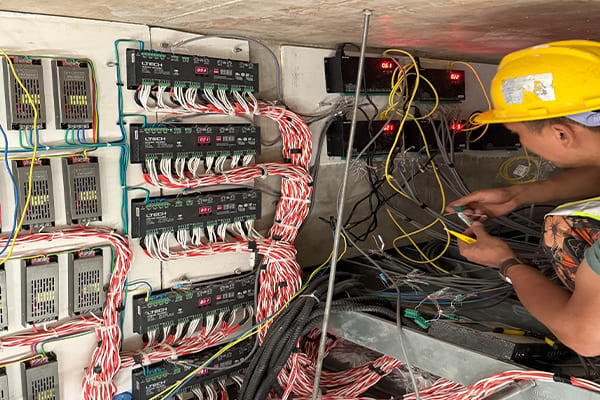
When we talk about maintenance, performance and longevity are key, but nothing is more important than safety. Architectural lighting systems involve high-voltage electricity, complex control wiring, and fixtures that are often mounted high up on a building's exterior. An AMC acts as a "lightning rod" for potential disasters, systematically identifying and neutralizing risks before they can cause harm. A loose bracket could lead to a falling fixture, and degraded wiring insulation is a serious fire hazard10. These are not risks worth taking.
Mitigating Electrical and Physical Risks
During a scheduled AMC visit, a technician will conduct a deep inspection of the entire system's physical and electrical health. This includes:
- Wiring Inspection: Checking for any signs of wear, cracking, or damage from sun exposure or pests.
- Leakage Protection: Testing circuit breakers and RCDs to ensure they function correctly.11
- Bracket Stability: Physically checking the torque and stability of all mounting hardware to prevent fixtures from becoming loose.
Ensuring Flawless Control
Modern lighting is about more than just turning lights on and off. Complex dynamic effects are usually run by control systems like DMX512. An AMC also covers the health of this digital infrastructure. Technicians will check signal links for interference or degradation to ensure your light shows run smoothly without glitches. In fact, for many of my past projects, I provide free programming updates and effect changes each year. This is a crucial part of ongoing service. A building's lighting shouldn't be static; it should evolve with seasons, holidays, and special events. An AMC ensures the system is always ready for these updates and that the dynamic effects you paid for continue to work perfectly.
What Kind of AMC Services Should You Expect for Your Project?
Are you unsure what a maintenance contract should even include? You might worry about paying for services you don't need or missing out on ones you do.
Typical AMC services include regular inspections, fixture cleaning, electrical and control system diagnostics, replacement of faulty parts, emergency repair response, and spare parts management. Contracts are often available in two main types: full-coverage (parts and labor) and partial-coverage (labor only).
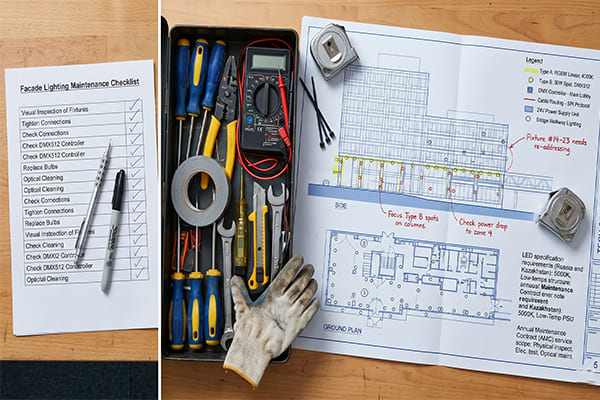
Understanding what's inside an AMC helps you choose the right plan for your project and budget. The main goal of any AMC is to transform unpredictable, emergency repair costs into a controlled, predictable annual expense. This shift is one of the best ways to improve the overall ROI of your lighting project. Instead of scrambling for a fix when half your building goes dark, you have a dedicated team ready to respond, often with the necessary spare parts already on hand. This drastically reduces downtime and keeps your property looking its best.
Core AMC Service Components
While every contract can be tailored, most professional AMCs will include a core set of services:
- Scheduled Inspections: Regular site visits (e.g., quarterly or semi-annually) to perform all preventive checks.
- Systematic Cleaning: Professional cleaning of all light fixtures and lenses.
- Electrical Testing: Checks on power supplies, wiring, and safety circuits.
- Control System Diagnostics: Verification of DMX512 or other control signals and software.
- Faulty Part Replacement: Labor for replacing any failed components like LED drivers or boards.
- Emergency Response: A guaranteed response time for critical failures.
- Spare Parts Management: Managing the inventory of spare fixtures and parts you purchased with the project.
Choosing the Right Contract Type
Most providers offer a couple of primary models, which allows you to balance your budget with your needs.
| AMC Type | What It Typically Includes | Best For |
|---|---|---|
| Full Coverage (Comprehensive) | All labor, replacement parts, and emergency call-outs. | Clients who want a fixed, all-inclusive annual cost with no surprises. |
| Partial Coverage (Labor-Only) | All scheduled labor and emergency call-outs. The client pays for replacement parts as needed. | Clients with a tighter budget who can manage variable costs for parts. |
Conclusion
An AMC isn't an expense; it is a critical investment. It protects your lighting's beauty, extends its lifespan, and ensures safety, keeping your project shining for years to come.
"[PDF] Calculating Light Loss Factors for LED Street Lighting Systems", https://www.eere.energy.gov/buildings/publications/pdfs/ssl/msslc-sw2011_kauffman.pdf. Maintenance guidance for lighting systems generally identifies cleaning, inspection, replacement, and recordkeeping as measures that sustain illuminance, reliability, and safety over time; this supports the maintenance rationale but does not prove the cost outcome for any single project. Evidence role: general_support; source type: institution. Supports: An AMC preserves visual quality, extends equipment life, ensures operational safety, and controls costs for architectural lighting systems.. Scope note: Contextual support for lighting maintenance benefits; project-specific cost control depends on contract terms, environment, and equipment quality. ↩
"[PDF] Calculating Light Loss Factors", https://www1.eere.energy.gov/buildings/publications/pdfs/ssl/beckwith_depreciation_seattlemsslc2011.pdf. Lighting maintenance literature describes luminaire dirt depreciation, in which accumulated dirt on lamps, lenses, and optical surfaces reduces delivered light output; this directly supports the mechanism, although the magnitude varies with fixture design and local environment. Evidence role: mechanism; source type: institution. Supports: Environmental buildup on outdoor lighting fixtures can reduce light output and degrade the intended lighting effect.. Scope note: The source would support light-output reduction from dirt accumulation generally, not necessarily the exact visual appearance of every facade installation. ↩
"Assessing Lighting Quality and Occupational Outcomes in Intensive ...", https://pmc.ncbi.nlm.nih.gov/articles/PMC12564479/. Studies and maintenance guides on luminaire dirt depreciation report that cleaning luminaires can recover a substantial portion of lost light output; this can contextualize a 30% recovery claim, though it may not verify the author’s specific project experience. Evidence role: statistic; source type: research. Supports: Professional cleaning can restore a significant amount of lost brightness in lighting systems, potentially on the order of 30% in some conditions.. Scope note: Likely contextual rather than direct proof unless a source reports a comparable 30% cleaning recovery in outdoor architectural fixtures. ↩
"STANDARD LEDS WITH SUPERIOR LONG-TERM STABILITY | NIST", https://www.nist.gov/publications/standard-leds-superior-long-term-stability. Technical studies of LED aging document chromaticity shift over operating time, supporting the statement that LED packages can drift in color; the amount and direction of shift depend on package materials, temperature, drive current, and operating conditions. Evidence role: mechanism; source type: paper. Supports: LED chips can undergo color shift or chromaticity drift over time.. Scope note: Supports the general phenomenon of LED chromaticity shift, not the severity in a particular architectural project. ↩
"[PDF] Background and Guidance for Using the ANSI/IES TM-30 Method for ...", https://www.energy.gov/sites/default/files/2022-04/ssl-royer-leukos-tm-30-tutorial-2022.pdf. Lighting quality standards and guidance discuss uniformity and color consistency as measurable aspects of lighting performance; this supports the need for periodic measurement and adjustment, although it does not mandate AMC calibration for all projects. Evidence role: expert_consensus; source type: institution. Supports: Periodic calibration and adjustment can help maintain uniform and consistent lighting performance across a project.. Scope note: Supports the importance of uniformity and color consistency, not a universal requirement for every maintenance contract. ↩
"Strategical selection of maintenance type under different conditions", https://pmc.ncbi.nlm.nih.gov/articles/PMC10511507/. Reliability-centered maintenance literature finds that preventive maintenance can extend equipment service life and reduce failures when failure modes are age- or condition-related; this provides contextual support but may not substantiate a universal 50% life extension for LED architectural fixtures. Evidence role: statistic; source type: paper. Supports: Preventive maintenance can significantly extend operational life, potentially by 50% or more in some lighting-system contexts.. Scope note: A source may support preventive maintenance benefits generally; the precise 50% figure needs direct evidence from comparable lighting systems or should be qualified. ↩
"[PDF] LED LUMINAIRE LIFETIME: Recommendations for Testing and ...", https://www1.eere.energy.gov/buildings/publications/pdfs/ssl/led_luminaire-lifetime-guide.pdf. LED reliability studies identify junction temperature and heat dissipation as major determinants of lumen depreciation and electronic failure, supporting the concern that impaired heat sinks can accelerate failures; the phrase “chain reaction” is interpretive and may require softer wording. Evidence role: mechanism; source type: paper. Supports: Poor heat dissipation or clogged heat sinks can contribute to LED overheating and premature failure.. Scope note: Supports thermal stress as a failure mechanism, not necessarily cascading failure across an entire facade section. ↩
"[PDF] LLD & LED: Choosing the Right Light Loss Factor for LED Street ...", https://www.energy.gov/sites/prod/files/2014/10/f18/royer_salc2014.pdf. Technical literature on LED lifetime commonly identifies operating temperature, especially LED junction temperature, as a principal factor in lumen depreciation; this supports the importance of cooling but may not justify the absolute ranking “single most important” in all cases. Evidence role: expert_consensus; source type: research. Supports: Maintaining proper LED cooling is a key factor in preventing premature lumen depreciation.. Scope note: Supports temperature as a major factor; other factors such as drive current, materials, moisture, and electrical stress may also be important. ↩
"Department of Energy", https://www.energy.gov/. LED binning and manufacturing-variation guidance explains that LED products are sorted by chromaticity and flux bins and that replacements from different production runs may vary in color or output; this supports the spare-parts rationale but not any specific manufacturer’s availability. Evidence role: mechanism; source type: institution. Supports: Replacement LED fixtures ordered years later may differ in color temperature or performance because of binning and production changes.. Scope note: Supports general variation and binning issues; actual replacement matching depends on supplier controls and product documentation. ↩
"Electrical - Overview | Occupational Safety and Health Administration", http://www.osha.gov/electrical. Electrical-safety authorities identify damaged or deteriorated insulation as a fire and shock hazard because it can expose conductors and lead to faults; this directly supports the safety rationale for wiring inspection. Evidence role: expert_consensus; source type: government. Supports: Degraded wiring insulation in facade lighting systems can create serious fire hazards.. Scope note: General electrical-safety support; risk level depends on circuit protection, installation conditions, and applicable code compliance. ↩
"Residual-current device - Wikipedia", https://en.wikipedia.org/wiki/Residual-current_device. Electrical-safety guidance for residual-current devices states that RCDs/GFCIs should be tested periodically to verify tripping function, supporting their inclusion in maintenance checks; testing frequency may vary by jurisdiction and equipment type. Evidence role: expert_consensus; source type: government. Supports: RCDs and circuit protection devices should be tested periodically as part of electrical safety maintenance.. Scope note: Supports periodic testing in principle, while specific procedures and intervals should follow local codes and manufacturer instructions. ↩