It is frustrating to look at a spec sheet full of technical jargon. You need to choose the right light, but you worry a wrong choice could ruin your project.
To evaluate an LED fixture, you must check four key areas. Look at Luminous Efficacy (lm/W) for efficiency, PF and THD for electrical stability, CCT and CRI for light quality, and LM-79/LM-80/TM-21 reports for proven lifespan. This method is better than just looking at wattage.1
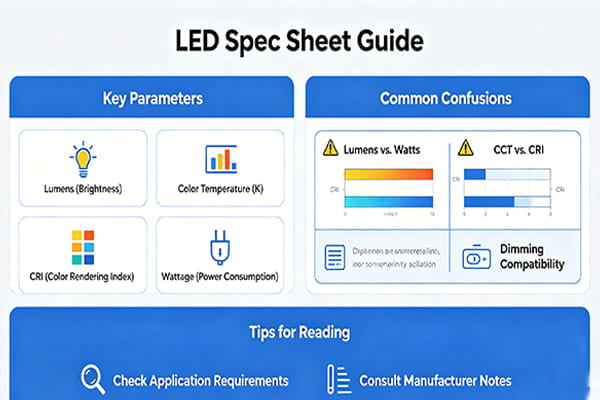
I have spent over a decade in the lighting industry. I've seen many project managers and engineers get confused by complex data sheets. They often focus on just one number, like wattage, and miss the bigger picture. This can lead to big problems later on. I want to share a simple framework I use to cut through the noise. It will help you quickly determine if an LED fixture is right for your project. Let's break it down into four simple parts.
How do you judge a light's energy efficiency from lumens and wattage?
You need bright lights for your project, but you also need to control the electricity bill. Just picking a fixture with high wattage can be a costly mistake.
The most important metric for efficiency is Luminous Efficacy, measured in lumens per watt (lm/W)2. Calculate this by dividing the Total Fixture Lumens by the Total Wattage. A good fixture should be over 120 lm/W, and a high-efficiency one will exceed 150 lm/W.3
Let's dive deeper into this. Lumens (lm) measure the total amount of visible light a fixture produces. Wattage (W) measures how much electrical energy it consumes. Looking at either one alone tells you very little. The magic is in their relationship, which is called Luminous Efficacy. It tells you how much light you get for every watt of energy you pay for.
It's very important to look for "Fixture Lumens" on the spec sheet, not "LED Chip Lumens." The chip's theoretical output is always higher than what comes out of the finished product because of losses from the driver, lens, and heat4. A trustworthy manufacturer will always provide the final fixture lumens.
Here is a simple comparison to show why this matters:
| Metric | Fixture A | Fixture B |
|---|---|---|
| Wattage | 100W | 80W |
| Fixture Lumens | 10,000 lm | 10,400 lm |
| Luminous Efficacy | 100 lm/W | 130 lm/W |
In this case, Fixture B is the clear winner. It uses 20% less energy but produces more light. It is a much more efficient product. We always tell our clients to aim for at least 120 lm/W for new projects.
What do PF and THD tell you about a fixture's electrical performance?
You plug in a light and it turns on. So it works, right? But poor electricals can cause hidden problems, like interfering with other equipment and wasting energy on the grid.
Power Factor (PF) measures how efficiently a device uses electricity.5 Aim for PF ≥0.9.6 Total Harmonic Distortion (THD) measures electrical "noise." Aim for THD <20%.7 Good PF and low THD are critical for stable, large-scale lighting projects.
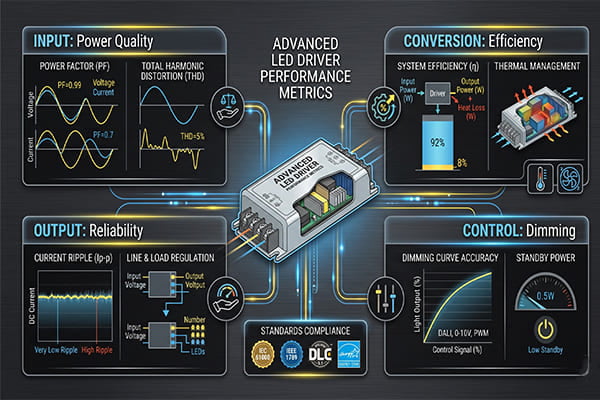
These two numbers are about the quality of the LED driver, which is the heart of the fixture. Let me explain them simply.
Power Factor (PF) is about efficiency. A perfect PF is 1.0. A PF of 0.95 means that 95% of the power drawn from the outlet is being used to create light. The other 5% is wasted. For any professional project, a PF of 0.9 or higher is the standard requirement.
Total Harmonic Distortion (THD) is about pollution. An LED driver can create "dirty" power that flows back into the electrical circuit. This can disrupt other sensitive electronic equipment on the same line.8 A lower THD is always better.
Here’s a quick guide for what to look for:
| Metric | Basic Standard | High-End Project | What it Means |
|---|---|---|---|
| PF | ≥ 0.90 | ≥ 0.95 | Efficient use of electricity. |
| THD | < 20% | < 10% | Low electrical interference. |
I remember a project where a contractor used fixtures with a low PF and high THD. The lights worked, but the building's control systems started acting strangely. The issue was the electrical noise from the cheap drivers. Always check these numbers to protect the entire electrical system.
How do CCT and CRI determine the quality of the light itself?
You found an efficient and electrically stable fixture. But if the light makes a building's facade look dull or changes its color, the project has failed.
Correlated Color Temperature (CCT) defines the color of the white light, from warm to cool.9 Color Rendering Index (CRI) measures how accurately the light shows object colors.10 For good quality, use lights with a CRI of 80 or higher, and choose a CCT that fits the mood.
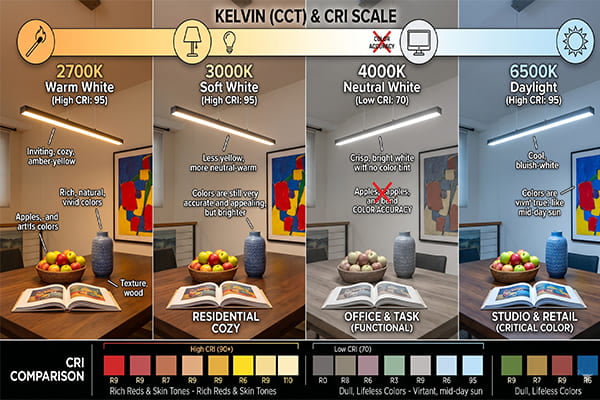
These two metrics are all about the visual experience. They determine how the light looks and feels.
First, Correlated Color Temperature (CCT) is measured in Kelvin (K). It describes the appearance of the white light.
- Warm White (2700K - 3000K): Cozy and inviting, like a traditional incandescent bulb. Great for hospitality or residential facades.
- Neutral White (4000K): Clear and clean. Good for offices, retail, and modern building exteriors.
- Cool White (5000K+): Crisp and bright, similar to daylight. Often used for industrial areas or for very high-intensity effects.
Second, the Color Rendering Index (CRI) is a score from 0 to 100. It measures how well the light source reveals the true colors of an object compared to natural sunlight. A CRI of 80 is considered good for most outdoor applications.11 For projects where color accuracy is critical, like lighting a historic building or a colorful mural, you should demand a CRI of 90 or more. Also, ask about the R9 value, which is the score for rendering the color red. A high R9 is important for making red bricks, wood, and skin tones look vibrant and natural.
| Metric | Application | Recommended Value |
|---|---|---|
| CCT | Hospitality Facade | 2700K - 3000K |
| CCT | Modern Office Building | 4000K - 5000K |
| CRI | General Landscape | ≥ 80 |
| CRI | Architectural Details | ≥ 90 (with good R9) |
Choosing the right combination is key to achieving your design vision.
How do LM-79, LM-80, and TM-21 reports prove a fixture's lifespan?
Every manufacturer says their lights will last 50,000 hours. But that is often just a marketing claim. How can you be sure you are not buying a product that will fail prematurely?
These are industry-standard reports that provide real data. LM-79 tests the fixture's initial performance. LM-80 tests the LED chip's lumen depreciation over time. TM-21 is a formula that uses LM-80 data to project the fixture's useful life, like L70 at 50,000 hours.
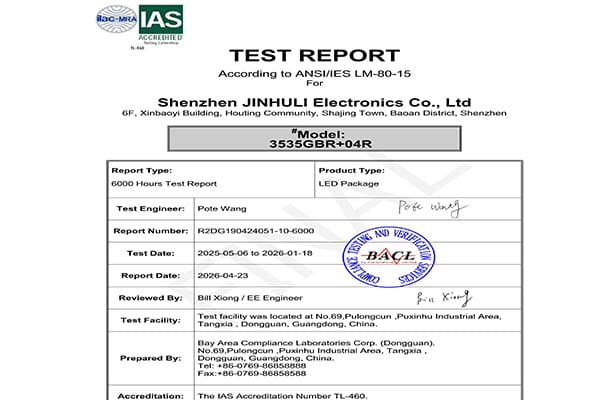
These reports are the only way to verify a manufacturer's claims about performance and longevity. If a supplier cannot provide them, you should be very careful.
Let's break them down one by one.
-
LM-79: This is a test on the complete, finished light fixture. A lab measures its total light output (lumens), power consumption (watts), efficacy (lm/W), CCT, and CRI. The LM-79 report is proof that the numbers on the spec sheet are real.
-
LM-80: This is a long-term test on just the LED chips themselves. The chips are run for 6,000 to 10,000 hours under controlled conditions. The lab measures how much the light output fades over that time. This data tells you how robust the core LED components are.
-
TM-21: This is not a test, but a calculation method. It takes the data from the LM-80 report and uses it to project the LED's lifespan. This is where the L70 rating comes from. An L70 rating of 50,000 hours means the fixture is projected to maintain at least 70% of its initial brightness for 50,000 hours.
When I talk to serious contractors, they always ask for these reports. It shows they are professionals who care about long-term quality, not just the initial price.
Conclusion
Next time you review a spec sheet, look beyond wattage. Check the luminous efficacy for efficiency, PF and THD for electrical health, CCT and CRI for light quality, and demand the LM reports.
"Lumens and the Lighting Facts Label - Department of Energy", https://www.energy.gov/energysaver/lumens-and-lighting-facts-label. U.S. Department of Energy lighting guidance explains that LED products should be evaluated by measured light output, energy use, color qualities, and standardized performance data rather than wattage alone; this supports the framework contextually, not as a formal universal checklist. Evidence role: expert_consensus; source type: government. Supports: A multi-metric LED evaluation method is stronger than judging a fixture by wattage alone.. Scope note: The source would support the general evaluation principle, but not necessarily the article’s exact four-part framework as the only correct method. ↩
"[PDF] Energy Efficiency of LEDs", https://www1.eere.energy.gov/buildings/publications/pdfs/ssl/led_energy_efficiency.pdf. A lighting reference or standards source defines luminous efficacy as luminous flux per unit power, expressed in lumens per watt, directly supporting the terminology and unit used here. Evidence role: definition; source type: encyclopedia. Supports: Luminous efficacy is measured in lumens per watt.. ↩
"[PDF] Energy Efficiency of LEDs", https://www1.eere.energy.gov/buildings/publications/pdfs/ssl/led_energy_efficiency.pdf. DOE or DesignLights Consortium technical materials can show that many modern LED luminaire efficiency benchmarks and qualification thresholds fall around or above the 100–150 lm/W range depending on product category; this supports the figures as practical benchmarks rather than universal pass-fail limits. Evidence role: statistic; source type: institution. Supports: LED fixtures above 120 lm/W can be considered efficient, and fixtures above 150 lm/W are high-efficiency in many contexts.. Scope note: Efficacy thresholds vary by fixture type, optics, CCT, CRI, application, and program year. ↩
"[PDF] Calculating Light Loss Factors", https://www1.eere.energy.gov/buildings/publications/pdfs/ssl/beckwith_depreciation_seattlemsslc2011.pdf. DOE solid-state lighting materials describe system-level efficiency losses from LED drivers, optics, and thermal conditions, supporting the distinction between LED package output and delivered luminaire output. Evidence role: mechanism; source type: government. Supports: Finished fixture lumens are lower than theoretical LED chip lumens because drivers, optics, and heat reduce delivered output.. Scope note: The exact magnitude of losses depends on fixture design and operating conditions. ↩
"[PDF] Measurement of relative and true power factors of air capacitors", https://nvlpubs.nist.gov/nistpubs/jres/21/jresv21n4p425_A1b.pdf. Electrical engineering references define power factor as the ratio of real power to apparent power in an AC circuit, which supports the article’s simplified description of PF as a measure of how effectively supplied electrical power is used. Evidence role: definition; source type: education. Supports: Power factor is a measure of how effectively an electrical device uses supplied AC power.. Scope note: Power factor describes AC power utilization and grid loading, not the fraction of power converted specifically into light. ↩
"[PDF] ENERGY STAR® Program Requirements Product Specification for ...", https://www.energystar.gov/sites/default/files/asset/document/Luminaires%20V2%200%20Final.pdf. ENERGY STAR or DesignLights Consortium requirements commonly specify a power factor of at least 0.9 for many commercial or non-residential LED lighting products, supporting this as a widely used professional benchmark. Evidence role: expert_consensus; source type: institution. Supports: A power factor of 0.9 or higher is a common target for professional LED lighting projects.. Scope note: The requirement is program- and product-category-specific and may not apply to every residential or specialty luminaire. ↩
"[PDF] AccurIC Ltd Comments ENERGY STAR Lamps V2.0 Draft Final ...", https://www.energystar.gov/sites/default/files/AccurIC%20Ltd%20Comments.pdf. LED lighting qualification specifications such as ENERGY STAR or DesignLights Consortium have used total harmonic distortion limits near 20% for certain product categories, supporting THD below 20% as a recognized benchmark. Evidence role: expert_consensus; source type: institution. Supports: THD below 20% is a commonly used target for acceptable LED lighting power quality.. Scope note: THD limits differ by program, product type, power level, and applicable electrical code or utility requirements. ↩
"Effect of LED Lighting on Selected Quality Parameters of Electricity", https://pmc.ncbi.nlm.nih.gov/articles/PMC9920439/. Power-quality literature from IEEE, NIST, or DOE explains that harmonic distortion from nonlinear loads can affect electrical distribution systems and sensitive equipment, supporting the mechanism described here. Evidence role: mechanism; source type: research. Supports: High harmonic distortion from LED drivers can interfere with other equipment on the same electrical system.. Scope note: Whether disruption occurs in a specific building depends on system impedance, load mix, wiring, filtering, and equipment susceptibility. ↩
"[PDF] A correlated color temperature for illuminants", https://nvlpubs.nist.gov/nistpubs/jres/7/jresv7n4p659_A2b.pdf. CIE, NIST, or lighting education sources define correlated color temperature as a Kelvin-based description of the apparent color of near-white light, supporting the warm-to-cool explanation. Evidence role: definition; source type: education. Supports: CCT describes whether white light appears warm, neutral, or cool.. Scope note: CCT describes apparent white-light color but does not fully characterize spectral power distribution or color rendering. ↩
"Color rendering index - Wikipedia", https://en.wikipedia.org/wiki/Color_rendering_index. CIE and DOE materials describe the Color Rendering Index as a measure of how a light source renders object colors relative to a reference illuminant, supporting the article’s definition. Evidence role: definition; source type: institution. Supports: CRI measures how accurately a light source renders object colors compared with a reference source.. Scope note: CRI is an established but imperfect metric and does not capture all aspects of color quality, especially for some LED spectra. ↩
"[PDF] ENERGY STAR® Program Requirements Product Specification for ...", https://www.energystar.gov/sites/default/files/asset/document/Luminaires%20V2%200%20Final.pdf. ENERGY STAR, DOE, or lighting-program guidance commonly uses CRI 80 as a baseline for acceptable color rendering in many LED products, supporting the value as a general benchmark. Evidence role: expert_consensus; source type: government. Supports: CRI 80 is commonly treated as a good or acceptable baseline for many LED lighting applications.. Scope note: The source may support CRI 80 as a general lighting benchmark rather than specifically proving suitability for all outdoor applications. ↩