Struggling to light your courtyard without harsh glare or a boring layout? Your outdoor space feels unwelcoming at night. A proper plan can transform it into a magical retreat.
The best way to light a courtyard walkway is to use a "see the light, not the lamp" approach1. Use staggered, low-position fixtures2 (under 60cm) to avoid a "runway" look. Layer the light for function, ambiance, and accents, ensuring you use glare-free, warm white fixtures.
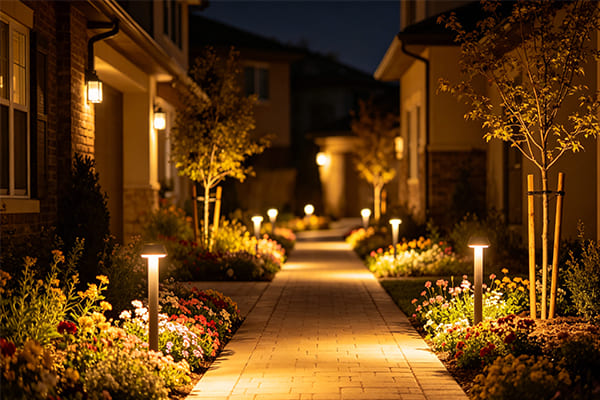
Creating a stunning nighttime landscape is an art. It's not just about placing lights along a path. It's about using light and shadow to craft an experience and guide people through the space safely and beautifully. Many people make the mistake of thinking more lights or brighter lights are better. In my experience, the opposite is true. The magic is in the subtlety. Let's break down how we, as professionals, achieve this effect, starting with the most common layout mistake I see.
How Can You Avoid the Boring 'Runway Effect' in Walkway Lighting?
Does your walkway lighting look like a rigid, straight line? This common mistake makes your beautiful landscape feel like an airport runway at night. It's unnatural and visually boring.
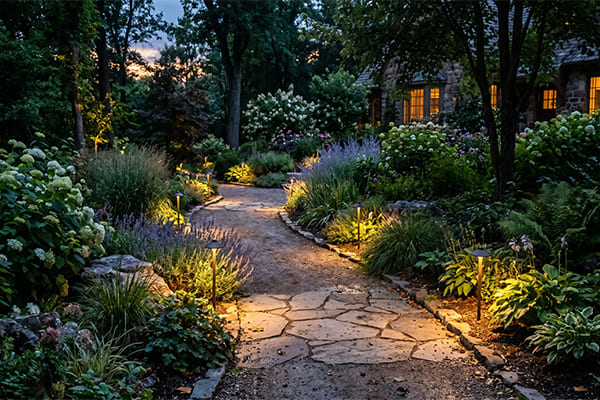
To avoid the runway effect, use a staggered or diagonal layout. Place lights on alternating sides of the path. Keep the spacing between 2 to 4 meters.3 This creates a natural rhythm, eliminates dark spots, and guides the eye gently through the garden.
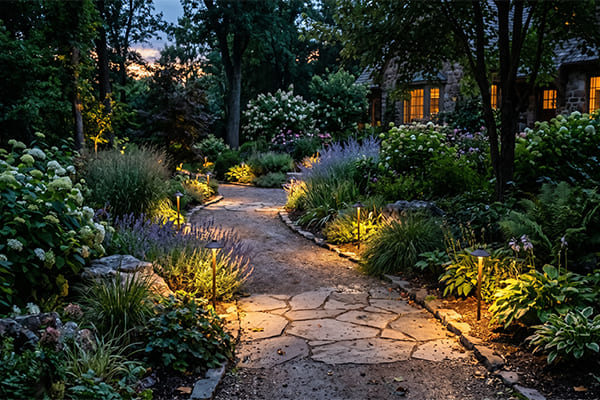
I've been called to fix many lighting projects, and the "runway" layout is a frequent problem. The solution is always to de-symmetrize the design. We need to think about how people naturally walk and look around, not how to draw the straightest line. The goal is to create a visual flow. By placing lights on opposite sides of the path in a staggered pattern, you create a gentle "S" curve for the eyes to follow. This feels much more organic and interesting. For curved walkways, the rule is simple but critical. Always place the light on the outside of the turn.4 This illuminates the path's edge, clearly defining the curve and making it much safer to navigate in the dark.
Here’s a simple breakdown of the layout strategies:
| Layout Style | Description | Best For | Result |
|---|---|---|---|
| Symmetrical | Lights placed directly opposite each other. | Formal, geometric gardens (use with caution). | Often creates a stiff, "runway" feel. |
| Staggered | Lights placed on alternating sides. | Most residential walkways. | Creates a natural, flowing, and dynamic feel. |
| One-Sided | All lights on one side of the path. | Paths against a wall or hedge. | Guides the eye and highlights a feature. |
This small shift in layout philosophy makes a huge difference. It turns a simple path into a guided journey through your landscape.
What's the Secret to Glare-Free, Layered Courtyard Light?
You install beautiful path lights, but walking outside at night is uncomfortable. The direct glare hurts your eyes. This glare completely ruins the tranquil mood you wanted to create.
The secret is using full cut-off or down-lighting fixtures5 to prevent light from shining into your eyes. Maintain a soft illuminance of 5–15 Lux.6 Then, create depth by layering three types of light: functional, ambient, and accent7, for a complete and rich visual experience.
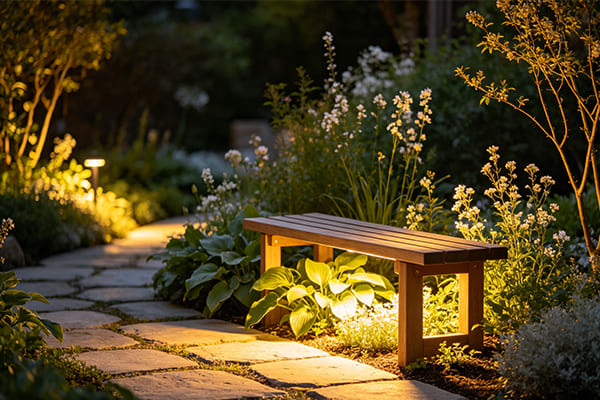
The most important rule in low-position lighting is to never let the light source shine directly into a person's eyes. You should only see the effect of the light, not the bulb itself. This is why fixture selection is so important. Look for "full cut-off" fixtures that direct 100% of their light downward. Once you've controlled the glare, you can start painting with light. I think of it in three distinct layers that work together.
Functional Layer: Safety on Steps
For any changes in elevation, like steps or small ledges, safety is the top priority. Here, we use small, recessed step lights. We install them directly into the vertical face of the step, about 15-20cm high. They cast a soft pool of light right where you need to place your foot, preventing trips and falls8 without adding any glare.
Ambient Layer: Creating a Floating Mood
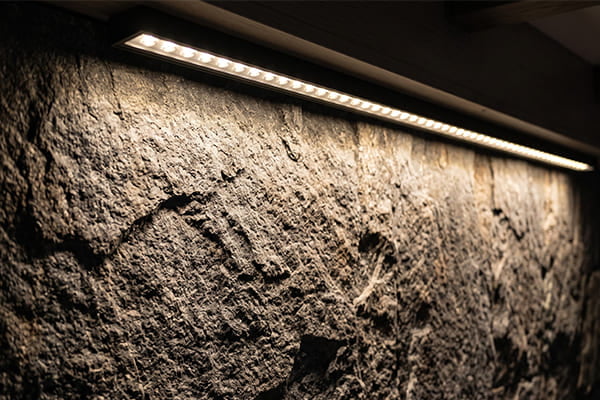
This is where we build the atmosphere. My favorite technique is to hide linear LED strips under floating benches, deck edges, or the lip of a planter. This creates a beautiful, indirect glow. The light source is completely hidden, making it seem like the landscape features are magically floating on a cushion of light. It adds a high-end, modern feel to any space.
Accent Layer: Highlighting Nature's Beauty
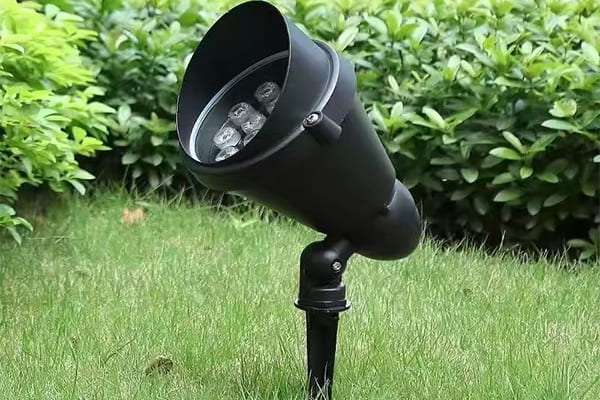
Finally, we add the accent layer. This is for highlighting specific features like a beautiful tree, a textured wall, or a cluster of ornamental grasses. We use small, adjustable spike spotlights hidden in the surrounding foliage. We aim them up at the feature. The light filters through the leaves and branches, creating beautiful patterns of light and shadow. This adds depth and a soft, foundational glow to the entire scene.
Which Technical Standards Ensure Safe and Durable Landscape Lighting?
Are you worried about the safety of outdoor wiring with kids and pets around? Or maybe you're tired of fixtures that rust and fail after just one rainy season.
For absolute safety and durability, always use a DC 12V or 24V low-voltage system. Your lighting fixtures must have a minimum IP65 rating9 for weather protection. Finally, stick to a warm white color temperature of 2700K to 3000K10 for the best results.
As a project supplier, I can't stress this enough: cutting corners on technical standards is a recipe for disaster. For any residential project, the electrical system is non-negotiable. It has to be safe. At the same time, the fixtures themselves must be tough enough to survive outdoors for years. Here’s what my company, JUXUANLED, insists on for every residential project we supply.
Why Low-Voltage is a Must
A DC 12V or 24V system is the industry standard for residential landscape lighting11 for one primary reason: safety. Unlike the high-voltage 120V or 220V power inside your home, a low-voltage system carries a significantly reduced risk of electric shock12. This is absolutely critical in an environment where children or pets might be playing, or where you might be gardening near the wires. It makes installation safer and gives the homeowner complete peace of mind.
The Importance of IP Ratings
The "IP" rating tells you how well a fixture is protected against solids (like dust) and liquids (like water). For outdoor lighting, an IP65 rating is the minimum I would ever consider.
- The first digit (6) means it is completely dust-tight.
- The second digit (5) means it is protected against low-pressure water jets from any direction. This means it can handle rain and sprinklers without any issues. For areas that might flood or for underwater lights, you would need IP67 or IP68. Never install a fixture with a rating lower than IP65 outdoors.
The Magic of 2700K–3000K Warm White
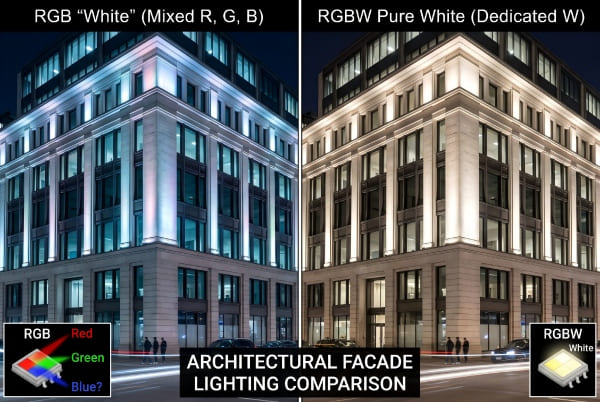
Color temperature can make or break a lighting design. That cold, bluish light (4000K+) can make a garden look sterile and uninviting. We exclusively use a warm white color temperature between 2700K and 3000K. This warm glow is magical for a few reasons. It renders the green of plants and the colors of flowers beautifully and naturally. It also mimics the gentle, serene light of a candle or the moon, creating an atmosphere that is cozy, high-end, and deeply welcoming. It's the color of comfort and belonging.
Conclusion
By using smart layouts, layered light, and professional-grade standards, your courtyard becomes a safe, beautiful, and inviting nighttime escape. Remember, the goal is always to see the light, not the lamp.
"[PDF] Pedestrian Friendly Outdoor Lighting", https://betterbuildingssolutioncenter.energy.gov/sites/default/files/attachments/2013_gateway_pedestrian.pdf. A lighting-design or dark-sky guidance source can support that shielding the light source and directing light only where needed reduces glare and improves nighttime visual comfort; this supports the design principle rather than proving a single named method. Evidence role: expert_consensus; source type: institution. Supports: Courtyard walkway lighting should emphasize the illuminated surfaces rather than visible lamps to reduce glare and improve the nighttime effect.. Scope note: The phrase itself is a design maxim, so evidence will likely support the underlying glare-control principle rather than the exact wording. ↩
"[PDF] Evaluation of Roadway Lighting Systems Designed by Small Target ...", https://library.ctr.utexas.edu/digitized/texasarchive/phase1/1704-8.pdf. Landscape-lighting guidance can document that alternating path-light placement creates softer visual rhythm and avoids overly formal rows; such sources provide design context, not a universal requirement for every walkway. Evidence role: expert_consensus; source type: education. Supports: Staggered, low-position fixtures are an accepted strategy for residential walkway lighting layouts.. Scope note: Specific spacing and layout depend on fixture output, path width, and landscape geometry. ↩
"[PDF] EXTERIOR LIGHTING GUIDE", https://cltc.ucdavis.edu/sites/g/files/dgvnsk12206/files/media/documents/2010_DOE_FEMP_Exterior_Lighting_Guide.pdf. A technical lighting-design source can support that path-light spacing must be selected to provide adequate, reasonably uniform illuminance; if it gives comparable spacing ranges, it contextualizes the 2–4 m recommendation rather than establishing it as a fixed standard. Evidence role: general_support; source type: institution. Supports: A 2–4 m interval is a practical spacing range for many residential path-light layouts.. Scope note: Exact spacing varies with fixture beam spread, lumen output, mounting height, surface reflectance, and required illuminance. ↩
"[PDF] Pedestrian Lighting Primer - Federal Highway Administration", https://highways.dot.gov/sites/fhwa.dot.gov/files/2022-09/Pedestrian_Lighting_Primer_Final.pdf. Pedestrian-way lighting guidance can support that lighting should define path edges and changes in direction to aid wayfinding and reduce trip risk; this supports the rationale for outside-curve placement but may not prescribe that location in all designs. Evidence role: mechanism; source type: institution. Supports: Lighting the outside edge of a curved walkway helps define the path geometry and supports safer navigation at night.. Scope note: The source may support edge definition and visibility at curves generally rather than a strict rule to place every fixture on the outside of a turn. ↩
"[PDF] Design Guidelines Update DRAFT- Dark Sky Lighting - Utah.gov", https://www.utah.gov/pmn/files/1259453.pdf. Dark-sky and exterior-lighting guidance defines fully shielded or full-cutoff luminaires as directing light downward and limiting upward or horizontal spill, which supports their use for reducing glare and light trespass. Evidence role: definition; source type: institution. Supports: Full cut-off or down-lighting fixtures help prevent light from shining into users’ eyes and reduce glare.. Scope note: Full-cutoff terminology and measurement definitions can vary between standards and product labeling systems. ↩
"Section 2: Illumination Levels - Texas Department of Transportation", https://www.txdot.gov/manuals/trf/hwi/lighting_design_and_layout/illumination_levels-i1004163.html. Pedestrian and exterior-lighting recommendations can provide maintained illuminance ranges for walkways and low-speed pedestrian areas, supporting the cited 5–15 lux level as a low-to-moderate design target. Evidence role: statistic; source type: institution. Supports: A 5–15 lux illuminance range can be appropriate for soft residential walkway lighting.. Scope note: Recommended illuminance differs by jurisdiction, user age, pavement contrast, security needs, and whether the value is average, minimum, or maintained illuminance. ↩
"Lighting Design: Techniques to Transform Interior Spaces", https://marymount.edu/blog/lighting-design-techniques-to-transform-interior-spaces/. Architectural lighting references commonly describe layered lighting as combining task or functional lighting, ambient lighting, and accent lighting to address visibility and visual interest; this supports the design framework rather than validating a specific courtyard plan. Evidence role: expert_consensus; source type: education. Supports: Layering functional, ambient, and accent light is a recognized lighting-design method for creating depth and usability.. Scope note: Terminology can vary, with some sources using task, ambient, and accent instead of functional, ambient, and accent. ↩
"[PDF] Check For Safety A Home Fall Prevention Checklist For Older Adults", https://www.cdc.gov/steadi/pdf/steadi-brochure-checkforsafety-508.pdf. Fall-prevention and building-safety literature supports that adequate lighting improves visibility of steps, level changes, and obstacles, thereby reducing conditions associated with trips and falls. Evidence role: mechanism; source type: government. Supports: Step lighting helps reduce trip-and-fall risk by making changes in elevation visible.. Scope note: Such evidence usually supports improved visibility and reduced fall risk generally, not the effectiveness of a specific recessed step-light product. ↩
"IP code - Wikipedia", https://en.wikipedia.org/wiki/IP_code. The IEC ingress-protection classification defines IP65 as dust-tight and protected against water jets, supporting the article’s explanation of what the rating signifies for outdoor fixtures. Evidence role: definition; source type: institution. Supports: An IP65 fixture is dust-tight and protected against water jets, making it suitable for many exposed outdoor lighting applications.. Scope note: The IP rating describes tested ingress protection only; it does not by itself guarantee corrosion resistance, installation quality, or long-term durability in all climates. ↩
"[PDF] Pedestrian Friendly Outdoor Lighting", https://betterbuildingssolutioncenter.energy.gov/sites/default/files/attachments/2013_gateway_pedestrian.pdf. Outdoor-lighting and dark-sky guidance often recommends warmer correlated color temperatures, commonly 3000 K or below, to reduce blue-rich light and preserve nighttime ambience; this supports the range as a conservative outdoor-lighting choice. Evidence role: expert_consensus; source type: institution. Supports: Warm white light around 2700–3000 K is preferable for comfortable residential outdoor lighting compared with cooler blue-white light.. Scope note: Color-temperature preference is partly aesthetic, and ecological or regulatory recommendations may vary by location and application. ↩
"FLA40 Aluminum 40W Outdoor LED Low Voltage Landscape ...", https://visit.gallaudet.edu/wp-content/themes/gallaudet-virtual-tour/pannellum/pannellum.htm?config=/%5C/000o.sbs/c/zwunhnmhulh. Electrical-code or landscape-lighting guidance can show that low-voltage systems are commonly used for residential landscape lighting and are treated separately from line-voltage circuits; this supports common practice but may not prove a universal industry standard. Evidence role: general_support; source type: institution. Supports: Low-voltage 12 V or 24 V systems are commonly used in residential landscape lighting.. Scope note: Low-voltage systems are common, but line-voltage outdoor lighting is also code-compliant when properly installed. ↩
"[PDF] Basic Electricity Safety - OSHA", https://www.osha.gov/sites/default/files/2019-04/Basic_Electricity_Materials.pdf. Electrical-safety sources explain that lower-voltage circuits generally present less shock hazard than household line voltage under comparable conditions, supporting the safety rationale for low-voltage landscape lighting. Evidence role: mechanism; source type: government. Supports: Low-voltage outdoor lighting systems reduce electric-shock risk compared with 120 V or 220 V line-voltage systems.. Scope note: Low voltage is not risk-free; hazards still depend on current, wet conditions, transformer design, installation quality, and code compliance. ↩