How Do You Choose the Right Linear LED for Architectural Contour Lighting?
You've designed a building with beautiful, clean lines. But at night, the contour lighting is a disaster. You see ugly dark spots between fixtures, or the lines look wobbly and cheap. This ruins the architecture and makes a high-end project look amateur. The entire investment is wasted on a poor first impression.
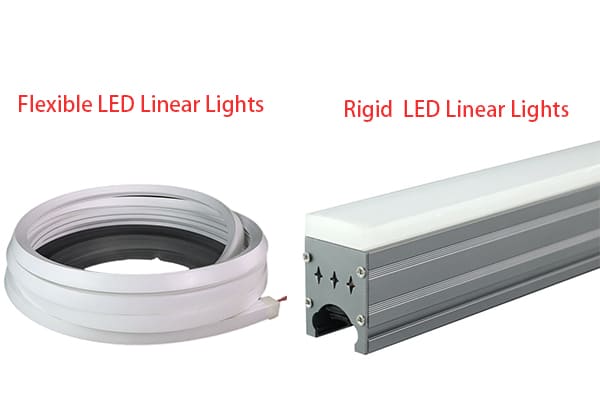
For straight contours, always choose rigid aluminum linear lights for their structural integrity1. For curved surfaces, use flexible silicone LED strips2. The choice between these two types is the most critical first step to achieving a professional, seamless look.
Getting this right is about more than just picking a product. It's about matching the technology to the building's form, the environment, and the visual story you want to tell. I've specified linear lights on hundreds of projects, and I've learned that success lies in a few key decisions. Let's break down my selection process.
Rigid or Flexible: Which Light Fits Your Building's Shape?
You’re trying to light a curved dome, but a rigid fixture creates awkward, segmented lines. Or you’re lighting a long, straight bridge, but a flexible strip sags and looks uneven. Using the wrong light form for the building's shape is the fastest way to an unprofessional result.
Use rigid aluminum linear lights for straight lines on skyscrapers and bridges. Use flexible silicone LED strips for curved shapes like domes and traditional eaves. If a curve can be made with short, rigid sections without ruining the look, that is always the more reliable option.
For Straight Lines: The Power of Rigid Aluminum
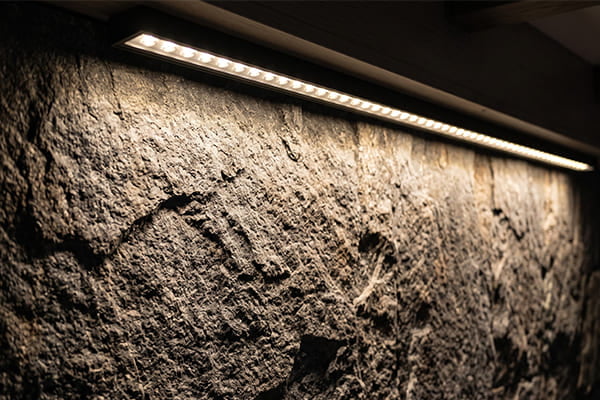
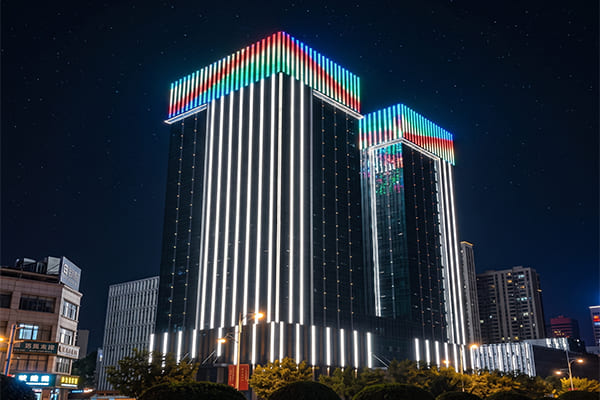
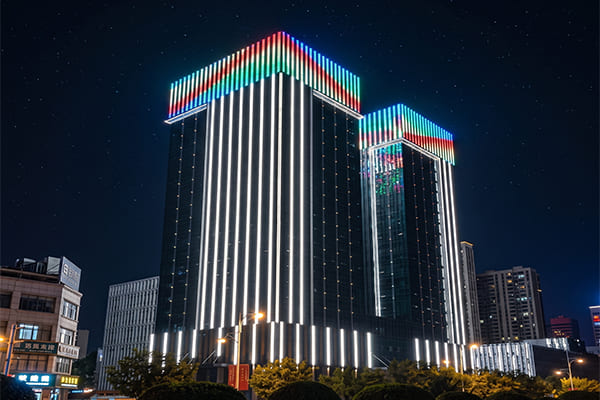
When your design has long, straight contours, structural integrity is everything. This is where rigid aluminum linear lights shine. Their metal housing acts as a strong, straight spine. It guarantees that a 50-meter line of light will look perfectly straight, not wavy. This is essential for modern office buildings, bridges, and any architecture defined by clean geometry.
I typically specify DC24V, 10-12W/m models. I also insist on fixtures with back-entry cables and M12 solid waterproof connectors3. This design allows for end-to-end placement with no gaps, eliminating the dark spots that plague cheaper, side-entry cable products.
For Curved Surfaces: The Adaptability of Flexible Silicone
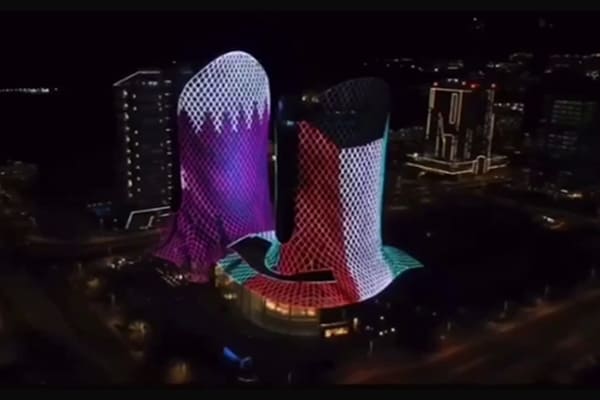
When you face complex curves, domes, or ornate traditional cornices, a rigid fixture just won't work. Flexible LED strips, usually made of extruded silicone, are designed to bend and follow these intricate shapes. They can create a perfect, flowing line of light that seems to be part of the architecture itself, achieving the ultimate "light without a visible fixture" effect.
However, I always use them with caution. A client of mine in Dubai loved using flexible strips for outdoor projects. But we found they were more prone to issues during shipping and installation compared to rigid fixtures. If you can create a convincing curve by joining several short, angled rigid fixtures, I often recommend that path for better long-term reliability.
| Light Type | Best Application | Key Advantage | Main Weakness |
|---|---|---|---|
| Rigid Aluminum Linear | Straight lines (facades, bridges) | Structural straightness, excellent heat dissipation | Cannot conform to tight curves |
| Flexible Silicone Strip | Curved surfaces (domes, arches) | Perfect fit on complex shapes | Lower durability, can sag if not supported |
What Specs Ensure Your Lights Survive the Outdoors?
Your beautiful lighting installation looks great for the first six months. Then, after one rainy season, fixtures start failing. The plastic covers turn a sickly yellow, and the ends of the light runs are noticeably dimmer than the start. The project's quality is degrading right before your eyes, leading to angry calls and costly repairs.
For outdoor survival, demand a minimum of IP65 (IP67 near water)4, UV-resistant materials5, and a DC24V power system. These three specs are the baseline for preventing water damage, material degradation, and inconsistent brightness over long runs.
The Non-Negotiable IP Rating and UV Resistance
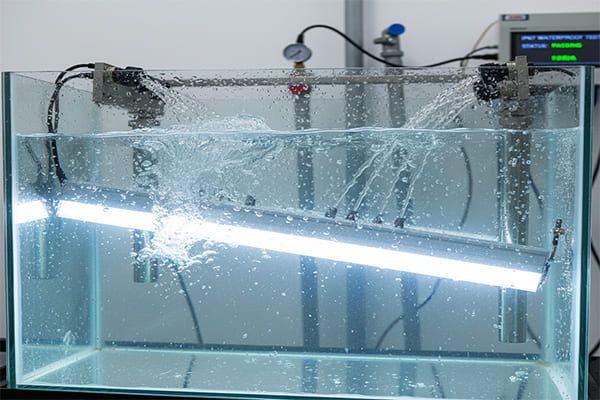
The outdoors is a harsh environment. Rain, dust, and sun are relentless. An IP (Ingress Protection) rating of at least IP65 is my absolute minimum for any outdoor project. This ensures the fixture is dust-tight and can withstand jets of water. For coastal areas, swimming pools, or regions with heavy rainfall, I upgrade to IP67 for full water immersion protection.
Just as important is UV resistance. Cheap plastic or acrylic covers will turn yellow and become brittle after just a year or two of sun exposure. This not only looks terrible but also reduces light output. I always specify fixtures with high-quality, UV-stabilized PC (polycarbonate), glass, or acrylic covers that are guaranteed not to yellow for at least 3-5 years.
Why DC24V is My Standard for Electrical Safety and Performance
I always choose DC24V constant voltage systems over DC12V or high-voltage AC. A DC12V system suffers from significant voltage drop over long distances. This means the beginning of a 10-meter run will be bright, but the end will be visibly dimmer. It looks unprofessional. DC24V allows for much longer runs with consistent brightness from end to end6, ensuring the entire building is "level."
Compared to high-voltage AC (110V/220V), a DC24V system is also much safer for installers to work with7, especially in wet outdoor conditions. It simplifies the installation and reduces safety risks.
| Specification | My Recommendation | Why It's Crucial |
|---|---|---|
| IP Rating | IP65 minimum, IP67 for wet areas | Prevents water and dust from entering and destroying the fixture. |
| Material | UV-stabilized PC, Glass, or Acrylic | Prevents the lens from yellowing and cracking under sun exposure. |
| Voltage | DC24V Constant Voltage | Minimizes voltage drop for consistent brightness and improves safety. |
How Do You Control the Light for the Perfect Visual Effect?
You’ve installed the lights, but the effect is all wrong. The light is a cold, harsh white on a warm, historic building. Or, it's spilling everywhere, creating light pollution instead of accenting the architecture. The soul of the project is missing because the quality of the light itself was ignored.
Control the visual effect by choosing the right color temperature (CCT) for the building's style and the right optics for the desired beam. Use a milky cover for soft ambience and a lens for a powerful, directed beam. For dynamic effects, DMX5128 or SPI control is essential.
Setting the Mood with Color Temperature
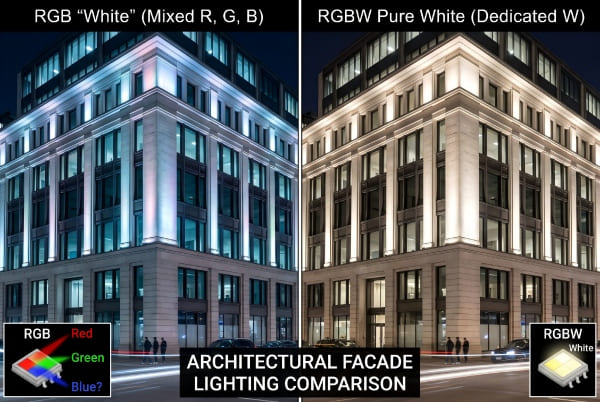
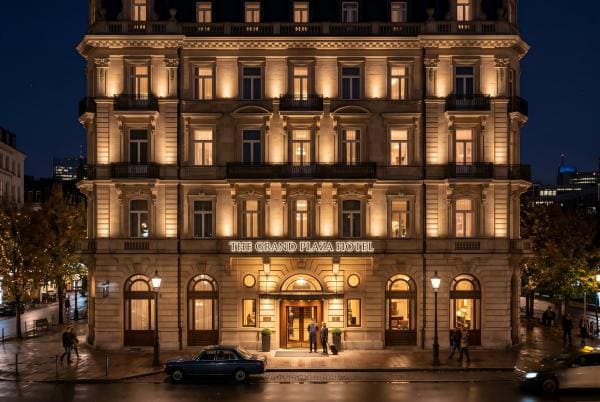
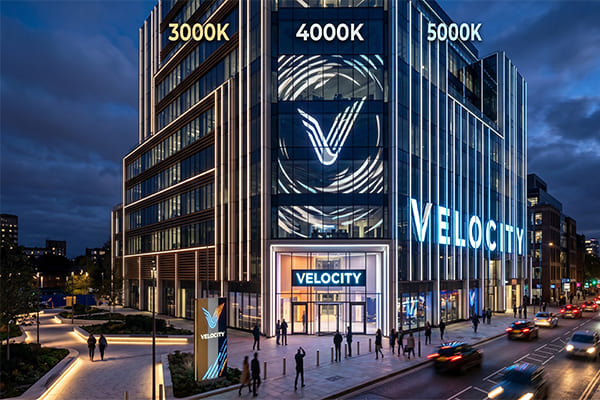
The color of the light sets the emotional tone. For historic buildings with brick or stone, I lock in a warm white between 2200K and 3000K9. This warm glow feels timeless and respects the material's character. I also insist on a high color rendering index (CRI > 80)10 to make the colors look rich and natural. For modern public buildings with glass and steel, a cooler, neutral white around 4000K often works best. It feels clean, crisp, and contemporary.
Precision Beam Control with Optics
The cover on the linear light determines how the light is shaped.
- For soft, gentle light: Choose a milky white PC or acrylic diffuser. This creates a wide, even glow that's perfect for applications where people will be close to the building. It creates a pleasant atmosphere.
- For power and focus: Choose a clear glass or aluminum cover paired with a lens. This is for projecting light over a long distance, such as on a high-rise building. An asymmetrical lens11, like a 20*40° optic, is one of my favorites. It pushes the light forward and up, grazing the facade efficiently while minimizing wasted light that spills into the sky.
Making It Smart with DMX or SPI
If the building is a landmark that needs to change colors or play animations, then a smart control protocol is a must. I specify DMX512 or SPI for any project that requires dynamic effects. This allows for pixel-level control, meaning every small section of the linear light can be a different color. It also allows for remote monitoring, so the maintenance team can be alerted if a fixture fails. This turns the building from a static object into a living, breathing part of the cityscape.
Conclusion
Great contour lighting is not about stacking up brightness. It’s about seamless integration and precise control that allows a building to have a presence at night. When I choose a product, I know that the long-term success of the project—3 to 5 years down the line—depends on the details you can't see: the thickness of the aluminum for heat dissipation12, the quality of the potting glue, the brand of the LED chips, and the reliability of the connectors. These are the things that prevent "broken lines" and ensure the design endures.
"[PDF] Design and evaluation of an LED-based light fixture", https://www.lrc.rpi.edu/s/SPIE5187-43_Gu.pdf. A source on LED luminaire construction and thermal/mechanical design supports that aluminum housings provide structural rigidity and heat-spreading functions in linear fixtures; this contextual support does not by itself prove superiority for every facade geometry. Evidence role: mechanism; source type: research. Supports: Rigid aluminum linear lights are appropriate for straight architectural contours because their housings provide structural integrity.. Scope note: Contextual support for the material and fixture form, not a project-specific performance guarantee. ↩
"[PDF] UV Responsive, Bottlebrush Structured Silicone Elastomers", https://clarke.seas.harvard.edu/sites/g/files/omnuum2996/files/2025-10/UV%20Responsive%2C%20Bottlebrush%20Structured%20Silicone%20Elastomers%20Huo-Clarke.pdf. A technical source on silicone LED neon/flexible strip construction supports that silicone encapsulation allows LED strips to bend around curved architectural forms; the source may describe material capability rather than long-term facade performance. Evidence role: mechanism; source type: research. Supports: Flexible silicone LED strips are suitable for curved surfaces because their construction allows bending around complex forms.. Scope note: Supports bendability of silicone-encapsulated strips, not durability under all outdoor installation conditions. ↩
"IP67 M12 Standard Circular Connector - Mouser Electronics", https://www.mouser.com/c/connectors/circular-connectors/standard-circular-connectors/?ip%20rating=IP67&thread%20size=M12&srsltid=AfmBOor4vVESuhsBI17Qe9gEnNUyBgA6rMj16ht9wEOFJ5HDBzpQeW2e. Standards and technical references on M12 circular connectors support that M12 connector systems are commonly specified with IP-rated sealing for industrial and outdoor electrical connections; this supports connector suitability, not the quality of any individual connector brand. Evidence role: general_support; source type: institution. Supports: M12 waterproof connectors can support reliable sealed connections in outdoor linear LED installations.. Scope note: Connector performance depends on the exact product rating, assembly quality, and installation conditions. ↩
"IP code - Wikipedia", https://en.wikipedia.org/wiki/IP_code. The IEC ingress-protection code defines IP65 as dust-tight protection against water jets and IP67 as dust-tight protection against temporary immersion, supporting the distinction between general outdoor and wetter locations. Evidence role: definition; source type: institution. Supports: IP65 and IP67 ratings indicate different levels of dust and water protection relevant to outdoor lighting.. Scope note: The IP code defines enclosure protection tests; it does not guarantee lifetime performance against corrosion, UV exposure, or installation defects. ↩
"Photodegradation and photostabilization of polymers, especially ...", https://pmc.ncbi.nlm.nih.gov/articles/PMC4320144/. Materials-science references support that ultraviolet radiation can degrade polymers through photo-oxidation, causing yellowing, embrittlement, and loss of optical performance; this supports the need for UV-stabilized materials but not a specific service-life claim. Evidence role: mechanism; source type: paper. Supports: UV-resistant materials help prevent sunlight-driven degradation of outdoor lighting covers.. Scope note: Actual degradation rate depends on polymer formulation, stabilizers, climate, and exposure intensity. ↩
"[PDF] Chapter 7 Direct-Current Circuits - MIT", https://web.mit.edu/8.02t/www/802TEAL3D/visualizations/coursenotes/modules/guide07.pdf. Electrical engineering references on voltage drop support that, for the same power and conductor resistance, higher low-voltage DC distribution reduces current and associated voltage loss compared with lower-voltage systems; this supports the principle, not a fixed maximum run length. Evidence role: mechanism; source type: education. Supports: A 24 V DC LED system can reduce voltage drop relative to a 12 V system and help maintain more consistent brightness over longer runs.. Scope note: Run length still depends on load power, cable gauge, driver design, and allowable voltage tolerance. ↩
"[PDF] Basic Electricity Safety - OSHA", https://www.osha.gov/sites/default/files/2019-04/Basic_Electricity_Materials.pdf. Electrical-safety standards and occupational guidance distinguish extra-low-voltage circuits from mains-voltage circuits because lower voltages generally reduce electric-shock risk, especially in wet environments; this supports relative safety, not hazard elimination. Evidence role: expert_consensus; source type: government. Supports: A 24 V DC system is generally safer to handle than 110/220 V AC mains circuits during installation.. Scope note: Low-voltage systems can still pose fire, short-circuit, and installation hazards if improperly designed or installed. ↩
"RDM (lighting) - Wikipedia", https://en.wikipedia.org/wiki/RDM_(lighting). Technical standards and references describe DMX512 as a digital communication protocol for controlling stage and architectural lighting equipment, supporting its use for programmed dynamic lighting effects. Evidence role: definition; source type: institution. Supports: DMX512 is a control protocol used for dynamic architectural lighting effects.. Scope note: DMX512 enables control signaling, but pixel-level behavior depends on fixture electronics, addressing, and system architecture. ↩
"correlated color temperature (CCT) of a light source", https://ies.org/definitions/correlated-color-temperature-cct-of-a-light-source/. Architectural and lighting-design references classify 2200–3000 K illumination as warm white and associate lower correlated color temperatures with warmer visual appearance; this supports the color classification rather than proving aesthetic suitability for all historic materials. Evidence role: definition; source type: institution. Supports: Color temperatures from about 2200 K to 3000 K are considered warm white and are commonly used to create a warm nighttime appearance.. Scope note: The appropriateness of warm light for a specific historic facade remains a design judgment influenced by material, context, and conservation requirements. ↩
"Color rendering index - Wikipedia", https://en.wikipedia.org/wiki/Color_rendering_index. Lighting-science references define the color rendering index as a measure of how accurately a light source renders object colors relative to a reference illuminant, supporting the link between higher CRI and more natural color appearance. Evidence role: definition; source type: institution. Supports: A CRI above 80 is used to support richer, more natural color appearance in architectural lighting.. Scope note: CRI is an imperfect metric and does not fully describe color quality for all LED spectra or applications. ↩
"(PDF) The impact of facade lighting on environmental sustainability", https://www.academia.edu/126563919/The_impact_of_facade_lighting_on_environmental_sustainability_Investigation_methods. Outdoor-lighting guidance on optical distribution supports that asymmetric optics direct light preferentially toward target surfaces and can reduce unwanted spill compared with uncontrolled distributions; this supports the optical principle, not a specific 20×40° product outcome. Evidence role: mechanism; source type: institution. Supports: Asymmetrical lenses can direct facade lighting more efficiently and help reduce upward or wasted light.. Scope note: Actual spill-light reduction depends on aiming, mounting position, lumen output, surface reflectance, and the fixture’s tested photometry. ↩
"[PDF] Lifetime and Reliability", https://www1.eere.energy.gov/buildings/publications/pdfs/ssl/life-reliability_fact-sheet.pdf. LED thermal-management literature supports that heat-sink material, mass, geometry, and thermal resistance affect LED junction temperature and, consequently, lumen maintenance and reliability; this supports the thermal mechanism, not a universal minimum aluminum thickness. Evidence role: mechanism; source type: paper. Supports: Aluminum body design and thickness can influence heat dissipation and long-term LED reliability.. Scope note: Specific performance must be verified by thermal testing for the actual fixture design and installation environment. ↩